Rebranding aligns with Nation’s 250th Birthday and expanding support for entrepreneurs from every walk of life in pursuit of the American Dream.
HOUSTON – Oct. 6, 2025 – PRLog — Acceler8Success, founded in 2014 and later expanded into Acceler8Success Group, today announced its next evolution: Acceler8Success America. The official rebranding, set to launch in the 4th quarter, will align with the United States’ upcoming 250th birthday in 2026 — a historic milestone celebrating freedom, opportunity, and the American Dream.
Acceler8Success America was first introduced a year and a half ago as an initiative to help immigrant entrepreneurs pursue business ownership as a pathway to the American Dream. That program highlighted the resilience, diversity, and determination of individuals building futures in America through entrepreneurship. Building on its success, the organization is now expanding its efforts — accelerating its mission to empower all entrepreneurs, small business owners, franchisees, and restaurant operators nationwide.
“Our nation’s semi-quincentennial is more than just a celebration of history; it’s a chance to recommit to the values that make America unique,” said Paul Segreto, Founder and CEO of Acceler8Success America. “Entrepreneurship is at the heart of the American Dream, and by rebranding now, we’re aligning our vision with this national milestone. From immigrant entrepreneurs starting their first venture to seasoned operators scaling multi-unit businesses, Acceler8Success America is here to accelerate their journey.”
Throughout Q4 2025, the Acceler8Success ecosystem — including websites, blogs, newsletters, podcasts, social media platforms, and marketing materials — will transition to the Acceler8Success America brand. Updated logos, messaging, and digital assets will be unified under the tagline: The American Dream Accelerated.
Erik Premont, President of Acceler8Success America, emphasized the broader impact: “This rebrand reflects not just where we’ve been, but where we’re going. By expanding our consulting, coaching, business advisory, brokerage, and fractional leadership services, we are doubling down on our mission to equip entrepreneurs and operators with the tools, resources, and community they need to succeed in today’s competitive landscape.”
Acceler8Success America provides a full suite of services designed to support entrepreneurs and operators at every stage of the journey:
Consulting: Practical strategies to launch, grow, or transform businesses.
Coaching: Individual and group guidance to build confidence and accountability.
Business Advisory: Expertise in operations, marketing, finance, franchising, and scaling.
Brokerage Services: Connecting buyers and sellers of businesses, franchises, and restaurants.
Fractional Leadership: Part-time and project-based executive support to establish systems and accelerate growth.
Beyond its services, Acceler8Success America fosters a thriving community of like-minded individuals — from immigrant entrepreneurs to families building generational businesses, to franchisees and restaurant operators scaling their brands. This network of knowledge, collaboration, and support ensures that entrepreneurship is not a solitary pursuit but a shared movement.
“As we enter this exciting new chapter, our commitment remains unchanged,” Segreto added. “We’re not just helping people achieve the American Dream — we’re making it count by creating legacies, strengthening communities, and fueling the future of entrepreneurship in America.”
Although Acceler8Success Café is temporarily closed until October 6th, when we’ll be announcing exciting changes to Acceler8Success Group, I felt it important to share timely information about the American Franchise Act. This legislation, in my view, represents a significant step forward in helping entrepreneurs pursue and achieve the American Dream.
In putting this together, I’ve drawn from the work and insights of some of the greatest minds in franchising (and some AI for clarity). The credit is truly theirs for keeping us informed and for tirelessly advancing conversations that affect franchise owners, franchisors, and the communities they serve.
If I’ve overlooked something, or if what I’ve shared is incomplete, inaccurate, or perhaps even outdated, please don’t hesitate to let me know. I’ll gladly revise and update, as my goal is to ensure this information remains accurate, relevant, and useful to all who follow franchising’s evolving story.
Personally, I believe the American Franchise Act is long overdue. By clarifying the rules, reducing unnecessary risk, and fostering stability, it has the potential to positively transform the franchise landscape. More importantly, it can open the doors for countless entrepreneurs to start businesses, create jobs, and build lasting legacies.
At its core, franchising has always been one of the most accessible pathways to business ownership. The American Franchise Act reinforces that pathway, and I believe it will help many more entrepreneurs — including first-time business owners, women, immigrants, and underrepresented groups — realize their own version of the American Dream.
The American Dream and Entrepreneurship
For many Americans, the “American Dream” is the idea that through hard work, persistence, and some opportunity, one can build a business, achieve financial independence, and contribute to one’s community. Business ownership is a key pathway in that vision. Yet starting and scaling an independent business comes with high risk, capital requirements, operational challenges, regulatory burdens, and market risk.
Franchising has long been viewed as a hybrid model: giving entrepreneurs a structure, proven systems, brand recognition, and operational playbooks, while still allowing them to be (relatively) independent owners. It lowers some of the risk of going it completely alone. But uncertainties in the legal environment — especially around employment liability — have constrained that pathway. The American Franchise Act seeks to reduce that uncertainty, thereby strengthening the franchise avenue as a route to economic opportunity.
One of the thorniest legal and regulatory questions in franchising is: when can a franchisor (the brand owner) be held responsible for employment-related decisions at a franchisee’s location (e.g. wages, hours, hiring/firing, scheduling)? In other words — when are the franchisor and franchisee “joint employers”?
Over the last decade, that standard has repeatedly changed, depending on shifts in National Labor Relations Board (NLRB) rulings and federal regulation. This regulatory “whiplash” has created significant legal uncertainty. 1851 Franchise+5National Law Review+5franchiselaw.foxrothschild.com+5
Proponents of the American Franchise Act argue that this instability has discouraged investment, increased litigation risk, and made it harder for startups/franchisees to plan and grow.
What the Act Proposes
Under the Act, the law would explicitly define that in the franchise context:
In simpler terms, the franchisor would not automatically be deemed jointly liable merely because it sets standards, provides training, or monitors performance. Only where the franchisor steps into direct operational decisions (like hiring, firing, wages, discipline) would it be considered a joint employer. Saxton & Stump+3National Law Review+3franchiselaw.foxrothschild.com+3
By codifying this standard in statute, the Act aims to remove ambiguity, lock in a consistent rule, and allow franchise systems to better predict and manage liability.
How It Could Benefit Entrepreneurs & Foster the American Dream
Here’s how, if passed, the American Franchise Act could strengthen the franchise pathway for entrepreneurs and support their pursuit of the American Dream:
1. Reduced Legal & Regulatory Risk
One of the biggest barriers for prospective franchisees is the unpredictability of liability. If franchisors can be held jointly liable for employment practices of local franchisees even when not directly involved, that risk can deter investment, cause franchise systems to pull back support, or push franchisors to micromanage franchisees (reducing their autonomy).
2. Greater Access to Franchise Ownership, Especially for First-Time Owners
Because franchising allows entrepreneurs to “plug into” a tested model, it is often more accessible than creating an entirely new brand from scratch. But high uncertainty can make lenders or investors hesitant to back franchise deals. With legal certainty, more capital may flow, making franchise ownership viable for more people.
3. Preservation of Franchise Autonomy & Incentive to Invest Locally
If franchisees can be more confident that they control their staffing, operations, and strategic decisions (within brand standards), they may be more motivated to invest in local innovation, customer service, facility improvements, and community engagement.
4. Encouragement of Growth, Jobs, & Economic Activity
With lower risk and more certainty, existing franchisors may be more willing to expand, and new franchise systems may form. That leads to job creation, investment in new locations (especially in underserved communities), and ripple effects in the supply chains.
For example, in the hotel sector, the American Hotel & Lodging Association predicts that the Act would bolster hotel franchising — a key channel for entrepreneurs in hospitality — creating and safeguarding jobs. AHLA+2Hotel Online+2
Also, the International Franchise Association notes there are more than 831,000 franchise small-business establishments in the U.S. whose growth would be supported by this legal clarity. International Franchise Association
5. Stability for Long-Term Planning & Investments
Entrepreneurs need to make investments—capital improvements, hiring, training, marketing, scaling. But regulatory uncertainty makes long-term planning difficult. If the law is stable and predictable, entrepreneurs can confidently take on debt, expand, and innovate.
6. Protecting Entrepreneurs’ Equity & Capital
When liability is unclear, franchisors or regulators might seek to increase oversight, cast wider liability nets, or push for consolidation. That could squeeze franchisees’ margins or reduce their leverage in the relationship. By locking in a fair standard, franchisees’ capital investments are better safeguarded.
7. Boosting Local Economies & Broadening Access to Upward Mobility
Because franchises operate locally, the success of franchisees can seed wealth in local communities, particularly in areas underserved with business opportunities. As more entrepreneurs succeed, they can hire locally, stimulate local supply chains, and contribute to economic revitalization.
This dynamic helps ensure that the benefits of business ownership are not concentrated only in major cities or among already well-resourced individuals.
Potential Critiques & Challenges
No legislation is without challenges or critiques, and the American Franchise Act will likely face close scrutiny. Some of the potential counterpoints include:
Labor protections vs. liability shielding — Critics may argue that narrowing joint employer liability could weaken worker protections, because franchisors might evade accountability more easily. The counterargument is that the Act preserves worker rights under NLRA and FLSA; it only limits attribution of liability unless control is direct. Saxton & Stump+4International Franchise Association+4National Law Review+4
Definition and evidentiary challenges — What constitutes “substantial, direct, and immediate control” may itself be litigated. The Act’s language will need to be precise, and courts may have to interpret borderline cases.
Scope limitation — The Act applies only to franchise relationships. In non-franchise joint employer contexts (e.g. staffing agencies, subcontracting, gig economy arrangements), existing law or other reforms will be needed.
Political hurdles — Passage depends on legislative support, negotiations, amendments, and possible opposition over labor policy, federal-state balance, or other ideological lines.
Unintended consequences — There’s always a risk that franchisors interpret the law in ways that shift burdens to franchisees, or reduce support services, arguing that certain supervisory oversight would trigger liability.
Conclusion: Reinforcing the Franchise Pathway to the American Dream
The American Franchise Act is an ambitious, narrowly tailored attempt to bring stability and clarity to a legal framework that has been characterized by volatility and confusion for a decade. For entrepreneurs, especially those who see franchising as a viable route to business ownership, that clarity could be transformational.
By reducing liability uncertainty, preserving autonomy, encouraging capital investment, and facilitating expansion, the Act has the potential to make franchising a more robust and widely accessible vehicle for achieving upward mobility, community impact, and generational wealth.
If passed and enforced effectively, the American Franchise Act can help reaffirm franchising as one of the durable ladders of the American Dream — a ladder empowered not just for a few, but for many aspiring business owners across sectors, communities, and backgrounds.
About the Author
Paul Segreto brings more than 40 years of hands-on experience in franchising, restaurants, small business development, and entrepreneurship.
Recognized as one of the Top 100 Global Franchise and Small Business Influencers, Paul is also the voice of Acceler8Success Cafe and Your Entrepreneurial Success, daily platforms where thousands of entrepreneurs turn for insight, strategies, and motivation. A lifelong advocate for ethical growth and brand integrity, he coaches founders, franchise and restaurant executives, and entrepreneurial families, guiding them to find clarity in complexity and achieve lasting success through intentional leadership.
Ready to elevate your business or navigate today’s challenges with confidence? Reach out to Paul directly at paul@acceler8success.com — your next step begins with a conversation.
About Acceler8Success Group
Acceler8Success Group is a comprehensive business advisory firm dedicated to empowering entrepreneurs, small business owners, franchise professionals, restaurant operators, and industry leaders. Through strategic consulting, personalized coaching, and impactful content, we provide the tools and guidance needed to drive growth and long-term success.
With a sharp focus on entrepreneurship, franchising, restaurants, and small business development, Acceler8Success Group delivers practical insights and proven strategies that translate vision into results.
By combining deep industry expertise with a robust content ecosystem, we help build sustainable businesses and cultivate responsible leadership. Our mission is clear: to support today’s innovators and tomorrow’s legacy builders as they pursue—and accelerate—the American Dream.
There are weeks in our lives when everything seems to converge—personal memories, current events, professional responsibilities, and emotions we didn’t expect to feel so intensely. This past week was one of those weeks for me.
As I was in the middle of finalizing plans for major changes at Acceler8Success Group—plans I had proudly announced were coming at Acceler8Success Café just last week—I found myself hit with one of the most emotional stretches I’ve experienced in a very long time.
September has always been a heavy month for me. Every year, I feel a deep pull around 9/11, a date that reshaped the world and left indelible scars on so many of us. For me, the pain is personal. I lost high school classmates that day, and I carry memories of having worked in the Twin Towers for three years. The grief never fades, only deepens with reflection, and every September it returns with fresh weight.
As if that weren’t enough, many of us were shaken by the assassination of Charlie Kirk. Whether you agreed with him or not, his death struck like a thunderbolt across the nation, reminding us how fragile and volatile our times have become. It added another layer of grief and disbelief to an already difficult week.
For me, the result was silence. My creativity, usually my lifeline and compass, came to a sudden stop. For the first time in more than a thousand consecutive days, I didn’t publish an article. For the first time in over a year, I didn’t publish two. The blank space felt foreign, uncomfortable, almost like I was letting down not only myself but the community that has come to expect my words daily. Yet at the same time, it felt necessary.
Sometimes silence isn’t absence—it’s presence. A presence of reflection, of mourning, of giving ourselves permission to pause. And that is exactly what I’ve decided to do.
September, as it happens, is another month that focuses on mental health awareness… If there was ever a time to heed that message, it is now. So, I am taking these weeks to regroup, to recollect my thoughts, to do some much-needed soul searching. Acceler8Success Café will be closed until Monday, October 6th. My blog at Your Entrepreneurial Success will also go silent until that date.
This is not an end but a pause. In the meantime, I encourage you to explore the thousands of archived articles at Acceler8SuccessCafe.com and YourEntrepreneurialSuccess.com. There is wisdom in revisiting lessons we may have once skimmed over, just as there is comfort in returning to familiar words in unfamiliar times.
During this pause, I will still be active across social media. In fact, I suspect my posts will take on a more reflective and thought-provoking nature as I use writing in shorter forms to clear my own mind—and, hopefully, to offer encouragement and perspective to those who have turned to me for support in their own journeys. Sometimes what we write for ourselves is exactly what others need to read.
When we return on October 6th, it won’t just be a reopening. It will be a renewal. That date will mark the formal announcement of the changes and shift at Acceler8Success Group—timed perfectly for the start of Q4, as we all refocus on achieving our goals before year’s end.
Until then, business continues as usual in many respects. Projects move forward, goals remain in sight, and the pursuit of success does not stop. But for me personally, this short pause is essential. It’s a reminder that even in entrepreneurship—where the grind often demands consistency above all else—we must recognize the humanity that underpins it all.
Entrepreneurship is not only about building businesses. It’s about resilience. It’s about knowing when to push forward and when to step back. It’s about aligning our goals not only with opportunity but also with meaning, balance, and health.
So as we approach October with renewed determination, let us not forget that rest is not weakness. Reflection is not delay. Sometimes, they are the very accelerators we need to achieve the dreams we’re chasing.
Make the next few weeks great. Make it happen. Make it count.
About the Author
Paul Segreto brings more than 40 years of hands-on experience in franchising, restaurants, small business development, and entrepreneurship.
Recognized as one of the Top 100 Global Franchise and Small Business Influencers, Paul is also the voice of Acceler8Success Cafe and Your Entrepreneurial Success, daily platforms where thousands of entrepreneurs turn for insight, strategies, and motivation. A lifelong advocate for ethical growth and brand integrity, he coaches founders, franchise and restaurant executives, and entrepreneurial families, guiding them to find clarity in complexity and achieve lasting success through intentional leadership.
Ready to elevate your business or navigate today’s challenges with confidence? Reach out to Paul directly at paul@acceler8success.com — your next step begins with a conversation.
About Acceler8Success Group
Acceler8Success Group is a comprehensive business advisory firm dedicated to empowering entrepreneurs, small business owners, franchise professionals, restaurant operators, and industry leaders. Through strategic consulting, personalized coaching, and impactful content, we provide the tools and guidance needed to drive growth and long-term success.
With a sharp focus on entrepreneurship, franchising, restaurants, and small business development, Acceler8Success Group delivers practical insights and proven strategies that translate vision into results.
By combining deep industry expertise with a robust content ecosystem, we help build sustainable businesses and cultivate responsible leadership. Our mission is clear: to support today’s innovators and tomorrow’s legacy builders as they pursue—and accelerate—the American Dream.
Rebranding is far more than a fresh logo, a new slogan, or a modernized color palette. At its best, it is a strategic initiative designed to reposition a business for the future. The objective of rebranding is to reshape how a company is perceived both internally and externally, aligning its image with evolving goals, markets, and customer expectations.
Done well, rebranding provides clarity. Over time, even the strongest brands can become diluted, outdated, or misaligned with their mission. A thoughtful rebrand sharpens the message, refines the value proposition, and communicates a vision that resonates with current realities and future aspirations. It tells customers not only what the company does but also why it matters.
Rebranding also embraces change. Markets shift, competitors emerge, and consumer preferences evolve. Brands that thrive adapt alongside these forces. A successful rebrand signals innovation, growth, and relevance. It creates a bridge between a company’s past and its next chapter.
Another key objective is differentiation. In crowded industries, brands must stand out to be remembered. Rebranding provides the opportunity to highlight unique strengths, embrace bold design, and adopt a sharper voice. This differentiation not only builds visibility but also fosters deeper loyalty.
Most importantly, rebranding strengthens connection. A brand is more than how a business wants to be seen—it’s about how it makes people feel. A rebrand is a chance to align language, imagery, and experiences with values that matter to customers, employees, and stakeholders. When done right, it fosters trust, loyalty, and advocacy.
Ultimately, rebranding sets the stage for growth. Whether preparing for expansion, entering new markets, or attracting investment, a refreshed identity conveys ambition, confidence, and readiness for what’s ahead. It creates a platform for long-term success.
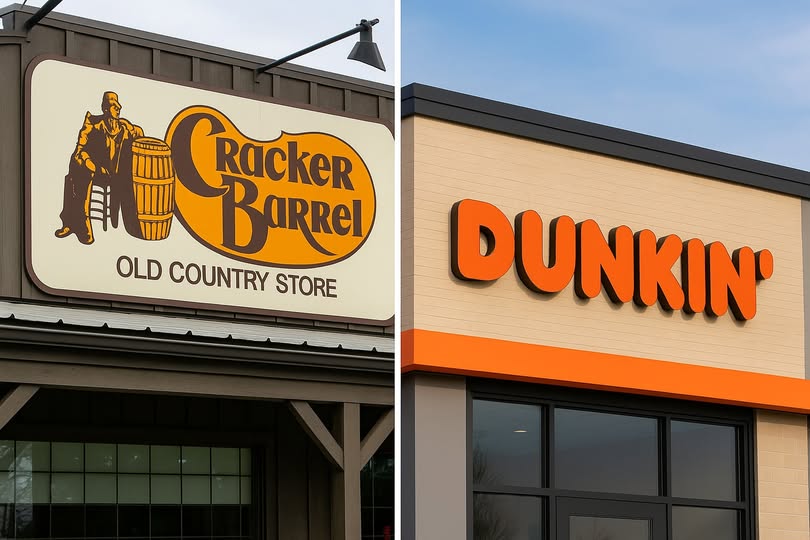
But while the objectives of rebranding are clear, not every effort achieves them. Two very different examples—Cracker Barrel and Dunkin’—show how rebranding can either undermine or accelerate a company’s trajectory.
Cracker Barrel: Rebranding for the Wrong Reasons
Cracker Barrel Old Country Store built its reputation on rustic charm, comfort food, and nostalgia. From its rocking chairs to its Southern-inspired décor, the brand was synonymous with tradition and consistency. Customers knew what to expect, and that reliability was its strength.
Yet in an effort to “modernize” and appeal to new audiences, Cracker Barrel pursued a rebrand that softened or altered much of what made it unique. The effort was not driven by strategic necessity but by a desire to chase relevance.
The missteps were significant:
Abandoning core identity by downplaying its signature country-store aesthetic.
Sending mixed signals about whether it was still rooted in tradition or trying to be something new.
Alienating loyal customers who felt the brand was turning its back on its heritage.
Focusing on cosmetics rather than deeper improvements in menu innovation, technology, or customer experience.
Instead of creating clarity, Cracker Barrel’s changes created confusion. Instead of strengthening connections, they risked alienating the very audience that had made the brand successful. The case demonstrates how rebranding without purpose or alignment to core values can do more harm than good.
Dunkin’: Rebranding Done Right
In contrast, Dunkin’ offers a compelling example of how rebranding can accelerate growth when done with clarity and intention. For decades, the company was known as Dunkin’ Donuts. Yet consumer behavior was changing—customers increasingly viewed Dunkin’ not just as a donut shop but as a beverage-led brand competing with Starbucks and other coffee giants.
Recognizing this shift, Dunkin’ rebranded by dropping “Donuts” from its name. The move was bold, but it was anchored in strategy:
Clarity: The new name highlighted Dunkin’s true focus—coffee, beverages, and convenience—without denying its roots.
Adaptation to change: The rebrand aligned the company with evolving consumer demand for beverages over indulgent baked goods.
Differentiation: By positioning itself as faster, friendlier, and more accessible than premium competitors, Dunkin’ carved out its own lane.
Connection: The company retained its playful pink-and-orange identity and loyal tone of voice, ensuring longtime customers felt included.
Growth: The rebrand provided a foundation for expansion, digital innovation, and global relevance.
Unlike Cracker Barrel, Dunkin’ did not abandon its DNA. Instead, it distilled its essence into a sharper, more relevant identity. Customers could still “run on Dunkin’,” but now with a stronger focus on what mattered most to them—coffee and convenience.
Lessons for Business Leaders
The contrast between Cracker Barrel and Dunkin’ reveals critical lessons about the true objective of rebranding:
Rebranding must be purposeful, not reactionary.
Evolution should honor the past while positioning for the future.
Cosmetic changes alone are not enough—strategic clarity is essential.
Loyalty should be strengthened, not risked.
A rebrand should set the stage for growth, not create confusion.
When guided by strategy and authenticity, rebranding is a catalyst for long-term success. When driven by trend-chasing or superficial updates, it risks undermining decades of equity.
Make today a great day. Make it happen. Make it count.
About the Author
Paul Segreto brings more than 40 years of hands-on experience in franchising, restaurants, small business development, and entrepreneurship.
Recognized as one of the Top 100 Global Franchise and Small Business Influencers, Paul is also the voice of Acceler8Success Cafe and Your Entrepreneurial Success, daily platforms where thousands of entrepreneurs turn for insight, strategies, and motivation. A lifelong advocate for ethical growth and brand integrity, he coaches founders, franchise and restaurant executives, and entrepreneurial families, guiding them to find clarity in complexity and achieve lasting success through intentional leadership.
Ready to elevate your business or navigate today’s challenges with confidence? Reach out to Paul directly at paul@acceler8success.com — your next step begins with a conversation.
About Acceler8Success Group
Acceler8Success Group is a comprehensive business advisory firm dedicated to empowering entrepreneurs, small business owners, franchise professionals, restaurant operators, and industry leaders. Through strategic consulting, personalized coaching, and impactful content, we provide the tools and guidance needed to drive growth and long-term success.
With a sharp focus on entrepreneurship, franchising, restaurants, and small business development, Acceler8Success Group delivers practical insights and proven strategies that translate vision into results.
By combining deep industry expertise with a robust content ecosystem, we help build sustainable businesses and cultivate responsible leadership. Our mission is clear: to support today’s innovators and tomorrow’s legacy builders as they pursue—and accelerate—the American Dream.
The American Dream has long stood as a beacon of hope and possibility. For generations, it has promised that through determination, hard work, and belief, one can rise above circumstances to achieve success and fulfillment. For entrepreneurs, franchisees, restaurant operators, mom-and-pop small business owners, and immigrant entrepreneurs, this Dream takes shape in unique yet interconnected ways. Each pathway reflects personal aspirations while also contributing to the broader economic and cultural fabric of America.
For entrepreneurs, the American Dream represents the chance to create something from nothing—an idea brought to life through courage and perseverance. Entrepreneurs embody the essence of opportunity by turning vision into enterprise, often disrupting industries, creating jobs, and sparking innovation. Their pursuit is not only about personal achievement but also about contributing to a cycle of growth that benefits communities and inspires future generations.
For franchisees, the American Dream often means accessing a proven model while still owning a business of their own. It allows individuals to marry their entrepreneurial spirit with established systems of support, training, and brand recognition. By investing in a franchise, they gain a vehicle to independence while minimizing some of the risks of going it alone. For many, especially first-generation Americans, franchising has been a powerful bridge to achieving stability, building wealth, and establishing a legacy for their families.
For restaurant operators, the American Dream is often tied to service, hospitality, and the joy of bringing people together. Restaurants serve as community hubs, places where stories are shared and traditions are honored. Whether running a single location or a chain of establishments, restaurant owners reflect resilience in an industry known for its challenges. Their success is measured not only by profits but by the smiles of customers, the loyalty of staff, and the satisfaction of building something that touches people’s daily lives.
For mom-and-pop small business owners, the American Dream is deeply personal. These businesses often begin as family endeavors, rooted in tradition, necessity, or passion. They thrive on local support, personal relationships, and authenticity. Small business ownership symbolizes freedom—the freedom to make decisions, to control one’s future, and to carve out a life on one’s own terms. Even modest success represents victory, because it affirms the values of independence and perseverance.
For immigrant entrepreneurs, the American Dream is both a vision and a lived experience. Arriving in a new country, often with limited resources, they bring determination, unique perspectives, and cultural richness that fuel innovation and growth. Many immigrant-owned businesses become cornerstones of local communities, blending traditions from their home countries with the opportunities of America. Their journeys often inspire others, proving that belief, resilience, and hard work can turn hope into reality. Immigrant entrepreneurs embody the very spirit of the American Dream, often seeing it more vividly than those born into it, and in doing so, they help accelerate the Dream for themselves, their families, and the communities they serve.
What unites all these paths is belief—the conviction that the Dream is possible. Like other dreams, the American Dream becomes reality when believed in and pursued with intention. Yet the story does not end with the first taste of success. For many, achieving the Dream opens the door to an even greater pursuit: the American Dream accelerated. Reaching new heights, scaling businesses, expanding horizons, and pushing boundaries reflect not just achieving the Dream, but living it fully. Each step upward, each new milestone, is a reminder that the Dream is not static—it evolves as aspirations grow.
At Acceler8Success, we remain committed to helping entrepreneurs and business owners not only achieve but accelerate their American Dream. Our mission is to provide the tools, resources, and community that empower individuals to move faster, think smarter, and reach higher.
In the days ahead, we will be unveiling exciting changes designed to take our mission to the next level—all centered around the American Dream accelerated. These developments will strengthen how we support current and aspiring entrepreneurs, franchisees, restaurant operators, and small business owners across the country. Stay tuned for the details, as we continue building a platform that inspires, empowers, and proves that the American Dream is not just alive, but thriving.
Make today a great day. Make it happen. Make it count.
About the Author
Paul Segreto brings more than 40 years of hands-on experience in franchising, restaurants, small business development, and entrepreneurship.
Recognized as one of the Top 100 Global Franchise and Small Business Influencers, Paul is also the voice of Acceler8Success Cafe and Your Entrepreneurial Success, daily platforms where thousands of entrepreneurs turn for insight, strategies, and motivation. A lifelong advocate for ethical growth and brand integrity, he coaches founders, franchise and restaurant executives, and entrepreneurial families, guiding them to find clarity in complexity and achieve lasting success through intentional leadership.
Ready to elevate your business or navigate today’s challenges with confidence? Reach out to Paul directly at paul@acceler8success.com — your next step begins with a conversation.
About Acceler8Success Group
Acceler8Success Group is a comprehensive business advisory firm dedicated to empowering entrepreneurs, small business owners, franchise professionals, restaurant operators, and industry leaders. Through strategic consulting, personalized coaching, and impactful content, we provide the tools and guidance needed to drive growth and long-term success.
With a sharp focus on entrepreneurship, franchising, restaurants, and small business development, Acceler8Success Group delivers practical insights and proven strategies that translate vision into results.
By combining deep industry expertise with a robust content ecosystem, we help build sustainable businesses and cultivate responsible leadership. Our mission is clear: to support today’s innovators and tomorrow’s legacy builders as they pursue—and accelerate—the American Dream.
For franchisors, some of the most dynamic growth doesn’t come from new entrants but from those already within the system—franchisees who have mastered their operations, proven their resilience, and shown a commitment to the brand. Encouraging such individuals to pursue additional locations can deliver outsized benefits: faster ramp-up, higher performance, and deeper alignment with brand standards. Yet the opportunity for expansion, while enticing, must be approached with a long-term lens. Growth at the expense of balance—whether personal, operational, or systemic—can erode the very foundation of success.
The Context of Today’s Franchise Environment Franchise systems are operating in a climate shaped by economic volatility, rising costs, and heightened consumer expectations. For many franchisees, their current units already demand exceptional focus. Inviting them to step into multi-unit ownership requires more than ambition—it requires readiness. Readiness is not only financial and operational but also personal. The demands of leading multiple businesses affect family life, partnerships, and long-term wellbeing. A decision made hastily, or out of perceived pressure, risks creating strain that ultimately undermines performance.
Growth as a Long-Term Strategy, Not a Reflex The best expansion decisions are not kneejerk reactions to a profitable quarter or the sudden availability of a prime site. They are intentional, carefully aligned with the franchisee’s long-term goals, the franchisor’s brand strategy, and the ecosystem of other franchisees. For franchisors, this means asking hard but essential questions:
Is this franchisee truly positioned—financially, operationally, and personally—to lead beyond a single unit?
How will expansion affect their existing business, their family commitments, and their long-term career aspirations?
Does this growth strengthen the brand’s market presence without cannibalizing or undermining other franchisees?
Franchisors should be proactive in guiding these conversations, ensuring the expansion path aligns with a roadmap measured in years, not months.
Partnership at a Higher Level Supporting a franchisee in multi-unit growth is not simply about site selection or financing—it is about helping them evolve as leaders. Managing multiple locations requires different skill sets: delegation, talent development, strategic decision-making, and the ability to sustain culture across dispersed teams. Many successful single-unit operators struggle when they attempt to replicate their personal involvement in every new location. Without systems, trust in management, and an ability to step back, quality suffers.
Franchisors who recognize this can provide the training, coaching, and resources that turn strong operators into capable multi-unit leaders. This elevates the partnership from transactional to transformational. Franchisees become not just operators but true brand stewards.
Guarding the System-Wide Balance Expansion decisions must also consider the wider franchise community. While one franchisee’s growth may be beneficial, unchecked expansion can disrupt territorial balance, limit opportunities for new franchisees, or create resentment within the system. Franchisors must maintain fairness, transparency, and a long-term vision to avoid inadvertently favoring certain operators at the expense of others.
Ultimately, every new unit must serve not only the interests of the expanding franchisee and the franchisor, but also the brand as a whole. Growth that disregards its ripple effects risks damaging trust and cohesion across the network.
A Pathway to Enduring Strength When approached with intention, expanding through existing franchisees can be a cornerstone of sustainable brand growth. But franchisors and franchisees alike must resist the temptation of short-term wins and instead focus on creating value that endures. Expansion should be earned, carefully evaluated, and aligned with the individual’s capacity, family, and future vision—as well as the collective good of the system.
Franchisors who foster this level of thought leadership in their organizations create a culture of disciplined growth—where ambition is celebrated but always tempered by strategy. In doing so, they not only accelerate development but also protect the brand’s reputation, strengthen franchisee relationships, and ensure the system thrives for decades to come.
Expansion Readiness Checklist
A practical tool for franchisors and franchisees to evaluate whether opening additional locations is the right move at the right time:
Operational Performance
Current unit(s) consistently meet or exceed sales, profitability, and compliance benchmarks
Systems and processes are stable, efficient, and transferable
Customer satisfaction scores and brand standards are consistently strong
Financial Capacity
Sufficient capital reserves and access to financing without over-leveraging
Healthy cash flow from existing operations
Ability to withstand potential ramp-up periods without straining existing units
Leadership & Management
Proven ability to delegate and lead through managers, not just hands-on involvement
A bench of talent in place or actively being developed
Comfort with shifting from day-to-day operator to multi-unit strategist
Personal & Family Readiness
Alignment with family and personal goals regarding time, stress, and lifestyle impact
Support from partners, spouses, or key advisors
A long-term vision that balances professional ambition with personal wellbeing
System & Community Fit
Expansion strengthens the brand footprint without cannibalizing other locations
Growth is consistent with the franchisor’s long-term development plan
Open communication with fellow franchisees to maintain trust and cohesion
Decision-Making Approach
Expansion is based on long-term strategy, not short-term opportunity or pressure
All risks have been openly discussed and contingency plans prepared
Both franchisor and franchisee agree that timing, resources, and vision align
Make today a great day. Make it happen. Make it count.
About the Author
Paul Segreto brings over four decades of hands-on experience in franchising, restaurants, and small business development.
Named one of the Top 100 Global Franchise and Small Business Influencers, Paul is also the voice behind the Acceler8Success Cafe, a daily content platform where thousands of entrepreneurs gain insight and motivation. A lifelong advocate for ethical growth and brand integrity, Paul continues to coach founders, franchise leaders, and entrepreneurial families, helping them find clarity in chaos and long-term success through intentional leadership.
Looking to elevate your business or need expert guidance to navigate current challenges? Connect directly with Paul at paul@acceler8success.com — your next step starts with a conversation.
About Acceler8Success Group
Acceler8Success Group is a multifaceted business advisory platform committed to empowering entrepreneurs, small business owners, franchise professionals, and industry leaders through strategic consulting, coaching, and curated content.
With a strong focus on entrepreneurship, franchising, restaurants, and small business growth, Acceler8Success Group delivers actionable insights and real-world strategies across its suite of brands, including the following:
By blending deep industry expertise with a dynamic content ecosystem, Acceler8Success Group fosters sustainable success and responsible leadership for today’s innovators and tomorrow’s legacy builders.
With fewer than four months remaining in the calendar year, a pressing question looms over sales professionals and business leaders alike: Can this deal, with all its moving parts, be brought to closure before year-end? At first glance, the inquiry seems straightforward. Yet beneath the surface lies a challenge that demands far more than intuition, improvisation, or optimism. Success in this narrowing window requires a fusion of disciplined analysis, methodical planning, and precise execution.
The most effective approach is to invert the usual perspective and work backwards through the sales process. Rather than fixating exclusively on the outcome — a signed contract neatly dated before December 31 — the prudent professional deconstructs the journey into its constituent phases. Each milestone must be identified, each step allotted its rightful lead time, and each dependency mapped in reverse sequence. In doing so, what was once uncertain becomes structured, yielding a timeline that imposes both clarity and control upon the path to closure.
At the heart of this discipline are numbers — the impartial arbiters of commercial reality. Every sales organization, whether explicitly or implicitly, operates on conversion ratios: the number of inquiries required to generate a qualified lead; the proportion of leads that progress to proposal; and the fraction of proposals that ultimately crystallize into signed agreements. When tracked rigorously, these ratios reveal a process that functions almost with mechanical precision, each stage cascading into the next as predictably as sheets aligned by a collating machine. The mathematics are unyielding. They do not flatter, they do not deceive — they simply expose the truth.
Consider a representative scenario. Historical data might show that the average sales cycle spans sixty days. Moreover, analysis might indicate that, on balance, five formal proposals are required to secure a single closed deal. From such information, the timeline for success is no longer abstract. To achieve a December close, proposals must be advanced by early November, discovery sessions conducted in October, and initial outreach commenced no later than September. Should these benchmarks falter, the likelihood of achieving year-end closure diminishes not gradually but precipitously.
Proactivity, in this context, transcends mere attitude. It is a discipline grounded in respect for both data and time. To act proactively is to recognize that opportunity pipelines must be deliberately filled now in order to yield results in the months to come. If the ratios dictate that twenty inquiries are needed to secure one transaction, then generating those inquiries well in advance becomes an imperative, not a preference. Anything less invites shortfall.
By embracing this framework, ambiguity dissolves and accountability sharpens. The conversation shifts from aspirational targets to concrete, quantifiable milestones. Resources can be allocated with purpose, expectations calibrated with accuracy, and performance evaluated with objectivity. In effect, year-end closing ceases to be a gamble. It becomes a calculated progression of interlocking steps, each governed by metrics that are immune to optimism’s distortions.
As the year’s final chapter approaches, the organizations that adopt this backward-planning discipline will not only finish with strength but will also carry momentum into January and beyond. Those that neglect the discipline — relying instead on instinct, inertia, or hope — may find themselves entering the new year burdened by missed opportunities and diminished credibility. And in sales, as in life, hope is never an adequate substitute for preparation.
Make today a great day. Make it happen. Make it count.
About the Author
Paul Segreto brings over four decades of hands-on experience in franchising, restaurants, and small business development.
Named one of the Top 100 Global Franchise and Small Business Influencers, Paul is also the voice behind the Acceler8Success Cafe, a daily content platform where thousands of entrepreneurs gain insight and motivation. A lifelong advocate for ethical growth and brand integrity, Paul continues to coach founders, franchise leaders, and entrepreneurial families, helping them find clarity in chaos and long-term success through intentional leadership.
Looking to elevate your business or need expert guidance to navigate current challenges? Connect directly with Paul at paul@acceler8success.com — your next step starts with a conversation.
About Acceler8Success Group
Acceler8Success Group is a multifaceted business advisory platform committed to empowering entrepreneurs, small business owners, franchise professionals, and industry leaders through strategic consulting, coaching, and curated content.
With a strong focus on entrepreneurship, franchising, restaurants, and small business growth, Acceler8Success Group delivers actionable insights and real-world strategies across its suite of brands, including the following:
By blending deep industry expertise with a dynamic content ecosystem, Acceler8Success Group fosters sustainable success and responsible leadership for today’s innovators and tomorrow’s legacy builders.
Every entrepreneur begins with a dream. It might be to build a business, leave a legacy, or create financial freedom. Dreams are powerful; they inspire, motivate, and ignite possibilities. But dreams, on their own, don’t change your life. They only become real when you commit to them more deeply than you commit to your comfort zone.
The comfort zone feels good because it’s safe. There’s no risk, no embarrassment, no fear of failure. But here’s the truth that every successful entrepreneur eventually faces: nothing grows in the comfort zone. Businesses aren’t built there. Legacies aren’t forged there. The comfort zone is where dreams slowly wither into regrets.
Commitment, on the other hand, is where transformation happens. It’s more than ambition or wishing for success—it’s a relentless decision to take consistent, purposeful action even when it’s inconvenient, uncertain, or exhausting.
Think about it honestly for a moment. How committed are you to your dream?
Are you willing to sacrifice comfort today for the chance at freedom tomorrow?
Will you push through doubt and fear when setbacks hit, as they inevitably do?
Do you show up every day for your vision, even when the payoff feels distant?
Entrepreneurship is never a straight line. There will be long nights, unexpected failures, financial stress, and moments when quitting feels easier than continuing. But those who rise above are the ones who understand that commitment isn’t just about passion—it’s about discipline. It’s about persistence when others lose focus. It’s about believing so strongly in the outcome that no obstacle can derail the journey.
True commitment means investing in yourself and your future. Time, energy, money, and learning—these are the currencies of transformation. Every book you read, every skill you acquire, every mentor you lean on becomes a building block toward your dream. The more you invest, the more resilient you become, and the more prepared you are to seize opportunities when they arise.
Here’s the challenge: life will continue to present you with choices between comfort and growth. You’ll have to decide whether you’re willing to endure short-term sacrifice for long-term success. And only you can answer that question.
Your dream is possible. But it demands everything from you—your focus, your courage, and your commitment. If you want to change your life, you must first decide to leave behind the illusion of safety and step boldly into the discomfort of growth.
The moment your commitment outweighs your comfort is the moment you accelerate your journey to success. That’s when the dream becomes reality.
So ask yourself again, and this time answer with conviction: How committed am I to my dream?
Make today a great day. Make it happen. Make it count.
About the Author
Paul Segreto brings over four decades of hands-on experience in franchising, restaurants, and small business development.
Named one of the Top 100 Global Franchise and Small Business Influencers, Paul is also the voice behind the Acceler8Success Cafe, a daily content platform where thousands of entrepreneurs gain insight and motivation. A lifelong advocate for ethical growth and brand integrity, Paul continues to coach founders, franchise leaders, and entrepreneurial families, helping them find clarity in chaos and long-term success through intentional leadership.
Looking to elevate your business or need expert guidance to navigate current challenges? Connect directly with Paul at paul@acceler8success.com — your next step starts with a conversation.
About Acceler8Success Group
Acceler8Success Group is a multifaceted business advisory platform committed to empowering entrepreneurs, small business owners, franchise professionals, and industry leaders through strategic consulting, coaching, and curated content.
With a strong focus on entrepreneurship, franchising, restaurants, and small business growth, Acceler8Success Group delivers actionable insights and real-world strategies across its suite of brands, including the following:
By blending deep industry expertise with a dynamic content ecosystem, Acceler8Success Group fosters sustainable success and responsible leadership for today’s innovators and tomorrow’s legacy builders.
This weekend at Acceler8Success Cafe, we’re starting something new—a weekly reflection designed to capture the essence of the conversations and insights we shared over the past several days. For those who may have missed reading during the hustle of the workweek, this is your opportunity to catch up. And for others who followed along, it’s a chance to revisit key ideas, reinforce lessons, and look at them through a fresh, reflective lens. We hope you find value in this new feature, not only as a convenient summary but also as an opportunity to pause, reflect, and connect the dots between topics that all point toward one larger theme: accelerating success in entrepreneurship and franchising.
By pulling together these articles into one weekend recap, we aim to make the content more accessible and actionable. Whether you’re diving in for the first time or reviewing with fresh perspective, our goal is to spark ideas, provide practical insights, and inspire you to take the next step forward in your own entrepreneurial journey. Think of it as a moment to recharge with lessons that matter, a chance to share in the collective wisdom of the week, and an invitation to engage with the community that is growing here at Acceler8Success Cafe.
As you read through this week’s reflections, we’d love to hear your thoughts. Which insights resonated most with you? What takeaways will you apply in your own business or career? Share your reflections in the comments and join the conversation—we’re stronger when we learn and grow together.
We kicked off the shortened week after Labor Day with Scaling a Franchise System: What It Means and How to Do It Effectively. Too often, emerging franchisors mistake scaling for simply adding locations. But scaling isn’t just about getting bigger—it’s about getting better. It requires building repeatable systems, leveraging technology, strengthening training, and developing leadership structures that can support sustainable growth. True scaling transforms a promising concept into a lasting franchise system by protecting brand integrity, enforcing consistency, and sustaining culture across the network.
By midweek, the focus shifted toward franchisee alignment with Business Plans as Alignment Tools: Raising the Standard in Franchising. Here, we emphasized the importance of requiring franchisees to create business plans after training but before opening. This exercise reinforces lessons learned, aligns franchisor and franchisee expectations, and sets benchmarks for accountability. Business plans provide both sides with clarity, discipline, and a shared roadmap. For franchisees, it builds ownership and strategic focus; for franchisors, it creates measurable insights into preparedness and execution.
On Thursday, we explored the challenges of the restaurant segment in Keeping the System Moving Forward: A Guide for Restaurant Franchisors to Inspire, Align, and Empower Franchisees. Facing volatile sales, staffing shortages, and rising costs, restaurant franchisors must lead with transparency, collaboration, and balance. Franchisees need clear communication, peer-to-peer learning opportunities, and leadership that blends optimism with realism. By redirecting negativity into constructive problem-solving, franchisors can reinforce trust and keep systems united and resilient during turbulent times.
We wrapped up the week with Investor-Ready Franchising: Why Preparation Matters Even Without a Sale in Sight. Even if franchisors have no plans to sell, preparing as though investors are watching builds stronger, more resilient systems. Institutional-grade infrastructure, financial transparency, franchisee satisfaction, and strong leadership make brands more attractive not only to potential buyers but also to franchisees and partners. Preparing for investor scrutiny ensures compliance, strengthens brand equity, and future-proofs the system—whether or not a sale ever takes place.
Final Reflection
This week’s insights at Acceler8Success Cafe reinforced a central theme: franchising thrives when brands balance ambition with discipline. Scaling effectively, requiring alignment through business plans, inspiring franchisees during adversity, and preparing systems with an investor mindset all point toward one outcome—sustainable growth built on strong foundations. The American Dream in franchising isn’t just about rapid expansion; it’s about creating brands that endure, empower entrepreneurs, and prove worthy of investment for the long run.
Make this weekend a great one. Make it happen. Make it count.
About the Author
Paul Segreto brings over four decades of hands-on experience in franchising, restaurants, and small business development.
Named one of the Top 100 Global Franchise and Small Business Influencers, Paul is also the voice behind the Acceler8Success Cafe, a daily content platform where thousands of entrepreneurs gain insight and motivation. A lifelong advocate for ethical growth and brand integrity, Paul continues to coach founders, franchise leaders, and entrepreneurial families, helping them find clarity in chaos and long-term success through intentional leadership.
Looking to elevate your business or need expert guidance to navigate current challenges? Connect directly with Paul at paul@acceler8success.com — your next step starts with a conversation.
About Acceler8Success Group
Acceler8Success Group is a multifaceted business advisory platform committed to empowering entrepreneurs, small business owners, franchise professionals, and industry leaders through strategic consulting, coaching, and curated content.
With a strong focus on entrepreneurship, franchising, restaurants, and small business growth, Acceler8Success Group delivers actionable insights and real-world strategies across its suite of brands, including the following:
By blending deep industry expertise with a dynamic content ecosystem, Acceler8Success Group fosters sustainable success and responsible leadership for today’s innovators and tomorrow’s legacy builders.
Franchisors today operate in an environment where growth capital and consolidation are reshaping the landscape. Private equity firms and multi-brand operators are consistently evaluating opportunities to acquire high-potential franchise systems. Even if a franchisor has no immediate intention of entertaining offers, preparing the brand as though investors or portfolio acquirers might come knocking ensures long-term resilience, maximizes enterprise value, and builds an organization ready for sustained growth.
Institutional-Grade Infrastructure Private equity groups and strategic buyers scrutinize infrastructure. They want evidence that a franchise brand can scale beyond its current footprint. That requires more than a strong concept—it demands systems. Comprehensive manuals, technology platforms, supply chain agreements, franchisee training programs, and compliance procedures all need to demonstrate scalability. A franchisor with these in place signals to investors that the business can support aggressive unit growth without compromising quality or profitability.
Financial Transparency and Performance Metrics Sophisticated buyers expect robust financial reporting. A franchisor must be able to deliver clear, consistent data: franchisee unit economics, average unit volumes, royalty collection rates, and systemwide sales reporting. Historical EBITDA trends, normalized financials, and support for Item 19 in the FDD are essential. Brands that maintain financial discipline and adopt GAAP-aligned accounting practices project professionalism and instill investor confidence, even when a sale is not imminent.
Franchisee Health and Satisfaction No metric matters more to both equity groups and multi-brand consolidators than franchisee success. High-performing, satisfied franchisees are the backbone of a strong system. Savvy franchisors proactively measure franchisee satisfaction, monitor profitability, and maintain open communication. Demonstrating low turnover, strong validation, and an engaged franchisee advisory council paints a picture of stability—precisely what investors seek when evaluating risk.
Brand Strength and Market Positioning For a buyer, brand equity often translates directly into enterprise value. A clear, differentiated positioning in the marketplace supported by national or regional awareness indicates staying power. Strong digital presence, thoughtful PR, and consistent consumer messaging elevate perception. A franchisor should also be able to articulate the brand’s growth story—why customers choose the brand, why franchisees invest, and why competitors should take notice.
Compliance and Legal Readiness Equity groups will scrutinize litigation history, FDD compliance, and the enforceability of franchise agreements. Ensuring airtight legal documents, clean disclosure practices, and proper registrations mitigates red flags. Emerging brands should work with experienced franchise attorneys to review all legal frameworks, making certain they reflect best practices and anticipate long-term system needs.
Human Capital and Leadership Bench Strength Investors look closely at people. They want to know that leadership has the experience and vision to scale, and that the brand is not over-reliant on one founder. Building a leadership team and governance structure demonstrates maturity. Even fractional executives or advisors can signal to outside parties that the brand is forward-thinking and professionally managed.
Preparing Without Selling It is important to note that preparing for private equity or multi-brand interest is not synonymous with planning to sell. Rather, it is about building a more valuable, investable brand. A system that can withstand scrutiny from sophisticated acquirers is also a system that can thrive independently, attract stronger franchisees, and negotiate more favorable vendor agreements. In effect, the exercise of preparing for investors future-proofs the brand.
Final Thoughts Franchisors who approach their businesses with an investor’s mindset will find themselves better positioned regardless of whether they ever pursue a transaction. By emphasizing institutional infrastructure, financial discipline, franchisee success, brand strength, compliance, and leadership development, a franchisor creates a brand that not only attracts outside interest but also endures and prospers in an increasingly competitive market. Preparing for private equity or strategic acquisition is not about the exit—it is about building a franchise system worthy of investment.
Make today a great day. Make it happen. Make it count.
About the Author
Paul Segreto brings over four decades of hands-on experience in franchising, restaurants, and small business development.
Named one of the Top 100 Global Franchise and Small Business Influencers, Paul is also the voice behind the Acceler8Success Cafe, a daily content platform where thousands of entrepreneurs gain insight and motivation. A lifelong advocate for ethical growth and brand integrity, Paul continues to coach founders, franchise leaders, and entrepreneurial families, helping them find clarity in chaos and long-term success through intentional leadership.
Looking to elevate your business or need expert guidance to navigate current challenges? Connect directly with Paul at paul@acceler8success.com — your next step starts with a conversation.
About Acceler8Success Group
Acceler8Success Group is a multifaceted business advisory platform committed to empowering entrepreneurs, small business owners, franchise professionals, and industry leaders through strategic consulting, coaching, and curated content.
With a strong focus on entrepreneurship, franchising, restaurants, and small business growth, Acceler8Success Group delivers actionable insights and real-world strategies across its suite of brands, including the following:
By blending deep industry expertise with a dynamic content ecosystem, Acceler8Success Group fosters sustainable success and responsible leadership for today’s innovators and tomorrow’s legacy builders.






You must be logged in to post a comment.