Tag: customer-experiences

When Restaurants Stop Serving People and Start Managing Transactions

When restaurants lose sight of hospitality, they don’t usually notice it all at once. It rarely happens because someone wakes up and decides guests no longer matter. It happens quietly, through small decisions that feel practical in the moment. Speed replaces warmth. Efficiency replaces eye contact. Policies replace judgment. Over time, the restaurant still serves food, but it stops serving people.

Hospitality is not the same as service. Service is transactional. Hospitality is relational. Service is about delivering what was ordered. Hospitality is about how a guest feels before, during, and after the meal. When hospitality fades, restaurants often convince themselves they are improving operations. They tighten scripts. They shorten conversations. They push staff to turn tables faster. They reduce flexibility in the name of consistency. The result is a place that may run smoothly on paper but feels cold in practice.

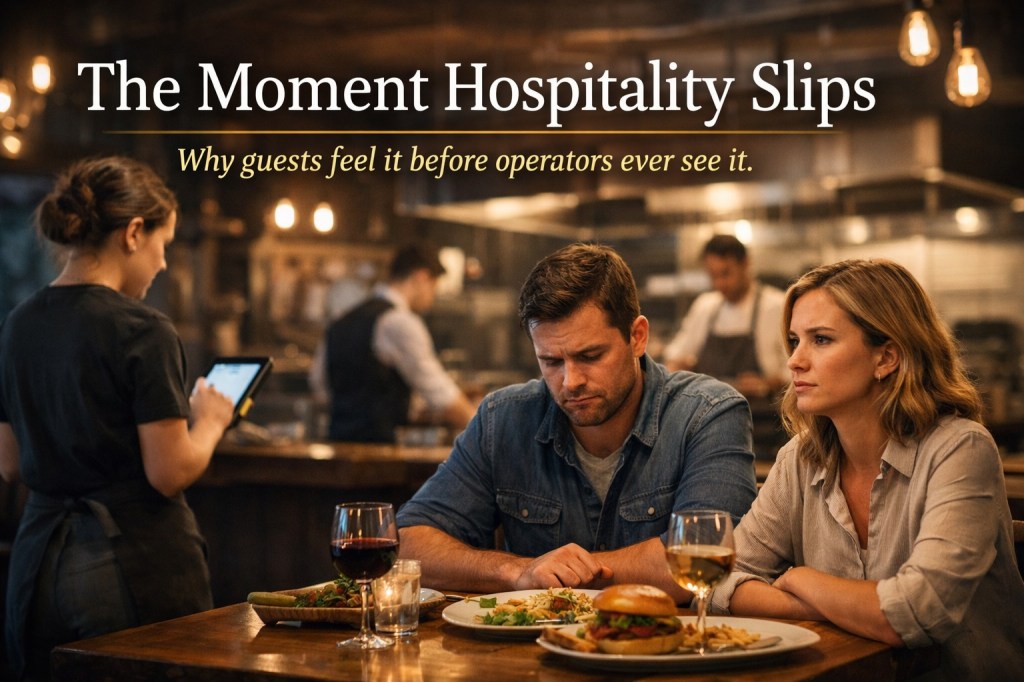
Guests notice immediately, even if they can’t articulate why. They sense when a greeting feels rehearsed instead of genuine. They feel when a server is rushing past them rather than welcoming them. They notice when a problem is met with policy instead of empathy. Food quality may remain strong, pricing may be competitive, and marketing may be clever, yet something feels off. The experience becomes forgettable at best and frustrating at worst.

For staff, the loss of hospitality is just as damaging. When employees are trained to execute tasks rather than care for guests, their work becomes mechanical. Pride erodes. Engagement drops. Team members stop thinking like hosts and start thinking like rule enforcers. Turnover rises because people rarely stay long in environments where they are discouraged from being human. A restaurant without hospitality often becomes a restaurant constantly hiring.

Leadership plays a central role in this shift. When owners and managers focus exclusively on food cost, labor percentages, ticket times, and reviews, hospitality becomes an afterthought. Metrics matter, but when they become the mission, they crowd out the very behavior that drives long-term loyalty. Hospitality cannot be delegated to a training video or a line in a handbook. It must be modeled, reinforced, and protected, especially during busy or stressful moments.

Technology can accelerate the problem when misused. Tablets, kiosks, QR codes, and apps can improve efficiency, but they can also create distance. When technology replaces interaction instead of supporting it, guests feel like obstacles in a process rather than welcomed participants in an experience. Convenience without connection is not hospitality. It is automation.

Over time, restaurants that lose sight of hospitality begin to rely heavily on discounts, promotions, and advertising to compensate for declining loyalty. They chase new customers because they fail to keep existing ones. The brand becomes louder while the experience becomes quieter. The restaurant survives, but it no longer inspires. It becomes interchangeable with dozens of others offering similar food at similar prices.

The most successful restaurants understand that hospitality is not soft or optional. It is a strategic advantage. It is what turns first-time guests into regulars and regulars into advocates. It is what allows a restaurant to recover from mistakes with grace rather than damage. Hospitality creates forgiveness, trust, and emotional connection, none of which can be purchased through marketing.

When restaurants rediscover hospitality, the change is immediate and powerful. Guests feel seen again. Staff feel empowered again. The room feels alive. Hospitality does not slow a restaurant down. Done right, it gives meaning to everything else happening inside the four walls. Food feeds the body, but hospitality feeds the relationship. When that relationship is lost, the restaurant may still operate, but it stops truly serving.


About the Author

Paul Segreto brings over forty years of real-world experience in franchising, restaurants, and small business growth. Recognized as one of the Top 100 Global Franchise and Small Business Influencers, Paul is the driving voice behind Acceler8Success Café, a daily content platform that inspires and informs thousands of entrepreneurs nationwide. A passionate advocate for ethical leadership and sustainable growth, Paul has dedicated his career to helping founders, franchise executives, and entrepreneurial families achieve clarity, balance, and lasting success through purpose-driven action.


About Acceler8Success America

Acceler8Success America is a comprehensive business advisory and coaching platform dedicated to helping entrepreneurs, small business owners, and franchise professionals achieve The American Dream Accelerated.

Through a combination of strategic consulting, results-focused coaching, and empowering content, Acceler8Success America provides the tools, insights, and guidance needed to start, grow, and scale successfully in today’s fast-paced world.

With deep expertise in entrepreneurship, franchising, restaurants, and small business development, Acceler8Success America bridges experience and innovation, supporting current and aspiring entrepreneurs as they build sustainable businesses and lasting legacies across America.

Learn more at Acceler8SuccessAmerica.com

Why Guests Leave Quietly and Don’t Come Back: A Lesson for Restaurant Operators

Doing things right in restaurant operations shouldn’t feel elusive, yet the industry continues to struggle under the weight of declining sales, shrinking margins, and an ever-growing list of closures. Hardly a day goes by without another restaurant becoming a cautionary tale. Labor shortages, rising food costs, rent, competition, and the economy are often cited as the reasons. All of them are real. All of them are challenging. But they also tend to mask a deeper, more uncomfortable truth: many restaurants aren’t failing because of one catastrophic mistake, but because of dozens of small ones quietly piling up over time.

This raises an important question for every operator. Are the challenges you’re facing the result of one major issue, or are they the accumulation of overlooked details? At what point do small missteps stop being isolated and start becoming a pattern your guests can feel? And perhaps most importantly, do you recognize that moment when it happens, or does it only become clear once customers stop coming back?

Taking care of a customer to a high degree of satisfaction is not rocket science. Hospitality is not abstract. It lives in awareness, intention, and consistency. Yet the bar seems to have lowered, with an unspoken expectation that guests should be more forgiving. But should they be? When a guest reaches for cash or pulls out a Gold American Express card, they’re not just paying for food. They’re paying for care, pride, and the expectation of a positively memorable experience. Is that really too much to ask, every time?

In an ideal world, restaurants would approach every guest interaction as if it truly mattered, because it does. Not through slogans or mission statements, but through execution. Through doing the right things, the right way, repeatedly. Talk doesn’t build loyalty. Results do. And the results customers experience are shaped by the details you either notice first or miss entirely.

Perfection is often dismissed as unrealistic in today’s restaurant environment. Too many variables. Too many moving parts. But is perfection actually unattainable, or has it simply become inconvenient to pursue? Absolute perfection may be elusive, but coming damn close is not only possible, it’s necessary. Standards rise when perfection is the goal. Training improves. Accountability sharpens. Pride returns. When excellence is chased, even the inevitable mistakes are handled with care.

A recent visit to a well-regarded local pizza and Italian restaurant illustrates how easily small details can undermine an otherwise solid operation. The concept was good. The space was attractive. Yet the experience felt uneasy. A side of spaghetti arrived watery, clearly not drained correctly. A basic step missed. The spoon meant for twirling pasta was oversized and awkward, making eating uncomfortable. The new tables, while beautiful, wobbled just enough to be distracting. None of these issues were disastrous on their own, but together they planted doubt. If these visible details slipped through, what else might be overlooked behind the scenes?

This is the danger of “little things” in restaurants. They don’t shout. They whisper. They accumulate. They shape perception. How many small irritations does it take before a guest decides not to return? How many details must be missed before trust begins to erode? And how many operators never realize customers are leaving, not because of one bad experience, but because of several slightly disappointing ones?

That reality becomes even clearer in what I now call the Rainbow Cookie Story.

For fifteen years, our family ordered rainbow cookies every holiday season from the same Brooklyn bakery. These cookies are a staple on Italian tables, and for us, they were tradition. Each year, we ordered four pounds. The package barely arrived before it was opened. One bite and memories flooded back—years past, holidays, conversations. It wasn’t just dessert. It was an experience.

Then last year, that experience changed. The familiar festive tin with its carefully arranged pinwheel of cookies was replaced with a flimsy cardboard box. The presentation was gone. Worse, the cookies weren’t fresh. They had absorbed the taste of damp cardboard. This was an order that, with shipping, ran well over $125. We called the bakery to express disappointment and were met with a dismissive response: “Yep, we changed. No more tins. Sorry. That’s the way we do it now.”

No empathy. No effort to make it right.

For the first time in fifteen years, the cookies didn’t disappear before Christmas. Half were thrown out once the holidays ended. This year, we didn’t order from them at all. No second chance. No referrals. Loyalty vanished in one season, not because of change, but because disappointment was met without care.

Instead, we tried a different Brooklyn bakery. The cookies were phenomenal. Fresh. Thoughtfully packaged. Familiar in all the right ways. Within a day of the order arriving, we placed another one because everyone dove right in. Four pounds are fading fast. A new tradition was born, and an old one quietly ended.

That’s how quickly loyalty can be lost.

This story isn’t about cookies. It’s about respect. It’s about understanding that every experience reinforces or erodes trust. When a guest expresses disappointment, how you respond matters more than the mistake itself. Are they heard? Are they valued? Or are they told, implicitly or explicitly, to accept it or move on?

So here is the challenge, and the call to action for restaurant operators.

Slow down and walk your restaurant as a guest, not as an owner. Sit at the tables. Use the utensils. Taste the food exactly as it’s served. Notice what wobbles, what feels rushed, what feels overlooked. Pay attention to how your team responds when something goes wrong. Ask yourself whether the experience you’re delivering today truly earns loyalty tomorrow. Create systems that catch the small issues before guests do. Empower your team to fix problems in the moment. Treat disappointment as a gift, not an inconvenience.

Because in this industry, the little things are never little. They are the difference between a guest who comes back and one who quietly disappears. And in a business where loyalty is fragile and memories are powerful, doing things right—consistently, intentionally, and with care—isn’t optional. It’s survival.


About the Author

Paul Segreto brings over forty years of real-world experience in franchising, restaurants, and small business growth. Recognized as one of the Top 100 Global Franchise and Small Business Influencers, Paul is the driving voice behind Acceler8Success Café, a daily content platform that inspires and informs thousands of entrepreneurs nationwide. A passionate advocate for ethical leadership and sustainable growth, Paul has dedicated his career to helping founders, franchise executives, and entrepreneurial families achieve clarity, balance, and lasting success through purpose-driven action.


About Acceler8Success America

Acceler8Success America is a comprehensive business advisory and coaching platform dedicated to helping entrepreneurs, small business owners, and franchise professionals achieve The American Dream Accelerated.

Through a combination of strategic consulting, results-focused coaching, and empowering content, Acceler8Success America provides the tools, insights, and guidance needed to start, grow, and scale successfully in today’s fast-paced world.

With deep expertise in entrepreneurship, franchising, restaurants, and small business development, Acceler8Success America bridges experience and innovation, supporting current and aspiring entrepreneurs as they build sustainable businesses and lasting legacies across America.

Learn more at Acceler8SuccessAmerica.com