Tag: emerging-franchisors

What Will Your Franchisees Tell the Next Candidate Who Calls?

Ahead of IFA’s 2026 Emerging Franchisor Conference in Nashville, consider what a prospective owner can learn in ten minutes on the phone with someone who has already made the investment.
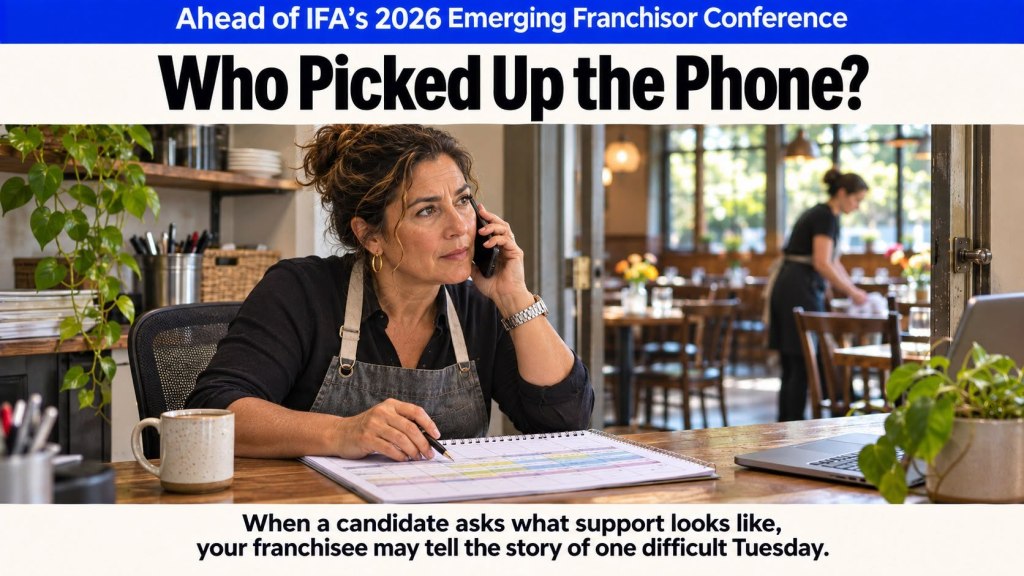
Imagine a prospective franchisee calling one of your first owners just after the lunch rush. They’ve met you, visited your original location, and spent an evening at the kitchen table going over the investment with their spouse. They have a few questions left. One of them is, “When you had your first difficult month, who did you call, and what happened?”

As the founder, you might picture the field visit, the follow-up emails, and the hours your team spent helping that owner. The owner might remember one particular Tuesday, sitting in the office with a full dining room, a payroll due Friday, and very little money in the bank. What happened that afternoon is probably the story the candidate will hear.

Yesterday at Acceler8Success Café, we looked at where growth can stall between a candidate’s first inquiry and a franchisee’s opening day. Today, I’d like to spend some time on a conversation we touched on along the way. In franchising, we call it validation. For the person making the call, it’s a chance to ask someone who once sat at a kitchen table much like theirs, “How did this work out for you?”

What Did Support Look Like on That Tuesday?

Suppose the owner tells the candidate, “I called because sales were up and I couldn’t figure out why I was still short on cash.”

Imagine two ways that story could continue. In one, the founder promises to have someone look into it. A week later, the owner calls again and explains the situation to a second person. By then, they’ve transferred money from their personal account to cover payroll.

In the other, someone from operations calls back that afternoon and asks the owner to pull up next week’s schedule and the last four weeks of sales by hour. Together they discover that the restaurant is still staffing weekday afternoons the way it did during its grand opening. They make an adjustment and agree to look at the numbers again after the next payroll.

Both owners had a difficult month. Both reached out. Consider what each can now tell a candidate who asks, “What do I get for the royalties I pay?” One can describe a change they made, the person who helped them make it, and what happened afterward. The other can tell you exactly how many people they had to call.

The Owner You Haven’t Heard From Lately

If you’re leading an emerging brand, you probably know which franchisee will pick up when you call. You may also know which one will tell you, in considerable detail, what needs fixing. I’d make time this week for the owner whose name rarely comes up at a leadership meeting.

Their royalties arrive on time. Sales look steady. Your field team reports that the location is running well. What you may have missed is that the owner has been covering the general manager’s shifts for three months. From the home office, you see a consistent labor percentage. At the owner’s kitchen table, the conversation is about another Saturday they promised their family they’d have off.

I’d ask that owner, “What’s taking more of your time than you expected when you signed?” Then I’d give them room to answer before offering a solution. Perhaps they need help recruiting a manager. Perhaps the business at its current sales volume can only support the owner doing that job. Those answers lead to different decisions, both for the person running the location and for the next candidate who expects to hire a manager.

“Would You Do It Again?”

It’s a fair question for a candidate to ask, and one I’d encourage founders to ask their franchisees directly. The follow-up I’d use is, “What part of your experience most influenced that answer?”

An owner might say, “Yes, I’d do it again. I just wish someone had told me how long it would take before I could pay myself consistently.” A founder could hear the yes and leave the meeting feeling good. I’d stay with the second sentence. What did that owner understand about working capital before signing? When did they realize their household budget would be stretched? Have more recent owners had a similar experience?

There’s just as much to learn from the owner who says, “Yes, and here’s what made the difference.” Maybe an experienced franchisee invited them to spend a day at their location before hiring their first crew. If that day helped the new owner decide whom to hire and how to train them, it’s worth asking whether the next owner should have that opportunity, too.

And if someone says they would choose differently today, hear them out. Thank them for telling you. If you agree to look into something, give them a date and call them back yourself. Whatever they eventually tell a candidate about that conversation belongs to them. What you do after hearing it belongs to you.

Final Thoughts

If you’re still preparing to award your first franchise, try this at your next leadership meeting. Choose one promise you expect to make to a prospective owner, such as “We’ll help you manage labor.” Walk through who would take that Tuesday call, what information they’d need, and when they’d check back. You may discover there’s work to do before you’re comfortable making that promise.

If you already have franchisees, you can start with a simpler question. “What’s one thing you tell candidates about owning this business that you wish we understood better at the home office?” I’d be prepared to hear something that has never appeared in a field report.

Tomorrow, we’ll close this week’s series with the question I’d take to Nashville: If you could sit down with a founder who has already worked through the challenge you’re facing, what would you ask?

Whether you’re attending the 2026 Emerging Franchisor Conference or following along from home, I’d welcome a discussion. If you’re a franchisee, what do you wish someone had told you before you signed? If you’re a founder, what has an owner told you that changed the way you support the next one?

DM me or email me at Paul@Acceler8Success.com.
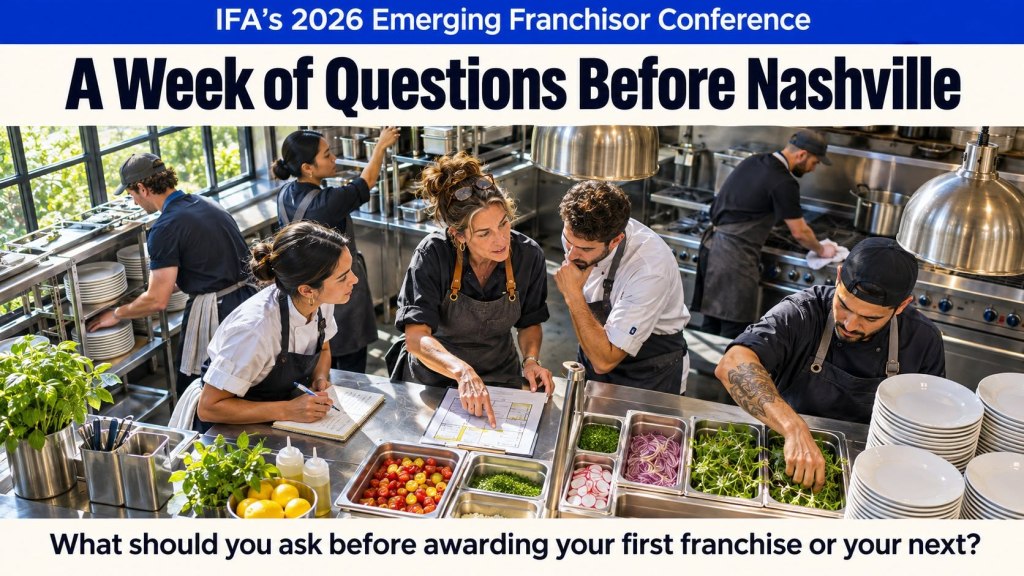
Ahead of IFA’s Emerging Franchisor Conference, Would You Invest in Your Own Franchise?

This week at Acceler8Success Café begins with a question for founders preparing to award their first franchise or their next. What would you want to know before putting your own money into the business?

A week from today, emerging franchisors will gather in Nashville for the 2026 Emerging Franchisor Conference, hosted by the International Franchise Association (IFA). The conference takes place November 16–18 at the Embassy Suites by Hilton Nashville Downtown. In the days leading up to it, I’d like to spend some time here at Acceler8Success Café on the questions founders are bringing with them and the ones they may still be trying to put into words.

Maybe you own a business and someone has just asked if they can buy a franchise. Maybe you’ve awarded your first few franchises and discovered how much happens between signing an agreement and opening the doors. Or maybe you’ve been franchising for a few years and find yourself looking at the growth plan you wrote at the outset, wondering why the numbers on the page look so different from the business you’re leading today.

Whether you’re heading to Nashville or staying close to home, here’s where I’d start. If you could sit down over coffee with a founder who has already worked through the challenge you’re facing, what would you ask?

When Someone Asks, “Can I Buy a Franchise?”

It’s quite a compliment when a customer wants to open a business just like yours. Imagine a longtime regular at your restaurant saying, “My neighborhood needs a place like this. If you ever decide to franchise, call me.” You know the person. You know the neighborhood. You can already picture the second location.

Before you make that call, think about last Friday night. When two employees called out, who rearranged the shifts? When a catering order came in during the dinner rush, who knew how much the kitchen could handle? When a longtime customer had a complaint, did the manager resolve it, or did everyone look for you?

Now consider that same Friday evening from the prospective franchisee’s side. They’ll be paying today’s rent. They may need to hire a manager to cover the hours you routinely work. They’ll owe royalties and may have a loan payment due whether Friday is busy or slow. They’ll also have to earn the neighborhood relationships you’ve spent years building.

That’s where I’d begin a feasibility conversation. Could another owner deliver the experience your customers love, pay the people it takes to run the business, draw a reasonable income, and earn a return that makes the investment worthwhile? Which assumptions can you support with operating experience? Which ones do you still need to test?

Once You’ve Awarded Franchises, the Question Changes

Your first franchisees can tell you things you couldn’t have known when you wrote the original plan. They know which parts of training prepared them for opening day, which expenses surprised them, and how long it took before they felt comfortable drawing a paycheck. Give them room to tell you.

One question I’d ask is, “What did you have to figure out on your own that you expected us to help you with?”

Suppose an owner tells you that training prepared her to make the product and serve the customer, but six weeks after opening she still couldn’t build a labor schedule that made sense for her sales. Sit down with her and review a few weeks of schedules alongside actual sales by shift. Find out whether other owners struggled with the same thing. What you learn can help her with next week’s schedule and give you a specific skill to teach the next franchisee before opening.

For a brand approaching 50 locations, I’d ask one more question. Does that kind of feedback still reach someone who can act on it? When the founder knew every franchisee personally, a phone call might have been enough. Today, could you trace the last concern an owner raised, see who took responsibility for it, and find out whether anyone called the owner back?

When Growth Falls Short of the Plan

Let’s say you expected to have 20 locations open by now and you have six. Put that number on the table at a leadership meeting and someone is likely to suggest generating more leads. Before committing money, I’d want to know how you arrived at the original projection and where actual experience began to diverge from it.

Did too few qualified candidates enter the process? Did several promising candidates withdraw after talking with existing franchisees? Are signed franchisees spending months looking for sites at rents their businesses can support? Any one of those situations could leave you with six open locations. Each calls for a different decision.

I’d start by looking closely at two people, a candidate who withdrew and a franchisee who signed but has yet to open. Walk through what happened with each. What did the candidate say when they stepped away? When did someone last speak with the signed owner about the site search? Does that owner know what help to expect from you this week?

Those conversations can bring a growth discussion down to a decision you can actually make. You might need to change whom you recruit. You might need to revisit your site criteria. Or you may discover that an existing franchisee raised a concern months ago that’s now surfacing in conversations with candidates.

Final Thoughts

Before awarding your first franchise—or your next one—consider what you’d want to know if you were the person signing the agreement. What will it cost me to get the doors open? Can I earn a living at the sales volume this location can reasonably support? Who will I be able to call when something happens that training didn’t cover?

If you’re preparing to franchise, pick the question you’d have the hardest time answering and spend some time on it this week. If you’re already franchising, invite one of your owners to tell you, “Here’s what I wish we’d both understood before I opened.” The answer may point to something you can do for that owner today and something you’ll want to change before awarding another franchise.

Whether you’re attending the 2026 Emerging Franchisor Conference in Nashville or following the conversation from home, I’d welcome a discussion about what you’re working through. Maybe you’re weighing your first award, helping a franchisee get the doors open, or trying to understand why growth has slowed. What’s the one question you’d put on the table if we were sitting down over coffee?

DM me or email me at Paul@Acceler8Success.com.
Many Emerging Franchisors Reach This Moment: The Question Is What Happens Next.

I had a conversation recently with the founder of an emerging franchise brand with 234units that has stayed with me.

He looked at me and said,

“Paul, I’ve been working harder than I ever have. Every day I’m chasing the next opportunity, trying to generate enough cash flow to keep everything moving forward. Sometimes I run promotions at our corporate locations just to create the cash I need to support my franchisees and the brand. I know those decisions often cost me more in the long run because they pull me away from what I should be doing… building a franchise organization instead of simply keeping one alive.”

Then he paused before saying something I suspect many franchise brand founders have thought but few will admit.

“I’m frustrated beyond belief. I’m honestly wondering if it’s time to give up and go in a different direction.”

I didn’t answer immediately.

Not because I didn’t know what to say.

Because I’ve heard those words many times over the years from founders trying to build franchise organizations. And, if I’m being transparent, every founder reaches moments where they question whether the sacrifices are worth it.

One of the greatest misconceptions about building a franchise brand is that success is simply a function of working harder.

If that were true, every founder putting in 70-hour weeks would eventually build a thriving franchise system.

We all know that’s not reality.

The problem often isn’t a lack of work ethic.

It’s that founders become trapped in survival mode.

When cash flow becomes today’s priority, tomorrow’s vision often gets pushed aside.

You need revenue.

You personally solve operational issues.

You jump into sales.

You handle marketing.

You recruit franchisees.

You answer every phone call.

You wear every hat imaginable.

Before long, you’re spending all of your time working in the business instead of building the franchise system you envisioned.

Because you’re consumed by today’s demands, you never have enough time to further develop the infrastructure that produces tomorrow’s growth.

The cycle repeats itself.

As our conversation continued, I asked him one question.

“If your franchise brand disappeared tomorrow, what part of this journey would you still want to wake up and do every day?”

He didn’t answer right away.

Finally, he said,

“I love helping people succeed. I love developing people. I love building a brand that creates opportunities for others. I love seeing franchisees achieve things they never thought possible.”

I smiled.

Then I asked another question.

“If that’s what inspires you, why are you spending so much of your time doing everything else?”

Sometimes founders become prisoners of their own growth.

The more momentum a brand begins to generate, the more demands are placed on the founder.

Every franchise inquiry needs attention.

Every operational issue lands on the founder’s desk.

Every marketing decision requires approval.

Every challenge finds its way back to the person who started it all.

Before long, the founder becomes the system.

And that’s exactly what prevents the system from becoming scalable.

Later in the conversation he asked me,

“So what do I do?”

My answer surprised him.

“I don’t think you need another initiative.”

“I think you need fewer.”

Most emerging franchise brands don’t struggle because they lack opportunities.

They struggle because they’re trying to pursue too many opportunities at the same time.

Growth.

Franchise sales.

Operations.

Technology.

Marketing.

Training.

Support.

Strategic partnerships.

Additional revenue streams.

Everything feels important.

But focus isn’t about doing more.

It’s about deciding what matters most.

Before we wrapped up, I left him with one final question.

“Are you ready to give up on your vision… or are you simply ready to give up on the way you’ve been trying to build it?”

Those are two very different decisions.

I’ve come to believe that many franchise founders aren’t actually ready to quit.

They’re simply exhausted.

Exhausted from carrying every responsibility.

Exhausted from making every decision.

Exhausted from trying to build a franchise organization while simultaneously operating as the CEO, salesperson, trainer, marketer, recruiter, operations manager, and chief problem solver.

Sometimes what needs to change isn’t the vision.

It’s the strategy.

It’s the structure.

It’s recognizing that building a franchise system requires building an organization—not just operating a business.

And, it’s the willingness to let others help.

I’ve spent more than four decades working with franchise brands at every stage of development. The industries differ, but the conversations are remarkably similar.

The founders who ultimately build enduring franchise organizations aren’t necessarily the ones who work the hardest.

They’re often the ones who gain the clarity to simplify, the discipline to prioritize, and the willingness to build systems that allow the organization to grow beyond themselves.

If this conversation sounds familiar, know this:

You’re not alone.

And perhaps the answer isn’t to abandon the dream of becoming a successful franchisor.

Perhaps it’s time to rethink the path that gets you there.

I’d love to hear from other franchise founders. Have you ever felt caught between running today’s business and building tomorrow’s franchise organization?