 This year the hit ABC reality television show Shark Tank aired its 100th episode, making it the highest rated show on Friday night. Shark Tank, now in its sixth season, is amongst the top most watched reality shows on television. The shows panel usually consists of it’s recurring millionaire and billionaire venture capitalists: Kevin O’Leary, Robert Herjavec, Daymond John, Barbara Corcoran, Lori Greiner and Mark Cuban.
If you haven’t already seen the show, the way it works is that these venture capitalists are presented with new ideas, inventions and services from new businesses that are seeking investments. The people that enter the “Tank” are given the chance to present these VC’s, or “Sharks” as they are known on the show, with an opportunity to invest in their companies.
Many of the people who walk into the “Tank” are told by the “Sharks” that their business is not a business and that they are not even entrepreneurs. Some are dumbfounded when they hear this because they believe that they are serious entrepreneurs—not just another businessperson looking to make a buck.
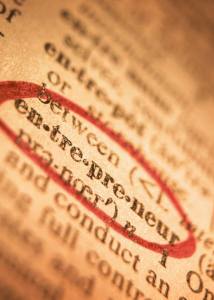
So what exactly differentiates an entrepreneur from a businessperson? An entrepreneur is defined as, “a person who organizes and operates a business or businesses, taking on greater than normal financial risks in order to do so.” A businessperson is defined as, “a man or woman who works in business or commerce, especially at an executive level.” Although the two seem closely related, they actually differ on a major level. In order to understand this concept, we’ll have to use the “Sharks” themselves as examples.
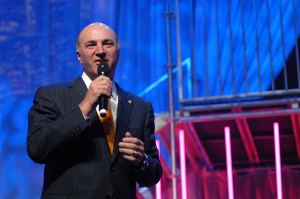 Kevin O’Leary earned his way to fame and fortune by building his educational software company SoftKey, right out of college. As his empire grew, he eventually acquired The Learning Company for over $600 million—taking the name as well. Eventually, O’Leary sold his business to a company called Mattel for $3.8 billion in a stock swap. In 2003, O’Leary moved on to his next venture, Storage Now, which was later acquired for $110 million.
O’Leary now sits on several boards and operates as an advisor to many companies. O’Leary eventually made his way to the Shark Tank after the success of his other show Dragon’s Den, which Shark Tank is modeled after. O’Leary is known as “Mr. Wonderful” on the show for his outlandish and often brutal honesty—as he so puts. He approaches his investment decisions with the cold hard truth that he believes some ideas are just not meant to be businesses.
 Robert Herjavec got his start by building up his Internet security empire, BRAK Systems, until he eventually sold it to AT&T Canada in 2000. After an early retirement, Herjavec found his way back to the Internet security world when he founded The Herjavec Group in 2003, where he currently operates as the CEO. Herjavec also started out on Dragon’s Den with O’Leary and now holds a recurring spot on Shark Tank. Herjavec appears to be more optimistic than the other “Sharks”, with more of a sensitive side. Maybe it’s the fact that his working-class father immigrated to America in pursuit of the “American Dream” and taught him that hard work pays off—which he’s used as the model for his success.
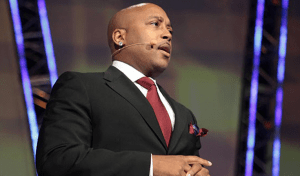 Daymond John, who is most famously known for his start-up company FUBU, which he grew with the help of celebrity endorsement and a mortgage from his Mother’s house. John built FUBU into the global empire it is today, with global sales at over six billion to date. Although he is known to be a more reserved “Shark,” taking careful consideration before jumping on a deal, John is known to have a compassionate side and one that has been seen before on Shark Tank.
 Barbara Corcoran built her empire with nothing more than a mere $1,000 loan that she used to start her real estate company The Corcoran Group—which she co-founded. In 2001, Corcoran sold her company to NRT Incorporated for $66 million. Corcoran is responsible for pioneering many revolutionary techniques that changed the real estate market. Corcoran is a wild one—the fun-loving “Shark,” who astounds the others with her business decisions but somehow always proves that she still has her business swagger.
 Lori Greiner began her career with the invention of a revolutionary jewelry box that was capable of holding over 100 earrings. Greiner is now known as the “Queen of QVC”, since she has helped launch over 400 products via the network and holds over 120 U.S. and international patents. She is also the president and CEO of the company For Your Ease Only. Greiner is a savvy investor who has helped grow hundreds of companies. She is a force to be reckoned with—despite her physical appearance she is not to be underestimated.
 Mark Cuban, the richest of the “Sharks”, made his billions despite some claims that were ultimately defeated in court, with the start of his company MicroSolutions in the 1980’s. In 1990, Cuban sold his company for $6 million. After that, Cuban moved on to his next venture AudioNet, which became Broadcast.com and eventually sold to Yahoo! for $5.7 billion. Cuban is probably the deadliest of the “Sharks,” with the biggest bite. He’s known for his ruthless execution and ability to swoop in at any moment and steal a deal right from another “Shark’s” mouth. Although this is true, Cuban has been known to drop out of the race if he feels he can’t contribute more than another “Shark.”
As far as the term entrepreneur is concerned, assuming that it’s not as subjective an idea, but more literal: Mark, Kevin and Robert seem to fit this definition best as opposed to Barbara, Lori and Daymond. The reason for this is due to the fact that these people have started their companies, sold them and started new ones, continuing this trend indefinitely. Daymond is sort of in the middle since his claim to fame is mostly FUBU. Barbara and Lori predominantly gained success from one business, which generated most of their wealth, later allowing them to invest in future companies.
At some point in their lives I believe that all of these “Sharks” were full-time entrepreneurs but as time progressed and success achieved, Barbara and Lori, and to some extent, John actually “switched” positions and became businesspeople, just managing their day to day operations, investing in some other companies, but letting others follow through on the vision, actually passing the entrepreneurial torch on to the next eager person, or better stated, igniting the entrepreneurial torch for others.
Please visit www.FranchiseFoundry.com for more information on emerging brands and entrepreneurs.












 Recently, I posted the article
  In his piece, Kuemmerle seeks to outline the various risks and challenges that a prospective entrepreneur will have to take on to truly succeed. Kuemmerle wants to force business-people to look in the mirror and ask themselves: is this really the model I want to follow to achieve my personal business dreams? The converse to his questions are: is franchising a better business model?
You must be logged in to post a comment.