A weekend recap from Acceler8Success Café for founders considering their first franchise award, supporting their first owners, or wondering why growth has fallen short of expectations.
On Monday, I asked whether you’d invest in your own franchise. By Friday, we were talking about a founder with six locations open and a seventh owner still waiting on a site. What stayed with me was a detail a reader raised along the way. While everyone is watching the real estate, the person that franchisee hopes to hire as general manager may be interviewing somewhere else.
That’s the kind of detail I hoped this series would bring out. At the home office, number seven may appear on a development report with two words beside it: site search. For the franchisee, it’s a decision about what to tell someone who needs a start date. Both people are talking about the same opening. One of them can tell you what another week of waiting might cost.
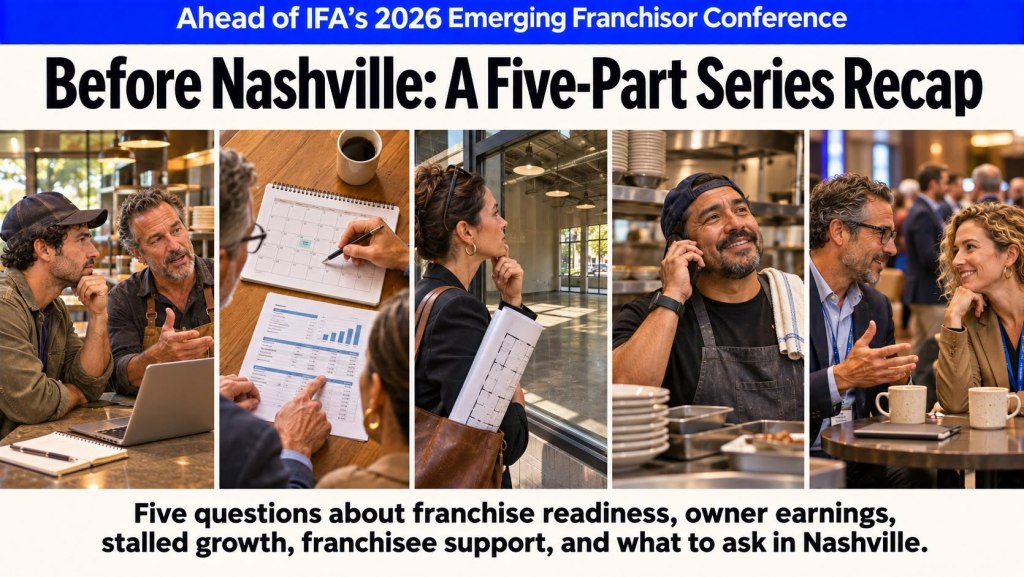
With the International Franchise Association’s 2026 Emerging Franchisor Conference taking place November 16–18 in Nashville, here are the five questions we explored this week and what I’d take from each into a conversation with another founder.
Monday, November 9 · Would you put your own money into this business?
Imagine a longtime customer asking about opening one of your restaurants. You can picture the neighborhood they have in mind. Now put yourself on their side of the table. They’ll pay today’s rent, train a new crew, and introduce themselves to customers who have known you for years. Which parts of your success can you teach them, and which are you still counting on them to figure out?
If you already have franchisees, you have someone who can answer from experience. Ask an owner what they had to learn on their own that they expected to learn from you. I’d want to hear that answer before sitting down with the next candidate.
Tuesday, November 10 · Who gets paid for the work you do for free?
Put last month’s calendar beside the P&L. If you closed the restaurant four Friday nights, the calendar shows four management shifts the business needed. What would those shifts have cost if you’d spent those evenings at home?
A prospective franchisee may be perfectly happy to work Fridays. They still deserve to understand how much of the money they take home compensates them for doing the job and how much they earn on the capital they invested. The same scrutiny belongs on the revenue side. If a local employer places a catering order with you every Thursday, what will you teach the next owner about winning an account like that, and how long did it take you to earn it?
Wednesday, November 11 · Where did the growth plan first go off course?
If you expected 20 locations to be open and you have six, it’s tempting to budget for more franchise leads. First, I’d look at one qualified candidate who withdrew and one signed franchisee who has yet to open. The candidate may have learned that ownership requires more time on-site than they can give. The franchisee may be ready to operate but unable to find space at a rent the business can support.
Those two explanations lead to different decisions. One changes what you discuss with candidates early in the process. The other puts development and operations at the same table to reconsider which territories make sense and how quickly owners can expect a site decision.
Thursday, November 12 · What does support feel like to the owner receiving it?
A candidate asks one of your franchisees about support. The owner remembers a Tuesday afternoon when sales looked healthy, cash was tight, and payroll was due Friday. Who picked up? Did someone sit down with them over the numbers? When Friday came, did anyone follow up to see how payroll went?
Readers picked up on that last question. An owner remembers having to explain the same problem to three people. They also remember the person who said they’d check back on Friday and did. Sometimes we won’t like what we hear. I’d still want to hear it while there’s time to help the person who trusted us enough to bring it up.
Friday, November 13 · What decision would you like to bring home from Nashville?
Picture having coffee with a founder whose brand has grown to 30 locations. You mention that you have six and would like to grow faster. Then they ask what’s happening with number seven. Suddenly, you know exactly what you’d like to learn from them. When their team was your size, who had authority to approve a site? How quickly could they give an owner an answer? What did they do when two sites in the same territory came back too expensive?
Whether you’re going to Nashville or staying home, try finishing this sentence before Monday: “The decision my team and I need to make is ______.” Have the person recruiting franchisees and the person supporting openings write their answers independently. I’d be interested in whether they name the same decision.
If I could bring one more person into that conversation over coffee, it would be the owner of location six. That person remembers the territory as it looked on paper, the first rent quote, the opening payroll, and the moment they felt comfortable taking a paycheck. They also know what the home office did that helped. I’d ask them, “If you could change one thing for the owner of location seven, what would you change?”
Their answer might give you the question you want to take to Nashville. It might also give you something you can do for a franchisee before the conference even begins.
Whether you’re attending or following along from home, I’d welcome hearing which of these five questions belongs on your leadership team’s agenda and why. DM me or email me at Paul@Acceler8Success.com.
Before you ask someone to invest in your brand, look at the business they’ll own—and the profit they could reasonably earn from it.
If you didn’t sell a single franchise over the next twelve months, what would happen to your business?
For one founder, the answer might be, “We’d grow more slowly. We’d keep improving the original location, and we might open the next one ourselves.” For another, the honest answer might be, “Without those franchise fees, I’m not sure how we’d make payroll or support the owners we’ve already signed.”
Both founders see franchising as part of their future. The difference is that one has chosen a way to grow. The other may have lost the ability to choose.
That’s why, when I ask whether the future of your business and brand is entirely dependent on franchising, the word that matters most is entirely.
It’s a question worth asking before you offer your first franchise. It’s worth asking again when your first franchisee opens and you can finally compare your assumptions with someone else’s experience. And if you entered franchising with high expectations only to miss on franchise sales, openings, costs, and profitability, it may be the most consequential question you can ask.
A founder who can afford to wait can turn down a capable candidate whose proposed location is wrong for the brand. A founder who needs that candidate’s check by the end of the month faces a different decision. The site hasn’t changed. Neither has the risk to the franchisee. What has changed is the founder’s financial interest in saying yes.
That brings us back to a familiar question: Is the business ready to franchise? Before answering, let’s define ready.
What Does “Ready to Franchise” Actually Look Like?
My first test is this: Can a qualified franchisee, especially one of your first franchisees, reasonably expect to pay the full cost of operating under your brand, earn fair compensation for the work they do, and still have a profit that justifies the investment?
That distinction between compensation and profit matters. Suppose an owner works sixty hours a week managing a restaurant and, at the end of the year, takes home roughly what you would have paid a general manager to do the same job. That owner has earned a living. What have they earned on the money they put at risk to build, equip, and open the restaurant?
Now look at the P&L for your company-owned location. There’s an expense your franchisee will see that you may never see on yours: the royalty for operating under your name. A royalty calculated on sales can still come due in a month when the franchisee loses money. A required brand fund contribution may also apply. The Federal Trade Commission’s guide to buying a franchise makes this point from the buyer’s perspective. A prospective franchisor ought to examine it just as closely.
Consider a hypothetical location with $1 million in annual sales and $150,000 in operating profit after fair compensation for the person running it. Apply a 6% royalty and a 2% brand fund contribution. Assuming both are additional costs and neither replaces an expense already counted, that’s $80,000 a year. On the same sales, operating profit falls from $150,000 to $70,000. A 15% margin becomes 7%.
Those figures are illustrative. The question they raise is practical: Would $70,000 be an adequate operating profit for the amount this owner had to invest? How much cash would remain after loan payments and equipment replacement? How different would the answer be if the franchisee paid today’s rent while the original location still had five years left on a favorable lease?
There should, of course, be value on the other side of the royalty. Training can prevent costly mistakes. Purchasing agreements can improve margins. Good field support can help an owner recognize a labor problem in time to correct it. The issue is what you can deliver when that franchisee opens.
Your first franchisee can’t place an order at the price you hope to negotiate after location fifty. They can’t call the field consultant you intend to hire after the next three sales. And they can’t open the doors in a new town with the benefit of the twenty years you spent getting to know people in yours.
I would look at readiness through their eyes before I spent much time looking at a map of available territories.
Ten Things to Lock Down Before Franchising—or Revisit Before Expanding Further
The franchisee’s profit after fees and fair pay. Build a P&L for the business a franchisee would actually operate. Include royalties, advertising, technology, occupancy, labor, and fair compensation for management. Then build a separate cash-flow picture that accounts for debt payments and reinvestment. Find out what happens if sales come in below plan or take longer to develop. A model that works only in its best month needs more work.
The evidence behind the original location’s results. Examine actual records across busy seasons, slow periods, and difficult months. Identify the advantages that belong to that particular location: an old lease, a family member covering shifts without pay, or a supplier extending terms on the strength of a personal relationship. Put a realistic cost against each. Find out how much of the original profit another owner could reasonably reproduce.
An operation that runs without the founder in the building. Put a trained manager in charge long enough to encounter an equipment failure, a short-staffed weekend, and a customer who wants an exception. Pay attention to the calls that still come to you. Each one tells you something about a decision you have yet to teach, delegate, or document.
Training that produces competent operators. Hand your procedures to someone who didn’t help write them and watch that person use them. Can they staff a shift, receive an order, spot a quality problem, and close out the day accurately? An experienced employee who says, “Everyone knows how to do that,” has probably just identified something a new franchisee needs you to explain.
Demand beyond the home market. Understand why customers come back and what it costs to win a customer who has never heard of you. A founder’s reputation, a high school across the street, or a steady stream of lunch business from a nearby employer may explain more of the original location’s success than anyone realizes. Test what travels before drawing territories around places you’d like to go.
The cash required to open and stay open. Price the buildout, equipment, deposits, inventory, training, preopening payroll, and launch marketing. Then ask what happens if rent starts on schedule but opening day slips by two months. An owner can finish construction on budget and still run short of cash before enough customers establish a habit of coming back.
The people and money to support the first owners. Name the person who will train the first franchisee, help open the second location, and answer the first owner’s call when both need help on the same afternoon. Budget for that overlap. Then run the franchisor’s numbers assuming the next sale takes six months longer than expected. The people who have already signed are still entitled to the support you committed to provide.
The brand rights, suppliers, and systems a new owner will rely on. Confirm with qualified counsel that you have the rights you intend to grant. Verify that critical suppliers can serve the proposed markets at workable prices and that the equipment, ordering systems, and quality controls perform there. If the signature product depends on one supplier, know what the operator should do when the delivery doesn’t arrive.
Standards for whom you’ll accept and where you’ll open. Define the financial resources, operating involvement, and judgment the business requires. Apply the same discipline to site selection and geography. Decide before an attractive candidate comes along what would make you say no. It’s considerably harder to hold the line once you’ve put their franchise fee in your forecast.
A reason to franchise and an offering that reflects it. Compare franchising with opening another company-owned location, serving more customers in an existing market, or improving the profitability of the business you have. If franchising advances your goals and offers another owner a worthwhile opportunity, work with your advisers and franchise counsel to align the fees, agreements, and support commitments with what you can deliver. You should be able to explain why the arrangement makes economic sense from either side of the table.
If You’ve Recently Started Franchising, Go Back to the First P&L
Once your first franchisee opens, you have something you didn’t have when you developed the offering: an owner who can tell you what it actually took to get the doors open and what it takes to keep them open.
Sit down with that person. Put the original assumptions alongside the invoices, the payroll, and the sales reports. Then ask a question the paperwork won’t answer: What are you doing yourself to make these numbers work that we didn’t account for?
You may discover that a location appears to be on its labor target because the franchisee and their spouse are covering shifts that the model assumed would be staffed. Or you may learn that food costs are running high because the distributor’s minimum order is too large for a new restaurant’s sales volume. One finding changes your understanding of profitability. The other gives the franchisor a specific problem to take to the supplier. Neither would be apparent in a report announcing that the location opened on time.
Give a new business a fair chance to develop. Comparing its third month with your flagship’s tenth year won’t tell you much. Compare it with what you expected for month three, identify the differences, and agree on what should improve by month six. “Give it more time” is reasonable only if you can explain what the additional time is expected to accomplish and whether the owner has the cash to get there.
Your first franchisees can teach you a great deal. What you learn from them should change what you do for them—and what you tell the next person considering your brand.
What If You Entered Franchising and Missed on Nearly Every Mark?
Perhaps you planned to award ten franchises, signed three, and opened one. The opening cost more than expected. Sales came in below plan. The franchisee is drawing on personal savings, and your team is counting on another franchise fee to fund a visit to help the first owner.
Where do you begin?
Start by separating difficulty selling franchises from difficulty making money as a franchisee. A brand with profitable, well-supported owners and a weak recruiting effort has one set of problems. A brand that attracts candidates readily but whose owners can’t earn an adequate return has another. If you’ve missed on both, a better sales campaign may bring more people into the very situation you need to correct.
My priority would be the people who have already said yes.
Speak with each owner. Review their location’s P&L, current cash needs, and experience with the support your team promised. Listen for patterns. If one operator consistently schedules too many people for a quiet shift, that may call for coaching. If every operator who follows your staffing guide loses money on the same shift, take another look at the guide.
Where the evidence warrants it, pause new franchise awards while you continue supporting existing owners. Tell those owners what you found, what you intend to change, who is responsible, and when you will review progress together. If delivered product costs are the problem, put someone in charge of securing workable terms and check the next invoices. If your opening estimate was too low, rebuild it from actual costs before another candidate relies on it.
Set a condition for resuming expansion that has something to do with franchisee results. For example: can the affected locations sustain improved margins over several reporting periods while paying for all the labor the business requires? That tells you more than a newly signed agreement ever could.
Be prepared for the possibility that the answer is still no. If reasonable changes cannot produce a worthwhile return for operators, leadership may need to restructure the program or reconsider further expansion. The money already spent developing a franchise is real. So is the money the next person would be asked to invest.
And here we come back to entirely. If the only way to pay for fixing the problems of your first three franchisees is to find a fourth, what kind of business are you offering that fourth person?
Final Thoughts
After more than four decades in and around franchising, I believe founders owe themselves an honest answer to a question that can get lost in the excitement of expansion: Would I buy my own first franchise on the terms I’m asking someone else to accept?
Answer it as the buyer. Use the rent they’ll pay, the cash they’ll need, the hours they’ll work, and the support you can afford to give them today. Leave out your hometown reputation and the purchasing power you hope to have someday. Then look again at what remains for the person taking the risk.
If the opportunity still makes sense, you have a credible reason to move forward. If it doesn’t, you’ve learned something valuable while there is still time to act. And if you already have franchisees, invite them into that conversation. They’re living the answer.
Before asking how many franchises you could sell, ask how well the people buying them could do.
If you’re considering franchising your business, have recently awarded your first franchises, or are leading a brand that has fallen short of expectations, let’s talk. At Acceler8Success America, we work with business and restaurant owners on franchise feasibility and with emerging brands on the operating, financial, and support issues that surface after launch.
Bring the question that matters most at your stage: Are we ready to franchise? What are our first owners telling us? What needs to change before we expand again?
Not sure about your next steps? Reach out to me via direct message or email me directly at paul@acceler8success.com. I look forward to speaking with you!
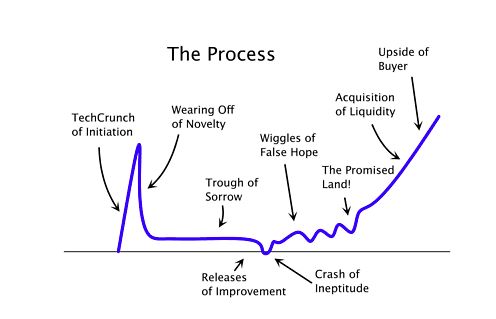
Many people think startups are up and to the right all the time. But more exhibit this startup curve than any other growth pattern. Of course, some never get past the “trough of sorrow”. But many do. Mostly by staying focused on the problem they are trying to solve and working diligently to get to the promised land.
Would love to hear some thoughts on this from today’s entrepreneurs!
“Your work is going to fill a large part of your life, and the only way to be truly satisfied is to do what you believe is great work. And the only way to do great work is to love what you do.”

You must be logged in to post a comment.