As the Multi-Unit Franchising Conference comes to a close, I’ve found myself reflecting on the conversations shared with me from a number of attendees…
Because over the past few days, I’ve shared a different perspective.
That multi-unit is not the destination. It’s the transition.
That multi-brand is not simply growth. It’s a shift in mindset.
And that the real evolution in franchising isn’t measured by how many units you own…
It’s defined by how you think.
Operator → Entrepreneur Execution → Strategy Units → Enterprise
That’s the progression.
And yet…
Most never make that shift deliberately.
They scale within a system. But rarely step back to design one.
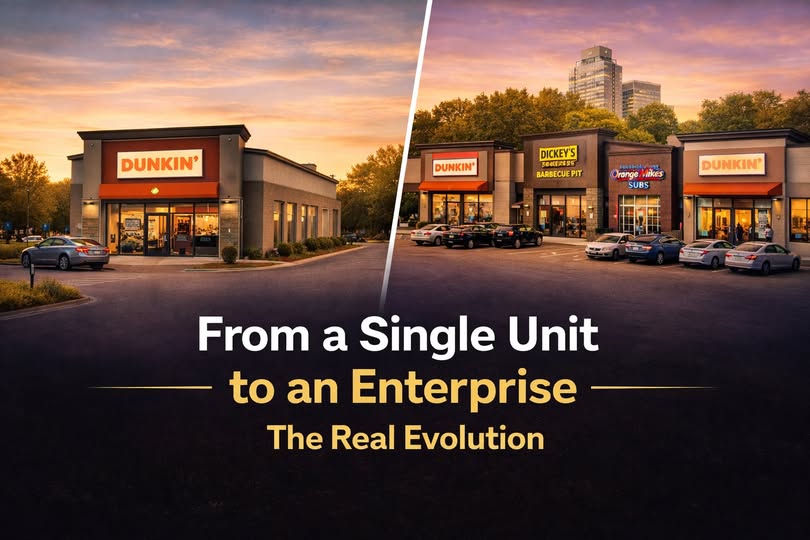
The image I’ve shared says it simply:
From a single unit… to an enterprise.
But what’s not visible is the decision that happens in between.
The moment when you stop asking: “How do I grow this brand?”
And start asking: “What am I actually building?”
That’s where everything changes.
So let me ask you—
Coming out of this week…
Where do you see the real opportunity?
Is it continuing to scale within a brand you know well? Or is it stepping back and building something broader, more intentional, more enterprise-driven?
At what point does focus become limitation?
At what point does experience in one brand create the confidence—or the obligation—to think beyond it?
And for those who have already made the move…
What triggered it?
Opportunity? Frustration? Vision? Or necessity?
No right answer.
But it is a very different conversation depending on how you see it.
Over the past few days, I’ve shared thoughts on: • Multi-unit franchising • Multi-brand franchising • And where the real inflection point actually is
If you’ve been following along, I’d genuinely value your perspective.
Where are you in that journey?
And if this conversation resonates, if you’re at that point where growth needs to become more intentional, more structured, more strategic—
Let’s talk.
I’m working with operators, investors, and franchisors who are navigating this exact transition… from units to enterprise, and with refranchising in the mix.
Reach out to me directly at paul@acceler8success.com to start the conversation and explore what a deliberate, strategic growth plan could look like for you.
Franchise development is not a sales goal. It is not “we want to sell 15 units in the next 12 months.” That statement is a wish. It may be an aspiration. It may even be a board-level mandate. But it is not a strategy.
If franchise development is not integrated into the broader business plan of the brand, it becomes expensive guesswork. And guesswork in franchising is one of the fastest ways to create brand damage that takes years to unwind.
Franchise development must begin with a far more uncomfortable question than “How many units do we want to sell?” The real question is, “How many units should we sell, in which markets, with what profile of operator, supported by what infrastructure, and at what pace that protects unit economics and franchisee performance?”
Growth without alignment is not growth. It is exposure.
The Development Plan Must Be Anchored to the Business Plan
If a brand’s three-year business plan calls for strengthening supply chain efficiencies, building regional density in two priority markets, and improving average unit volumes by 8%, then the franchise development plan must directly support those objectives.
Development cannot live in isolation from operations, training, marketing, real estate, and field support. If you sell 15 units into markets where you have no operational infrastructure, you have not accelerated the brand. You have stretched it.
Every development plan should answer:
Where are we growing geographically and why?
Do we have the operational support structure in place for that growth?
Is our supply chain ready for increased volume?
Can our training department onboard the number of franchisees we intend to award?
What does growth do to our existing franchisees’ territories, performance, and morale?
If development is outpacing support, the math will catch up with you.
Understanding the Numbers Is Not Optional
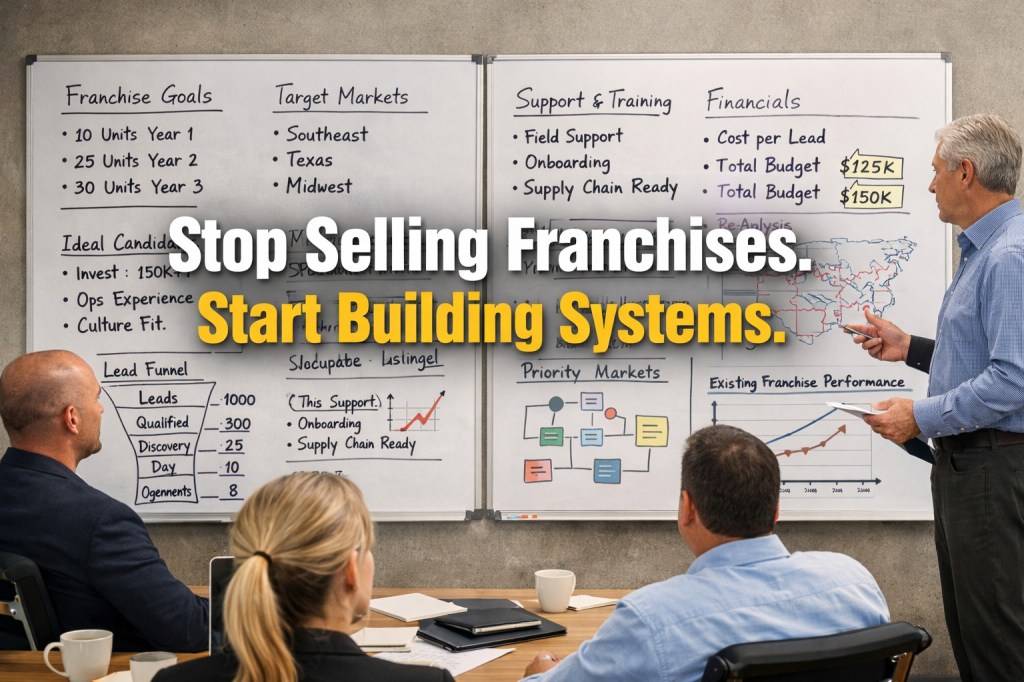
Franchise development is a funnel. A measurable, trackable, predictable funnel.
If you do not know how many raw leads convert to qualified candidates, how many qualified candidates convert to Discovery Day attendees, how many Discovery Days convert to awards, and how many awards actually open, you are not managing development. You are hoping.
Let’s say historically you know:
1,000 raw leads 300 qualified conversations 75 serious candidates 25 Discovery Days 10 franchise agreements 8 openings
That is a 0.8% lead-to-opening ratio.
If your goal is eight openings in the next 12 months and your historical performance holds, you need approximately 1,000 quality leads. Not impressions. Not clicks. Leads.
Now the next question becomes: what does it cost to generate 1,000 qualified leads?
If your blended cost per lead is $125, that is $125,000 in lead generation investment before factoring in internal development team compensation, CRM systems, travel, legal, and onboarding costs.
If you do not understand this math, your “15 units this year” target is not a plan. It is a number written on a whiteboard.
Not All Lead Sources Are Equal
Another mistake brands make is assuming that one lead source behaves the same as another.
Portal leads may convert at one rate. Expo leads at another. Referral leads from existing franchisees at a much higher rate. Broker networks at yet another. Social media may not convert directly at all, but it may increase credibility and lower friction at later stages of the funnel.
For example:
Expo leads may be fewer in volume but higher in intent. Portal leads may be high in volume but lower in qualification. Referral leads often have the highest closing ratios. Broker-referred candidates may close faster but at higher commission cost.
Social media, PR, and thought leadership content may not produce measurable leads immediately, but they strengthen brand perception, which improves conversion across the entire funnel.
A development strategy must identify:
Which channels generate volume Which channels generate quality Which channels support credibility Which channels reduce overall acquisition cost
Each channel has a role. None should be arbitrary.
Development Is Also a Financial Model
Too often, money is thrown at franchise development because “we need to sell X franchises by X date.”
That mindset is dangerous.
Franchise development must be budgeted like any other investment initiative. If your franchise fee is $45,000 and your average total development cost per award is $18,000, you must determine whether your net economics support reinvestment into brand infrastructure.
Selling franchises to fund operations is not a long-term strategy. It is a short-term survival tactic that erodes brand integrity.
Development revenue should support:
Operational field support expansion Training capacity Marketing infrastructure Technology systems Leadership depth
If franchise fee revenue is being used to plug operational losses, growth will eventually expose structural weaknesses.
The Impact on Existing Franchisees
Every franchise awarded changes the system.
Existing franchisees are watching. They evaluate new development based on three silent questions:
Will this strengthen the brand? Will this dilute my territory or my sales? Will corporate still support me with the same intensity?
If development outpaces performance, current franchisees lose confidence. When that happens, validation weakens. And when validation weakens, development slows.
The healthiest franchise systems grow in a way that improves franchisee economics. New units create brand awareness, increase regional advertising efficiency, improve supply chain leverage, and create multi-unit operators who understand the system.
But poorly planned growth creates cannibalization, operational strain, and cultural dilution.
Development must protect the ecosystem.
Territory Strategy and Profile Discipline
Another common failure is awarding franchises to anyone with a checkbook.
Development must define the ideal operator profile. Not just financially qualified, but culturally aligned and operationally capable.
Are you seeking owner-operators? Multi-unit developers? Semi-absentee investors? Strategic regional operators?
Each requires different onboarding, different support structures, and different performance expectations.
Territory strategy matters just as much. Growth should create density. Density reduces marketing cost per unit, improves operational efficiency, and strengthens brand awareness.
Scattered growth across isolated markets may generate franchise fees, but it rarely creates long-term system strength.
Support After the Sale
Awarding a franchise agreement is not success. Opening successfully and achieving unit-level performance benchmarks is success.
Your development plan must be aligned with your onboarding capacity. If you award 20 units but can only properly support 10 openings, your pipeline becomes congested and franchisee frustration builds.
Field support ratios matter. Training schedules matter. Real estate timelines matter.
Development should be paced according to operational readiness, not optimism.
Development Must Be Deliberate
Franchise development is not about selling. It is about building.
It requires:
Clear geographic priorities Defined operator profiles Documented funnel metrics Understood cost per lead Blended channel strategy Infrastructure readiness Alignment with financial objectives Respect for existing franchisees
When development is deliberate, growth compounds. When it is reactive, growth destabilizes.
Franchise brands that succeed long term treat development as a strategic discipline. They understand the math. They respect the operational realities. They align growth with infrastructure. They protect franchisee economics.
Planning must be more than wishes, hopes, and dreams.
It must be anchored in numbers, supported by structure, and integrated into the entire enterprise.
Because in franchising, growth is not the objective.
Sustainable, profitable, system-wide performance is.
Have you built a development strategy or simply set a sales goal? If this all sounds uncomfortably familiar, it may be time to reassess your development strategy.
Franchise development should be engineered, not improvised. It should be grounded in numbers, supported by operational capacity, aligned with your long-term valuation objectives, and protective of existing franchisees.
If you are ready to pressure-test your development funnel, clarify your cost-per-lead economics, align growth with infrastructure, and build a strategy that supports sustainable performance, let’s have that conversation.
Reach out directly at paul@acceler8success.com and let’s discuss how to move from selling franchises to building a system worthy of scale.

You must be logged in to post a comment.