Why Local Franchise Brands, clustering, and deliberate franchising will define the future of entrepreneurship.
There’s a hard truth in franchising that too often gets ignored: you don’t build a national brand first and hope it works locally… you prove it locally first, then earn the right to grow. And yet, across the industry, the instinct to scale continues to outpace the discipline to validate. It raises an uncomfortable but necessary question: Have we, in many cases, confused expansion with success?
Why is it that so many brands feel compelled to franchise before they have truly earned the right to do so? Why is growth still so often measured by the number of units sold rather than the strength of the markets built? Why do we continue to see systems introduced into franchising with limited operating history, incomplete infrastructure, and unproven economics, only to watch them struggle under the weight of their own ambition?
Developing as a local brand should not be viewed as a temporary stage on the way to something bigger. It should be the strategy. Not because it is easier, but because it is harder and because it forces the kind of discipline that sustainable growth demands. The alternative, launching into franchising with the expectation that the model will somehow refine itself across multiple markets, is not strategy at all. It is hope. And hope, no matter how well intentioned, has never been a substitute for execution.
The local-first approach changes the entire trajectory of a brand. It shifts the focus from expansion to establishment, from projection to proof, from vision to validation. It asks a brand to answer the questions that truly matter before asking others to invest in the answers. What actually drives revenue? Where do margins hold, and where do they break? What does it take to deliver a consistent customer experience day in and day out? How does the operation perform not once, but repeatedly, under real-world conditions?
These are not theoretical exercises. They are realities that can only be understood through time, repetition, and pressure. And that is where the concept of clustering becomes not just relevant, but essential. The goal is not to open as many locations as possible in as many places as possible. The goal is to build density within a market, to create presence, to become known. There is a profound difference between a brand that has one location in five cities and a brand that has five locations in one city. The former is visible. The latter is embedded.
And this leads to a question that challenges one of the industry’s most common assumptions:
Who says a brand must expand nationally to be successful?
Who cares if a brand doesn’t expand nationally if it is able to saturate a local market?
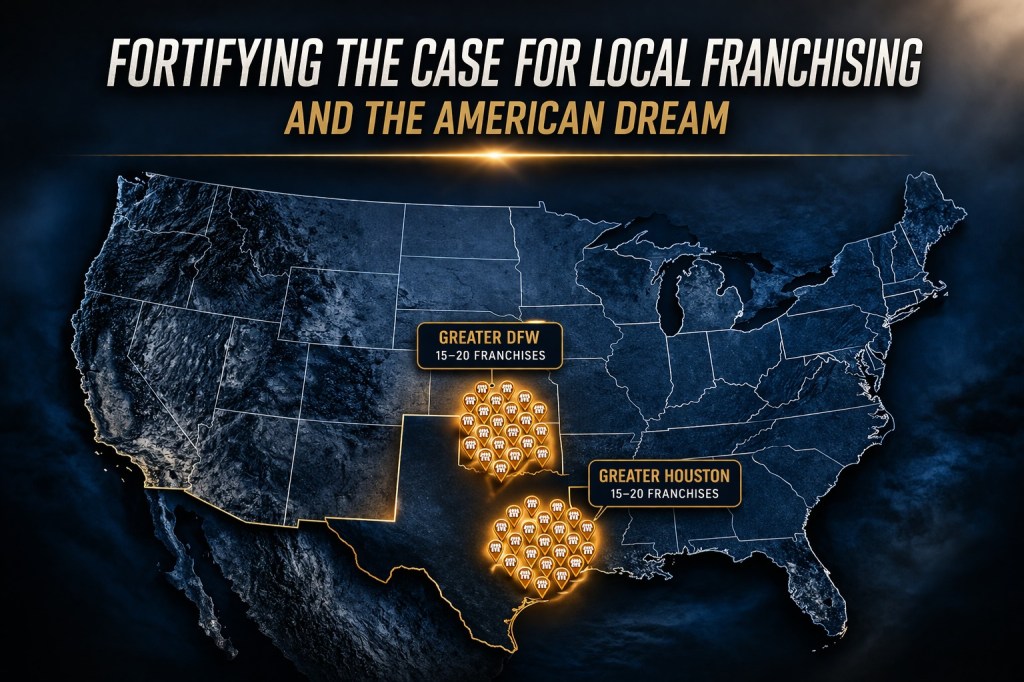
Is having 20 units scattered across 15 states better than having twenty across the Greater Houston Area?
Think about the ability to support those franchisees.
Think about the strength of brand awareness.
Think about marketing efficiency and local dominance.
Think about operational consistency and leadership accessibility.
And then think about what comes next.
Because once a brand truly owns a market, once it has built density, awareness, and operational strength, it is no longer guessing how to grow. It has a blueprint.
So what happens when that same model is taken from Houston to Dallas?
What happens when another 15 to 20 units are developed with the same discipline, the same clustering strategy, the same focus on saturation before expansion?
Isn’t that a far more powerful form of growth?
And can you get any more “local” than that?
When a brand builds in clusters, it accelerates learning in a way that scattered growth never can. Operational challenges are identified and addressed more quickly. Training systems are refined through repetition. Leadership is developed with intention. Marketing becomes more efficient, more targeted, more impactful. Most importantly, brand awareness begins to take hold. The business moves beyond being a place people try and becomes a place people return to, recommend, and rely on. It becomes part of the community
A Local Franchise Brand is not defined by how many units it has, but by how deeply it has penetrated its market. It is defined by whether the community recognizes it, trusts it, and supports it. It is defined by whether the operation performs consistently across multiple locations and whether the infrastructure exists to support continued growth without compromising quality. If those elements are not yet in place, then the question must be asked, why expand?
Too often, franchising is treated as a milestone, as if the act of franchising itself somehow validates the concept. But franchising is not validation. Validation comes first. It comes from building something that works, something that holds up under pressure, something that can be repeated with confidence. Only then does franchising become what it is meant to be, a multiplier of success, not a mechanism for discovering it.
This is where the transition from Local Franchise Brand to Emerging Franchise Brand truly occurs. It is not triggered by reaching a certain number of units or entering a certain number of markets. It happens when a brand has developed the strength, the systems, and the self-awareness to replicate itself intentionally. When it can take what has been built in one market and apply it, with discipline, to another. When it understands not just what it does, but why it works.
At that point, expansion is no longer a gamble. It is a strategy.
And in this moment, that strategy carries even greater significance. As we move into Q2 2026, we find ourselves just one quarter away from America’s 250th birthday. It is a milestone that, at its core, represents far more than history. It represents the spirit of entrepreneurship that has defined this country from the beginning, the belief that individuals can build something of their own, create opportunity, and contribute to their communities in meaningful ways.
But it also forces us to confront a difficult reality. Is that dream still as accessible as it once was? Or is it, as many have suggested, slipping out of reach?
Just yesterday, March 31, 2026, JPMorgan Chase announced its American Dream Initiative, an expansion of its commitment to local economic opportunity, with a goal of helping 10 million small businesses thrive. As Jamie Dimon stated, “The American Dream is alive, but it’s slipping out of reach for too many people—and for future generations.” That observation is not just economic. It is deeply entrepreneurial. Because access to business ownership, particularly at the local level, remains one of the most powerful pathways to restoring that dream.
And this is precisely where International Franchise Association’s Franchising Means Local Initiative takes on even greater importance.
Franchising has always been local, but the industry doesn’t always act like it.
Every franchise location is locally owned. Every franchisee is part of their community. Every unit creates jobs, supports local economies, and contributes to the neighborhoods they serve. The IFA’s initiative reminds us of that truth.
But Local Franchise Brands live it from the beginning.
They don’t just operate locally.
They are built locally.
And when they scale through clustering and disciplined expansion, they don’t lose that local identity—they replicate it, market by market.
This is where Acceler8Success America is leaning in with intention.
There is a continued push to elevate Local Franchise Brands, to support local business growth, and to drive a resurgence of economic activity across Small Town USA. But just as importantly, there is a focus on strengthening brands before they scale.
Because what happens if a brand expands before its culture is clearly defined?
What happens if marketing lacks clarity and consistency?
What happens if sales are not driven by strategy?
What happens if profitability is not fully understood?
These are not minor issues. These are the fault lines where brands break.
Acceler8Success America is committed to helping local brands solidify their foundation, building the right culture, refining marketing to drive awareness and engagement, strengthening sales through disciplined execution, and improving profitability at the unit level.
Because growth does not fix weaknesses.
It magnifies them.
But when a brand gets this right locally, when it builds strength within a market, it creates something entirely different.
It creates a model that can be repeated.
So what if the industry shifted?
What if more brands focused on owning a market before entering the next?
What if franchising became the result of discipline, not the pursuit of it?
What if Local Franchise Brands became the standard?
Local Franchise Brands represent the American Dream in its most authentic and accessible form. They are built by individuals and families who take risks, who commit to their communities, who learn through doing. They are proven not through projections, but through performance. And when they are developed with intention through clustering, through discipline, through a relentless focus on getting it right, they create a foundation that can be scaled without losing what made them successful in the first place.
Each new market becomes more than expansion.
It becomes an extension of the American Dream.
So the question remains: Are we building franchise systems for growth, or are we building them for longevity?
Because those are not always the same thing.
Local should not be where a brand starts because it has to. It should be where it starts because it is the most effective way to build something that endures. Build locally. Develop clusters. Earn awareness. Prove the model. Strengthen culture. Refine marketing. Drive sales. Improve profitability. Then—and only then—scale with intention.
That is how Local Franchise Brands evolve into Emerging Franchise Brands.
That is how we align with Franchising Means Local not just in message, but in practice.
That is how we practice deliberate franchising.
And that is how we accelerate the American Dream.
If you are exploring franchise development or refranchising, or questioning whether your brand is truly ready to grow, now is the time to take a disciplined approach, one that aligns national ambition with local execution. At Acceler8Success America, the focus is clear: take what is often approached broadly at a national level and hyper-focus it locally, building real strength before scaling, while strengthening culture, elevating marketing, driving sales, and improving profitability where it matters most.
Start the conversation at paul@acceler8success.com.

You must be logged in to post a comment.