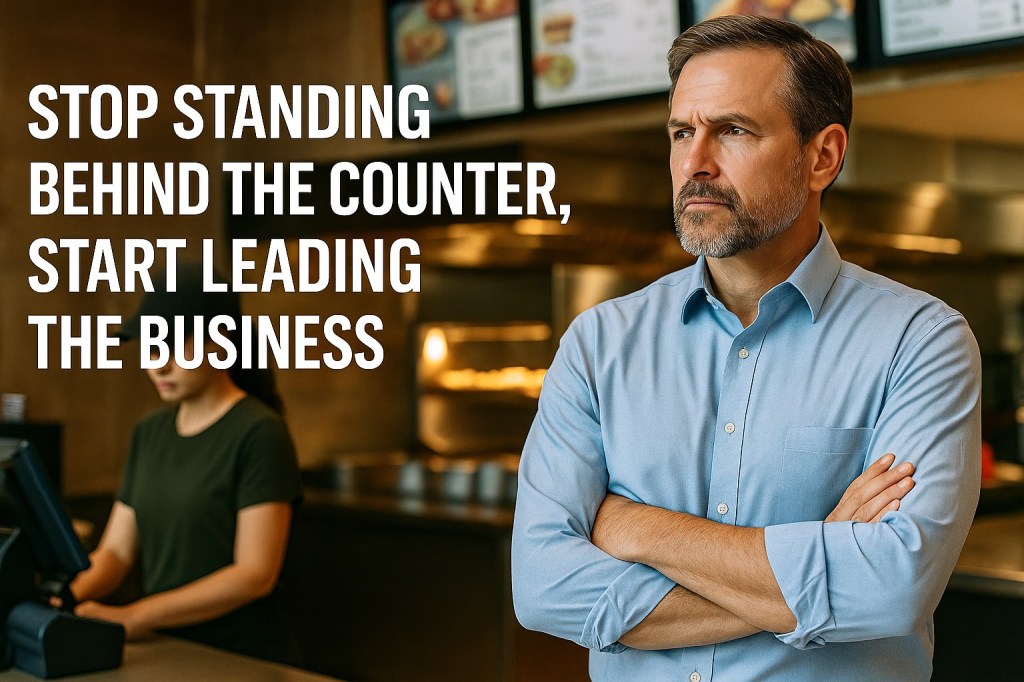
Franchise systems succeed when franchisees succeed, yet one of the most common and costly missteps within franchising is how often owners spend the majority of their time working inside their business instead of on it. Franchisors have an opportunity — and an obligation — to train franchisees to understand the difference. It begins with a simple but powerful question: should a franchisee take on what effectively becomes a $15-per-hour position within the business, or should they lead the business to maximize profitability, growth, scalability, and asset value?
For years, the belief was that franchisees needed to be hands-on, shoulder-to-shoulder with their team, immersed in day-to-day operations to stay connected to challenges. That argument still surfaces today. It is often said that working in the business keeps a franchisee tuned in to what customers expect and what employees need. However, there is a counterargument that cannot be ignored — and it is far more aligned with long-term success. When a franchisee becomes absorbed in daily tasks, they risk losing strategic perspective. They may become excellent at frontline responsibilities, but less effective at leadership, management, marketing, financial oversight, and growth. Essentially, they cannot see the forest for the trees.
This issue often reveals itself early in the franchisor’s training process. Many systems teach franchisees how to run the business but fall short in teaching them how to lead the business. Training is heavily weighted toward operations, checklists, recipes, service steps, or POS procedures. While these are critical, they can inadvertently reinforce the franchisee’s instinct to jump behind the counter, perform tasks, and fill shifts. The outcome is predictable. Franchisees become the highest-paid hourly employees in their own business, stretched thin, exhausted, and unable to make the kinds of decisions that actually grow revenue or profitability.
What franchisors must teach — and reinforce continuously — is the discipline of working smarter. Franchisees must understand that their responsibilities cannot be delegated, while most operational tasks can and should be. Their value lies in building people, tightening systems, driving marketing, analyzing financials, improving culture, and increasing customer lifetime value. When they step back from the front line and step into leadership, the business scales beyond their physical presence. That is where true profitability is found.
The challenge, of course, is mindset. Many franchisees come from corporate roles, operations-heavy backgrounds, or first-time entrepreneurial experiences where doing equals progress. Their instinct is to stay busy, to be seen, to jump in wherever help is needed. If they come from a customer-facing business, they often believe their personal involvement is what drives customer experience. But franchisors must help them see that their real job is not to ring the register but to build a business that rings without them.
This shift begins with training that emphasizes leadership over labor. Scenario-based learning, financial modeling, staffing strategies, task delegation frameworks, and metrics-driven management must take center stage. Franchisees should leave training not only knowing how to operate the business, but knowing how to create an environment where employees can operate the business successfully. Franchisors must explain the opportunity cost: every hour spent on a frontline task is an hour not spent growing the top line, improving margins, strengthening teams, or expanding to additional units.
There is also the matter of visibility. Some franchisees argue that working inside the business keeps them connected to daily challenges, employee morale, and customer behavior. That is valid to a point, but it becomes problematic when it replaces strategic leadership. Franchisors should teach franchisees how to maintain visibility without sacrificing their role. Scheduled floor time, structured observation periods, listening tools, weekly team meetings, and performance dashboards provide insight without trapping the owner inside daily operations.
Ultimately, the franchisee’s highest and best use is leadership. They must set the tone, drive accountability, build a culture of execution, and ensure compliance with brand standards. These responsibilities cannot be outsourced to a $15-per-hour employee. They also cannot be fulfilled effectively when the franchisee is constantly running registers, prepping product, or filling shifts. Leadership requires elevation, and franchisors must help franchisees understand the value of stepping into that role.
Training is the foundation of that shift. When franchisors prioritize teaching franchisees to think like leaders, act like strategists, and operate like business owners, everything changes. The franchisee becomes more profitable. The location becomes better run. The brand becomes stronger. And the system becomes more sustainable. Working on the business is where growth happens, where opportunities are recognized, and where long-term success is built.
Franchisees who embrace this philosophy discover that their business doesn’t depend on their physical presence to succeed — only their leadership. And that is the difference between owning a job and owning a scalable enterprise. For franchisors, the more effectively they train franchisees to work smarter, not harder, the stronger their entire network becomes.
About the Author
Paul Segreto brings over forty years of real-world experience in franchising, restaurants, and small business growth. Recognized as one of the Top 100 Global Franchise and Small Business Influencers, Paul is the driving voice behind Acceler8Success Café, a daily content platform that inspires and informs thousands of entrepreneurs nationwide. A passionate advocate for ethical leadership and sustainable growth, Paul has dedicated his career to helping founders, franchise executives, and entrepreneurial families achieve clarity, balance, and lasting success through purpose-driven action.
About Acceler8Success America
Acceler8Success America is a comprehensive business advisory and coaching platform dedicated to helping entrepreneurs, small business owners, and franchise professionals achieve The American Dream Accelerated.
Through a combination of strategic consulting, results-focused coaching, and empowering content, Acceler8Success America provides the tools, insights, and guidance needed to start, grow, and scale successfully in today’s fast-paced world.
With deep expertise in entrepreneurship, franchising, restaurants, and small business development, Acceler8Success America bridges experience and innovation, supporting current and aspiring entrepreneurs as they build sustainable businesses and lasting legacies across America.
Learn more at Acceler8SuccessAmerica.com
 Some time back, posted on LinkedIn was a discussion about franchising that generalizes negative franchise experiences, places blame for the experiences on “improper practices” and ultimately forces the franchise community to defend its practices, and ultimately, its integrity. My question is, “When do franchisees take responsibility for their own actions, or in many cases, their own in-actions?”
 After what many franchise professionals claim was a tough couple of years,
  Since then, Lizette introduced me to her
You must be logged in to post a comment.