When development of a business to a franchise brand begins with gimmicks, inflated promises, and manufactured excitement, the people who ultimately pay the price are often the future franchisees who believed the story.
There is something deeply troubling about the way franchising is increasingly marketed to independent business and restaurant owners. Instead of beginning with the difficult but necessary question—Is this business truly ready to be franchised?— too many conversations begin with a sales pitch. A restaurant generating $1 million in annual revenue is suddenly described as a potential $3 million franchise brand, as though a multiple pulled from the air can transform one successful location into a scalable enterprise. Another seductive claim suggests that an owner can go from one location to a multimillion-dollar exit simply by converting the business into a franchise, as though declaring an intent to scale automatically creates enterprise value, qualified buyers, or a future transaction. Business owners are invited to enter contests to “win” a franchise launch package, as if creating a franchise system were comparable to winning a website makeover or a year of free advertising. Franchising is promoted as a low-risk, low-capital way to expand, while the enormous obligations that come with becoming a franchisor are minimized, glossed over, or omitted altogether. There are countdowns, limited-time offers, discounted development packages, financing hooks, promises of rapid national growth, and images of maps filling with territories. The message is designed to excite. It is designed to flatter. It is designed to make the business owner believe that the next logical step is not merely expansion, but franchising… and that anyone questioning the timing may simply lack vision. At some point, however, we must ask whether it is really necessary to sell entrepreneurs on franchising this way. If a business is genuinely prepared to become a franchise system, why should gimmicks be necessary at all?
The truth is that franchising is not a prize, a promotion, a valuation shortcut, or a magical conversion of one operating business into a multimillion-dollar brand. A million-dollar restaurant is a restaurant with a million dollars in sales. That fact alone tells us very little about profitability, cash flow, owner dependence, management depth, unit economics, transferability, market demand, operational consistency, or whether the concept can produce acceptable returns for an unrelated owner in another market. It certainly does not establish that the business is worth three times its revenue simply because someone packages it as a franchise. Nor does one franchised location, or even a handful of them, create a multimillion-dollar exit. A meaningful exit requires durable royalty revenue, healthy franchisee economics, responsible growth, brand strength, reliable systems, capable leadership, clean legal and financial records, and a buyer who believes those advantages will endure without the founder. Until those elements exist, the promised exit is not a valuation; it is a marketing story about a transaction that may never occur.
A business may be successful because of its founder’s personality, relationships, instincts, reputation, location, work ethic, or constant personal involvement. Those qualities can make an excellent local business, but they are not automatically transferable. Franchising requires the founder to turn experience, judgment, and daily improvisation into a documented and teachable system that another person can execute. It requires the economics to work not only for the original owner, but for a franchisee who must pay an initial fee, royalties, marketing contributions, financing costs, occupancy expenses, opening costs, and often a higher total development cost than the founder ever faced. If the concept cannot survive that added economic burden while still providing the franchisee with a reasonable opportunity to build a sustainable business, then it is not ready to be franchised… regardless of how attractive its sales volume may look in a headline.
Yet the franchise-system-development marketplace often rewards speed over readiness. The entrepreneur is told that franchising allows expansion using other people’s capital, but is not told nearly enough about the corresponding duty attached to accepting that capital. The founder hears about collecting franchise fees and royalties, but not about the cost of recruiting responsibly, training effectively, supporting consistently, protecting the supply chain, monitoring compliance, investing in technology, developing marketing resources, maintaining the franchise disclosure document, managing the franchise relationship, and helping franchisees navigate inevitable operational challenges. The founder is encouraged to imagine dots appearing on a national map, but not to calculate the infrastructure required to support those dots. “Low risk” may describe the franchisor’s reduced need to finance every new location directly, but it does not describe the risk transferred to the franchisee who may invest savings, pledge a home, sign a lease, take on an SBA-backed loan, or personally guarantee hundreds of thousands of dollars. Franchising does not eliminate risk. It distributes risk, and too often, it concentrates the most devastating financial and personal consequences on the party with the least control over the system.
The contest model may be one of the clearest examples of how misplaced the industry’s priorities have become. What exactly does it mean to “win” a franchise launch package? Does the winner also receive proven unit economics, tested systems, experienced leadership, sufficient working capital, a support team, a defensible market position, franchisee recruitment standards, and the willingness to remain accountable for years? Of course not. At best, the winner receives a collection of documents, branding, consulting hours, and development services. Those things may be necessary components of building a franchise offering, but they do not make the underlying business franchisable. Legal documents can disclose a system; they cannot create one. An operations manual can record processes; it cannot prove they work across different owners and markets. A polished franchise sales website can attract candidates; it cannot ensure that the opportunity deserves their investment. When the packaging comes before the proof, the industry risks manufacturing franchisors instead of developing franchise systems.
The likely outcome is rarely included in the promotional message. The prospective franchisor is shown the possibility of becoming the next nationally recognized brand, but not the much greater possibility of remaining a very small franchise organization, perhaps with only a handful of units sold to existing customers, friends, relatives, employees, or people already emotionally connected to the founder. There is nothing inherently wrong with a small franchise system if it is healthy, adequately supported, economically sound, and honestly represented. The problem arises when a modest local concept is sold a vision of rapid scale that bears little relationship to its capitalization, market appeal, leadership capability, or readiness. Too many emerging brands sell several franchises, struggle to open them, lack the revenue to build support infrastructure, and then enter a dangerous cycle: they need more franchise fees to fund the obligations created by the franchises already sold. Franchise sales become the source of operating cash rather than the result of a strong and sustainable system. Growth is no longer strategic; it becomes a means of survival.
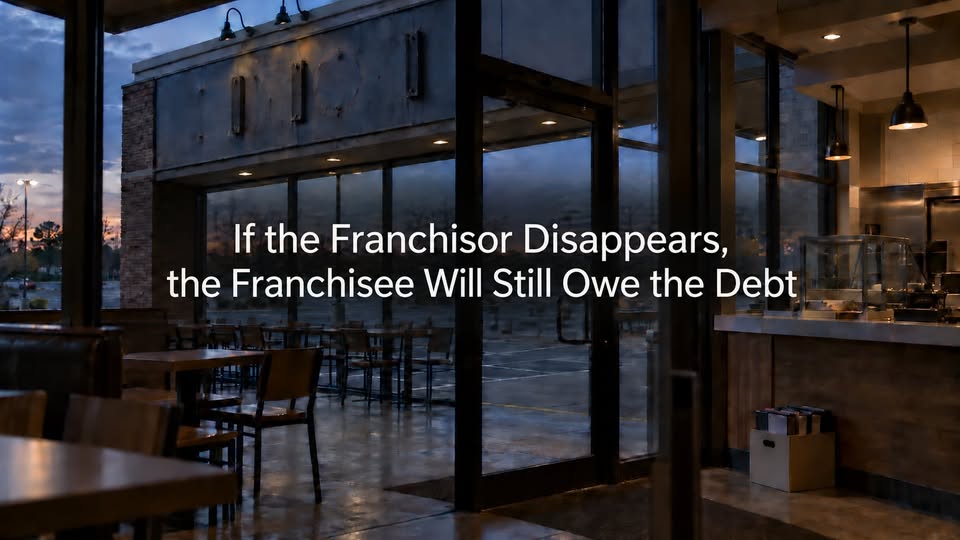
When that cycle collapses, the franchisor may close, dissolve, stop answering calls, cease providing support, or simply disappear. The franchisees, however, do not disappear with it. They remain responsible for their leases, loans, payroll, vendor obligations, equipment financing, and personal guarantees. They may still have signs on their buildings, branded materials in their stores, proprietary products they can no longer obtain, technology systems that no longer function, and customers who assume the brand continues to stand behind the business. In some cases, franchisees continue flying the flag long after the franchisor has vanished in the night, not because the system remains viable, but because removing the name, converting the business, or closing the doors would require money they no longer have. The public may see an operating location and assume the franchise system still exists. The franchisee knows otherwise. They are operating inside the shell of a promise.
I raise this issue not as a theoretical concern, nor as someone opposed to franchising. Quite the opposite: I have spent decades in and around franchising, and I believe deeply in what a responsible franchise relationship can accomplish. I raise it because we are currently working with several franchisees whose franchisors disappeared during the earliest stages of their systems. These franchisees did not merely lose the benefit of an aspirational brand story. They were left with hundreds of thousands of dollars in debt and, in some instances, without even the basic premise of a functioning business. The systems, resources, products, support, or infrastructure upon which their investments depended were never adequately delivered or simply ceased to exist. One of these franchisees has filed for bankruptcy while another is now contemplating the same. The third is considering his options. Behind these franchisees are families, homes, retirement savings, damaged credit, strained marriages, sleepless nights, and years of financial recovery. Those realities should be present in every serious conversation about franchise system development, because they are the consequences when a franchise is sold before a system is ready or when people who know better choose promotion over responsibility.
This is also where the industry must confront an uncomfortable truth: compliance does not necessarily equal integrity. A franchise disclosure document may satisfy the technical requirements of disclosure and still describe a weak, undercapitalized, or unproven system. A franchisor may comply with the required waiting period and still exert enormous emotional pressure on a candidate. A development firm may complete every item in its contracted package and still leave behind a founder with no realistic ability to recruit, open, train, support, or retain franchisees. Attorneys, consultants, brokers, sales organizations, lenders, suppliers, and marketers can each perform their narrow function while the broader venture remains fundamentally unsound. When everyone is paid for completing a transaction or advancing a launch, but no one is accountable for asking whether the launch should occur, the process itself becomes part of the problem.
What must change begins with replacing persuasion with qualification. The first phase of any franchise-system-development engagement should be a rigorous readiness assessment conducted before the founder is sold legal documents, marketing campaigns, lead-generation programs, or franchise sales services. That assessment should examine profitability and cash flow at the unit level; whether compensation for an owner-operator has been properly accounted for; the performance of more than one location when possible; the degree of founder dependence; the repeatability of operations; supply-chain stability; management capacity; technology; training requirements; market differentiation; franchisee capitalization needs; and the likely economics after all franchise-related fees and expenses are included. It should also assess the founder personally. Does this individual genuinely want to support other business owners, or merely want to expand the brand? Can the founder accept accountability, share control, communicate consistently, resolve conflict, and invest ahead of royalty revenue? Becoming a franchisor is not merely a growth strategy. It is an entirely new business built around supporting the success of franchisees.
The industry must also stop implying that every successful business should franchise now. For many founders, the most responsible recommendation may be to wait twelve, twenty-four, or thirty-six months. It may be to open a second or third company-owned location, stabilize margins, reduce dependence on the founder, document operations, strengthen management, build reserves, test another market, or correct weaknesses that the first location’s sales have concealed. For others, joint ventures, management agreements, company-owned expansion, strategic partnerships, or simply remaining an outstanding independent business may be the better path. Saying “not yet” or even “not through franchising” is not a failure of franchise-system-development. It is evidence of professional judgment. Any advisor who never advises a prospect not to franchise is not evaluating readiness; that advisor is selling a product.
Greater integrity also requires radical honesty about likely outcomes. Prospective franchisors should see more than best-case projections and stories of brands that reached hundreds of locations. They should understand how many emerging franchise systems remain small, how long responsible growth can take, what adequate support costs, how difficult qualified franchisee recruitment can be, and how little initial franchise fee revenue remains after commissions, onboarding, training, legal obligations, and opening support. They should be required to build conservative capitalization plans that do not depend on continuous franchise sales to remain solvent. They should establish contingency plans for supporting existing franchisees if sales slow or stop. Most importantly, they should understand that the first franchisees are not test subjects whose capital finances the franchisor’s learning curve. They are business owners who have relied upon the franchisor’s representations and entrusted a substantial portion of their financial future to the system.
Franchisee recruitment must change as well. The objective should not be to sell a territory to every candidate who qualifies financially. It should be to award a franchise only when the candidate, market, capitalization, expectations, and system are aligned. Salespeople and brokers should not be rewarded solely for completed transactions without regard to whether locations open, survive, and perform. Emerging franchisors should resist selling distant or scattered territories simply because a check is available. The first few franchisees require more support, not less, and their locations should ordinarily be close enough for the franchisor to observe, assist, learn, and respond. Controlled growth may not produce the dramatic map used in marketing presentations, but it creates something far more valuable: evidence that the system works beyond the founder’s original location.
There must also be clearer accountability across the franchise-system-development ecosystem. Those who promote franchise development should disclose how they are paid, what their services can and cannot accomplish, and whether their financial incentives depend on persuading a founder to proceed. Franchise brokers and sales organizations should evaluate the capitalization and support capacity of emerging brands before presenting them to candidates. Lenders should look beyond the existence of franchise documents and examine whether the franchisor has the infrastructure to deliver what the borrower’s business requires. Attorneys should continue to protect their clients legally, but the broader advisory team must ensure founders understand that disclosure is not the same as validation. No single participant can guarantee success, but every participant can refuse to help create the illusion that franchising is easy, fast, or inherently low risk.
If the industry does not correct these practices, the damage will not remain confined to individual failed brands. Every franchisee abandoned by an underprepared or vanished franchisor becomes a story shared with family members, employees, lenders, landlords, other entrepreneurs, journalists, regulators, and online communities. Each bankruptcy, lawsuit, shuttered location, and allegation of misleading promotion creates a ripple that reaches responsible franchise systems as well. Public perception rarely distinguishes neatly between a poorly conceived emerging franchise and franchising as a whole. Enough stories of people losing their savings under the banner of “business ownership with support” can erode confidence in the entire model. That erosion invites more negative publicity, greater skepticism, tighter financing, increased litigation, and potentially more aggressive regulation. Responsible franchisors will then bear part of the cost created by those who treated franchise development as little more than a marketing funnel.
Protecting the integrity of franchising does not require eliminating ambition, innovation, or emerging brands. It requires restoring seriousness to the decision. Franchising can be a powerful method of expansion when a proven business, properly capitalized franchisor, capable leadership team, disciplined growth strategy, and well-qualified franchisees come together in alignment. It can create generational wealth, local ownership, jobs, and enduring brands. But those outcomes are not produced by contests, inflated valuations, artificial urgency, or declarations that franchising is a low-risk shortcut to growth. They are produced by preparation, patience, transparency, capitalization, accountability, and an unwavering recognition that the franchisor’s decisions affect other people’s lives.
Final Thoughts
We do not need to become better at selling entrepreneurs on franchising. We need to become better at telling them the truth about it. We need to be willing to say that a strong business may not yet be a franchise, that high revenue does not automatically create transferable value, that expansion funded by franchisees is not the same as expansion without risk, and that the privilege of accepting another person’s investment creates a responsibility that extends far beyond signing an agreement. Before we help another starry-eyed business owner become a franchisor, we should ask whether the system is ready, whether the founder is prepared, whether adequate capital exists, and whether we would feel comfortable recommending the opportunity to someone investing our own family’s savings. If the answer is no, the franchise-system-development services should not be sold, packaged, launched, or given away as a prize. The integrity of franchising and the financial futures of the people who believe in it, demands nothing less.




 Between building a larger community network, adding an additional revenue stream and the plethora of other
You must be logged in to post a comment.