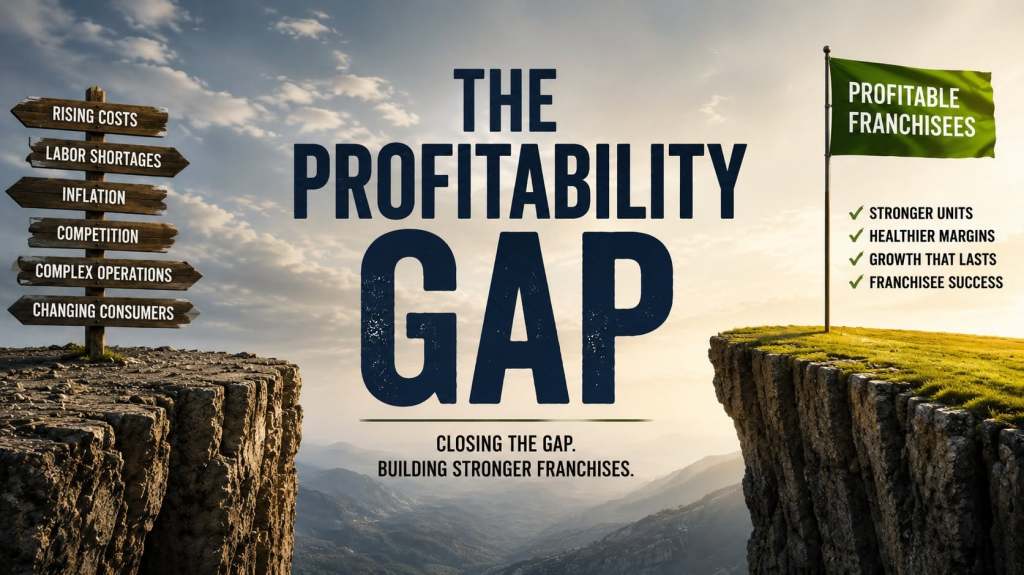
There was a time when franchising was often measured by one number: growth.
How many units were opened?
How many franchise agreements were signed?
How many new markets were entered?
Growth was the headline.
Today, however, the most important metric in franchising is not growth. It is not technology. It is not private equity investment. It is not brand awareness. It is not social media followers.
It is franchisee profitability.
Without profitable franchisees, growth eventually stalls. Without profitable franchisees, innovation becomes difficult. Without profitable franchisees, recruitment becomes harder, transfers increase, and franchise relationships become strained.
Franchisee profitability is not simply another metric. It is the foundation upon which every successful franchise system is built.
The New Reality
Today’s franchisees are operating in an environment unlike any we have seen before.
Labor costs continue to rise.
Insurance costs continue to increase.
Occupancy expenses are climbing.
Food and supply costs remain volatile.
Consumers are more value-conscious than ever.
Competition comes not only from traditional competitors but from emerging concepts, independent operators, delivery platforms, virtual brands, and changing consumer behaviors.
Many franchise systems are asking franchisees to do more while simultaneously facing greater pressure on margins.
The result is a simple but uncomfortable reality:
Revenue growth does not automatically translate into profit growth.
A franchisee can generate record sales and still struggle financially.
That’s why the conversation within franchise leadership teams must evolve.
The focus can no longer be solely on driving top-line revenue.
The focus must be on helping franchisees improve bottom-line profitability.
The Franchisee Success Equation
When franchisees are profitable:
➡️ They reinvest in their businesses.
➡️ They remodel locations.
➡️ They hire stronger teams.
➡️ They become multi-unit operators.
➡️ They renew franchise agreements.
➡️ They refer prospective franchisees.
➡️ They strengthen the culture of the brand.
When franchisees are not profitable:
⚠️ They delay investments.
⚠️ They cut corners.
⚠️ They become disengaged.
⚠️ They challenge system initiatives.
⚠️ They seek exits.
⚠️ They become critics rather than advocates.
In many ways, franchisee profitability is the ultimate report card for a franchisor.
Not because franchisors control every variable.
But because franchisees judge the value of the franchise system through one lens:
“Is this helping me build a better business and a better future?”
Questions Every Franchise Executive Should Ask
Perhaps the most important exercise for franchise leaders today is honest self-assessment.
Development
❓ Are we focused on awarding franchises or creating successful franchisees?
❓ Would we enthusiastically recommend our franchise opportunity to a close family member based on current franchisee performance?
❓ Are we recruiting franchisees who fit the system, or simply filling territories?
Operations
❓ What specific initiatives have we implemented in the last 12 months that directly improved franchisee profitability?
❓ How much operational complexity have we added to the system?
❓ Are we helping franchisees simplify and improve execution, or creating additional burdens?
Marketing
❓ Are our marketing programs generating measurable returns for franchisees?
❓ Are we driving profitable sales or simply driving transactions?
❓ If franchisees had complete discretion, would they continue investing in our marketing programs?
Technology
❓ Does every technology investment improve franchisee economics?
❓ Have we measured ROI from the franchisee perspective?
❓ Are we implementing technology because it solves a problem or because it is the latest trend?
Vendor Relationships
❓ Are vendor programs designed to maximize franchisee profitability or franchisor revenue?
❓ Are rebates and incentives aligned with franchisee success?
❓ Have we challenged vendors to find new ways to improve franchisee margins?
Leadership
❓ When was the last time senior leadership spent meaningful time inside a franchisee’s business?
❓ Do we truly understand the daily challenges franchisees face?
❓ Would franchisees describe us as partners or regulators?
The Ultimate Test
There is one question that may be more important than all the others.
Before implementing any initiative, franchise executives should ask:
“How will this improve franchisee profitability?”
Not eventually.
Not theoretically.
Not as a side benefit.
Specifically.
Directly.
Measurably.
If leadership teams consistently asked and answered that question, many decisions would look different.
Some initiatives would move forward faster.
Others might never leave the conference room.
Looking Ahead
The franchise systems that will thrive over the next decade will not necessarily be the largest.
They will be the systems that create the strongest economic outcomes for franchisees.
They will be the brands that recognize that franchisees are not simply customers of the franchisor.
They are business owners who have invested their savings, borrowed capital, taken risks, and entrusted part of their future to the brand.
Growth remains important.
Innovation remains important.
Technology remains important.
But all of those things should serve a greater purpose.
Helping franchisees build profitable, sustainable businesses.
Because at the end of the day, franchisees do not deposit brand awareness into the bank.
They do not pay their bills with unit counts.
They do not fund retirement with social media engagement.
They build wealth through profitability.
And when franchisees build wealth, franchise systems build strength.
A Challenge to Franchise Leaders
Imagine for a moment that your board of directors, investors, executive team, and franchisees all agreed that beginning tomorrow, the single most important measure of success for your franchise system would be franchisee profitability.
What would change?
Would your development strategy change?
Would your marketing priorities change?
Would your technology roadmap change?
Would your field support model change?
Would your vendor relationships change?
Would your franchisees notice the difference?
More importantly, would they feel the difference?
The answers to those questions may reveal whether your organization is truly aligned with long-term franchise success.
Because in franchising, sustainable growth is not created by selling more franchises.
It is created by helping existing franchisees become more successful.
Everything else follows.
Let’s Continue the Conversation
If you’re a franchisor, franchise executive, private equity group, franchise board member, or emerging franchise brand, I encourage you to take an honest look at your organization and ask a simple question:
Are we truly focused on franchisee profitability, or are we simply assuming it will take care of itself?
Over the course of my 40+ years in franchising, I have worked with franchise organizations ranging from emerging brands to some of the most recognized names in the industry. One thing has remained consistent:
The strongest franchise systems are those that never lose sight of the franchisee.
If your organization is looking to strengthen franchisee relationships, improve unit economics, increase system-wide profitability, or realign strategic priorities around franchisee success, I welcome the opportunity to discuss your goals and challenges.
Email me directly at paul@acceler8success.com to schedule a confidential conversation.
Together, we can explore what it takes to build a stronger franchise system by helping franchisees achieve greater success.

You must be logged in to post a comment.