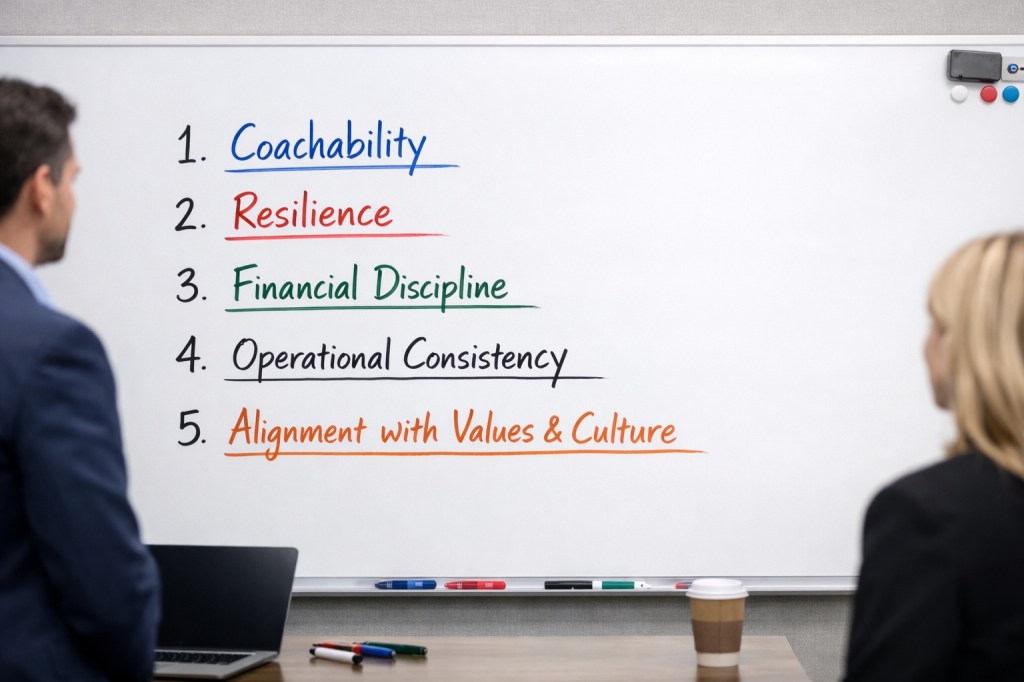
Franchise systems are often described as proven business models, but the most seasoned franchisors understand that the model itself is only half the equation. The other half is the individual who is granted the right to operate under the brand. Every new franchisee is not just opening a business; they are assuming custody of a reputation that may have taken decades to build. That reality elevates franchisee selection from a transactional process to a strategic responsibility with long-term consequences for the entire system.
The first trait franchisors should consistently seek is coachability. Franchising is built on the premise that there is a defined way to do things, yet many candidates enter the process believing their experience alone will carry them. Coachable franchisees demonstrate humility, curiosity, and a willingness to follow systems even when their instincts suggest otherwise. They understand that brand standards are not constraints, but safeguards. A franchisor must ask: is this candidate truly open to guidance, or are they simply nodding in agreement to get through the approval process? And when the honeymoon period ends, will they still be receptive to feedback that challenges their assumptions?
Resilience is the second indispensable trait. Every franchise system, regardless of maturity, encounters disruption. Labor shortages, supply chain issues, economic downturns, and local market challenges are not hypothetical; they are inevitable. Resilient franchisees do not internalize setbacks as personal failures, nor do they externalize blame. They remain engaged, solutions-oriented, and accountable. Franchisors should ask themselves whether a candidate has demonstrated perseverance in past ventures or whether they have a pattern of exiting when conditions become uncomfortable. How will this individual respond when the business underperforms projections for several consecutive months?
Financial discipline is the third core trait and one that is frequently misunderstood. Capital alone does not equate to financial maturity. Disciplined franchisees respect unit economics, manage cash flow conservatively, and understand the long game of reinvestment. They resist the temptation to overextend, underpay, or compromise quality to chase short-term relief. Franchisors should consider whether a candidate views the franchise as a system to be stewarded or a personal ATM to be optimized for immediate returns. What decisions will this franchisee make when faced with the choice between preserving cash and protecting the brand experience?
Operational consistency follows closely behind. Franchising depends on reliability, not brilliance. Customers choose franchise brands because they know what to expect, and that expectation must be met repeatedly across locations and markets. Franchisees who value consistency train diligently, measure performance, and respect procedures even when no one is watching. Franchisors must ask whether a candidate appreciates the discipline required to execute a system day after day, or whether they are prone to improvisation that may feel innovative but ultimately dilutes the brand. How much variation is too much, and who bears the cost when consistency erodes?
Alignment with brand values and culture rounds out the top five traits. Culture is not a poster on the wall; it is reflected in daily decisions, employee treatment, customer interactions, and community engagement. Franchisees who align with the brand’s values strengthen trust across the network and become informal leaders within the system. Those who do not may technically comply while quietly undermining the spirit of the brand. Franchisors should ask whether this candidate represents the brand they want replicated dozens or hundreds of times. If every franchisee behaved the same way, would the brand be stronger or weaker?
For franchisees aspiring to multi-unit ownership, these traits become even more consequential, but additional qualities emerge. Strategic thinking is essential, as multi-unit operators must understand how decisions scale and how systems perform across multiple locations. Leadership replaces individual effort as the primary driver of results, requiring the ability to recruit, develop, and retain capable managers. Delegation becomes a necessity rather than a preference. Franchisors should ask whether a candidate can transition from operator to leader without losing control or clarity. Is this individual prepared to build infrastructure, or are they simply accumulating units without a scalable plan?
When a promising candidate is missing one or two traits, franchisors face a critical judgment call. Not every deficiency should result in rejection, but none should be ignored. Coachability can sometimes be developed through structured onboarding and mentoring. Financial discipline can be reinforced with education, reporting, and accountability. What matters is whether the candidate acknowledges the gap and demonstrates a genuine commitment to growth. Franchisors must ask whether they are prepared to invest the time and resources required to close that gap, and whether the system is equipped to support that development.
Unaddressed gaps, however, can become systemic risks. A franchisee who lacks resilience may disengage during challenging periods, increasing the burden on support teams and creating instability within the network. A financially undisciplined operator may fall out of compliance, strain relationships with vendors, or compromise brand standards in ways that affect neighboring franchisees. Over time, these issues can erode trust, create internal friction, and weaken the brand’s market perception. Franchisors should ask themselves whether tolerating a misalignment today creates a larger problem tomorrow.
The most effective franchisors approach franchisee selection and development with clarity and courage. They define the traits that matter most, assess them honestly, and address gaps proactively. They recognize that saying no to the wrong candidate is often an act of stewardship, not exclusion. Perhaps the most important question franchisors can ask is this: are we building a network of owners who can grow with the brand, protect it during adversity, and represent it with pride, or are we simply filling territories and hoping the system absorbs the risk?
Franchising succeeds not when every unit opens, but when every unit contributes positively to the whole. The traits franchisors prioritize today will shape the culture, performance, and resilience of the brand for years to come.
About the Author
Paul Segreto brings over forty years of real-world experience in franchising, restaurants, and small business growth. Recognized as one of the Top 100 Global Franchise and Small Business Influencers, Paul is the driving voice behind Acceler8Success Café, a daily content platform that inspires and informs thousands of entrepreneurs nationwide. A passionate advocate for ethical leadership and sustainable growth, Paul has dedicated his career to helping founders, franchise executives, and entrepreneurial families achieve clarity, balance, and lasting success through purpose-driven action.
About Acceler8Success America
Acceler8Success America is a comprehensive business advisory and coaching platform dedicated to helping entrepreneurs, small business owners, and franchise professionals achieve The American Dream Accelerated.
Through a combination of strategic consulting, results-focused coaching, and empowering content, Acceler8Success America provides the tools, insights, and guidance needed to start, grow, and scale successfully in today’s fast-paced world.
With deep expertise in entrepreneurship, franchising, restaurants, and small business development, Acceler8Success America bridges experience and innovation, supporting current and aspiring entrepreneurs as they build sustainable businesses and lasting legacies across America.
Learn more at Acceler8SuccessAmerica.com

You must be logged in to post a comment.