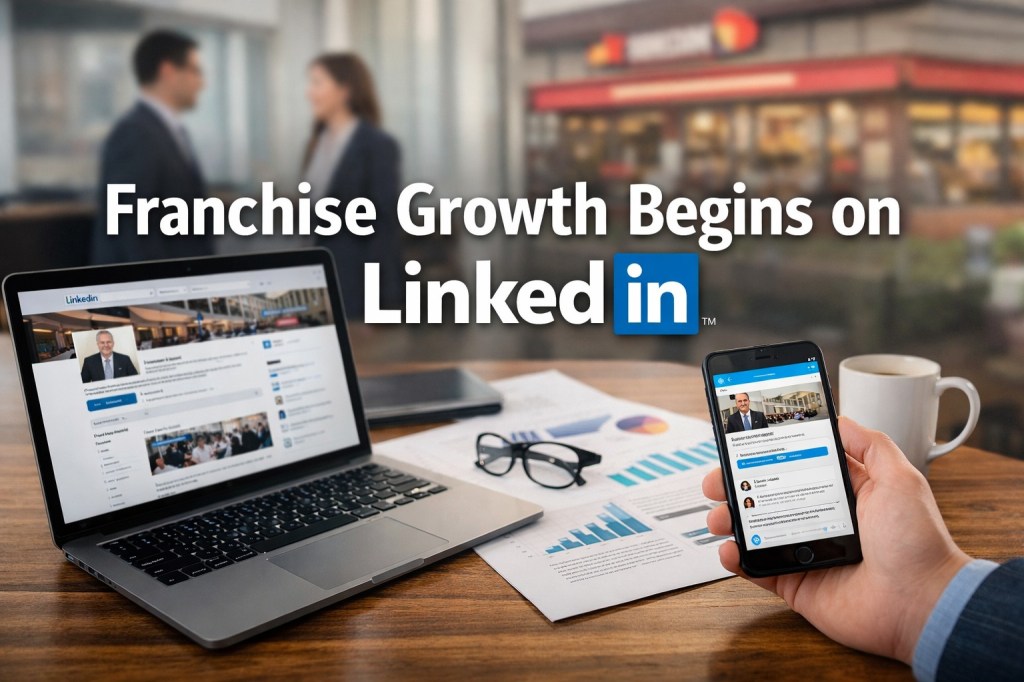
Franchising has always been built on relationships. Long before a franchise agreement is signed, long before a discovery day is scheduled, and long before a territory is awarded, trust must exist. In today’s environment, that trust is formed digitally first. And no platform plays a more critical role in shaping that trust than LinkedIn.
While many franchisors continue to focus heavily on consumer-facing platforms such as Facebook, Instagram, or TikTok, LinkedIn operates in an entirely different arena. It is not a platform for attracting customers. It is the platform for attracting franchisees, multi-unit operators, strategic partners, vendors, and leadership talent. It is, in many ways, the front door to the franchise opportunity itself.
For franchisors focused on thoughtful, deliberate expansion, LinkedIn is not optional. It is foundational.
Franchisees Are Not Just Buyers. They Are Investors.
The decision to become a franchisee is not impulsive. It is deliberate, analytical, and often deeply personal. Prospective franchisees are evaluating more than the brand. They are evaluating the leadership behind it. They want to understand the people, the culture, the vision, and the stability of the organization.
Before initiating a conversation, most serious candidates will research the franchisor’s leadership team on LinkedIn. They will review their experience, career progression, and professional credibility. They will examine how leaders communicate, what they share, and how they engage with others. They are not simply looking for success. They are looking for authenticity, consistency, and clarity.
A strong LinkedIn presence allows franchisors to demonstrate leadership long before the first direct interaction occurs.
LinkedIn Establishes Credibility at Scale
In franchising, perception matters. A franchisor may have a strong model, excellent unit economics, and a proven operating system. But if that credibility is not visible, it effectively does not exist to those evaluating the opportunity.
LinkedIn allows franchisors to showcase that credibility consistently. This includes sharing milestones such as new franchise agreements, openings, and expansions. It includes highlighting franchisee success stories, operational improvements, and brand evolution. It includes demonstrating the expertise and depth of the leadership team.
Every post contributes to a broader narrative. Over time, that narrative establishes trust.
Unlike traditional franchise portals or broker listings, LinkedIn allows franchisors to control their own story rather than relying solely on third-party platforms to tell it.
It Attracts the Right Franchisees, Not Just More Franchisees
One of the greatest risks in franchising is awarding franchises to the wrong candidates. Growth without alignment creates operational challenges, cultural fragmentation, and long-term brand risk.
LinkedIn naturally attracts professionals, operators, and executives. These individuals are often more experienced, more capitalized, and more aligned with structured business environments. Many are corporate professionals exploring entrepreneurship, multi-unit operators expanding their portfolios, or seasoned entrepreneurs seeking proven models.
By consistently communicating the brand’s expectations, values, and operational standards on LinkedIn, franchisors attract candidates who align with the brand’s culture and philosophy.
This improves not only franchise sales efficiency, but long-term system stability.
It Strengthens the Brand Beyond Franchise Sales
LinkedIn’s impact extends far beyond franchise development. It strengthens the brand’s position across multiple dimensions.
It attracts leadership talent. Strong operators, executives, and managers are far more likely to engage with brands that demonstrate professional credibility and clear direction.
It strengthens relationships with landlords and developers. Real estate partners increasingly evaluate brands through their digital presence.
It enhances vendor relationships. Vendors want to work with brands that demonstrate growth, stability, and professionalism.
It builds confidence among existing franchisees. When franchisees see consistent leadership communication and brand momentum, it reinforces their own confidence in the system.
LinkedIn becomes a central communication hub for the brand’s entire ecosystem.
Leadership Visibility Is More Important Than Brand Visibility
One of the most overlooked realities of LinkedIn is that people connect with people more than logos. While company pages are important, the personal presence of founders and leadership teams carries significantly greater impact.
Prospective franchisees want to know who they will be working with. They want to see leadership’s perspective, philosophy, and approach. They want to feel connected before committing.
When franchisors share insights, lessons learned, operational philosophy, and brand vision through their personal LinkedIn presence, they humanize the brand. This builds trust in ways traditional marketing cannot.
This is especially important for emerging and growth-stage franchise brands.
LinkedIn Shortens the Franchise Development Cycle
Franchise sales cycles are often lengthy. Candidates move slowly because trust takes time to build. Questions need to be answered. Confidence needs to develop.
LinkedIn accelerates this process.
When prospective franchisees have already been exposed to leadership’s thinking, brand momentum, franchisee success stories, and operational philosophy through LinkedIn, they enter conversations more informed and more confident. Much of the early trust-building has already occurred.
This allows franchise development conversations to focus less on proving credibility and more on determining mutual fit.
It Positions the Brand for Long-Term Expansion
Franchising is not about rapid expansion alone. Sustainable franchising requires attracting the right partners, maintaining operational integrity, and preserving brand value.
LinkedIn supports this by positioning the franchisor as a credible, stable, and forward-thinking organization.
It communicates professionalism. It demonstrates leadership maturity. It reflects organizational stability.
For franchisors seeking to expand in markets like Texas and throughout the United States, LinkedIn provides a platform to reach qualified candidates across geographies without reliance on traditional franchise portals alone.
It allows expansion to occur through relationships, not just transactions.
LinkedIn Is Not Advertising. It Is Leadership Communication.
The most effective franchisors do not use LinkedIn to advertise. They use it to communicate.
They share perspective. They share progress. They share lessons learned. They share their vision for the future.
Over time, this communication builds familiarity, credibility, and trust.
Franchisees do not simply buy into a brand. They buy into leadership.
LinkedIn allows franchisors to demonstrate that leadership every single day.
For franchisors serious about expansion, LinkedIn is no longer just a useful platform. It is one of the most powerful and underutilized tools for attracting the right franchisees, strengthening the brand, and building the foundation for long-term, sustainable growth.
About the Author
Paul Segreto brings over forty years of real-world experience in franchising, restaurants, and small business growth. Recognized as one of the Top 100 Global Franchise and Small Business Influencers, Paul is the driving voice behind Acceler8Success Café, a daily content platform that inspires and informs thousands of entrepreneurs nationwide. A passionate advocate for ethical leadership and sustainable growth, Paul has dedicated his career to helping founders, franchise executives, and entrepreneurial families achieve clarity, balance, and lasting success through purpose-driven action.
About Acceler8Success America
Acceler8Success America is a comprehensive business advisory and coaching platform dedicated to helping entrepreneurs, small business owners, and franchise professionals achieve The American Dream Accelerated.
Through a combination of strategic consulting, results-focused coaching, and empowering content, Acceler8Success America provides the tools, insights, and guidance needed to start, grow, and scale successfully in today’s fast-paced world.
With deep expertise in entrepreneurship, franchising, restaurants, and small business development, Acceler8Success America bridges experience and innovation, supporting current and aspiring entrepreneurs as they build sustainable businesses and lasting legacies across America.
Learn more at Acceler8SuccessAmerica.com




 As a franchisor, you are in the business of building relationships; relationships with your franchisees, with your potential franchisees and with your end customers. Relationships build sales, build your brand and build your franchise.
You must be logged in to post a comment.