Tag: franchisors

Designing Strategic Focus for the Modern Franchisor

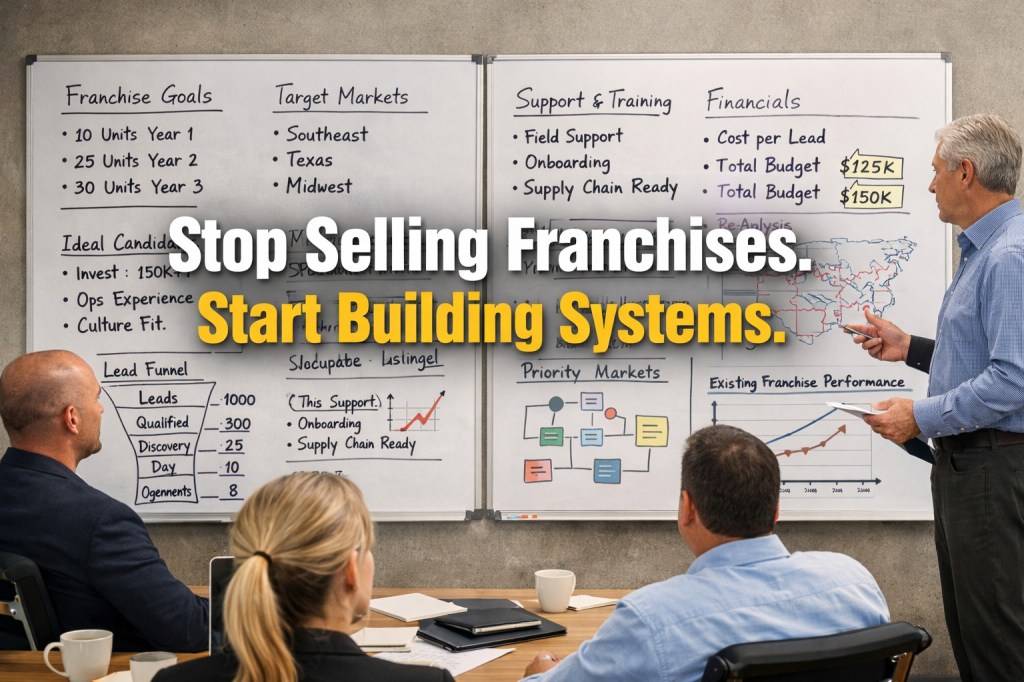
There are moments in the life of a franchise brand when incremental improvement is no longer enough. When dashboards, weekly calls, leadership huddles, and well-intended off-sites all begin to feel like motion without momentum. When decisions are technically sound but strategically thin. When alignment is assumed rather than tested. At that point, what senior leadership needs most is not another initiative, not another consultant in the room, and certainly not another “team-building” exercise disguised as strategy. What is needed is deliberate separation from the business in order to finally think about the business.

A properly designed two- to three-day leadership retreat is not a reward, not a perk, and not a morale exercise. It is a working session in the purest sense of the word. Its purpose is quiet, uninterrupted, disciplined strategic thinking. Under no circumstances should there be calls to or from the office. No “quick check-ins.” No texts framed as emergencies that somehow resolve themselves once answered. No one half-present while mentally managing daily operations. The moment the office is allowed into the room, the retreat loses its power. Strategy does not survive constant interruption.

The environment matters more than most leaders realize. Ideally, this retreat takes place at a destination where cars are unnecessary. A walkable setting, a resort or remote location where the group arrives together and stays together. This is not incidental; it is structural. When people can leave freely, they do. When distractions are nearby, they find their way in. When leaders retreat to separate hotels, bars, or side conversations, alignment fractures before it is ever built. Physical proximity reinforces psychological commitment. If the leadership team is serious about acting as one, it must first be together as one.

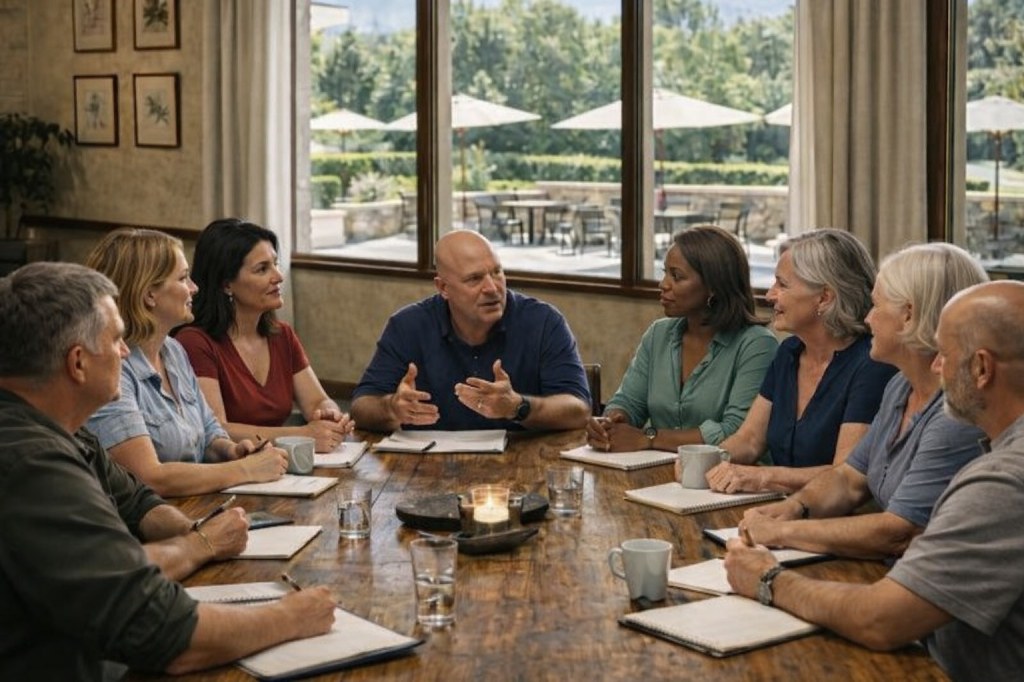
This requires intentional togetherness throughout the entire retreat. Meals are shared without exception. Breakfast, lunch, and dinner are all part of the working environment. There is no lingering at the bar after dinner, no splitting off into smaller groups, and no one-on-one conversations between two or three leaders outside the presence of the full team. This is not about control; it is about integrity of process. Alignment built in fragments is not alignment at all. This retreat is about collective truth, not selective consensus.

What this environment is meant to create is the modern equivalent of the old advertising agency war room. When the stakes were high and the ideas mattered, teams locked themselves in, covered walls with thinking, challenged each other relentlessly, discarded what did not hold up, and emerged with clarity forged through friction. Franchisors face stakes that are arguably higher. You are stewarding a brand, a system, and the livelihoods of franchisees who depend on your clarity, discipline, and consistency. Polite agreement is not enough. Intellectual honesty is required.

An often-overlooked component of these retreats is perspective gathered from outside the room, particularly from franchisees. Insight gathered in advance from franchise owners should be brought into the conversation not as an agenda item and not as a referendum on leadership performance, but as context. As texture. As a reality check. These insights are not meant to steer the meeting or dominate it; they exist to ground leadership thinking in the lived experience of the system. What franchisees are feeling, where they are confused, what they are frustrated by, and where they see opportunity provides invaluable perspective that senior leadership cannot generate in isolation. Ignoring that voice weakens strategy; acknowledging it sharpens it.

For this retreat to work, full transparency must be the standard, not the aspiration. There must be explicit permission to disagree, challenge assumptions, and surface uncomfortable truths without fear of being labeled negative, disloyal, or disruptive. If leadership cannot argue productively behind closed doors, conflict will eventually leak into the system in far more damaging ways. This room must be a place where reality is spoken plainly and where silence is treated as a failure of responsibility, not professionalism.

Preparation is non-negotiable. Every participant must arrive ready to lead a portion of the conversation, not with polished presentations designed to defend territory, but with thoughtful frameworks and hard questions. The agenda should be divided into essential categories that define the health of the franchise system. Brand culture deserves more than aspirational language; it requires an honest assessment of what behaviors are rewarded, what behaviors are tolerated, and whether internal conduct matches external promises. Day-to-day operations must be examined for systemic friction, not surface-level inefficiencies. Where does complexity creep in unnecessarily? Where are standards unclear or inconsistently enforced?

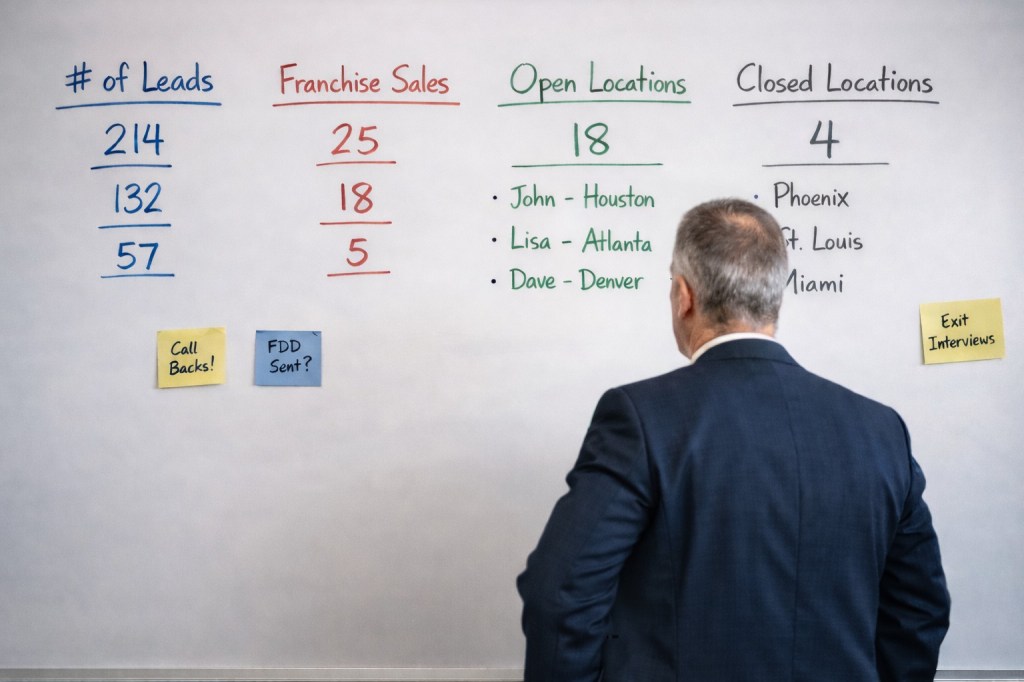
Franchise relationships demand particularly candid examination. Are franchisees truly heard, or merely acknowledged? Where has trust eroded, and why? What issues are repeatedly escalated without resolution? Franchise development should be scrutinized beyond pipeline metrics. Are growth decisions aligned with long-term brand health, or are short-term targets quietly driving compromise? What markets, profiles, or deal structures should be paused or eliminated entirely?

The absence of a facilitator is intentional. This is not a workshop; it is a leadership obligation. When an external voice manages the conversation, leaders often unconsciously outsource accountability for the hardest moments. In this setting, the leadership team must self-regulate. It must sit in discomfort long enough to move past defensiveness and into insight. The tension that arises is not a problem to solve; it is evidence that real work is happening.

Equally important is what happens between sessions. Long days spent together reveal how leaders think, listen, react, and recalibrate. Conversations that continue over dinner are not breaks from the work; they are extensions of it. Trust is built not through exercises but through shared intensity, mutual respect, and the experience of staying present when it would be easier to disengage.

The retreat does not end with ideas. It ends with decisions. The group must leave with a clear, agreed-upon plan to move forward, complete with priorities, ownership, timelines, and accountability. Ambiguity is not strategic flexibility; it is deferred conflict. Every leader should leave knowing exactly what they are responsible for and how progress will be measured.

That accountability must continue. Thereafter, the leadership team should commit to meeting once a month for an extended office session dedicated to reviewing progress, challenging assumptions, and editing the plan as reality evolves. Not status updates. Not operational reviews. Strategic recalibration. The retreat sets the direction; disciplined follow-up sustains it.

The real question for franchisors and senior leadership teams is not whether they can afford to step away for two or three days. It is whether they can afford to continue without doing so. When was the last time your leadership team thought deeply instead of reacting quickly? What conversations are being postponed because there never seems to be space for them? What truths are being managed around rather than confronted directly? And if everything were truly on the table, what would need to be said that has not yet been voiced?

Strategic clarity is rarely accidental. It is earned through presence, discipline, and collective courage. It is built in rooms where honesty outweighs comfort, where togetherness is intentional, and where leadership commits to acting as one long after the retreat ends.


About the Author

Paul Segreto brings over forty years of real-world experience in franchising, restaurants, and small business growth. Recognized as one of the Top 100 Global Franchise and Small Business Influencers, Paul is the driving voice behind Acceler8Success Café, a daily content platform that inspires and informs thousands of entrepreneurs nationwide. A passionate advocate for ethical leadership and sustainable growth, Paul has dedicated his career to helping founders, franchise executives, and entrepreneurial families achieve clarity, balance, and lasting success through purpose-driven action.


About Acceler8Success America

Acceler8Success America is a comprehensive business advisory and coaching platform dedicated to helping entrepreneurs, small business owners, and franchise professionals achieve The American Dream Accelerated.

Through a combination of strategic consulting, results-focused coaching, and empowering content, Acceler8Success America provides the tools, insights, and guidance needed to start, grow, and scale successfully in today’s fast-paced world.

With deep expertise in entrepreneurship, franchising, restaurants, and small business development, Acceler8Success America bridges experience and innovation, supporting current and aspiring entrepreneurs as they build sustainable businesses and lasting legacies across America.

Learn more at Acceler8SuccessAmerica.com

Franchisors Financially Assisting Franchisees: Good Or Bad Idea?

The following article was posted at LSJ.com and discusses franchisors assisting franchisees froma financial standpoint in order for the franchisees to withstand the current economic crisis. But, is it a good or bad idea? Does it set precedence that will become expected at the first sign of economic trouble in the future? Will franchisors’ efforts and goodwill be used to hold them hostage in the future? Read the article and then decide for yourself. We look forward to your thoughts.financial-assistance

Some franchisers taking drastic steps to weather today’s tough economy
Staff and Wire Reports • April 6, 2009 • From Lansing State Journal

Co-signing loan papers, buying out operating contracts and modifying licensing fees are among the aggressive steps some franchisers are taking to help their franchisees weather the chilly economy.

Just like small, independent business owners, many franchisees have struggled amid a lingering credit crunch and weak consumer spending.

Their survival is important. Nationally, franchises accounted for 11 million jobs, or 8.1 percent of the private workforce, and produced $880.9 billion in goods and services in 2005, according to the most recent data available from the Washington-based International Franchise Association.

Franchisers, who license the right to operate businesses in their names, have a vested interest in continuing to attract new franchise buyers and to help their current store operators survive. Fewer franchises mean less licensing – and royalty-fee revenue, on which franchisers depend to survive.

A rash of store closures also can mar a franchise’s brand.

“I think we’re going to see a fallout in our industry just like we’re going to see a fallout in other industries,” said Jeff Johnson, founder and CEO of the Franchise Research Institute. The institute, based in Lincoln, Neb., performs surveys for franchisers that gauge their franchisees’ satisfaction.

The strategies franchisers are employing now are not unheard of even when the economy is good, Johnson said. But some of the more aggressive steps, such as buying back stores from franchisees who want out of their contracts and temporarily foregoing certain fees, are rare.

Restaurant and other food service franchisees have been among the hardest hit by the economic downturn. Health care and certain technology-related franchises still are seeing strong demand, though.

Local and national franchisers say they’re still seeing demand from prospective buyers who want to open new franchises. The biggest problem is securing credit.

“It’s like a pendulum has swung,” said Bob Fish, CEO of East Lansing-based Biggby Coffee, which has 109 franchise-owned coffee shops.

A year ago, Fish said, new franchisees easily could get loans to cover the roughly $300,000 cost to open a Biggby store – even with a company stipulation that franchisees have enough cash to cover about one-third of the cost.

Now, he said, franchisees are lucky to get loans for half the cost. “It has slowed things down, absolutely,” he said.

Fish said his advice to franchisees stays the same: Shop around for a lender.

But some franchisers have stepped in to help applicants obtain financing by being a co-guarantor for loans and lines of credit.

“We have literally done a handful of those, but it is not a big number at all,” said Lee Knowlton, chief operating officer for Scotts-dale, Ariz.-based franchising company Kahala Corp. Kahala’s chains include Cold Stone Creamery, Blimpie, Samurai Sam’s Teriyaki Grill, TacoTime and other fast-food restaurants.

One of the biggest challenges for Kahala and other restaurant franchises has been real estate.

In some instances, franchisees who moved into shopping malls and neighborhood strip centers are struggling because major tenants around them closed.

But the economy has created opportunities, too. With the real estate market in decline, there are deals to be had for commercial space to open new stores, said Brent Taylor, president and CEO of East Lansing-based TT&B Inc., which franchises toy stores.

Taylor owns TreeHouse Toys & Books in Lansing Township’s Eastwood Towne Center and franchises under the Brilliant Sky Toys & Books name.

“We’ve been able to negotiate some real estate deals with landlords that are just unprecedented with what we’ve seen,” he said.

Some franchisers have started buying back distressed stores from their franchisees or letting them be shut down.

Tropical Smoothie Cafe, a Destin, Fla.-based franchise that sells sandwiches, wraps, salads and fruit drinks, reopened two Phoenix-area franchises in the last year. “It’s the very first time that we’ve done anything like that,” said Scott Palmateer, a regional franchise consultant for Tropical Smoothie Cafe.

Delhi Township-based Two Men and a Truck International Inc. CEO Brig Sorber said failing franchises can damage the reputation of the whole system.

So, even as growth has slowed at the moving company – which added only six franchises last year – Sorber is focusing attention on improving existing operations.

The privately owned company, with about 200 locations, has been hurt by the national decline in the housing market – which means fewer people are moving.

Two Men is working on ways to help its franchisees cut costs and to get into new markets, such as moving for businesses and interstate moving, Sorber said. “There’s less moving going on, but there also are less people doing the moving,” he said.

Lansing State Journal business reporter Jeremy W. Steele and Andrew Johnson of the Arizona Republic contributed to this story.

Franchise Growth: Are Concessions and Discounts Necessary?

This article is based upon a recent discussion in a LinkedIn franchise group. The original discussion posted the question, “What kind of discounts or concessions are required now to get a franchisee candidate to move forward?” and generated many responses and different views. The following is my response when my view about getting back to basics was preceived to be fine during “normal” times as opposed to during more difficult times, such as the present. A subsequent response from another franchise professional implied there are too many franchisors. I’ve addressed that as well.

discountAlthough it’s certainly easier to accomplish franchise growth during “normal” times, the basics need to be in place even more so during tough times. That’s not to say we don’t need to think and act outside-the-box to make something happen. It just means we need to be extra prudent and diligent in our actions and not use the economy as an excuse for poor execution of skills.

If we are to offer discounts and concessions in awarding franchises we need to be extremely careful we don’t oversell or create the perception of desperation. By doing so, we’ll either lose the deal or create a situation whereby the franchisee will not have respect for the franchise system and feel if one or two concessions were made initially, why not more moving forward? And then, there’s the perspective of franchisees already in the system that paid full amounts without concessions. What’s in it for them?

Nevertheless, with reports like Franchise Update’s about poor franchise sales performance and practices, I can’t help believe franchise systems wouldn’t be in better shape if their sales basics were perfected. It has to start with the basics before changing direction or considering revisions to the program.

In any business, just like in any sport, when a slump is emminent, it’s the fundamentals that need to be worked on before anything else should be considered or entertained. Once that’s done, then it makes good business sense to consider other options. At the very least, it should be done simultaneously. If not, what’s going to be the excuse when concessions and discounts don’t work?

PS – Saying there are too many franchisors is akin to saying there are too many businesses of the same kind. What happened to free enterprise and entrepreneurship? Maybe, franchising could be better served by more regulation, licensing and policing, to weed out the weaker (for whatever reason) franchisors and make it more difficult to become a franchisor. Unfortunately, I don’t see that happening because the “big boys” of franchising will squash those efforts in a New York minute. I look forward to debating this topic in a different discussion or forum.