Franchisee experience deserves sustained attention… from the first recruitment conversation through the eventual transition out of the business.
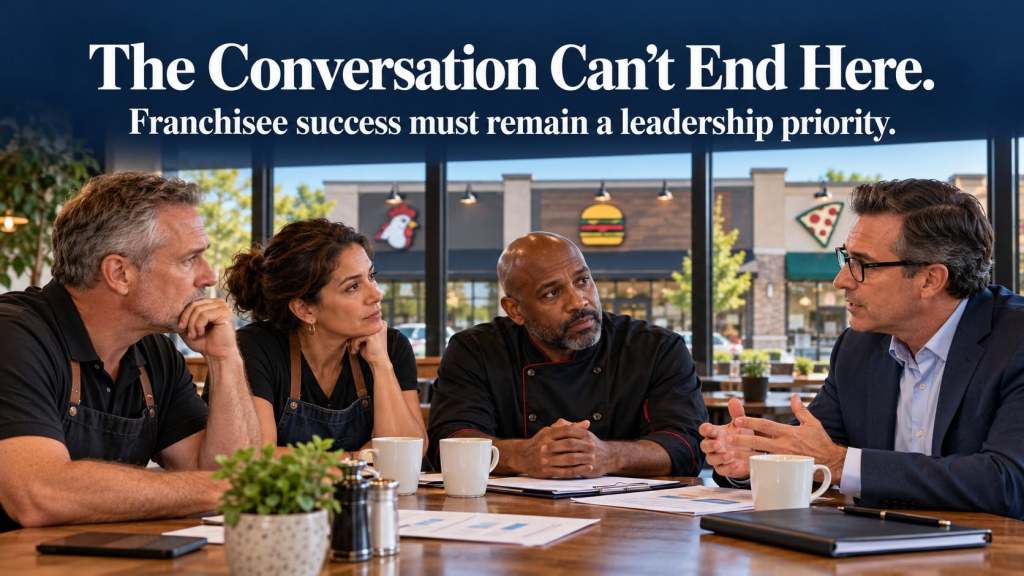
Of course, I’m not promoting a money-back guarantee on franchise fees and a franchisee’s investment. But yesterday’s article did generate a great deal of interest… and engagement. The conversation got started and continued throughout the day.
Bingo. That is exactly what is needed.
But if we don’t continue talking about it, the subject of creating—no, ensuring—great franchisee experiences, and everything required to deliver them, will crawl right back under the rock it has been hiding under.
Ensuring a great experience does not mean guaranteeing financial success. It means taking responsibility for the quality of the opportunity, the integrity of the recruitment process, and the support and leadership that follow.
The question in yesterday’s article was intended to make people pause: If franchisees could recover their investment and leave without lingering financial obligations, how many would stay? It was a hypothetical meant to examine the franchisee experience and the difference between wanting to remain and being financially unable to leave.
The responses brought forward thoughtful disagreements, practical observations, and concerns that deserve considerably more attention than a day’s worth of comments.
Thank you to all who shared their thoughts and perspectives.
A fair challenge makes the conversation better
One participant challenged the usefulness of the hypothetical. A profitable franchisee might gladly recover an entire investment and move on for personal reasons, changing priorities, or another opportunity. That decision would not necessarily indicate a failure by the franchisor.
Fair point.
The question cannot stand alone as a definitive measure of system health. Its value is in the discussion it opens and the questions that follow an owner’s answer.
That participant offered another test: Would a qualified buyer, knowing today’s investment requirements, operating demands, and unit economics, still purchase the franchise?
That deserves a place in the conversation, too.
For an existing franchisee, I would take it a step further: Knowing what you now know about both the business and the organization behind it, would you make the same decision again? Why—or why not?
The explanation matters more than the yes or no.
Someone approaching retirement may have an excellent business and still want to leave. Someone else may remain because selling would leave an unacceptable financial loss. Those experiences require different interpretations.
The objective is to understand what ownership has actually delivered relative to what the individual reasonably expected when joining the brand.
The franchisee experience begins before the agreement
A recurring theme in the discussion was the importance of a credible Franchise Value Proposition: What, precisely, is the franchisee receiving in exchange for the investment, fees, obligations, and operating requirements?
The answer must extend beyond brand recognition and enthusiasm for the concept.
It should explain how the business works, what ownership requires, where the system creates value, and whether the economics support an acceptable return under realistic conditions.
One participant emphasized selecting candidates with the right Capital, Capability, and Character. I agree.
Capital must be sufficient for more than getting the doors open. Capability must match the actual responsibilities of ownership. Character matters in a relationship that depends on following standards, sharing accurate information, and meeting commitments.
The discussion also raised an important concern about sales incentives. Any suggestion of a guarantee or minimal risk could become another selling device, encouraging weaker qualification and attracting candidates for the wrong reasons.
That reinforces why my hypothetical should never be confused with a proposed offer.
Responsible recruitment requires disciplined qualification, clear expectations, and a sales process that helps both parties make an informed decision. A signed agreement cannot be the only measure of whether that process worked.
Its quality becomes apparent when the franchisee begins operating.
Different owners require different evaluations
Several comments emphasized something I consider fundamental: A single-unit owner-operator, a multi-unit franchisee, and an enterprise operator should not be evaluated as though they are purchasing the same ownership experience.
Their capital structures, management capabilities, income needs, and growth objectives can differ substantially.
A single-unit owner may depend on the business for household income and spend most working hours inside the operation. A multi-unit owner may need enough operating profit to support managers and an additional layer of oversight. An enterprise operator may evaluate the opportunity within a larger portfolio and expect infrastructure capable of supporting development at scale.
Each needs a credible opportunity. Each also needs an accurate understanding of what the franchisor can deliver.
Recruiting a capable single-unit operator does not automatically establish that the person is prepared to develop five locations. Recruiting a well-capitalized investor does not establish that the investor has the operating leadership required to manage them.
The appropriate franchisee profile should follow the demands of the business and the ownership model being offered.
That work belongs near the beginning of franchise development.
Leadership owns the connections
The conversation moved beyond candidate selection to a larger leadership responsibility: making the parts of the franchise organization work together.
Recruitment, real estate, unit development, training, marketing, operations, and ongoing support all influence the franchisee’s outcome.
A sound concept can still produce a disappointing ownership experience when those functions fail to connect.
The sales process may establish expectations that operations cannot fulfill. Development delays may consume working capital before opening. Training may prepare someone to perform tasks without preparing that person to manage the business. Expansion commitments may move faster than the support team’s capacity.
Individually, each department may report that it completed its responsibilities. The franchisee still lives with the combined result.
Founders and CEOs must understand those connections. They must also be willing to resolve gaps that cross departmental boundaries.
A franchisee experiences one brand. Leadership should manage it that way.
The warning signs can appear long before a closure
One of the most practical contributions focused on operating signals that can be overlooked when support teams concentrate on sales and compliance.
The examples included owners working more hours while reported labor percentages remain on target; personal funds covering working-capital shortages; maintenance and reinvestment being postponed; and supplier payments stretching even while royalties remain current.
Those observations deserve attention.
An acceptable labor percentage can conceal an owner working without adequate compensation. Cash in the bank can reflect a personal contribution rather than healthy operations. Strong sales can coexist with growing financial strain.
These indicators do not all mean the same thing, and none should be interpreted without context. Together, however, they make a compelling case for looking beneath the usual performance reports.
Another participant raised a related concern: Silence can be mistaken for stability.
A franchisee who does not complain may be doing well. That owner may also be embarrassed, exhausted, uncertain about the numbers, or unaware of how serious the situation has become.
Waiting for a request for help places too much weight on the franchisee’s ability to identify, explain, and disclose the problem.
Useful support includes helping owners understand their businesses well enough to recognize trouble early—and creating a relationship in which they feel comfortable discussing it.
An open location tells only part of the story
Several comments returned to profitability, owner compensation, and sustainable returns as essential measures of franchise system health.
One observation was especially direct: Can the owner pay themselves for the hours they work?
That question should be routine.
Owner labor has value. A business that appears profitable because the owner absorbs management responsibilities without reasonable compensation needs closer examination.
Another contributor described a smaller system with established, profitable locations as more impressive than a much larger footprint supported by thin margins and inadequate infrastructure.
I understand that perspective.
Location counts and development agreements demonstrate activity. Evaluating the quality of that growth requires understanding what the locations produce for the people operating them.
One commenter also raised the question of whether the financial return justified the continuing effort and exposure compared with other uses of capital. The specific comparison will differ by owner, but the underlying question is legitimate: Is this business producing a return that makes sense for the money, time, responsibility, and risk involved?
That assessment should include compensation for work performed, the capital remaining at risk, reinvestment needs, and the value being built.
A percentage presented without that context tells an incomplete story.
Honest discussion must include difficult experiences
Some responses reflected frustration with the balance of risk in franchising.
One contributor described concerns about the number of parties compensated during a franchise sale while the franchisee assumes substantial financial obligations. That person also called for reasonable exit options when legitimate circumstances arise and reported having witnessed retaliation against franchisees who raised concerns.
A former franchisee expressed strong agreement with the concerns raised in the article.
These are individual accounts and perspectives, rather than evidence about every franchise organization. They nevertheless deserve to be heard and examined.
A healthy franchise relationship needs room for difficult questions. Owners should be able to discuss financial performance, support shortcomings, and disagreements without assuming that speaking candidly will damage the relationship.
Franchisee accountability remains essential. Agreements, standards, and operating responsibilities matter.
So does the franchisor’s willingness to consider whether a concern is valid, whether a problem is recoverable, and whether an orderly transition may sometimes serve the parties better than prolonged deterioration.
Discussing those possibilities is part of responsible system management.
The economics extend to the lease
A commercial real estate professional added another valuable perspective: An open location is not necessarily a healthy tenant.
The comment emphasized underwriting beyond the brand name and personal guarantee—examining realistic sales, total occupancy costs, working capital after construction, operator experience, and trade-area demand.
That perspective connects directly to franchisee experience.
Lease terms shape the economics the owner must live with. Tenant improvements, rent commencement, concessions, and escalations should support a viable operating plan.
A favorable concession at the beginning cannot, by itself, repair an occupancy cost the business cannot sustain.
Franchisors, franchisees, and landlords all have an interest in a location capable of generating durable performance. An impressive opening means much less if the owner subsequently exhausts personal savings to maintain it.
From engagement to action
I appreciate everyone who contributed, including those who challenged the premise. Their comments expanded the discussion from a provocative question into a much broader examination of franchise system integrity.
But engagement is only the beginning.
Franchisor leadership can put this conversation to work by asking:
- Does our recruitment process identify owners suited to the specific business and ownership model?
- Do current unit economics support reasonable owner compensation, operating needs, reinvestment, and a return on capital?
- Where do development delays or gaps in training and support create avoidable financial pressure?
- Can we recognize an owner’s deteriorating position before it becomes a default?
- Do franchisees feel comfortable telling us what is happening?
- What have we changed because of what we learned?
Those questions require evidence, candid conversations, and follow-through.
They also require a willingness to reconsider a growth target when the existing system needs attention.
Final Thoughts
My position remains straightforward: I believe strongly in franchising, and I believe the franchisee experience deserves sustained attention throughout the relationship.
That experience begins with how the opportunity is presented and who is invited to join. It develops through financing, site selection, opening, daily operations, support, reinvestment, and growth. Eventually, it includes the owner’s ability to transition the business.
No franchisor can promise that every owner will succeed. Every franchisor can examine whether its decisions give qualified owners a credible opportunity to do so.
The responses to yesterday’s article demonstrated how much there is to discuss. They also showed how many people are willing to contribute useful experience when the question is put on the table.
Now we need to keep it there.
Franchisee experience should remain on the leadership agenda after the comments slow down, the next development announcement is ready, and attention turns to another issue.
The people who invested in the brand are still operating their businesses. Their experience continues every day.
Our attention should, too.
For franchise founders and leadership teams: Bring this discussion into your next management meeting. Ask whether your recruitment, economics, development process, and support capabilities are working together to create businesses worth owning—and identify where action is needed.
If you would welcome an experienced outside perspective on franchise readiness, franchisee profitability, system performance, or the direction of your brand’s growth, let’s have a candid conversation. Through Acceler8Success America, we help founders and leadership teams evaluate those priorities and determine practical next steps.
Reach out to me via a direct message or by email to Paul@Acceler8Success.com. I look forward to our discussion.
And keep contributing to the conversation: What has your organization changed because it listened to its franchisees… and what still needs to change?


You must be logged in to post a comment.