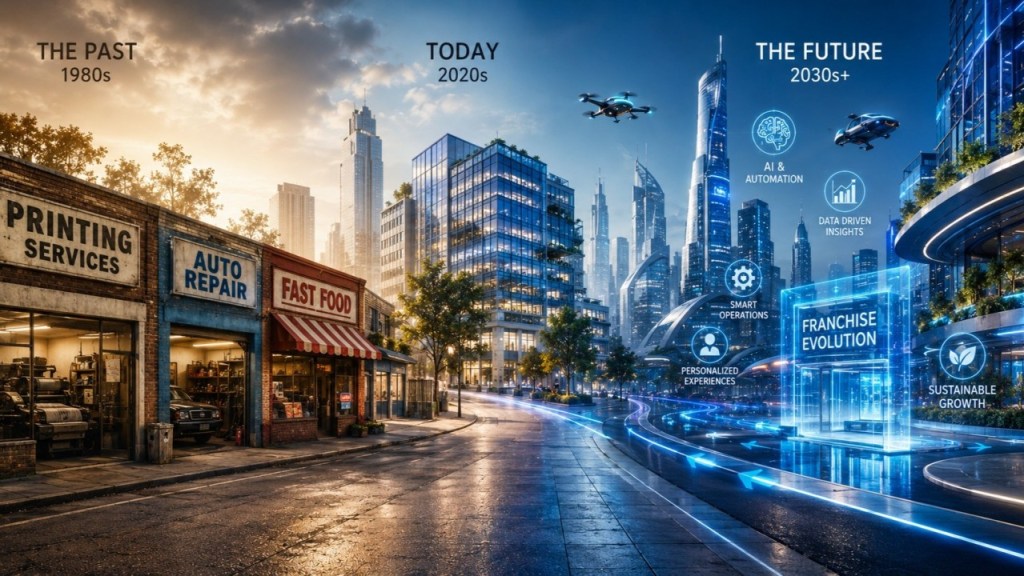
There are moments when I find myself thinking deeply about the future of franchising. Perhaps that comes naturally after spending more than four decades in and around the franchise community. I first entered franchising in 1982, and the industry I stepped into then looks almost unrecognizable compared to what we see today.
Back then, at least from my perspective and experience, franchising was heavily defined by a handful of highly visible categories. Fast food dominated the conversation. Automotive repair was everywhere. Printing services were growing rapidly as businesses relied on local commercial printers for virtually everything. Of course, there were many other franchise segments at the time, but those were the ones that stood out to me most clearly.
The franchise model itself felt different. Growth was often driven by physical visibility, operational consistency, and market saturation through brick-and-mortar expansion. Technology existed, but it certainly was not driving the business. Data was limited. Marketing was local. Customer engagement was personal and face-to-face. Convenience meant something very different than it does today.
Then came wave after wave of change.
The internet changed consumer behavior. Mobile technology changed expectations. Delivery transformed restaurants. Digital marketing disrupted traditional advertising. Social media shifted how brands communicate and build trust. Automation changed operations. Artificial intelligence is now beginning to reshape decision-making, customer service, recruitment, training, and operational efficiency in ways many could not have imagined even ten years ago.
And yet, despite all of that change, I still believe we are only scratching the surface of what franchising will eventually become.
When I think about the future of franchising, I am less focused on predicting the next hot category and more focused on understanding how the very structure of franchise businesses may evolve. Many current franchise segments will still exist in the future, but they may look completely different than they do today.
Restaurants may become smaller, more automated, and more delivery-centric while simultaneously becoming more experiential for dine-in guests. Fitness concepts may continue shifting toward wellness ecosystems that include nutrition, recovery, mental health, diagnostics, and personalized health data. Service brands may increasingly rely on AI-powered customer interaction, predictive maintenance systems, robotics, and remote support models.
Retail franchising may continue evolving away from traditional inventory-heavy storefronts and toward hybrid showroom, fulfillment, and experiential models. Education franchises may become deeply integrated with virtual learning, workforce development, entrepreneurship training, and AI-supported personalization. Senior care franchises may expand far beyond home care into broader aging-in-place solutions supported by technology, monitoring systems, and coordinated wellness platforms.
And perhaps most interesting of all, entirely new franchise categories will emerge that many of us cannot yet fully envision.
Forty years ago, who could have predicted large-scale franchising in areas like IV therapy, cryotherapy, esports, drone services, virtual reality entertainment, or highly specialized wellness concepts? Innovation has always found its way into franchising because franchising itself is ultimately a vehicle for scaling solutions to consumer demand.
But here is what I believe matters most.
The brands that survive long term will not simply be the biggest brands. They will be the brands willing to evolve before they are forced to evolve.
That distinction matters.
Too many businesses wait until disruption is already damaging their relevance before they begin adapting. By then, the market has often moved ahead of them. Consumer expectations have changed. Competitors have innovated. Technology has reshaped the playing field.
History is filled with brands that once appeared untouchable until they became obsolete because they failed to look ahead. They protected what worked yesterday instead of preparing for what consumers would want tomorrow.
The strongest franchise organizations of the future will likely be those that continuously ask difficult questions today.
What will our customer expect five years from now?
Will our current operating model still be relevant?
How will technology reshape our customer experience?
Will our physical footprint still make sense?
What parts of our business should become more automated and what parts should remain deeply human?
How do we maintain culture and personal connection in an increasingly digital world?
How do we remain operationally efficient without losing brand identity?
How do we future-proof the franchisee experience itself?
Those are not questions for tomorrow. Those are questions for today.
One of the greatest mistakes any brand can make is believing that current success guarantees future relevance. It does not. Markets evolve. Consumers evolve. Technology evolves. Expectations evolve. And franchising must continue evolving alongside them.
What excites me most, however, is that franchising remains one of the most adaptable business models ever created. At its core, franchising is entrepreneurship combined with systems, scalability, and local ownership. That flexibility gives franchising an incredible ability to reinvent itself generation after generation.
I believe the future of franchising will be smarter, faster, more data-driven, more personalized, and more integrated into consumers’ daily lives than ever before. But I also believe the brands that ultimately thrive will still understand the timeless fundamentals of people, culture, trust, leadership, and customer experience.
Technology may reshape the tools, but human connection will still define the strongest brands.
The future is coming whether brands prepare for it or not.
The question is not whether franchising will evolve further.
The question is whether your brand will evolve with it.
The Future Begins Tomorrow
It is never too early for franchise brands to begin looking ahead. In fact, the brands that start thinking about the future before they are forced to react are often the ones that position themselves for long-term sustainability and growth.
The brands that failed to prepare for changing consumer behavior, emerging technologies, operational disruption, and evolving expectations often became case studies in obsolescence rather than examples of innovation.
The future belongs to the brands willing to think beyond today.
If you would like to discuss how your franchise brand should begin preparing for the future of franchising, from growth strategy and operational evolution to positioning, culture, technology integration, and long-term sustainability, I welcome the conversation.

You must be logged in to post a comment.