As the Multi-Unit Franchising Conference comes to a close, I’ve found myself reflecting on the conversations shared with me from a number of attendees…
Because over the past few days, I’ve shared a different perspective.
That multi-unit is not the destination. It’s the transition.
That multi-brand is not simply growth. It’s a shift in mindset.
And that the real evolution in franchising isn’t measured by how many units you own…
It’s defined by how you think.
Operator → Entrepreneur Execution → Strategy Units → Enterprise
That’s the progression.
And yet…
Most never make that shift deliberately.
They scale within a system. But rarely step back to design one.
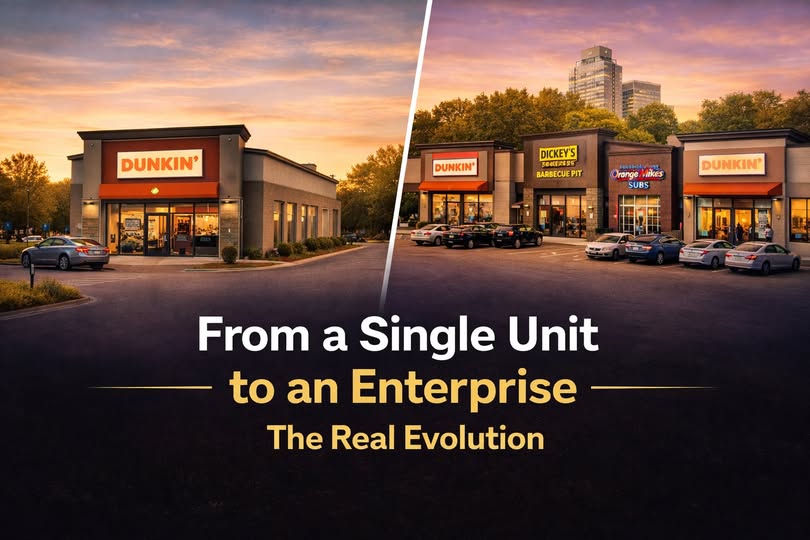
The image I’ve shared says it simply:
From a single unit… to an enterprise.
But what’s not visible is the decision that happens in between.
The moment when you stop asking: “How do I grow this brand?”
And start asking: “What am I actually building?”
That’s where everything changes.
So let me ask you—
Coming out of this week…
Where do you see the real opportunity?
Is it continuing to scale within a brand you know well? Or is it stepping back and building something broader, more intentional, more enterprise-driven?
At what point does focus become limitation?
At what point does experience in one brand create the confidence—or the obligation—to think beyond it?
And for those who have already made the move…
What triggered it?
Opportunity? Frustration? Vision? Or necessity?
No right answer.
But it is a very different conversation depending on how you see it.
Over the past few days, I’ve shared thoughts on: • Multi-unit franchising • Multi-brand franchising • And where the real inflection point actually is
If you’ve been following along, I’d genuinely value your perspective.
Where are you in that journey?
And if this conversation resonates, if you’re at that point where growth needs to become more intentional, more structured, more strategic—
Let’s talk.
I’m working with operators, investors, and franchisors who are navigating this exact transition… from units to enterprise, and with refranchising in the mix.
Reach out to me directly at paul@acceler8success.com to start the conversation and explore what a deliberate, strategic growth plan could look like for you.
There is a point in franchising where the narrative shifts. It is subtle at first, almost imperceptible, but once it happens, everything changes.
The operator who once followed a system begins to think beyond it. The individual who once executed begins to build.
This is not accidental. It is the natural progression of a franchisee who has moved beyond a single unit, beyond a single brand, and into something more deliberate.
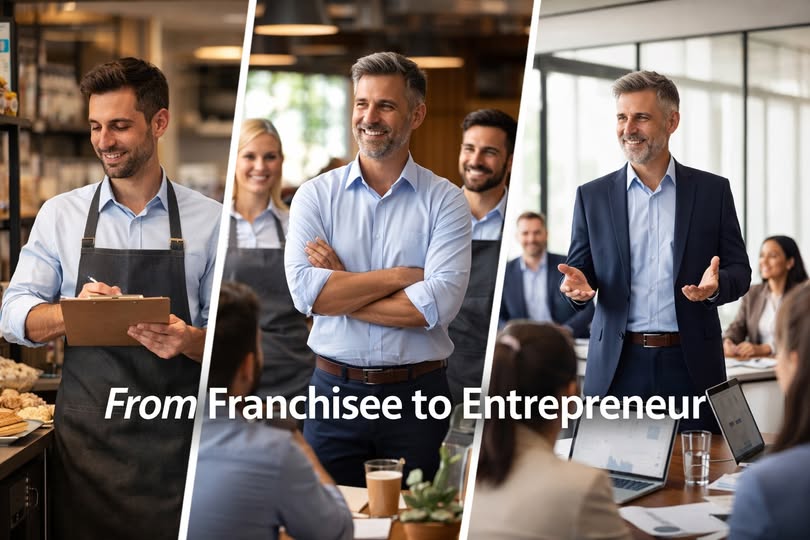
This is the evolution of a franchisee into an entrepreneur.
At the single-unit level, even for the most capable operators, the role is largely defined. You are executing a proven model. You are managing people, controlling costs, delivering a product or service consistent with brand standards. Success is measured in operational excellence. Discipline matters. Consistency matters. But the ceiling, while often attractive, is still defined by the box you operate within.
Multi-unit ownership begins to stretch that ceiling. It introduces leverage. It forces the operator to move from working in the business to working on the business. You can no longer be everywhere. You can no longer make every decision. You begin to build infrastructure. You develop leaders. You create systems within the system.
At this stage, many believe they have arrived as entrepreneurs.
In reality, they have only begun the transition.
The true inflection point occurs when a franchisee moves beyond a single brand.
Multi-brand franchising changes the game entirely.
Now, you are no longer simply scaling a model. You are allocating capital across different models. You are comparing performance across brands, across dayparts, across customer segments. You are evaluating not just how to run a business, but which business to run.
That is entrepreneurship in its purest form.
A multi-brand operator begins to think like a portfolio builder.
One concept may dominate breakfast and lunch. Another may win in dinner and late-night. One brand may deliver high margins with lower volumes. Another may drive top-line revenue with tighter margins but stronger brand equity.
The entrepreneur sees how these pieces fit together, not as isolated businesses, but as a coordinated strategy.
Real estate decisions become more sophisticated. Site selection is no longer about the next location, but about market coverage, brand adjacency, and cannibalization avoidance. Talent development evolves from store-level management to organizational design. Capital allocation becomes intentional. Growth is no longer about adding units. It is about building value.
And perhaps most importantly, risk is reframed.
A single-brand, even multi-unit operator, is exposed to the fortunes of that one brand. Brand missteps, changing consumer preferences, or shifts in unit economics can have a material impact.
The multi-brand entrepreneur diversifies that risk. Not recklessly, but deliberately. They understand that no brand is immune to cycles. They build accordingly.
This is where mindset separates operators from entrepreneurs.
The operator asks: How do I run this brand better?
The entrepreneur asks: Where should I deploy capital next, and why?
The operator focuses on execution.
The entrepreneur focuses on strategy, structure, and long-term value creation.
None of this diminishes the importance of operational excellence. In fact, it amplifies it. A multi-unit, multi-brand portfolio only works if each unit performs. But the center of gravity shifts. The business is no longer defined by a single set of operating standards. It is defined by the decisions made above them.
There is also a leadership evolution that cannot be overlooked.
In single-unit and early multi-unit operations, leadership is often proximity-based. The owner is close. Present. Involved.
In multi-brand environments, leadership becomes cultural. It must scale without constant presence. It must be taught, reinforced, and lived through others. This requires intentionality. It requires clarity. It requires a willingness to let go of control in order to gain scale.
Many franchisees aspire to own more units. Fewer are prepared to think across brands. Fewer still are willing to accept the responsibility that comes with it.
Because with multi-brand ownership comes a different level of accountability.
You are no longer just a steward of a brand.
You are a builder of an enterprise.
That is the distinction.
Franchising provides the pathway. It offers the model, the systems, the support. But entrepreneurship emerges when the individual begins to make decisions that shape outcomes beyond a single brand’s framework.
And at that intersection, the franchisee becomes something more.
Not by title, but by behavior. Not by aspiration, but by action.
An entrepreneur.
If you’re a multi-unit operator beginning to think beyond a single brand, or a franchisor evaluating how your best operators evolve into multi-brand groups, this is where the conversation changes.
Growth is no longer about adding locations. It becomes about structure. Alignment. Intentional expansion. Long-term value creation.
And most importantly, making the right decisions before you scale further.
If you’re navigating that shift—or preparing for it—let’s start a conversation. Reach out to me at paul@acceler8success.com.
There’s something different about walking into the exhibit hall at the Multi-Unit Franchising Conference in Las Vegas for the first time. It’s not just the energy. It’s not just the brands. It’s not even the conversations.
It’s the shift.
You arrive as a franchisee. You leave thinking like something more.
For many first-time attendees, the experience begins with excitement. Rows of emerging and established brands. Conversations that feel full of possibility. Panels that challenge assumptions you didn’t even realize you had. You’re surrounded by operators who look like you, and others who don’t, yet are navigating similar decisions at different levels.
But somewhere between walking the floor, listening to those eye-opening discussions, and sitting across from another operator who casually mentions they own five brands across three states, something changes.
You begin to question loyalty.
Not in a negative sense. Not in a disloyal sense. But in a strategic sense.
Because the reality hits you.
You’re not here evaluating the brand you currently operate under. You’re here evaluating what comes next.
And for the first time, the idea of multi-unit becomes secondary to something much bigger.
Multi-brand.
That’s where the shift begins.
Expanding within a single brand has a certain comfort to it. You know the systems. You know the playbook. You understand the culture, the expectations, the support structure. Growth feels like a continuation of what you already do well.
But walking that exhibit hall, you start to see opportunities that don’t just add units… they add dimensions.
Different dayparts. Different customer bases. Different operating models. Different economics.
And now the questions change.
Not “Should I open another location?”
But “Should I diversify my portfolio?”
And more importantly…
“Does this next brand make me stronger, or does it complicate everything I’ve built?”
Because multi-brand franchising is not simply expansion. It is transformation.
You have to begin thinking in terms of integration, not just addition.
Does the new concept complement your current operations? Does it create operational efficiencies or operational friction? Will it leverage your existing infrastructure, or require an entirely new one? Do the peak hours align… or conflict? Does your current leadership bench have the capacity to support another brand… or will you need to rebuild your organization to sustain it?
And perhaps the most important question of all:
Are you building a portfolio… or collecting businesses?
There’s a difference.
A portfolio is intentional. It’s strategic. Each brand serves a purpose. Each decision builds toward something larger than the individual units themselves.
Collecting businesses is reactive. It’s driven by opportunity without alignment. And over time, it creates complexity that quietly erodes performance.
As you move through conversations at the conference, another realization begins to take shape.
The operators who are succeeding at multi-brand are not just better operators.
They are better builders.
They’ve shifted from working in a business to architecting a structure.
They think about leadership layers, not just store-level management. They invest in systems that transcend any single brand. They focus on capital allocation, not just unit-level profitability. They build organizations, not just locations.
And that leads to a deeper, more personal question.
Are you ready to make that shift?
Because multi-brand franchising is often the tipping point where a franchisee begins to see themselves as an entrepreneur.
But the title alone doesn’t create the outcome.
The reality is, managing multiple brands requires a different level of discipline, clarity, and self-awareness.
Can you step out of day-to-day operations and truly lead? Can you trust others to execute at a high level across different systems and standards? Can you maintain focus when your attention is divided across brands, teams, and markets? Can you build a leadership team that is not dependent on you?
Because without that transition, multi-brand quickly becomes multi-pressure.
And pressure without structure leads to breakdown.
That’s why the most important part of attending the Multi-Unit Franchising Conference isn’t what you see.
It’s what you take back with you.
The conversations. The insights. The realizations.
But more than anything, the decisions.
Not every opportunity is the right opportunity. Not every brand is the right fit. Not every next step should be taken immediately.
Sometimes the most strategic move is to pause, evaluate, and build the foundation before you expand.
Because growth without structure is risk.
But growth with intention is how long-term value is created.
If you’re walking out of this conference thinking differently than when you walked in, that’s a good thing.
If you’re questioning your next move, that’s an even better thing.
And if you’re seriously considering what multi-unit and multi-brand growth looks like for you, from exploration to strategy to execution, that’s where the real work begins.
Let’s have that conversation.
Reach out to me directly and let’s work through what your next step should be, how it aligns with what you’ve already built, and how to move forward with clarity, discipline, and purpose.
There is something energizing about walking into a conference like the Multi-Unit Franchising Conference in Las Vegas. The conversations are bigger. The vision is bigger. The language shifts from “my store” to “my portfolio.” From managing a team to building an organization. From making a living to creating enterprise value.
For the single-unit franchisee, it can feel like a defining moment. You’ve proven you can open and operate. You’ve survived the early days. You’ve built a team, stabilized operations, and maybe even reached a level of profitability that finally allows you to breathe.
And now you’re asking the question.
What’s next?
This is where MUFC2026 becomes more than just a conference. It becomes a signal. Not just of where the industry is going, but of what you should be listening for as you decide whether multi-unit ownership is right for you.
Because the natural answer seems obvious. More units. More revenue. More scale.
But that’s where things begin to blur.
Because multi-unit ownership, while often positioned as the next logical step, is not simply a continuation of what you’ve already done. It is an entirely different business.
The single-unit franchisee is an operator. Close to the business. Close to the team. Close to the customer. Decisions are often immediate and personal. Adjustments are made in real time. Success is driven by presence, hustle, and attention to detail.
The multi-unit operator is not just operating units. They are building infrastructure. Systems. Layers of leadership. Processes that must perform without them in the room. The shift is not from one to two units. The shift is from operator to developer.
And that transition is where many get it wrong.
So as you walk the floor, sit in sessions, and listen to the conversations at the conference, listen differently.
Listen for what is beneath the success stories.
It is easy, especially in an environment like this, to be drawn into the energy of scale. To hear someone talk about ten locations, fifty locations, a hundred locations, or a portfolio of brands across multiple states. It sounds like the destination. It feels like success.
But what you should be listening for is how they got there.
What systems did they build before they scaled? Who was running the business when they weren’t there? How many times did they slow down before speeding up? What did they have in place before they opened the second unit, not the tenth?
Because what often goes unspoken are the scars behind those stories.
Multi-unit ownership, pursued too early, introduces a different level of risk.
The first is dilution of focus. What made the first unit successful is often the owner’s presence. Their standards. Their relationships. Their accountability. The moment a second unit opens, that presence is divided. Without systems in place, performance begins to slip. Not dramatically at first, but gradually. And quietly.
The second is people. The single-unit owner is often the best operator in the building. Multi-unit ownership requires letting go of that role and trusting others to execute. Not just one person, but multiple leaders across multiple locations. Hiring, training, and retaining that level of talent is not an extension of operations. It is a new discipline entirely.
The third is capital. Growth consumes cash. Even successful operators underestimate the working capital required to open and stabilize additional units. Delays happen. Ramp-up takes longer than expected. Margins compress. What looked like expansion can quickly become exposure.
The fourth is complexity. Two units are not double the complexity of one. They are exponential. Scheduling, inventory, culture, consistency, reporting, communication. Each layer introduces friction. Without structure, that friction becomes chaos.
And then there is the most overlooked risk of all. Identity.
Many single-unit franchisees believe they are building a business. In reality, they are often building a job that they have mastered. Multi-unit ownership forces a redefinition. You are no longer the business. You are building the organization that runs the business.
Not everyone wants that. Not everyone should.
So the question becomes, what is the right path?
It is not about avoiding multi-unit ownership. It is about earning it.
And if you’re listening closely, you’ll start to hear a different message emerge.
Not from the stage, but in the conversations between sessions. From the operators who have done it, not just those who are selling it.
A practical progression begins with mastery, not momentum. The first unit should not just be profitable. It should be predictable. Performance should not rely on the owner’s daily presence. It should run on systems, standards, and a team that can execute consistently.
From there, leadership becomes the focus. Before a second unit is ever opened, there should be someone capable of running the first without you. Not as a placeholder, but as a true operator. This is the first real test of scalability.
Next comes infrastructure. Reporting systems. Standard operating procedures. Training processes. Communication rhythms. These are often overlooked when things are small because they feel unnecessary. They are anything but. They are the foundation of multi-unit success.
Only then does expansion begin to make sense. And even then, it should be deliberate. One additional unit, not three. Stabilize. Refine. Strengthen the bench. Then consider the next.
Somewhere along that path, the mindset shifts. Growth is no longer about opening locations. It is about building an organization capable of supporting those locations.
That is the difference between a franchisee who owns multiple units and a multi-unit operator.
As the conversations unfold this week in Las Vegas, there will be no shortage of inspiration. And there should not be. Ambition drives growth. Vision creates opportunity.
But what you should be listening for is discipline.
Multi-unit ownership is not the holy grail. It is a different game. One that rewards those who approach it with intention, structure, and a clear understanding of what it truly requires.
For the single-unit franchisee, the goal is not to chase scale.
It is to become ready for it.
If there’s one thing I can tell you from experience, it’s this… multi-unit franchising will expose everything. It will amplify what you do well and it will magnify what you don’t. I’ve lived both sides of it. I’ve experienced the upside of scale, where the model works, the team performs, and growth creates real enterprise value. And I’ve experienced the other side, where moving too fast, without the right structure, turns opportunity into pressure and pressure into costly lessons.
So if you’re at MUFC2026 this week, or even if you’re simply at that crossroads in your own business, don’t just listen to the big numbers. Don’t just listen to the expansion stories. Listen for the discipline behind them. Listen for the structure. Listen for the pauses, the recalibrations, the moments where growth was earned, not assumed.
And if you want to talk it through with someone who has been there, on both sides of success and failure, I’m here for that conversation. No pitch. No pressure. Just a real, honest discussion about where you are, what you’ve built, and whether multi-unit ownership is truly the right next step for you.
Reach out to me directly via message or email at paul@acceler8success.com and let’s work through it together.
Each year the International Franchise Association commissions a study from PwC (PricewaterhouseCoopers) on the economic impact of franchising in the U.S. Highlights from that study include the following:
Taking into account the indirect impact of franchised businesses, business format franchises support more than 13.2 million jobs, $1.6 trillion in economic output for the U.S. economy, and 5.8 percent of the country’s GDP.
Franchise businesses provided more jobs in 2016 than wholesale trade, transportation and warehousing, nondurable goods manufacturing, and information (including software and print publishing, motion pictures and videos, radio and television broadcasting, and telecommunications carriers and resellers).
Quick service restaurants (QSR) is the largest category, representing 25 percent of all franchise establishments and 45.5 percent of all franchise jobs.
Jobs supported because of franchise businesses were at least 10 percent of the private sector nonfarm workforce in 33 states, and at least 6 percent in every state.
The number of people employed by franchises is greatest in California, Texas, Florida, Illinois, and Ohio.
Franchisees own and operate 88 percent of all business format franchise establishments and franchisors own and operate 12 percent.
Quick Serve Franchise Sector Continues to Blaze a Trail for Franchising
There is little doubt that the franchise industry is undergoing significant changes fueled in great part by the success of various PE firms that began in the QSR sector. As other franchise sectors are targeted by PE investors, the competitive environment in those sectors will become more challenging. In order to prepare for these challenges, small to medium sized franchises will need to become successful franchise systems that produces sustained system growth, successful franchisees and an efficient operating system.
Multi-unit franchisee ownership that originated in the QSR sector continues to increase as franchisors seek large multi-unit franchisees that can own and operate more franchise units.This ownership model provides organizational stability, ample financial resources, sustained growth and economies of scale to the franchisee operation.
Welcome to the pizza wars, where brands big and small, quick-service and fast-casual alike face two choices: pick up the pace and earn relevancy through definitive, clear marketplace differentiation or step aside.


 Each year the
You must be logged in to post a comment.