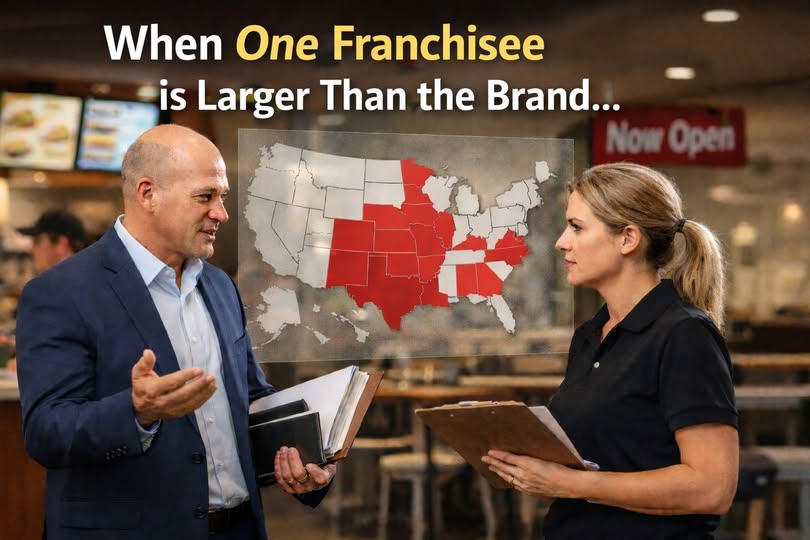
For an emerging franchise brand, few moments feel more validating than attracting an experienced multi-unit operator with a track record in another franchise system, deep pockets, and an appetite for scale. When that interest is paired with a large protected territory and a commitment to develop ten, twenty, thirty or more units, it can feel as though the brand has skipped several chapters in its growth story. The temptation is understandable. These deals signal confidence, momentum, and market belief. Yet they also represent one of the most consequential inflection points a young franchisor will face, because what appears to be acceleration can quietly introduce risks that reshape power, culture, and control in ways that are difficult, if not impossible, to reverse.
At the earliest stages of franchising, the franchisor is still becoming itself. The system may be functional, but it is rarely finished. Unit economics are still being validated across markets. Operating standards are evolving. Support infrastructure is lean by necessity, and leadership is learning in real time how to shift from being an operator to becoming a system builder. When a franchisee enters with significantly more multi-unit experience than the franchisor, the relationship begins on uneven psychological footing. Add a development commitment large enough to materially influence the system’s footprint, and the imbalance becomes structural rather than theoretical.
One of the most overlooked dimensions of this imbalance is financial. The large, experienced operator almost certainly has far greater financial resources than the young franchisor. That reality matters long before a dispute ever arises, because it shapes leverage, confidence, and risk tolerance on both sides. If disagreements escalate into a legal dispute, the operator’s ability to sustain prolonged litigation, absorb legal costs, and apply pressure through delay or attrition can heavily favor them. Even if the franchisor is technically right, the practical cost of being right may be too high for a young organization with limited capital and thin margins. That imbalance alone can subtly influence how firmly a franchisor enforces standards or pushes back on demands, particularly when the operator controls a meaningful percentage of projected system growth.
Operational influence often shifts well before legal leverage is tested. An experienced operator will naturally compare systems, question processes, and suggest alternatives based on what worked elsewhere. Some of that scrutiny can be healthy. The danger lies in how exceptions are handled. Requests framed as efficiency improvements or market realities can lead to carve-outs that are not available to smaller franchisees. Over time, these exceptions become informal policy. The franchisor may still speak about uniformity, but the system begins to operate on two tracks: one for the dominant multi-unit operator and another for everyone else. This is where the risk of the tail wagging the dog becomes real. Control is not lost in a single dramatic moment; it erodes through accommodation, deference, and the quiet fear of losing momentum if the relationship frays.
As the system grows, another subtle but highly consequential dynamic emerges. New franchisees, especially those entering an early-stage brand, naturally look for signals of credibility and stability. In the absence of a long-established franchisor track record, they gravitate toward visible success and experience. When one operator controls a large territory, operates multiple units, and is perceived as seasoned in franchising, that operator can quickly become an informal authority figure within the system. New franchisees may begin seeking guidance, validation, and advice from that operator rather than from the franchisor itself.
Over time, this creates a parallel leadership structure. Practices, shortcuts, and assumptions from another franchise brand can spread peer-to-peer, even when they conflict with the franchisor’s standards or strategic intent. Phrases like “this is how the big operator does it” begin to replace “this is the system standard.” The franchisor is no longer leading by design, but reacting by correction. At that point, the brand risks becoming operator-led rather than system-led, a dynamic that accelerates inconsistency and undermines long-term scalability.
Compounding this risk is the issue of attention gravity. Even when a large operator requires less day-to-day operational support, the sheer size of the deal tends to dominate leadership focus. Meetings, strategy discussions, internal resources, and emotional energy drift toward the partner with the biggest development schedule and the loudest future impact. Smaller early franchisees, often the ones who most need guidance and who quietly define brand culture, can become secondary. In a young system, this imbalance distorts priorities and creates blind spots that only surface later, when leadership realizes it has built processes around one operator rather than around the system as a whole.
Perhaps the most dangerous scenario is not open conflict, but underperformance. Experience in one franchise brand does not guarantee success in another. Differences in positioning, price point, labor model, supply chain, and customer expectations—combined with the reality that the business model may require a far more hands-on operating approach—can erode performance despite prior franchise experience. If a high-profile, large-territory operator struggles to open units on schedule, stalls after a handful of locations, closes underperforming stores, or grows increasingly frustrated with the business model, the consequences extend far beyond those individual units. In an early-stage franchise, perception carries disproportionate weight. Prospective franchisees, brokers, lenders, and vendors will inevitably read meaning into that struggle. One visible stumble can shape the narrative of a young brand far more powerfully than dozens of quiet successes.
When disagreements inevitably arise, the experience gap complicates resolution. The franchisor may feel compelled to assert authority to protect the brand, while the operator may view resistance as inexperience or rigidity. Without clearly defined non-negotiables, governance mechanisms, and escalation paths established from the outset, disputes can become personal rather than procedural. At that point, the imbalance of experience, capital, and influence becomes decisive, not because the franchisor lacks conviction, but because it lacks margin for error.
None of this suggests that large, experienced multi-unit operators are inherently a poor fit within a franchise system, particularly in the context of an emerging brand. When aligned properly, they can bring discipline, capital strength, real estate expertise, and operational insight that accelerates responsible growth. They can stress-test systems, expose weaknesses early, and help professionalize a franchisor’s infrastructure. The difference lies in timing and readiness. The question is not whether the operator is qualified, but whether the franchisor is ready to lead that relationship without compromising control, culture, or clarity.
There are moments when the most strategic decision an emerging franchisor can make is to say no. If systems are still fragile, if leadership lacks confidence in enforcing standards under pressure, if legal and financial reserves are insufficient to withstand serious conflict, or if a single operator would control an outsized share of future development, restraint is not caution—it is leadership. Growth one unit at a time is not a sign of weakness. It is often a sign of discipline.
Acceleration should come after the foundation is proven, not before. When a franchisor has validated unit economics across markets, refined its support model, clarified non-negotiable brand standards, and built the confidence to say no—even to powerful partners—multi-unit development becomes an asset rather than a liability. In franchising, momentum is valuable, but control is essential. The brands that endure are rarely the ones that grew fastest at the beginning, but the ones that grew at the right pace for who they were at the time.
One final thought is worth emphasizing. This is not an argument for automatically turning down a large, experienced operator or rejecting an ambitious multi-unit development deal outright. It is, however, a call to explore such opportunities with extreme caution, intentional structure, and sober perspective. These decisions should never be driven solely by excitement, ego, or the pressure to “prove” scalability early.
Before entering into any large, system-shaping agreement, an emerging franchisor should consult not only with their franchise attorney, but also with experienced franchisors who have navigated similar inflection points and with seasoned franchise development or advisory professionals who understand how power, culture, and control evolve as systems grow. Legal agreements can define rights and remedies, but they cannot replace judgment, lived experience, and foresight. In many cases, the most valuable insight comes from those who have already learned—sometimes the hard way—where early enthusiasm can quietly turn into long-term constraint.
Handled deliberately, a large, experienced operator can become a strategic partner and catalyst for sustainable expansion. Handled prematurely, the same relationship can redefine a young system before it has had the opportunity to define itself.
About the Author
Paul Segreto brings over forty years of real-world experience in franchising, restaurants, and small business growth. Recognized as one of the Top 100 Global Franchise and Small Business Influencers, Paul is the driving voice behind Acceler8Success Café, a daily content platform that inspires and informs thousands of entrepreneurs nationwide. A passionate advocate for ethical leadership and sustainable growth, Paul has dedicated his career to helping founders, franchise executives, and entrepreneurial families achieve clarity, balance, and lasting success through purpose-driven action.
About Acceler8Success America
Acceler8Success America is a comprehensive business advisory and coaching platform dedicated to helping entrepreneurs, small business owners, and franchise professionals achieve The American Dream Accelerated.
Through a combination of strategic consulting, results-focused coaching, and empowering content, Acceler8Success America provides the tools, insights, and guidance needed to start, grow, and scale successfully in today’s fast-paced world.
With deep expertise in entrepreneurship, franchising, restaurants, and small business development, Acceler8Success America bridges experience and innovation, supporting current and aspiring entrepreneurs as they build sustainable businesses and lasting legacies across America.
Learn more at Acceler8SuccessAmerica.com

You must be logged in to post a comment.