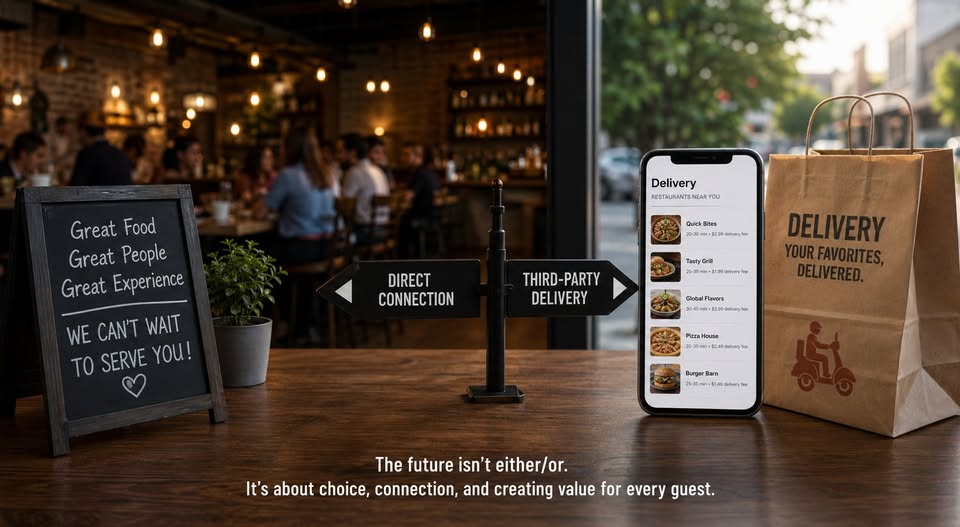
Delivery has become part of restaurant life. But convenience does not have to mean surrendering the customer, the margin, the brand experience, and ultimately the relationship.
There was a time when delivery was relatively simple. Pizza restaurants delivered pizza. Chinese restaurants delivered Chinese food. A handful of other concepts built delivery into their operating models, employed their own drivers, defined their own delivery areas, answered their own phones, collected their own customer information, and—most importantly—owned the relationship from the moment the order was placed until the food arrived at the customer’s door. Then the restaurant industry changed. Technology changed. Consumer expectations changed. Smartphones changed. The pandemic accelerated everything. And third-party delivery platforms moved from being an interesting incremental sales channel to something that, for many restaurant operators, began to feel almost unavoidable. Today, millions of customers don’t necessarily decide which restaurant they want and then figure out how to order from it. They open an app, browse dozens or hundreds of restaurants, compare pictures, promotions, delivery times, ratings and prices, and make their decision inside somebody else’s marketplace. That seemingly small change may be one of the most consequential shifts the restaurant industry has experienced in decades because it raises a fundamental question: Can today’s restaurant industry survive without third-party delivery? And perhaps more importantly, can it truly thrive while becoming increasingly dependent upon it?
Before answering, we need to separate two things that are too often treated as synonymous: off-premises dining and third-party delivery. They are absolutely not the same. Takeout, curbside pickup, drive-thru, catering, direct delivery, digital ordering and third-party delivery all fall within the broader off-premises universe, but their economics and their relationships with customers can be dramatically different. According to National Restaurant Association research, nearly three-quarters of restaurant traffic now occurs off-premises. Forty-seven percent of adults report picking up takeout at least weekly, 42% use drive-thrus weekly and 37% order delivery at least weekly. Younger consumers are even more engaged, with Gen Z and millennials increasingly considering off-premises restaurant occasions essential to their lifestyles. That tells me something important. Restaurants probably cannot turn back the clock on convenience. Nor should they try. But accepting convenience as a permanent consumer expectation does not automatically mean accepting third-party delivery as the permanent gatekeeper between restaurants and their customers.
We Need to Stop Confusing Revenue With Profitable Revenue
This is where the conversation becomes uncomfortable. Restaurant operators are naturally attracted to incremental revenue. An order that might not otherwise have existed appears on a tablet, food moves through the kitchen, another sale hits the POS system and gross revenue increases. But restaurant economics have never been about revenue alone. Food cost matters. Labor matters. Occupancy matters. packaging matters. credit-card fees matter. waste matters. marketing matters. discounting matters. And when another party is inserted between the restaurant and the consumer, the economics become even more complicated. Research discussed by the Wharton School has suggested that delivery platforms can intensify competition and pressure restaurant profitability even while providing access to customers and incremental demand. That should cause operators to ask a question that sounds ridiculously obvious but too often gets lost in the pursuit of sales: What are we actually making on these orders?
The answer will not be the same for every restaurant. A concept with strong food margins, efficient kitchen production, delivery-friendly products and sufficient unused kitchen capacity may find third-party delivery highly attractive. Another restaurant may discover that an additional $20,000 in monthly third-party sales creates considerably less incremental profit than expected after all associated costs are considered. Worse, those orders may arrive during peak periods when the kitchen is already operating near capacity, potentially slowing service for higher-margin dine-in and direct-order customers. In that situation, the restaurant hasn’t necessarily created incremental business. It may simply have introduced another competitor for its own kitchen capacity. That distinction needs considerably more attention.
The Answer Is Different for QSR, Fast Casual, Casual Dining and Fine Dining
Any discussion about eliminating—or reducing dependence upon—third-party delivery becomes meaningless if we attempt to apply one answer across the entire restaurant industry. A quick-service restaurant selling burgers, chicken, sandwiches, pizza or bowls operates in a completely different universe from an upscale steakhouse. Fast casual is different from family dining. A neighborhood independent is different from a 2,000-unit national chain. A restaurant generating a substantial percentage of business at lunch in an urban market faces a different consumer than a destination restaurant serving dinner in a suburban community.
For QSR and many fast-casual concepts, convenience isn’t merely an amenity anymore; it is part of the product. Customers are purchasing food, but they’re also purchasing time. The restaurant that tells a 28-year-old professional accustomed to ordering dinner from a phone that delivery is no longer available may not successfully retrain that customer. It may simply lose the customer. National Restaurant Association research reinforces just how deeply mobile and off-premises behavior has penetrated younger demographics: 74% of millennials and 65% of Gen Z adults had recently used mobile ordering according to its 2025 research. For these concepts, abandoning delivery altogether could be extremely difficult.
But that doesn’t mean they must abandon direct ordering.
Pizza offers perhaps the most obvious lesson. The pizza industry built delivery long before third-party marketplaces became ubiquitous. Many successful pizza brands trained generations of customers to call them directly and later migrated those relationships to websites and proprietary apps. The lesson isn’t necessarily that every restaurant should suddenly hire drivers. The lesson is that restaurants once understood that the customer ordering their food was their customer. That principle should not disappear simply because technology introduced another way of reaching the customer’s front door.
Casual dining presents another challenge. Here I believe restaurants should be much more selective. A casual restaurant exists partly because people want to gather. The food matters, certainly, but so do the booth, the bartender, the television showing the game, the birthday celebration, the server who remembers a regular customer, the appetizer shared across the table and the extra drink ordered because nobody is rushing out the door. Those occasions generate economic value that cannot necessarily be recreated by putting the entrée in a plastic container and sending it fifteen miles away. The National Restaurant Association has found that rebuilding on-premises traffic is a particularly high priority for casual and fine-dining operators, including 87% of casual-dining and 90% of fine-dining operators in its 2025 industry research.
Fine dining is an even clearer case. What exactly are we delivering? Is it dinner, or merely food? A $70 steak sitting in a container for thirty minutes is not the same product as that steak arriving properly rested and plated at the table. The ambiance is gone. The wine presentation is gone. The server is gone. The lighting is gone. The conversation with the bartender is gone. The anticipation is gone. The plating may be compromised. And the restaurant has potentially taken something designed as an experience and reduced it to a commodity competing on a screen alongside dozens of other choices. There may certainly be opportunities for carefully designed take-home experiences, catering, meal packages and premium delivery, but I would question whether conventional third-party delivery should ever become strategically central to most fine-dining brands.
Geography Changes Everything
We also need to stop talking about the American restaurant consumer as if he or she is one person. Manhattan isn’t Houston. Houston isn’t rural Iowa. Downtown Chicago isn’t suburban Atlanta. A college town isn’t a retirement community. Geography fundamentally changes the delivery equation.
Dense urban markets provide obvious advantages for third-party delivery. Large populations live within relatively small radiuses, consumers may not own automobiles, apartment living is common and restaurants are abundant. Convenience can genuinely mean not walking six blocks in the rain or not taking an elevator twenty floors down after a long workday. Delivery density can also make logistics more efficient. In those markets, I have difficulty imagining delivery disappearing as a major restaurant channel.
Move into suburban America, however, and the calculation changes. Consumers often own cars. Restaurants frequently have parking lots. Drive-thrus, curbside pickup and dedicated pickup shelves become practical alternatives. A customer may decide that driving seven minutes to pick up a $40 dinner is preferable to turning it into a significantly more expensive transaction after delivery charges, service charges, tips and potentially higher menu pricing are considered. Here lies an enormous opportunity for restaurants: make pickup extraordinarily easy. Dedicated parking. Accurate preparation times. Clearly marked pickup entrances. Shelves or lockers where appropriate. Text notifications. One-click reordering. Loyalty rewards. Family meal bundles. Perhaps even drive-up delivery to the customer’s vehicle. The objective shouldn’t be to make customers feel guilty for using third-party delivery. It should be to make ordering directly from the restaurant so easy and valuable that many customers voluntarily choose it instead.
Rural markets offer yet another equation. Restaurant density is lower, distances are greater and driver economics become more difficult. Yet there may be significant unmet demand. National Restaurant Association research found that 67% of rural consumers wanted more takeout options. That doesn’t necessarily scream “more third-party delivery” to me. It screams opportunity for creative local distribution. Restaurants could collaborate on local delivery networks. Communities could support shared delivery infrastructure. Restaurants might designate delivery days or defined delivery windows. Technology providers could facilitate ordering without controlling the entire customer relationship. We have spent years assuming the only innovation available is the model already dominating the marketplace. I don’t believe that’s true.
Demographics May Be the Toughest Challenge
Age may ultimately prove more important than geography. Older consumers who grew up calling restaurants or walking inside to place orders may have little resistance to direct ordering and pickup. Younger consumers have been conditioned differently. For them, aggregation itself has value. They aren’t always thinking, “I want Restaurant X.” They may be thinking, “I’m hungry. Show me what’s available.”
That difference is enormous.
The third-party platform isn’t simply providing delivery. It owns discovery.
That may ultimately be more valuable than the driver’s role. The restaurant isn’t just outsourcing transportation; it may be outsourcing the moment when the customer decides what to eat. Recent commentary about the delivery marketplace has made precisely this point: the real competitive battleground may increasingly be customer ownership rather than food production or delivery logistics alone. Once we understand that, the strategic danger becomes clearer. If consumers increasingly begin their restaurant journey inside somebody else’s app, restaurants risk becoming suppliers inside someone else’s ecosystem.
And suppliers are easier to replace than brands.
The Restaurant Industry Should Not Declare War on Third-Party Delivery
I don’t believe the answer is for restaurants to delete their accounts tomorrow morning. That would be unrealistic and, for many concepts, financially irresponsible. Third-party platforms provide tremendous consumer reach, technological infrastructure, logistics and discovery. They can introduce restaurants to customers who might never have found them otherwise. They can create incremental demand during slower periods. They can make delivery economically possible for operators that could never justify building an internal driver network. And there are restaurants that have become extraordinarily successful using these platforms. Here in Houston, for example, Aga’s Restaurant reportedly became the world’s highest-volume single-location restaurant on Uber Eats based on 2025 metrics, while building an enormous overall takeout operation. Clearly, third-party delivery can work spectacularly well under the right circumstances.
But there is a difference between using a channel and becoming dependent upon it.
Restaurants need to understand that difference.
What Needs to Change?
In my opinion, restaurants need to begin treating third-party delivery as customer acquisition and distribution, not as ownership of the customer relationship. That requires a completely different mindset. If a consumer discovers a restaurant through a delivery marketplace, wonderful. The restaurant gained exposure. Now the strategic objective should be creating enough brand value that the next interaction becomes direct whenever possible and appropriate. That means stronger loyalty programs, better first-party ordering technology, more compelling direct-order benefits, excellent pickup experiences, meaningful customer databases and marketing that gives customers a reason to maintain a relationship with the restaurant itself.
Restaurants also need menus designed specifically for off-premises consumption instead of assuming every dine-in item belongs in a delivery container. Some foods travel beautifully. Others deteriorate rapidly. Operators should evaluate contribution margin, preparation time, packaging requirements, travel durability and customer satisfaction by item. A delivery menu may need to be smaller than the restaurant menu. Prices may need to reflect channel economics where permitted. Bundles can increase average tickets. Family meals may travel better than individual entrées. Beverages, desserts, sauces, packaged products and reheatable items can expand tickets. The National Restaurant Association has found considerable consumer interest in meal bundles, meal kits, subscriptions and other expanded off-premises offerings. Off-premises shouldn’t merely mean putting the dining-room menu into containers.
Most importantly, restaurants need to rediscover the value of experience.
For years we have heard that consumers increasingly value experiences. Restaurants should own that advantage instead of surrendering it. You cannot download atmosphere. You cannot deliver the energy of a packed sports bar during a playoff game. You cannot put the smell of a wood-fired oven into a delivery bag. You cannot recreate the bartender remembering someone’s drink, the chef walking through the dining room, friends lingering over dessert, a first date, a business lunch, a family celebration or thirty minutes spent sitting across from someone we care about. National Restaurant Association research indicates that operators themselves recognize the importance of hospitality, atmosphere and socialization in creating perceived value and rebuilding restaurant traffic.
Restaurants need to give customers a reason to leave the house again.
That doesn’t mean abandoning convenience. It means creating two compelling propositions instead of one compromised proposition: an extraordinary restaurant experience when customers come to us and an extraordinarily convenient direct relationship when they don’t.
Maybe We Have Been Asking the Wrong Question
Can the restaurant industry survive without third-party delivery?
Some segments probably could. Some individual restaurants absolutely could. Others—particularly concepts heavily dependent upon younger consumers, dense urban populations and convenience occasions—might struggle significantly. But I don’t believe elimination is the question the industry should be debating.
The better question is whether restaurants can build a future in which third-party delivery is one channel among several instead of the channel upon which they become dependent.
Restaurants should own their brands. They should fight to own their customer relationships. They should build their own databases. They should reward direct customers. They should make pickup ridiculously easy. They should rethink their physical footprints around changing consumer behavior. They should create menus engineered for different channels. They should calculate profitability by channel instead of celebrating gross sales. They should use third-party marketplaces strategically for discovery, reach and incremental volume while continuously strengthening direct relationships.
And perhaps the restaurant industry should recognize something even bigger. The consumer isn’t necessarily demanding third-party delivery.
The consumer is demanding convenience.
Those are not the same thing.
If restaurants can provide convenience themselves—through better technology, curbside pickup, drive-thru innovation, direct delivery, subscriptions, catering, family meals, loyalty programs, scheduled ordering and perhaps new cooperative delivery models—then the industry’s relationship with third-party delivery can evolve from dependency toward partnership.
That is where I believe the opportunity lies.
The restaurant industry does not need to choose between the dining room and the doorstep. It needs to become much better at understanding the economics, purpose and customer behind each transaction. Sometimes the right answer will be third-party delivery. Sometimes it will be direct delivery. Sometimes it will be takeout. Sometimes it will be drive-thru. And sometimes the greatest opportunity will be convincing customers that getting out of the house, sitting down with friends or family, enjoying genuine hospitality and spending 30 or 40 minutes together is worth far more than having another bag left at the front door.
Because ultimately, restaurants were never built merely to distribute food.
They were built around hospitality, connection, convenience, community and experience.
Technology should help restaurants deliver those things. It should never cause them to forget which business they’re actually in.
Final Thoughts
Third-party delivery is probably not going away, nor should restaurants necessarily want it to. But dependency is different from participation. The winners of the next chapter of the restaurant industry may not be those that reject delivery or those that embrace it without question. They may be the operators who understand exactly when to use it, what it costs them, which customers want it, which menu items belong there and—above all—how to ensure that the restaurant’s brand remains more important than the app that delivered the meal.
So perhaps the question restaurant owners should be asking isn’t, “Can I afford to leave third-party delivery?”
It may be:
“Can I afford to let someone else own the relationship with my customer?”

You must be logged in to post a comment.