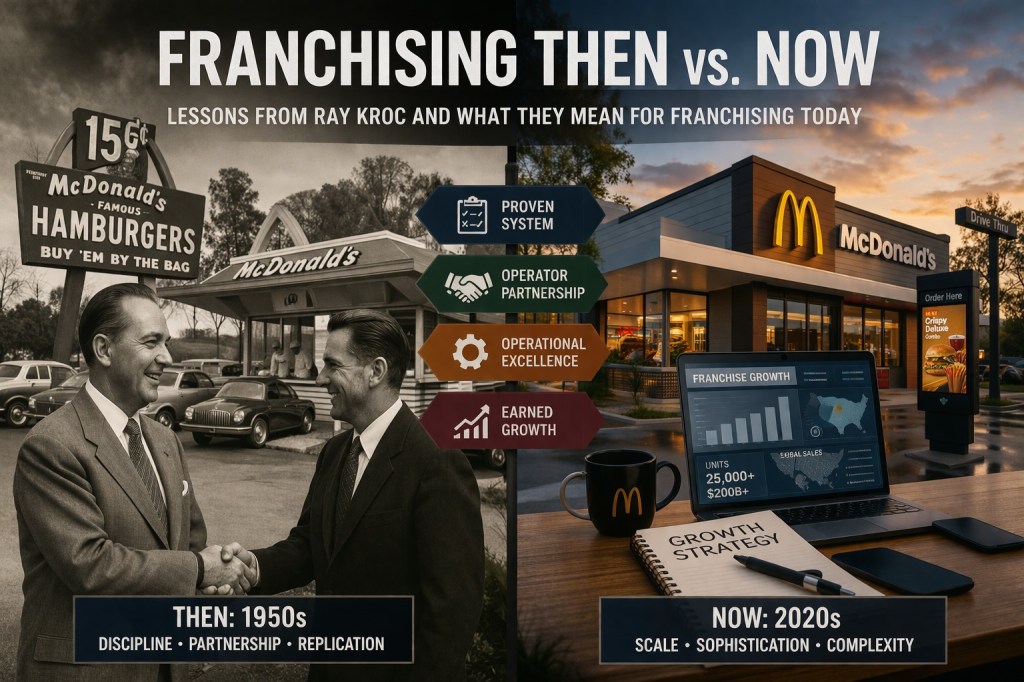
There was a time when franchising was not a sophisticated strategy wrapped in legal frameworks, private equity models, and layers of operational complexity. It was simpler. More personal. More intuitive. And in many ways, more honest.
When Ray Kroc began franchising McDonald’s in 1955, he wasn’t building a franchise system as we define it today. He was building a belief system. A way of doing things. A standard that could be replicated not just operationally, but culturally.
Franchising today is a very different machine.
Back then, it was about replication of a proven model with obsessive consistency. Today, it is often about scaling a concept as quickly as possible, sometimes before it is truly ready. Back then, the relationship between franchisor and franchisee was deeply rooted in partnership. Today, it can feel more like a transaction.
Kroc’s approach was grounded in discipline. He didn’t sell franchises to just anyone with capital. He looked for operators. People who would be in the restaurant, not above it. People who would live the business, not just invest in it.
Today, franchising has opened the door to a different kind of buyer. Multi-unit operators, private equity-backed groups, portfolio investors. There is nothing inherently wrong with that evolution. In fact, it has enabled brands to scale faster and reach markets that would have taken decades otherwise.
But something has been diluted along the way.
The early days of franchising demanded operational excellence before expansion. Systems were built, tested, refined, and proven repeatedly. Expansion was earned, not assumed. Today, too many brands reverse that equation. They sell the vision first, then attempt to build the infrastructure after the fact.
Kroc understood something fundamental that still applies today. Franchising is not a growth strategy. It is a replication strategy. Growth is the outcome, not the objective.
He was relentless about consistency. From the way a burger was assembled to how long fries stayed in the oil, everything was defined. Controlled. Measured. That level of discipline created trust. Customers knew exactly what they would get, no matter the location.
Today, consistency often competes with customization. Brands chase trends. Menus expand. Operations become more complex. In doing so, they sometimes lose the very thing that made them scalable in the first place.
Another defining difference is how success was measured.
In Kroc’s era, success was built unit by unit. Store-level economics mattered. Profitability mattered. The operator mattered. Today, success is too often measured by unit count, system-wide sales, or valuation multiples. Metrics that look impressive on paper but don’t always reflect the health of the individual business.
And that is where the risk lies.
Because franchising, at its core, is still about the unit. The individual business. The entrepreneur who has invested their capital, their time, and their future into that location.
When that gets lost, the system becomes fragile.
So what can we learn from the early days of franchising?
We can relearn the importance of discipline before scale. The idea that not every brand is ready to franchise, no matter how compelling the concept may be.
We can re-emphasize operator-first franchising. Not just selling to those who can afford it, but to those who are committed to it.
We can simplify. Complexity is the enemy of scalability. The more complicated the model, the harder it is to replicate consistently.
We can realign incentives. The success of the franchisor should be directly tied to the success of the franchisee, not just the sale of the franchise.
And perhaps most importantly, we can return to the idea that franchising is a long-term commitment, not a short-term growth play.
The evolution of franchising has brought undeniable advantages. Access to capital. Faster expansion. Greater market reach. But progress does not always mean improvement in every dimension.
Sometimes, the path forward requires looking back.
The principles that built McDonald’s into one of the most recognized brands in the world were not complex. They were disciplined. Intentional. Relentless in their execution.
Franchising today does not need to go backward. But it would benefit from remembering where it came from.
Because the future of franchising will not be defined by how fast brands grow.
It will be defined by how well they are built.
If you’re considering franchising your business, take a step back before you take the next step forward.
Franchising is not about speed. It’s about structure. It’s about alignment. It’s about building something that works… unit by unit, before it ever scales.
If you’re ready to explore franchising your business the right way, or want an objective perspective on whether doing so truly makes sense for you, connect with me directly, or email me at Paul@Acceler8Success.com.
The American Dream of Entrepreneurship is still very much alive.
Let’s build it the right way.

You must be logged in to post a comment.