As the Multi-Unit Franchising Conference comes to a close, I’ve found myself reflecting on the conversations shared with me from a number of attendees…
Because over the past few days, I’ve shared a different perspective.
That multi-unit is not the destination. It’s the transition.
That multi-brand is not simply growth. It’s a shift in mindset.
And that the real evolution in franchising isn’t measured by how many units you own…
It’s defined by how you think.
Operator → Entrepreneur Execution → Strategy Units → Enterprise
That’s the progression.
And yet…
Most never make that shift deliberately.
They scale within a system. But rarely step back to design one.
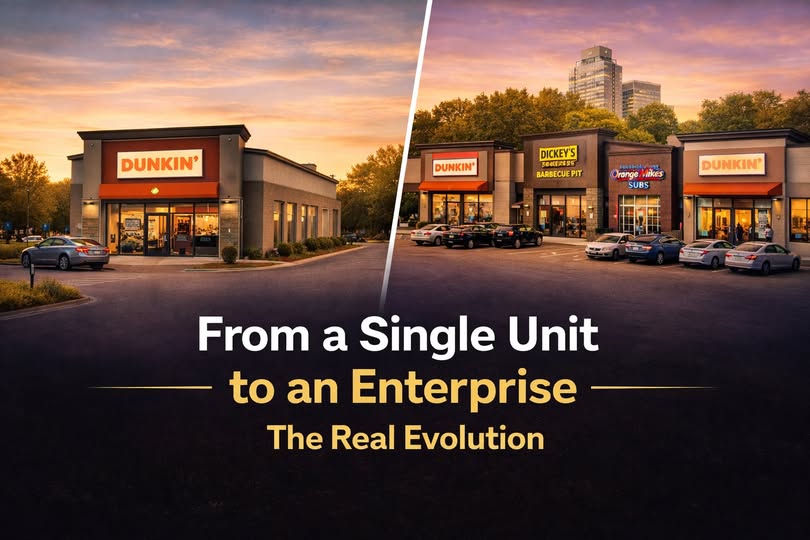
The image I’ve shared says it simply:
From a single unit… to an enterprise.
But what’s not visible is the decision that happens in between.
The moment when you stop asking: “How do I grow this brand?”
And start asking: “What am I actually building?”
That’s where everything changes.
So let me ask you—
Coming out of this week…
Where do you see the real opportunity?
Is it continuing to scale within a brand you know well? Or is it stepping back and building something broader, more intentional, more enterprise-driven?
At what point does focus become limitation?
At what point does experience in one brand create the confidence—or the obligation—to think beyond it?
And for those who have already made the move…
What triggered it?
Opportunity? Frustration? Vision? Or necessity?
No right answer.
But it is a very different conversation depending on how you see it.
Over the past few days, I’ve shared thoughts on: • Multi-unit franchising • Multi-brand franchising • And where the real inflection point actually is
If you’ve been following along, I’d genuinely value your perspective.
Where are you in that journey?
And if this conversation resonates, if you’re at that point where growth needs to become more intentional, more structured, more strategic—
Let’s talk.
I’m working with operators, investors, and franchisors who are navigating this exact transition… from units to enterprise, and with refranchising in the mix.
Reach out to me directly at paul@acceler8success.com to start the conversation and explore what a deliberate, strategic growth plan could look like for you.
It’s Time to Think Strategically About Refranchising Opportunities
If you’ll be attending the Multi-Unit Franchising Conference in Las Vegas, March 24–27, 2026, you can expect to hear a lot about growth. New units. Development pipelines. Territory expansion. It’s what this conference has always represented at its core, and why it continues to be one of the most valuable gatherings on the franchise circuit.
But here’s a perspective I’d encourage you to consider while you’re there.
Growth today is no longer just about building more. It’s about building smarter. And in my view, one of the most overlooked strategies, particularly for experienced operators, is refranchising.
This isn’t about what’s being presented on stage or showcased in the exhibit hall. This is about what should be part of your thinking in the hallways, in the quieter conversations, and in your own strategic planning.
The landscape continues to change. Multi-unit operators are increasingly becoming multi-brand operators. Capital is being deployed with greater discipline. The focus is shifting from unit count to portfolio quality, cash flow durability, and long-term enterprise value. Within that context, refranchising deserves far more attention than it typically receives.
For experienced operators, refranchising is not a fallback. It is a strategic growth lever.
At its core, it offers something traditional development often cannot… immediacy. You are not starting from zero. You are stepping into an operating business. There is revenue, a team, a customer base, and real performance data. Even if the unit is underperforming, it is grounded in reality. That alone changes the risk profile. You are not underwriting projections, you are evaluating what already exists.
For operators already managing multiple units, this distinction is critical. Growth is no longer just about opening doors. It is about deploying capital efficiently. Time to revenue matters. Time to scale matters. Refranchising compresses both.
And importantly, many refranchising opportunities are not single-unit acquisitions. You can often acquire multiple units within a market or across a region. That creates immediate scale. It builds density. It strengthens operational leverage. Instead of developing one unit at a time over several years, you can step into a cluster of locations and begin optimizing performance from day one.
That is a fundamentally different growth curve.
There is also a significant information advantage. With new development, you rely on Item 19 disclosures, validation calls, and assumptions. With refranchising, you analyze actual performance… labor, food costs, traffic patterns, and market dynamics. It’s all there. And for a seasoned operator, underperformance often signals opportunity rather than risk.
Because more often than not, these units are not being refranchised because the brand is broken. They are being repositioned due to ownership structure, strategic shifts, or a lack of focused execution. And importantly, these opportunities are not limited to struggling assets. In many cases, portfolios include a mix of both underperforming and highly successful units.
That balance is powerful, especially when acquiring multiple locations. High-performing units provide immediate cash flow and stability. Underperforming units offer upside through operational improvement. Together, they create a more balanced risk profile and a clearer path to value creation.
Corporate ownership, in particular, can sometimes lack the urgency, discipline, and local focus of a strong operator. What appears to be a problem can quickly become an opportunity in the right hands.
For multi-unit operators, that’s the advantage. You’re not learning the business. You’re improving it.
Refranchising also provides access to markets that might otherwise be unavailable. Prime trade areas are rarely open for new development—they’re already built out. Refranchising allows you to step into established locations with existing infrastructure and brand awareness. If your strategy includes building density, this is one of the most effective ways to do it.
And for those thinking beyond a single brand, this becomes even more compelling. Refranchising allows you to enter well-known brands, especially in the restaurant sector, at scale, without starting from scratch. It gives you the ability to evaluate, integrate, and expand within a portfolio framework. In many cases, franchisors are also motivated to place the right operators and often offer attractive incentives to facilitate that transition.
So while you’re at the Multi-Unit Franchising Conference, I’d encourage you to think beyond new unit development.
Ask yourself a different set of questions.
Where are the refranchising opportunities within strong, established brands? Where are there underperforming assets that could perform under your leadership? Where are the high-performing units that can anchor your investment? Where can you acquire multiple units and create immediate scale?
Those questions may not be front and center at the conference, but they should be front and center in your strategy.
Of course, refranchising is not without its challenges. Turnarounds require discipline. Teams must be realigned. Lease structures and capital requirements need careful evaluation. But for experienced operators, these are variables to be managed, not barriers to entry.
The key is clarity. Why is the unit underperforming? What will you do differently? How quickly can performance improve? What is the realistic path to profitability? Operators who approach refranchising with this level of focus consistently outperform those who rely solely on development for growth.
In a market where new development is more expensive, more competitive, and often slower to stabilize, refranchising offers something different… visibility, speed, and intentional growth.
And when approached correctly, it offers the ability to scale faster, smarter, and with greater control.
If you’re attending the Multi-Unit Franchising Conference or simply evaluating your next phase of growth, Acceler8Success America currently has over twenty refranchising opportunities within its growing portfolio—all within restaurant brands—including multi-unit packages that provide a strategic mix of high-performing and turnaround-ready locations.
And if what you’re looking for isn’t currently in our portfolio, we are actively engaged in discussions and negotiations with several additional brands. Based on our current pipeline, we expect our portfolio of refranchising opportunities to grow by two to three times over the next 90 days.
If you’re interested in learning more, reach out directly to me at paul@acceler8success.com or connect via direct message on LinkedIn.
Because while many will be focused on building the next unit, the real opportunity may lie in the units that already exist.
Refranchising has long been a strategic tool used by mature franchise systems to strengthen balance sheets, sharpen operational focus, and place restaurants in the hands of committed operators. Yet for many franchisors, refranchising is treated as a transactional exercise rather than the strategic growth initiative it should be.
In today’s uncertain economic climate, refranchising deserves far more attention. Done correctly, it stabilizes the brand, places locations with the right operators, and prepares the system for the next phase of growth. Done poorly, it simply transfers underperforming assets from one owner to another without addressing the underlying issues.
The difference lies in strategy.
At its core, effective refranchising begins with creating a clear and compelling story for every location or group of locations being offered for sale. Prospective franchisees are not simply buying a restaurant. They are investing in a future business opportunity. Without a well-articulated narrative explaining the current condition of the unit and the path forward, even experienced operators struggle to visualize long-term potential.
The starting point is transparency.
Why is the unit being sold?
The answer must be truthful and direct. In many cases the reasons are operational realities that can be addressed: corporate ownership priorities shifting, underperforming units that need local ownership, lease structures that require renegotiation, or locations that would perform better under multi-unit operators with a local market presence. Attempting to mask the truth undermines credibility. Investors and experienced franchise operators recognize challenges quickly. Franchisors that openly acknowledge those realities while presenting a credible improvement plan immediately gain trust.
Once the narrative is established, the next step is developing a specific turnaround or improvement plan for each opportunity.
A refranchising plan should never be generic. Each location deserves its own operational and strategic review. Some locations may require aesthetic changes such as updated interior finishes, signage improvements, lighting adjustments, or modernized exterior branding to better reflect current brand standards. Others may require functional changes that have a direct impact on profitability, such as kitchen layout improvements, technology upgrades, revised labor models, or menu adjustments better suited to the local market.
These changes should be clearly documented in the refranchising plan. Prospective buyers should understand what improvements are recommended, what they will cost, and what operational benefits they are expected to produce.
Equally important is identifying the ideal candidate for each opportunity.
One of the most common mistakes franchisors make is applying a single franchise candidate profile across every refranchising opportunity. The ideal buyer for a turnaround urban location may be very different from the operator best suited for a suburban market with strong catering potential. Some opportunities may require seasoned multi-unit restaurant operators with existing infrastructure. Others may be ideal for experienced franchisees within the system looking to expand their territory.
Defining the ideal candidate criteria for each specific opportunity increases the likelihood that the location ends up with the right operator.
Understanding the market itself is another critical component.
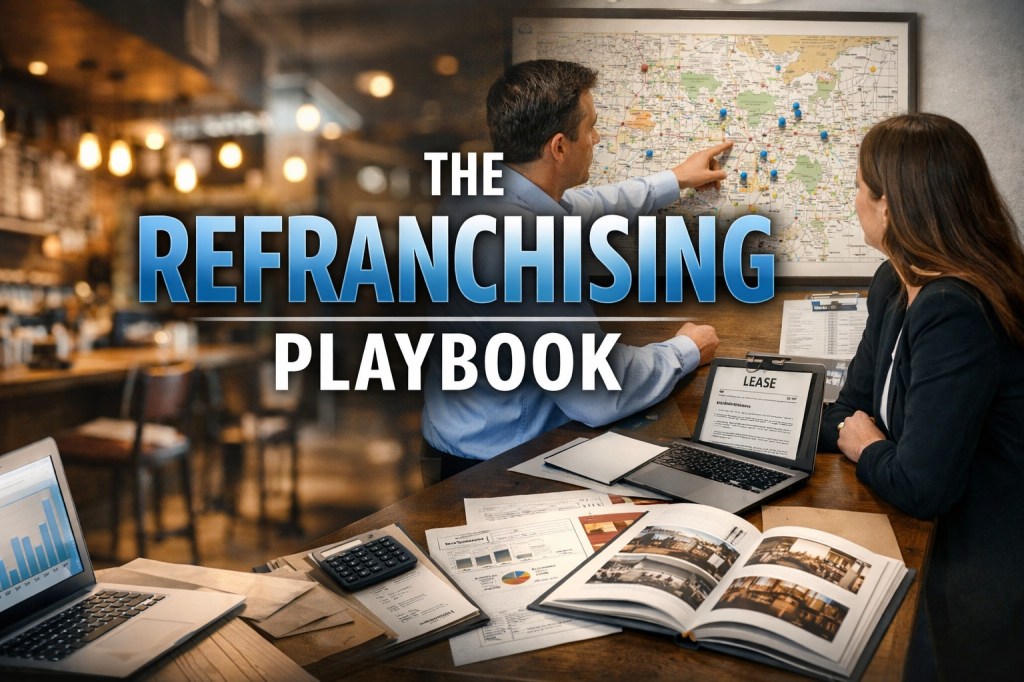
Every refranchising opportunity should include detailed market intelligence. Demographic data, population trends, daytime employment levels, traffic patterns, and household income levels all contribute to understanding the true potential of a location. Equally important is a careful review of the competitive landscape. Identifying nearby competitors, analyzing their positioning, and understanding their strengths and weaknesses provides valuable context for the buyer.
This information helps prospective franchisees see not only where the location stands today, but where it can realistically compete in the future.
Lease analysis is another often overlooked element in refranchising preparation.
A thorough review of each lease should identify key factors such as renewal dates, rent escalation schedules, common area maintenance obligations, and potential opportunities for renegotiation. In many cases, landlords welcome the opportunity to work with a new franchisee. A fresh operator bringing new energy to a location can represent a positive outcome for the property owner. Proactively exploring these possibilities can strengthen the investment case significantly.
Support from the franchisor also plays a major role in successful refranchising.
Rather than offering generic onboarding support, franchisors should develop a transition and support plan tailored to each location or group of locations. This may include enhanced training, operational support during the transition period, local marketing initiatives, or assistance with facility improvements.
For underperforming units, franchisors may also consider temporary financial relief structures that demonstrate commitment to the franchisee’s success. One example is a graduated royalty structure where royalty payments start at a reduced rate and increase over time as the location stabilizes and grows. When used thoughtfully, this approach signals partnership rather than simple asset transfer.
These types of support mechanisms can make a meaningful difference when recruiting experienced operators who are evaluating the risk of taking on a turnaround opportunity.
Perhaps the most important aspect of refranchising strategy is how the opportunity is presented.
The pitch for refranchising an existing location is very different from the pitch for a new franchise territory. A new franchise sale focuses on the brand story and development potential. Refranchising requires a more detailed investment narrative built around a specific location.
An effective refranchising pitch should clearly outline the current performance, the reasons for sale, the market dynamics, the improvement strategy, the investment required, and the long-term opportunity. When properly developed, this narrative allows prospective franchisees to see the path forward rather than focusing solely on current challenges.
In many cases, even experienced operators struggle to visualize long-term potential without this level of clarity. Providing a well-structured plan helps bridge that gap and significantly increases buyer confidence.
In today’s economic environment, refranchising is no longer simply a method for franchisors to reduce corporate ownership. It is a strategic tool for strengthening the system, attracting stronger operators, and positioning the brand for future expansion.
For brands navigating uncertain markets, it may be time to place a much larger spotlight on refranchising as part of the broader growth strategy.
When approached thoughtfully, refranchising becomes more than a transaction. It becomes a catalyst for system stability, operational improvement, and renewed momentum across the franchise network.
If your organization is evaluating the sale of corporate locations or franchise units that require new ownership, developing a structured refranchising strategy can make the difference between a difficult transaction and a successful long-term transition.
Acceler8Success America works with franchisors to design and execute disciplined refranchising strategies, from location-specific turnaround plans and market analysis to investor positioning and candidate recruitment.
If your brand is considering refranchising opportunities, let’s start the conversation about how to structure those opportunities for success. Please reach out to me at paul@acceler8success.com or via a direct LinkedIn message.
For decades, franchising has been presented as the rational path to restaurant ownership. Proven systems. Brand recognition. National marketing. Operational playbooks. Reduced uncertainty.
It is positioned as structured entrepreneurship.
And in many respects, it is.
But structure does not eliminate risk. It reallocates it. And capital, once deployed, demands more than operational stability. It demands appreciation.
If we remove sentiment from the equation and look at franchising through a capital markets lens, the conversation changes.
Consider a QSR model requiring a total investment between $475,000 and $625,000. We settle at $525,000. Franchise fee. Build-out. Equipment. Technology infrastructure. Opening inventory. Training. Working capital. The cost of admission into a system that promises a blueprint.
Three years later, the restaurant is stable. It produces $100,000 in annual net income. It is not failing. It is not distressed. It is performing in line with expectations for many operators in competitive markets populated by strong national and regional brands.
By conventional small-business standards, this is a success.
By capital allocation standards, it is a question mark.
Apply a modest three-times earnings multiple, typical for a single-unit resale in many restaurant systems. $100,000 becomes $300,000. Add perhaps $100,000 in hard assets. The estimated market value lands around $400,000.
Initial capital deployed: $525,000. Estimated enterprise value: $400,000.
There is a structural gap.
Yes, the owner may have extracted income along the way. Yes, debt may be amortizing. Yes, personal compensation matters. But from a valuation standpoint, the asset has not yet justified the capital risk in a compelling way.
This is where many entrepreneurs blur the line between income and equity.
Income is transactional. Equity is transformational.
A business that generates six figures annually may feel prosperous. But if it does not compound enterprise value relative to capital deployed, the return profile begins to resemble structured employment rather than asset creation.
The uncomfortable reality is that many franchise systems exhibit wide dispersion between median and top-quartile units. The median may produce acceptable cash flow. The top quartile produces valuation lift.
Buyers reward predictability above average performance. Lenders reward scale and stability. Institutional investors reward platform potential.
Median performance rarely commands premium multiples.
So the question becomes: are you underwriting to the median, or are you underwriting to the top quartile?
And perhaps more importantly: do you have a strategy to reach it?
Now consider a different entry point.
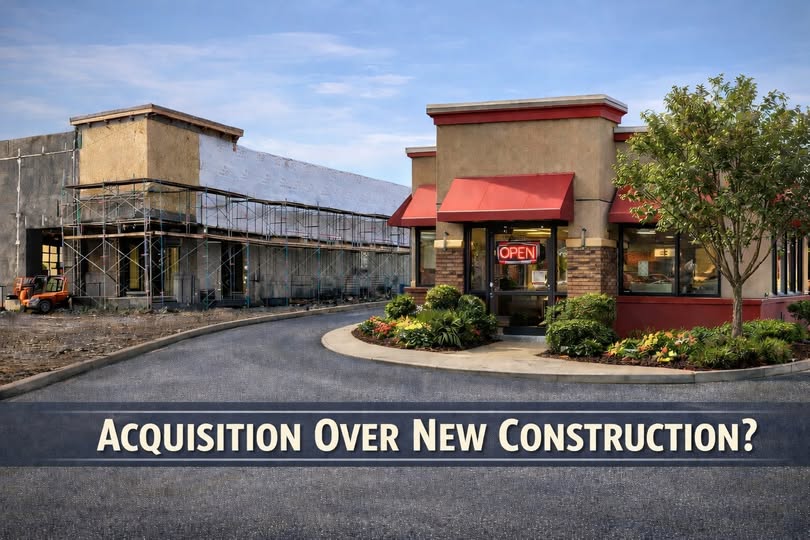
Instead of investing $525,000 to build a new unit from the ground up, imagine acquiring an existing unit through a refranchising opportunity at $375,000 or $400,000. The infrastructure exists. Revenue exists. Brand awareness exists. Equipment is operational. The location has proven traffic patterns, even if execution has lagged.
You are not financing construction risk. You are acquiring operating cash flow.
Suppose that unit currently generates $70,000 in annual net income. Not because the trade area is weak. Not because the brand is obsolete. But because management intensity has faded. Labor is inefficient. Culture has drifted. Local marketing is passive. Operational standards are inconsistently enforced.
In other words, the problem is not structural. It is managerial.
This distinction matters.
If disciplined leadership, restored cultural accountability, labor optimization, tighter food cost controls, and active community engagement can elevate net income from $70,000 to $150,000 within 18 to 24 months, the capital thesis shifts materially.
At $150,000 in net income and a three-times multiple, valuation approaches $450,000 before asset considerations. If performance is documented and sustainable, multiples may strengthen. At $175,000 or $200,000 in annual net income, enterprise value begins to move decisively beyond invested capital.
But the most significant shift is not numerical. It is temporal.
You are not waiting years for brand awareness to mature. You are improving an existing economic engine. The ramp to stabilized profitability may compress. The distance to valuation lift may shorten.
Now extend that strategy beyond a single unit.
Refranchising multiplied introduces an entirely different framework.
Instead of acquiring one underperforming location, imagine acquiring three, five, or more as part of a corporate refranchising initiative or negotiated portfolio transaction. Imagine coupling that acquisition with area development rights that secure future territory.
Now you are no longer an operator of stores. You are architecting a regional platform.
Three units improved from $70,000 to $150,000 each generate $450,000 in combined annual net income. Five units produce $750,000. Shared oversight reduces marginal overhead. Leadership infrastructure spreads across locations. Purchasing leverage strengthens. Marketing initiatives become coordinated rather than isolated.
Operational discipline becomes scalable.
At that point, valuation is not determined solely by unit-level multiples. It is influenced by portfolio stability, geographic clustering, leadership depth, and expansion optionality. The asset transitions from transactional resale to strategic acquisition candidate.
This is the realm where sophisticated buyers operate.
Private equity does not typically pursue isolated median units. It pursues scalable platforms with predictable EBITDA and growth pathways. Refranchising multiplied, when executed with discipline, begins to resemble that model.
There is also the matter of replacement cost.
If new development requires $525,000 per unit, but you acquire operating units below that threshold and elevate performance, you are effectively buying below replacement cost and selling based on improved earnings power. That spread is not theoretical. It is tangible equity creation.
But sophistication requires caution.
Not all underperformance is fixable. Some markets decline. Some brands plateau. Some trade areas saturate. Due diligence must interrogate the source of weakness. Is it structural, or is it managerial? Is the concept resilient, or is it commoditized? Is the competitive field stable, or is it intensifying?
Operational excellence cannot reverse macroeconomic decline. But it can unlock dormant performance in stable markets.
Franchising, viewed superficially, is about following a system.
Franchising, viewed strategically, is about selecting the right entry point, engineering performance into the top quartile, and scaling with intention.
The median single-unit franchisee often earns income. The top-quartile operator builds meaningful equity. The disciplined, multi-unit refranchising operator can compress time, leverage scale, and accelerate valuation.
The American Dream of entrepreneurship is frequently described in emotional terms. But capital does not respond to emotion. It responds to discipline.
Before investing in a new unit at full replacement cost, consider more refined questions:
Are you underwriting your future to median performance? Are you paying a premium for certainty that may only produce average results? Would acquiring and improving existing assets provide a wider margin of safety? Can scale and area development rights transform isolated stores into a regional enterprise? Are you building income, or are you building a platform capable of compounding value?
The most important question is not whether a franchise can make money.
The most important question is whether your approach to franchising treats capital with the seriousness it deserves and whether your strategy is designed to move from operator to enterprise builder.
That distinction separates participation from compounding.
Ultimately, if a candidate is evaluating a franchise opportunity today, their focus will most likely not rest solely on projected income once the unit stabilizes. The more strategic question is what the business is likely to be worth once performance is proven.
Entry price, realistic potential to achieve top-quartile results within the system, and the opportunity to scale beyond a single unit all matter. Those variables will ultimately determine whether the investment becomes a dependable income stream or an asset capable of compounding meaningful enterprise value over time.
If you’re a franchisor evaluating refranchising within your own system — or an investor exploring refranchising opportunities, multi-unit acquisitions, or an area development strategy — let’s engage in a conversation about your objectives and define what the right-fit opportunity would look like for you.
Every restaurant brand eventually reaches a moment of reckoning.
It rarely announces itself loudly. It does not come wrapped in a headline or framed as a crisis. It shows up in board meetings, in quiet executive conversations, in late-night reflections after reviewing another set of operational reports.
Are we building restaurants… or are we building an enterprise?
In the early years of a brand, corporate ownership is discipline. It is control. It is necessary. Founders and early leadership teams must validate the model. They must pressure-test labor assumptions, refine food cost structures, establish cultural expectations, and create a guest experience that can withstand replication. Corporate stores are not simply revenue generators; they are proving grounds. They are where the concept earns its credibility.
But what begins as discipline can quietly become inertia.
Operating restaurants at scale and architecting a scalable franchise system are fundamentally different responsibilities. One is operational management. The other is enterprise design. One requires daily intensity around staffing, scheduling, and cost control. The other requires clarity around governance, capital allocation, brand positioning, operator selection, and long-term development strategy.
Very few leadership teams can fully optimize both roles simultaneously over time.
This is where strategic refranchising enters, not as a tactical move, not as a liquidity event, not as a reaction to operational fatigue, but as a deliberate structural commitment.
Refranchising, when approached strategically, is a decision about identity. It is leadership acknowledging that the company’s highest-value contribution may no longer be operating units, but strengthening the architecture that allows others to operate them successfully.
Consider the capital structure of a heavily corporate-operated brand. Capital is embedded in leases, equipment, inventory, remodel cycles, and working capital demands. Every new corporate unit requires additional investment. Every underperforming unit absorbs managerial attention and financial flexibility. Growth becomes tied to internal capital reserves and management bandwidth.
Is that the most efficient use of capital for a brand that aspires to scale nationally or globally?
When a brand refranchises strategically, it converts operational capital into strategic capital. It lightens the balance sheet. It creates liquidity that can be reinvested into technology platforms, digital ordering ecosystems, loyalty systems, supply chain optimization, data analytics, field support infrastructure, and disciplined development pipelines. These investments do not benefit a single restaurant. They elevate the entire system.
That shift is not cosmetic. It is structural.
There is also the matter of leadership focus. When executive teams are deeply entangled in day-to-day restaurant operations, their attention is fragmented by volatility. Labor instability. Food cost spikes. Maintenance issues. Market-specific challenges. These are real and important issues, but they are tactical. They consume time and energy that might otherwise be directed toward system-wide strategy.
What could leadership accomplish if its primary focus shifted from operational firefighting to enterprise design? What would change if executive meetings centered less on individual store performance and more on franchisee profitability across markets, long-term development planning, and brand differentiation in an increasingly competitive landscape?
Strategic refranchising creates that space.
But refranchising is not a cure-all. It is an amplifier.
If unit-level economics are weak, refranchising exposes the weakness. If systems are poorly documented, refranchising spreads inconsistency. If franchise support is underdeveloped, refranchising strains relationships. The act of refranchising does not strengthen a brand; the readiness behind it does.
This is where leadership must ask difficult questions.
Are our unit economics truly defensible across diverse markets, or are they sustained by internal oversight that cannot be replicated? Are our systems robust enough that a disciplined operator can step in and execute without ambiguity? Is our franchise support infrastructure designed for scale, or for a small portfolio?
If the honest answers reveal gaps, then the strategic conversation is not about selling units. It is about strengthening the model before transition.
Operator selection becomes the center of the entire strategy. The right franchisee brings urgency, ownership, and capital discipline. Their equity is at risk. Their reputation in their community is directly connected to performance. They often respond to market dynamics faster than centralized corporate structures can. Their incentives are immediate and personal.
But what happens when capital is accepted without alignment? What happens when units are transferred to operators who lack infrastructure, leadership depth, or cultural compatibility? The consequences are rarely contained within one location. They ripple across the system.
Strategic refranchising demands discipline. It demands clarity about the profile of the operator the brand truly needs. It requires patience to say no to misaligned capital. It requires a long-term view that prioritizes enterprise strength over short-term transaction volume.
There is also a valuation dimension that cannot be ignored. Markets consistently reward brands that demonstrate predictable, high-margin, asset-light revenue streams. Royalty-based income structures often generate greater stability and stronger enterprise multiples than capital-heavy corporate portfolios. But valuation should not be the motivation. It should be the byproduct of structural clarity.
The deeper issue is sustainability.
A franchise brand built on disciplined refranchising is not dependent solely on internal capital to grow. It leverages the capital and leadership of aligned operators. It scales through distributed ownership while maintaining centralized brand governance. It builds resilience by diversifying operational responsibility without diluting standards.
Yet even here, restraint is necessary. Corporate ownership should not disappear entirely. Select corporate units can and should remain as innovation centers, training environments, and proof-of-concept laboratories. The question is not whether to operate. It is how much to operate, and why.
Are corporate units serving strategic purposes, or are they simply legacy assets that have never been re-evaluated?
At its core, strategic refranchising is about maturity. It is leadership recognizing that control is not the same as strength. That ownership of assets is not the same as ownership of brand equity. That operating more restaurants does not automatically equate to building more enterprise value.
It is a shift from accumulation to refinement.
And refinement requires courage. It requires confronting internal assumptions. It requires reassessing long-held structures. It requires asking whether the organization is structured for the next decade, not the last one.
If you are leading a restaurant brand today, consider this carefully. Is your corporate portfolio accelerating your enterprise, or absorbing the very capital and attention required to elevate it? Are you operating because it is strategically necessary, or because it is familiar?
These are not operational questions. They are identity questions.
The decision to refranchise strategically is not about shrinking a footprint. It is about sharpening a focus. It is about aligning capital, leadership, and structure with the enterprise you intend to build.
If these questions are already surfacing within your leadership team, they deserve a deliberate conversation. Not about transactions. About trajectory.
If you are evaluating your corporate portfolio, your development strategy, or the structural evolution of your brand, I invite you to reach out to me directly at paul@acceler8success.com.
Let’s examine whether refranchising, done strategically and with discipline, is the next structural commitment your brand must make.
Because the decision you make about refranchising will not simply affect next quarter’s numbers.

You must be logged in to post a comment.