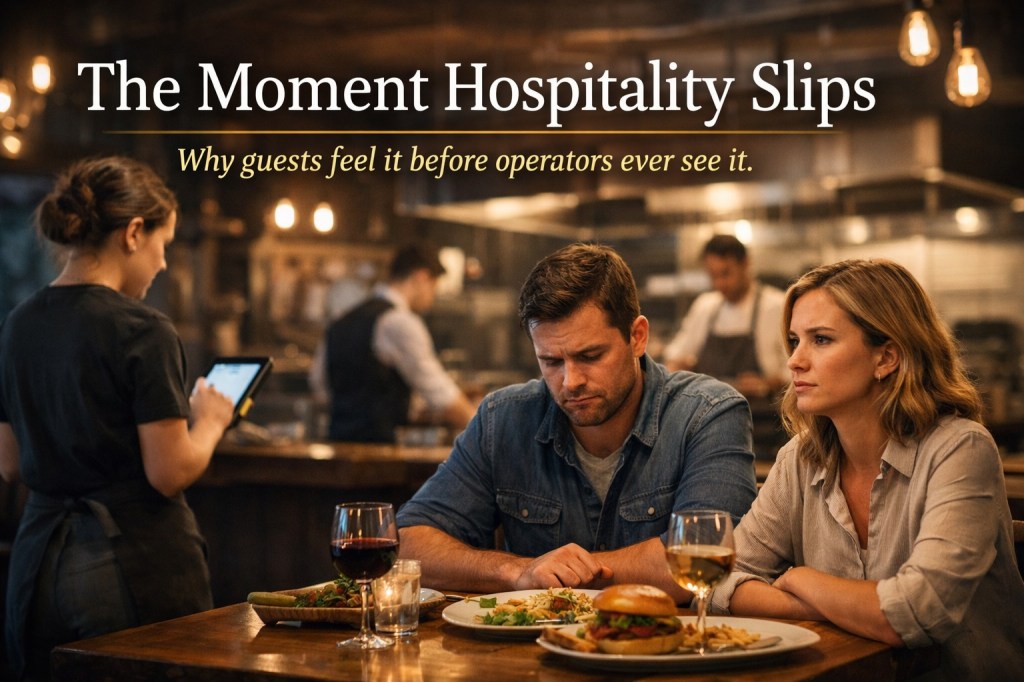
When restaurants lose sight of hospitality, they don’t usually notice it all at once. It rarely happens because someone wakes up and decides guests no longer matter. It happens quietly, through small decisions that feel practical in the moment. Speed replaces warmth. Efficiency replaces eye contact. Policies replace judgment. Over time, the restaurant still serves food, but it stops serving people.
Hospitality is not the same as service. Service is transactional. Hospitality is relational. Service is about delivering what was ordered. Hospitality is about how a guest feels before, during, and after the meal. When hospitality fades, restaurants often convince themselves they are improving operations. They tighten scripts. They shorten conversations. They push staff to turn tables faster. They reduce flexibility in the name of consistency. The result is a place that may run smoothly on paper but feels cold in practice.
Guests notice immediately, even if they can’t articulate why. They sense when a greeting feels rehearsed instead of genuine. They feel when a server is rushing past them rather than welcoming them. They notice when a problem is met with policy instead of empathy. Food quality may remain strong, pricing may be competitive, and marketing may be clever, yet something feels off. The experience becomes forgettable at best and frustrating at worst.
For staff, the loss of hospitality is just as damaging. When employees are trained to execute tasks rather than care for guests, their work becomes mechanical. Pride erodes. Engagement drops. Team members stop thinking like hosts and start thinking like rule enforcers. Turnover rises because people rarely stay long in environments where they are discouraged from being human. A restaurant without hospitality often becomes a restaurant constantly hiring.
Leadership plays a central role in this shift. When owners and managers focus exclusively on food cost, labor percentages, ticket times, and reviews, hospitality becomes an afterthought. Metrics matter, but when they become the mission, they crowd out the very behavior that drives long-term loyalty. Hospitality cannot be delegated to a training video or a line in a handbook. It must be modeled, reinforced, and protected, especially during busy or stressful moments.
Technology can accelerate the problem when misused. Tablets, kiosks, QR codes, and apps can improve efficiency, but they can also create distance. When technology replaces interaction instead of supporting it, guests feel like obstacles in a process rather than welcomed participants in an experience. Convenience without connection is not hospitality. It is automation.
Over time, restaurants that lose sight of hospitality begin to rely heavily on discounts, promotions, and advertising to compensate for declining loyalty. They chase new customers because they fail to keep existing ones. The brand becomes louder while the experience becomes quieter. The restaurant survives, but it no longer inspires. It becomes interchangeable with dozens of others offering similar food at similar prices.
The most successful restaurants understand that hospitality is not soft or optional. It is a strategic advantage. It is what turns first-time guests into regulars and regulars into advocates. It is what allows a restaurant to recover from mistakes with grace rather than damage. Hospitality creates forgiveness, trust, and emotional connection, none of which can be purchased through marketing.
When restaurants rediscover hospitality, the change is immediate and powerful. Guests feel seen again. Staff feel empowered again. The room feels alive. Hospitality does not slow a restaurant down. Done right, it gives meaning to everything else happening inside the four walls. Food feeds the body, but hospitality feeds the relationship. When that relationship is lost, the restaurant may still operate, but it stops truly serving.
About the Author
Paul Segreto brings over forty years of real-world experience in franchising, restaurants, and small business growth. Recognized as one of the Top 100 Global Franchise and Small Business Influencers, Paul is the driving voice behind Acceler8Success Café, a daily content platform that inspires and informs thousands of entrepreneurs nationwide. A passionate advocate for ethical leadership and sustainable growth, Paul has dedicated his career to helping founders, franchise executives, and entrepreneurial families achieve clarity, balance, and lasting success through purpose-driven action.
About Acceler8Success America
Acceler8Success America is a comprehensive business advisory and coaching platform dedicated to helping entrepreneurs, small business owners, and franchise professionals achieve The American Dream Accelerated.
Through a combination of strategic consulting, results-focused coaching, and empowering content, Acceler8Success America provides the tools, insights, and guidance needed to start, grow, and scale successfully in today’s fast-paced world.
With deep expertise in entrepreneurship, franchising, restaurants, and small business development, Acceler8Success America bridges experience and innovation, supporting current and aspiring entrepreneurs as they build sustainable businesses and lasting legacies across America.
It’s hard for me to ignore what’s happening in the restaurant world right now.
Almost daily, it seems I read something about another restaurant closing. Sometimes it’s a small independent concept that never found its footing. Sometimes it’s a once-busy local favorite that quietly ran out of runway. Sometimes it’s a brand that looked strong from the outside, until it wasn’t. And then, in the middle of all that, I’ll visit restaurants that are clearly succeeding, some that have found short-term momentum and others that have stayed relevant and profitable for years. That contrast has been hitting me in a very real way, because it doesn’t feel like we’re just watching businesses close. We’re watching livelihoods disappear. We’re watching dreams end.
And as I’ve spent more time in the field talking to operators, observing service, watching team dynamics, and paying attention to what guests say when they think no one is listening, I’ve found myself drilling down to a common denominator that keeps showing up again and again.
Customer reviews.
Not because reviews are always fair. Not because a star rating tells the whole story. But because reviews reveal something that too many restaurants overlook: the gap between what an operator believes is being delivered and what the guest is actually experiencing. Reviews shine a light on execution, consistency, and trust… all the things that determine whether a guest comes back, and whether they tell someone else to try you or avoid you.
In our ongoing work at Acceler8Success America, we keep seeing a pattern that should get the attention of every operator and leadership team in fast food, quick service, and fast casual. Across many concepts and markets, the overall rating tends to settle around the high threes. An average around 3.7 out of 5 is common. Then you have brands like Chick-fil-A consistently showing higher averages, often around 4.2, enough of a difference to change customer behavior. The gap between 3.7 and 4.2 isn’t just a few tenths of a point. Online, it’s the difference between “it’s probably fine” and “I feel good about going there.” It’s the difference between convenience and confidence.
And it begs a bigger question: how much better would these restaurants perform if they could consistently move their locations from 3.7 to 4.2, and then beyond that to 4.5, 4.7, or even higher?
Because at that point, reviews stop being a vanity metric and become a growth engine.
Here’s another question that deserves to be asked out loud, especially by leadership teams and franchise operators who track every food cost variance and labor hour with precision: what does a tenth of a point actually equal in revenue and profitability?
If your rating moves from 3.7 to 3.8, what does that do to first-time trial? To repeat visits? To conversion when a customer is choosing between you and two nearby competitors? To the number of guests who decide to “give you a shot” versus scroll past you? To the number of comps you issue, the remakes you absorb, the refunds you process, and the time your managers spend dealing with avoidable recovery moments?
Now multiply that effect. Not once. Multiply it to the desired level.
If a tenth of a point creates lift, what does three tenths do? What does five tenths do? What does a full point do over the course of a year?
That right there is your future!
A 3.7 score often creates invisible drag. You may still get traffic, especially if you’re well located and convenient, but you’re constantly leaking first-time trial. You’re losing the guest who compares three nearby options and chooses the one that feels safer. You’re also paying a hidden tax that doesn’t show up as a neat line item in the P&L: more refunds, more remakes, more complaints, more comps, more employee stress, and more operational disruption. That tax hurts profitability. It hurts morale. And over time, it wears down leadership teams and owners who already feel like they’re fighting a daily battle just to stay afloat.
At 4.2, the perception changes. Customers trust you faster. The decision to visit becomes easier. Your online reputation does part of your marketing for you, which means you’re less dependent on promotions and discounting just to keep volume steady. That trust also tends to attract stronger talent. Better-run restaurants feel better to work in, and teams stay longer in environments that feel organized, supported, and consistent. The business becomes healthier from the inside out.
At 4.5 and above, you enter a different tier. You are no longer “one of the options.” You become the preferred choice. And that is where long-term growth becomes easier, faster, and more sustainable. Expansion carries less friction because new guests are more willing to try you. Franchise development becomes easier because operators want in. Unit-level economics improve because waste decreases and loyalty increases. And when the market tightens, as it always does, the most trusted brands tend to hold share while others scramble.
This is why customer reviews matter so much, and why they show up as a common denominator when you compare closures to longevity.
Reviews are not primarily judging your menu. They are judging your execution.
They measure friction.
Guests aren’t reviewing your strategy, your labor model, your lease terms, or your challenges with vendors. They’re reviewing what happened in the last thirty minutes of their life. If the experience felt smooth, respectful, and consistent, they reward you. If it felt slow, wrong, careless, or indifferent, they punish you, often with emotion that seems disproportionate to what went wrong.
And in fast food, QSR, and fast casual, those breakdowns tend to happen in predictable moments: lunch rush, dinner rush, late-night shifts, understaffed days, high-turnover weeks, promotion surges, weather spikes, and any situation where the team is operating under stress.
That’s where ratings are won or lost. Not at 2:00 p.m. when everything is calm. Ratings are determined at 12:10 p.m. and 6:40 p.m., when the line is long, the kitchen is slammed, and leadership either shows up, or doesn’t.
So why does Chick-fil-A often land higher?
Because their advantage is not perfection. Their advantage is a system that reduces breakdowns and protects the guest experience under pressure. They don’t treat service as separate from operations. They treat service as the outcome of operations done well.
Hospitality isn’t just a script. It’s a standard. And standards only work when supported by process, training, and leadership presence. When the system is designed well, the guest experiences consistency. And consistency is what lifts ratings above the high-threes ceiling that many brands can’t break.
Which leads to the most uncomfortable question of all.
If the upside is so clear, why aren’t more establishments pushing harder?
Some operators will argue that reviews are biased. Others will say customers only leave reviews when they’re angry. And while there’s truth in both, those explanations can become excuses that keep businesses stuck.
The more honest answer is that raising ratings requires operational discipline, and operational discipline requires leadership focus. Many restaurants are trapped in survival mode. They’re fighting labor shortages, turnover, food cost swings, equipment issues, delivery complaints, and constant urgency. In that environment, excellence starts to feel optional. A 3.7 begins to feel “good enough,” because it’s familiar.
But familiar is not the same as profitable.
And it definitely isn’t the same as scalable.
Another reason many brands don’t push harder is that they measure the wrong things with the most intensity. They track sales, labor, and food cost religiously, but treat guest sentiment like a soft metric. Yet guest sentiment drives the very traffic that produces the sales they’re chasing. When ratings drop, everything gets harder. When ratings rise, everything becomes easier.
So what needs to be done to raise scores?
It starts by identifying the handful of recurring failures that drive most 1-star reviews. In fast food, QSR, and fast casual, they are almost always the same: long waits, incorrect orders, missing items, cold food, inconsistent quality, disengaged tone, messy dining rooms or restrooms, and off-premise mistakes like poor packaging or forgotten sauces. These aren’t mysteries. They’re predictable.
Then you stop treating reviews like a marketing problem and start treating them like operational intelligence. Every week, reviews should be categorized into a small set of themes and tied back to dayparts, staffing patterns, and bottlenecks. “We’re slow” isn’t a diagnosis. “Drive-thru stalls during staging between 12:00 and 1:00 when we’re down one expo and bagging is inconsistent” is a diagnosis. Once you diagnose correctly, fixes become clear.
You build an “under load” playbook. A real one. Not a binder on a shelf. A trained, rehearsed plan for peak hours that defines roles, staging flow, accuracy checks, and guest communication standards. Speed and accuracy are not supposed to be trade-offs. The best operations achieve both because they are structured.
You make order accuracy a ritual, not a hope. One simple verification step at the right point of the line prevents an angry guest later and a public one-star review that lasts forever.
You protect hospitality during stress. This is where many restaurants lose the most ground. Teams get slammed and tone turns transactional or irritated. Guests interpret that as disrespect. The standard doesn’t have to be theatrical. It has to be consistent: greet quickly, acknowledge delays, communicate clearly, thank the guest, and never allow stress to turn into attitude.
You treat cleanliness like trust-building. Guests use cleanliness as a shortcut for what they can’t see. A neglected dining room makes them doubt your kitchen. A bad restroom makes them doubt leadership. Cleanliness needs a cadence of frequent micro-resets so it never becomes a visible failure.
You win off-premise with packaging discipline. Pickup and delivery are review accelerators. When guests eat at home, the bag is your brand. Label it, seal it, stage it correctly, and ensure hot/cold handling is intentional. Missing sauces and utensils sound small until they become the reason a family meal feels ruined.
You build recovery into the operation. Mistakes will happen. The difference between a 3.7 store and a 4.2 store is how often mistakes happen and how they are handled. A fast, respectful, generous recovery can actually create loyalty. A slow, dismissive recovery turns a small problem into a permanent warning sign for hundreds of future customers.
And you invite feedback consistently. Not selectively. Many restaurants get review scores skewed downward because only frustrated guests speak up. The ethical answer is simply to make it easy for satisfied guests to share too. A healthier review mix doesn’t “game” the system. It reflects reality.
When you put this all together, the real point becomes clear.
Moving from 3.7 to 4.2 isn’t just about looking better online. It’s about building a stronger business, one that grows faster, wastes less, recruits better, retains longer, and withstands tougher market cycles. It’s about building a restaurant that doesn’t just survive the season, but earns loyalty year after year.
And if we’re serious about reducing restaurant closures, if we truly care about the people behind these businesses, then we have to stop treating customer reviews like background noise.
Because the question isn’t whether reviews matter.
The question is whether leadership teams are willing to treat review performance as the strategic asset it is.
If the difference between “average” and “trusted” is only a few recurring breakdowns per week, then the opportunity is not theoretical.
It’s operational.
And it’s available to every fast food, QSR, and fast casual brand willing to push harder… not with slogans, but with systems.
About the Author
Paul Segreto brings over forty years of real-world experience in franchising, restaurants, and small business growth. Recognized as one of the Top 100 Global Franchise and Small Business Influencers, Paul is the driving voice behind Acceler8Success Café, a daily content platform that inspires and informs thousands of entrepreneurs nationwide. A passionate advocate for ethical leadership and sustainable growth, Paul has dedicated his career to helping founders, franchise executives, and entrepreneurial families achieve clarity, balance, and lasting success through purpose-driven action.
About Acceler8Success America
Acceler8Success America is a comprehensive business advisory and coaching platform dedicated to helping entrepreneurs, small business owners, and franchise professionals achieve The American Dream Accelerated.
Through a combination of strategic consulting, results-focused coaching, and empowering content, Acceler8Success America provides the tools, insights, and guidance needed to start, grow, and scale successfully in today’s fast-paced world.
With deep expertise in entrepreneurship, franchising, restaurants, and small business development, Acceler8Success America bridges experience and innovation, supporting current and aspiring entrepreneurs as they build sustainable businesses and lasting legacies across America.
Doing things right in restaurant operations shouldn’t feel elusive, yet the industry continues to struggle under the weight of declining sales, shrinking margins, and an ever-growing list of closures. Hardly a day goes by without another restaurant becoming a cautionary tale. Labor shortages, rising food costs, rent, competition, and the economy are often cited as the reasons. All of them are real. All of them are challenging. But they also tend to mask a deeper, more uncomfortable truth: many restaurants aren’t failing because of one catastrophic mistake, but because of dozens of small ones quietly piling up over time.
This raises an important question for every operator. Are the challenges you’re facing the result of one major issue, or are they the accumulation of overlooked details? At what point do small missteps stop being isolated and start becoming a pattern your guests can feel? And perhaps most importantly, do you recognize that moment when it happens, or does it only become clear once customers stop coming back?
Taking care of a customer to a high degree of satisfaction is not rocket science. Hospitality is not abstract. It lives in awareness, intention, and consistency. Yet the bar seems to have lowered, with an unspoken expectation that guests should be more forgiving. But should they be? When a guest reaches for cash or pulls out a Gold American Express card, they’re not just paying for food. They’re paying for care, pride, and the expectation of a positively memorable experience. Is that really too much to ask, every time?
In an ideal world, restaurants would approach every guest interaction as if it truly mattered, because it does. Not through slogans or mission statements, but through execution. Through doing the right things, the right way, repeatedly. Talk doesn’t build loyalty. Results do. And the results customers experience are shaped by the details you either notice first or miss entirely.
Perfection is often dismissed as unrealistic in today’s restaurant environment. Too many variables. Too many moving parts. But is perfection actually unattainable, or has it simply become inconvenient to pursue? Absolute perfection may be elusive, but coming damn close is not only possible, it’s necessary. Standards rise when perfection is the goal. Training improves. Accountability sharpens. Pride returns. When excellence is chased, even the inevitable mistakes are handled with care.
A recent visit to a well-regarded local pizza and Italian restaurant illustrates how easily small details can undermine an otherwise solid operation. The concept was good. The space was attractive. Yet the experience felt uneasy. A side of spaghetti arrived watery, clearly not drained correctly. A basic step missed. The spoon meant for twirling pasta was oversized and awkward, making eating uncomfortable. The new tables, while beautiful, wobbled just enough to be distracting. None of these issues were disastrous on their own, but together they planted doubt. If these visible details slipped through, what else might be overlooked behind the scenes?
This is the danger of “little things” in restaurants. They don’t shout. They whisper. They accumulate. They shape perception. How many small irritations does it take before a guest decides not to return? How many details must be missed before trust begins to erode? And how many operators never realize customers are leaving, not because of one bad experience, but because of several slightly disappointing ones?
That reality becomes even clearer in what I now call the Rainbow Cookie Story.
For fifteen years, our family ordered rainbow cookies every holiday season from the same Brooklyn bakery. These cookies are a staple on Italian tables, and for us, they were tradition. Each year, we ordered four pounds. The package barely arrived before it was opened. One bite and memories flooded back—years past, holidays, conversations. It wasn’t just dessert. It was an experience.
Then last year, that experience changed. The familiar festive tin with its carefully arranged pinwheel of cookies was replaced with a flimsy cardboard box. The presentation was gone. Worse, the cookies weren’t fresh. They had absorbed the taste of damp cardboard. This was an order that, with shipping, ran well over $125. We called the bakery to express disappointment and were met with a dismissive response: “Yep, we changed. No more tins. Sorry. That’s the way we do it now.”
No empathy. No effort to make it right.
For the first time in fifteen years, the cookies didn’t disappear before Christmas. Half were thrown out once the holidays ended. This year, we didn’t order from them at all. No second chance. No referrals. Loyalty vanished in one season, not because of change, but because disappointment was met without care.
Instead, we tried a different Brooklyn bakery. The cookies were phenomenal. Fresh. Thoughtfully packaged. Familiar in all the right ways. Within a day of the order arriving, we placed another one because everyone dove right in. Four pounds are fading fast. A new tradition was born, and an old one quietly ended.
That’s how quickly loyalty can be lost.
This story isn’t about cookies. It’s about respect. It’s about understanding that every experience reinforces or erodes trust. When a guest expresses disappointment, how you respond matters more than the mistake itself. Are they heard? Are they valued? Or are they told, implicitly or explicitly, to accept it or move on?
So here is the challenge, and the call to action for restaurant operators.
Slow down and walk your restaurant as a guest, not as an owner. Sit at the tables. Use the utensils. Taste the food exactly as it’s served. Notice what wobbles, what feels rushed, what feels overlooked. Pay attention to how your team responds when something goes wrong. Ask yourself whether the experience you’re delivering today truly earns loyalty tomorrow. Create systems that catch the small issues before guests do. Empower your team to fix problems in the moment. Treat disappointment as a gift, not an inconvenience.
Because in this industry, the little things are never little. They are the difference between a guest who comes back and one who quietly disappears. And in a business where loyalty is fragile and memories are powerful, doing things right—consistently, intentionally, and with care—isn’t optional. It’s survival.
About the Author
Paul Segreto brings over forty years of real-world experience in franchising, restaurants, and small business growth. Recognized as one of the Top 100 Global Franchise and Small Business Influencers, Paul is the driving voice behind Acceler8Success Café, a daily content platform that inspires and informs thousands of entrepreneurs nationwide. A passionate advocate for ethical leadership and sustainable growth, Paul has dedicated his career to helping founders, franchise executives, and entrepreneurial families achieve clarity, balance, and lasting success through purpose-driven action.
About Acceler8Success America
Acceler8Success America is a comprehensive business advisory and coaching platform dedicated to helping entrepreneurs, small business owners, and franchise professionals achieve The American Dream Accelerated.
Through a combination of strategic consulting, results-focused coaching, and empowering content, Acceler8Success America provides the tools, insights, and guidance needed to start, grow, and scale successfully in today’s fast-paced world.
With deep expertise in entrepreneurship, franchising, restaurants, and small business development, Acceler8Success America bridges experience and innovation, supporting current and aspiring entrepreneurs as they build sustainable businesses and lasting legacies across America.
A new restaurant owner recently posted something raw, honest, and painfully familiar in a group full of people who live this life every single day. She shared that she was almost a year in, but felt like she had aged ten. She explained how she had gone through more employees than she ever imagined possible—some wanting more hours, others wanting fewer hours but higher pay, others wanting schedules that fit perfectly around their personal lives, and many bringing constant personal issues that required last-minute flexibility. Some showed up annoyed at the very work they were hired to do. The polished, eager interview version of each new hire lasted about two weeks before the real version appeared. She trains, she sets clear expectations, she stays hands-on, and still the result often feels like chaos.
In just three weeks, she lost three employees. Her husband works full-time, leaving her to be everything: chef, cook, manager, marketer, HR, scheduler, problem-solver. She loves the restaurant—it was their dream—but dreams get heavy when you’re carrying every part of them alone. She wasn’t complaining; she was reaching out. Asking how others survive this life. How they find reliable people. What questions help reveal character. Whether trial periods help. Any insight at all, because her exhaustion had become its own kind of crisis.
What followed was powerful. The post didn’t sit unanswered. Dozens of owners, operators, and managers chimed in. People who understood the exhaustion behind her words. People who had stood exactly where she stood. People who knew the feeling of being one call-out away from collapse. I responded as well, echoing what so many were already expressing: her struggle wasn’t unusual—it was the universal stage that almost every restaurant owner walks through in the early years.
The first year doesn’t just test your systems. It tests your capacity, your boundaries, your resilience. It turns enthusiasm into grit. It forces you to confront the gap between how you hoped things would go and how the industry actually works. Staffing issues make you feel like you’re rebuilding the same house every week while trying to live in it. But she wasn’t failing. She was adjusting, strengthening, and building the foundation that every successful operator eventually relies upon.
Across the thread, one theme dominated the conversation: character outweighs skill. Skills can be taught. Character cannot. The smartest way to reveal character isn’t with yes-or-no questions but with detailed, real-world scenarios.
Experienced owners emphasized the importance of asking, “Tell me about a time when…” Not hypotheticals. Not guesses. Actual lived experiences.
For example: “Tell me about a time you sent the correct information to the kitchen, but the guest said the order was wrong. How did you handle it?”
A real answer includes details, actions, thought processes, and follow-through: “I apologized, offered to remake the order, looped in my manager, we decided to comp it, the guest left satisfied, and we even received a positive review afterward.”
The shallow version—“I reordered it and apologized”—says nothing about character, ownership, or integrity.
The same applies to internal accountability. “You’re behind on chores but need to pick up your child from daycare. What do you do?” The right candidate describes communication, responsibility, and problem-solving, not shortcuts or excuses.
One seasoned operator in the thread pointed out a clever technique: ask a similar question later in the interview. If the details shift, if the tone changes, if the story contradicts itself, you have your answer. Consistency is a form of honesty.
And that’s where trial periods come in. Many operators encourage a 30–60 day onboarding phase where structure is not optional. The right people thrive in expectations. The wrong people fight them. Either way, you find out early—before you’re rebuilding schedules for the fifth time in a month.
But beneath all the tactical advice, the most important truth shared was this: she was carrying far too much alone. Many owners burn out not because they lack ability, but because they try to do everything at once. One reliable hire—just one—can shift the entire rhythm of a restaurant. It gives you room to lead, not just react. It gives you space to breathe, not just survive.
The collective wisdom in that thread was more than advice. It was solidarity. A reminder that the messy middle—the part where everything feels unstable and overwhelming—is not the end of the story. It’s the beginning of becoming the operator you need to be. She wasn’t breaking. She was becoming stronger, sharper, and more aware.
And she wasn’t alone. None of us were when we went through it. And she isn’t now.
Owners who survive this industry don’t do it because everything went smoothly. They survive because they kept going through the seasons that weren’t. They refined. They adjusted. They held standards. They learned to value character. They learned to build systems. They learned to stop carrying the entire dream alone. And eventually, they found the right people. When that happens, everything changes.
But the conversation didn’t end there—it opened the door to deeper questions. Questions every restaurant owner, manager, and operator should ask themselves:
Are you hiring for skill because it feels urgent, or for character because it’s sustainable? What story do your interview questions actually reveal about a person? How much structure have you built—and how much chaos are you accidentally allowing? Where are you carrying too much alone, and who could help carry even a small piece of it? Are your expectations clear, consistent, and enforceable—or are they flexible in ways that drain you? If someone watched your hiring process from start to finish, what would they say it prioritizes?
These aren’t easy questions, but they’re the right ones. They shape the future of a restaurant more than any menu change, renovation, or promotion ever could.
And now, the question turns to the wider community of owners and operators:
What has your experience taught you about hiring, burnout, reliability, and resilience in this industry? What interview questions help you identify character? What shifts made your restaurant run more smoothly? What’s the advice you wish someone had given you in your first year?
If you’ve lived through this season—or are living it right now—your story matters. Your insights matter. Your perspective might be exactly what another owner needs to hear to get through their week.
Share your thoughts. Share your lessons. Share your truth. This industry is hard—but when owners talk to each other, it gets a little easier.
About the Author
Paul Segreto brings over forty years of real-world experience in franchising, restaurants, and small business growth. Recognized as one of the Top 100 Global Franchise and Small Business Influencers, Paul is the driving voice behind Acceler8Success Café, a daily content platform that inspires and informs thousands of entrepreneurs nationwide. A passionate advocate for ethical leadership and sustainable growth, Paul has dedicated his career to helping founders, franchise executives, and entrepreneurial families achieve clarity, balance, and lasting success through purpose-driven action.
About Acceler8Success America
Acceler8Success America is a comprehensive business advisory and coaching platform dedicated to helping entrepreneurs, small business owners, and franchise professionals achieve The American Dream Accelerated.
Through a combination of strategic consulting, results-focused coaching, and empowering content, Acceler8Success America provides the tools, insights, and guidance needed to start, grow, and scale successfully in today’s fast-paced world.
With deep expertise in entrepreneurship, franchising, restaurants, and small business development, Acceler8Success America bridges experience and innovation, supporting current and aspiring entrepreneurs as they build sustainable businesses and lasting legacies across America.
This article continues the Celebrating Entrepreneurship series — each installment building toward a complete playbook for the modern entrepreneur in honor of National Entrepreneurship Month. So far, we’ve moved from disruption grounded in precision, to leadership presence, to transferable culture, to community belonging, and most recently, to creating anticipation that leads to opening-day excitement.
Now we arrive at the next stage in the entrepreneurial arc:
Opening day can create attention. But only consistency, connection, and meaning create enduring momentum.
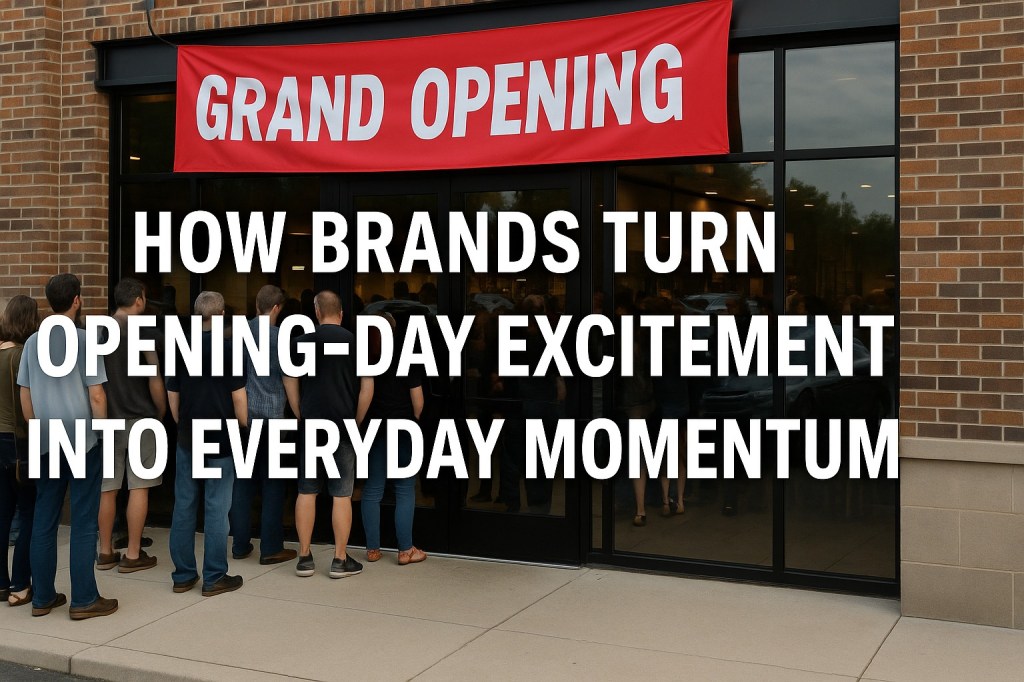
A long line at a grand opening is the spark.
Sustained momentum is the fire that keeps the business alive, relevant, and valued — long after the ribbon is cut and the excitement fades.
Grand openings are emotional events.
Sustained success is a relational practice.
The Problem Most Brands Face After Opening Day
After the excitement fades, many restaurants and franchise locations experience a decline that feels inevitable:
• Customer visits normalize
• Energy stabilizes
• Word of mouth slows
• Team enthusiasm fades
• Community connection weakens
This is not because demand disappears.
It is because intentional momentum-building stops.
The brands that remain top-of-mind do not wait for customers to return.
They continue to show up.
The Lesson: Ritual Sustains What Excitement Begins
Excitement is temporary.
Ritual is permanent.
Starbucks does not depend on launch campaigns to fill stores every day.
It depends on ritual — the morning stop, the familiar barista, the drink that matches identity.
Local restaurants and franchise brands can do the same.
Not by imitation — but by repetition of emotional touchpoints.
Momentum is not sustained by newness.
It is sustained by familiarity.
Three Pillars of Post-Opening Momentum
1. Consistency in Experience
Guests return when:
• Quality is reliable
• Staff interactions feel personal
• The business feels “the same” in the best way
This is where the transferable culture we discussed in the last article becomes essential.
If opening-day service is warm and present — and week eight feels automated and indifferent — momentum dies.
Consistency is not repetition of procedure.
Consistency is repetition of care.
2. Community Engagement as Continuing Behavior
Brands that remain relevant do not disappear after opening weekend.
They embed themselves into the rhythm of the community.
Examples:
• Hosting school spirit nights
• Sponsoring youth teams
• Providing meeting space for local groups
• Donating meals to community organizations
• Showing up at farmers’ markets, festivals, and local gatherings
These actions are not marketing.
They are presence.
Presence creates familiarity.
Familiarity creates loyalty.
3. Fresh Moments Without Losing Identity
Sustaining momentum requires periodic bursts of renewed curiosity — without confusing the brand’s identity.
Think of:
• Limited-time specials that fit the brand
• Seasonal menu items that feel natural
• Customer appreciation days
• Events that highlight team members or regulars
These are not promotions.
These are invitations.
The brand remains recognizable, yet alive.
Examples of Momentum Maintainers
Dutch Bros.
Energy and personality stay consistent every visit.
The excitement at the window is replicated, not performed once.
Buffalo Wild Wings
Connection to sports culture creates repeating reason to return.
The brand ties itself to local ritual, not just food.
Local Main Street Diners That Last for Generations
They don’t chase customers.
They know customers.
They become part of life, not an occasional visit.
The Key Truth of Sustained Momentum
Opening day creates awareness.
Identity creates loyalty.
Rhythm creates permanence.
Momentum is not preserved by doing more.
It is preserved by doing what matters again, and again, and again.
Customers return not because they are reminded —
but because they are remembered.
The Playbook Expands
This series has now shown the entrepreneur how to:
• Disrupt through intention
• Lead through presence
• Meet modern consumer expectations
• Become essential to the community
• Scale culture across locations
• Build anticipation before opening
• And now, sustain momentum long after
Next in the series, we move from sustaining momentum to expanding opportunity:
How the best brands grow without losing identity — and how to decide when and where to grow.
Because growth, when done in alignment with meaning, becomes legacy.
About the Author
Paul Segreto brings over forty years of real-world experience in franchising, restaurants, and small business growth. Recognized as one of the Top 100 Global Franchise and Small Business Influencers, Paul is the driving voice behind Acceler8Success Café, a daily content platform that inspires and informs thousands of entrepreneurs nationwide. A passionate advocate for ethical leadership and sustainable growth, Paul has dedicated his career to helping founders, franchise executives, and entrepreneurial families achieve clarity, balance, and lasting success through purpose-driven action.
Ready to elevate your business or navigate today’s challenges with confidence? Connect directly with Paul at paul@acceler8success.com, because every success story begins with a meaningful conversation.
About Acceler8Success America
Acceler8Success America is a comprehensive business advisory and coaching platform dedicated to helping entrepreneurs, small business owners, and franchise professionals achieve The American Dream Accelerated.
Through a combination of strategic consulting, results-focused coaching, and empowering content, Acceler8Success America provides the tools, insights, and guidance needed to start, grow, and scale successfully in today’s fast-paced world.
With deep expertise in entrepreneurship, franchising, restaurants, and small business development, Acceler8Success America bridges experience and innovation, supporting current and aspiring entrepreneurs as they build sustainable businesses and lasting legacies across America.
Introducing Acceler8Success America, the bridge to entrepreneurial triumph for immigrants in the U.S. Our forthcoming platform caters to both existing and aspiring immigrant business owners, offering guidance at every step of their entrepreneurial journey. Whether it’s launching a new business, exploring franchising options, or considering buying an existing business, we are committed to supporting the goals of individuals and families from diverse backgrounds, aiming to fulfill their dreams of owning a business in America. Our extensive resources encompass essential aspects such as immigration and visa assistance, business financing methods, real estate counsel, legal and insurance issues, and language translation services.
Recognizing the pivotal role of education in business success, we provide a variety of educational content, from basic business principles to sophisticated strategies for business succession. Our team is equipped with multilingual capabilities and cultural sensitivity, enabling us to serve a broad spectrum of entrepreneurs from different global regions. At Acceler8Success America, you’ll find the tools to navigate the U.S. business environment, with access to tailored resources and expert advice across various business industries, sectors, and models. Embark on a journey of discovery and opportunity in the U.S. business realm with Acceler8Success America as your guide.
Acceler8Success America is a joint venture between Acceler8Success Group and doubleSstudios.
For more information, please reach out to Paul Segreto at paul@acceler8success.com.



You must be logged in to post a comment.