Tag: restaurant-failures

The Hidden Cost of Restaurant Closures No One Is Talking About

The restaurant industry has always been romanticized as one of the purest forms of entrepreneurship. It is visceral. It is emotional. It is creative. It is also, increasingly, unforgiving.

In Greater Houston alone, it feels like every week brings news of another closure. Not one or two, but a steady drumbeat of seven to ten restaurants each month quietly or publicly shutting their doors. And those are only the ones that make headlines. For every public closing, there are others that fade out without notice. Concepts that never quite found their footing. Operators who ran out of time, capital, or both.

Yet in the very same breath, we see new restaurants opening at a similar pace. New concepts. New brands. New energy. New investment.

Which raises a difficult but necessary question. Has the restaurant industry reached saturation, or has it become something else entirely?

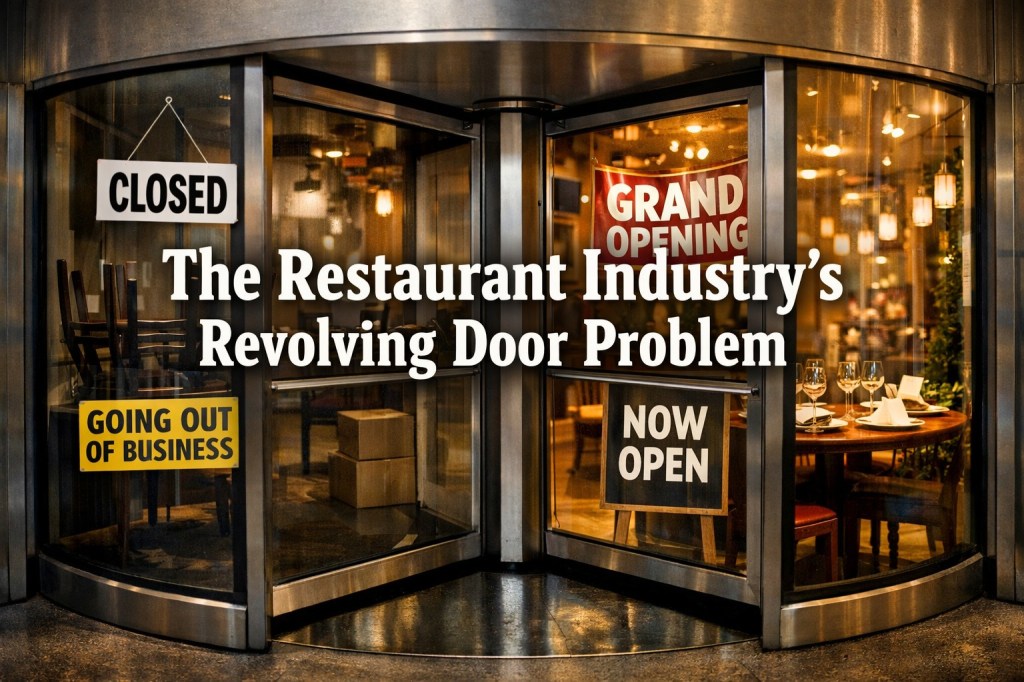
What we may be witnessing is not simply growth or decline, but a revolving door. An ecosystem where the number of restaurants remains relatively constant, not because of stability, but because of continuous turnover. One closes. Another opens. And the cycle repeats.

On the surface, that might suggest resilience. Demand still exists. Consumers still dine out. Entrepreneurs still believe.

But beneath that surface, there is a more concerning reality.

Every closure represents more than a failed business. It represents lost capital. Investor dollars that disappear. Bank loans that are written down. Personal savings that evaporate. Relationships strained. Confidence shaken.

Now multiply that across dozens, then hundreds, then thousands of closures over time.

That is not just churn. That is erosion.

The question becomes, where does that lost capital go? It does not recycle cleanly back into the next concept. It exits the system. Investors become more cautious. Lenders tighten. Private equity looks elsewhere. Independent operators hesitate.

And when capital becomes more selective, it does not just impact new restaurant openings. It affects the entire ecosystem surrounding the industry.

Landlords begin to feel it through increased vacancies or weaker tenants. Suppliers feel it through inconsistent volume. Equipment manufacturers see slower orders. Service providers, from marketing firms to technology platforms, experience contraction. Even municipalities feel the ripple effects through reduced sales tax revenue and stalled development.

At some point, the compounding effect of lost capital begins to reshape the industry itself.

So is this revolving door healthy?

In moderation, turnover is natural. It fuels innovation. It clears out weak concepts and makes room for stronger ones. It keeps the industry dynamic.

But when the velocity of failure begins to match or exceed the pace of thoughtful, well-capitalized growth, the equation changes. It stops being a cycle of renewal and starts becoming a pattern of depletion.

It also raises another, more uncomfortable possibility.

Maybe the issue is not just saturation. Maybe it is who is entering the industry.

Are there simply too many inexperienced operators stepping into one of the most complex, margin-sensitive businesses there is? Are too many concepts being launched without adequate capitalization, without a true understanding of unit economics, without the operational discipline required to withstand inevitable pressure?

Because when experience is limited and capital is thin, the margin for error disappears quickly.

And in this environment, error is not a possibility. It is a certainty.

It also makes me think about what I loosely refer to as a “Jack Welch GE era” for restaurants. During his time at General Electric, Jack Welch was known for a philosophy of continually evaluating performance, removing the bottom tier, and replacing it with new talent aimed at driving the organization higher. Whether perfectly applied or not, there is truth in the underlying concept.

Are we seeing a version of that play out across the restaurant industry?

Not through deliberate strategy, but through market forces.

The bottom tier, whether due to undercapitalization, lack of experience, or flawed models, is being pushed out. At the same time, a new wave of operators is stepping in, optimistic, ambitious, and often facing the same structural challenges.

The difference is, in a corporate setting, that kind of turnover is managed, measured, and supported with infrastructure.

In the restaurant industry, it is largely unmanaged.

And that is where the concern deepens.

Because without structure, without shared learning, without a more disciplined approach to entry and growth, we risk repeating the same cycle over and over again. New capital comes in. It gets tested. Too often, it gets lost. And the next wave follows, facing many of the same realities as the last.

At some point, we have to ask whether this is evolution… or simply repetition.

Because the issue is not simply that restaurants are closing. The issue is why they are closing, and whether those lessons are being captured, shared, and acted upon.

Are we opening too many concepts without fully understanding unit economics?
Are investors underwriting deals based on optimism rather than discipline?
Are operators expanding before the model is proven?
Are franchisors scaling without the infrastructure to support it?
Are landlords prioritizing occupancy over long-term viability?

These are not new questions. But they are becoming more urgent.

The future of the restaurant industry will not be determined by how many concepts open next year. It will be determined by how many are built to last.

That requires a shift in mindset.

From growth at all costs to disciplined expansion.
From chasing trends to building sustainable models.
From reactive decision-making to proactive strategy.
From isolated operators to collaborative ecosystems that share knowledge and data.

If we fail to make that shift, the revolving door will continue. And with each turn, more capital, more talent, and more opportunity will quietly slip away.

This is not a call for pessimism. It is a call for awareness. And more importantly, for action.

The conversation needs to happen now, not after the next wave of closures forces it upon us.

If you are an operator, investor, franchisor, or industry partner, the question is simple. Are you building for momentum, or are you building for longevity?

Let’s continue this conversation. Let’s challenge assumptions. Let’s share what is working and what is not. And most importantly, let’s begin identifying solutions proactively, before decisions are made under pressure, in the moment, and without the benefit of fully understanding both the problems and the potential solutions.

The restaurant industry will always be filled with passion. The next chapter must also be defined by discipline.

Reach out at paul@acceler8success.com or message me directly on social media to start a proactive discussion about building a smarter, more sustainable restaurant business or brand, independent or franchise.

Why Guests Leave Quietly and Don’t Come Back: A Lesson for Restaurant Operators

Doing things right in restaurant operations shouldn’t feel elusive, yet the industry continues to struggle under the weight of declining sales, shrinking margins, and an ever-growing list of closures. Hardly a day goes by without another restaurant becoming a cautionary tale. Labor shortages, rising food costs, rent, competition, and the economy are often cited as the reasons. All of them are real. All of them are challenging. But they also tend to mask a deeper, more uncomfortable truth: many restaurants aren’t failing because of one catastrophic mistake, but because of dozens of small ones quietly piling up over time.

This raises an important question for every operator. Are the challenges you’re facing the result of one major issue, or are they the accumulation of overlooked details? At what point do small missteps stop being isolated and start becoming a pattern your guests can feel? And perhaps most importantly, do you recognize that moment when it happens, or does it only become clear once customers stop coming back?

Taking care of a customer to a high degree of satisfaction is not rocket science. Hospitality is not abstract. It lives in awareness, intention, and consistency. Yet the bar seems to have lowered, with an unspoken expectation that guests should be more forgiving. But should they be? When a guest reaches for cash or pulls out a Gold American Express card, they’re not just paying for food. They’re paying for care, pride, and the expectation of a positively memorable experience. Is that really too much to ask, every time?

In an ideal world, restaurants would approach every guest interaction as if it truly mattered, because it does. Not through slogans or mission statements, but through execution. Through doing the right things, the right way, repeatedly. Talk doesn’t build loyalty. Results do. And the results customers experience are shaped by the details you either notice first or miss entirely.

Perfection is often dismissed as unrealistic in today’s restaurant environment. Too many variables. Too many moving parts. But is perfection actually unattainable, or has it simply become inconvenient to pursue? Absolute perfection may be elusive, but coming damn close is not only possible, it’s necessary. Standards rise when perfection is the goal. Training improves. Accountability sharpens. Pride returns. When excellence is chased, even the inevitable mistakes are handled with care.

A recent visit to a well-regarded local pizza and Italian restaurant illustrates how easily small details can undermine an otherwise solid operation. The concept was good. The space was attractive. Yet the experience felt uneasy. A side of spaghetti arrived watery, clearly not drained correctly. A basic step missed. The spoon meant for twirling pasta was oversized and awkward, making eating uncomfortable. The new tables, while beautiful, wobbled just enough to be distracting. None of these issues were disastrous on their own, but together they planted doubt. If these visible details slipped through, what else might be overlooked behind the scenes?

This is the danger of “little things” in restaurants. They don’t shout. They whisper. They accumulate. They shape perception. How many small irritations does it take before a guest decides not to return? How many details must be missed before trust begins to erode? And how many operators never realize customers are leaving, not because of one bad experience, but because of several slightly disappointing ones?

That reality becomes even clearer in what I now call the Rainbow Cookie Story.

For fifteen years, our family ordered rainbow cookies every holiday season from the same Brooklyn bakery. These cookies are a staple on Italian tables, and for us, they were tradition. Each year, we ordered four pounds. The package barely arrived before it was opened. One bite and memories flooded back—years past, holidays, conversations. It wasn’t just dessert. It was an experience.

Then last year, that experience changed. The familiar festive tin with its carefully arranged pinwheel of cookies was replaced with a flimsy cardboard box. The presentation was gone. Worse, the cookies weren’t fresh. They had absorbed the taste of damp cardboard. This was an order that, with shipping, ran well over $125. We called the bakery to express disappointment and were met with a dismissive response: “Yep, we changed. No more tins. Sorry. That’s the way we do it now.”

No empathy. No effort to make it right.

For the first time in fifteen years, the cookies didn’t disappear before Christmas. Half were thrown out once the holidays ended. This year, we didn’t order from them at all. No second chance. No referrals. Loyalty vanished in one season, not because of change, but because disappointment was met without care.

Instead, we tried a different Brooklyn bakery. The cookies were phenomenal. Fresh. Thoughtfully packaged. Familiar in all the right ways. Within a day of the order arriving, we placed another one because everyone dove right in. Four pounds are fading fast. A new tradition was born, and an old one quietly ended.

That’s how quickly loyalty can be lost.

This story isn’t about cookies. It’s about respect. It’s about understanding that every experience reinforces or erodes trust. When a guest expresses disappointment, how you respond matters more than the mistake itself. Are they heard? Are they valued? Or are they told, implicitly or explicitly, to accept it or move on?

So here is the challenge, and the call to action for restaurant operators.

Slow down and walk your restaurant as a guest, not as an owner. Sit at the tables. Use the utensils. Taste the food exactly as it’s served. Notice what wobbles, what feels rushed, what feels overlooked. Pay attention to how your team responds when something goes wrong. Ask yourself whether the experience you’re delivering today truly earns loyalty tomorrow. Create systems that catch the small issues before guests do. Empower your team to fix problems in the moment. Treat disappointment as a gift, not an inconvenience.

Because in this industry, the little things are never little. They are the difference between a guest who comes back and one who quietly disappears. And in a business where loyalty is fragile and memories are powerful, doing things right—consistently, intentionally, and with care—isn’t optional. It’s survival.


About the Author

Paul Segreto brings over forty years of real-world experience in franchising, restaurants, and small business growth. Recognized as one of the Top 100 Global Franchise and Small Business Influencers, Paul is the driving voice behind Acceler8Success Café, a daily content platform that inspires and informs thousands of entrepreneurs nationwide. A passionate advocate for ethical leadership and sustainable growth, Paul has dedicated his career to helping founders, franchise executives, and entrepreneurial families achieve clarity, balance, and lasting success through purpose-driven action.


About Acceler8Success America

Acceler8Success America is a comprehensive business advisory and coaching platform dedicated to helping entrepreneurs, small business owners, and franchise professionals achieve The American Dream Accelerated.

Through a combination of strategic consulting, results-focused coaching, and empowering content, Acceler8Success America provides the tools, insights, and guidance needed to start, grow, and scale successfully in today’s fast-paced world.

With deep expertise in entrepreneurship, franchising, restaurants, and small business development, Acceler8Success America bridges experience and innovation, supporting current and aspiring entrepreneurs as they build sustainable businesses and lasting legacies across America.

Learn more at Acceler8SuccessAmerica.com