An entrepreneurial perspective on Hire the American Dream by Dave Melton and Tim McIntyre—and the leadership commitment that helps employees thrive.
An employee accepts a job for reasons that extend beyond the responsibilities listed in a help-wanted advertisement. There are bills to pay, families to support, skills to develop, and ambitions that may never come up during an interview. An employer who takes time to understand those ambitions has a better foundation for building a productive relationship.
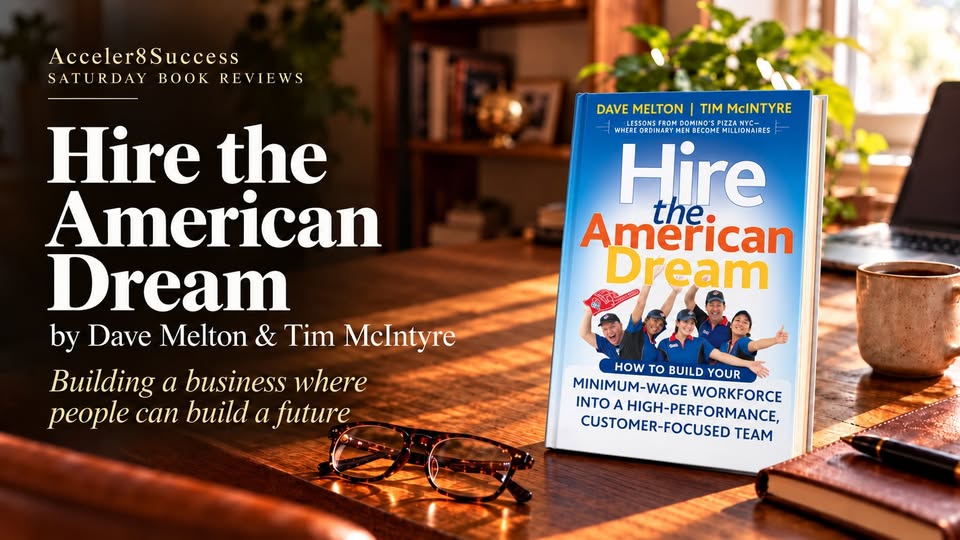
That is the perspective I bring to Hire the American Dream: How to Build Your Minimum Wage Workforce Into a High-Performance, Customer-Focused Team by Dave Melton and Tim McIntyre. Drawing on Melton’s experience as a Domino’s Pizza franchisee in New York City, the book connects the work of building a business with the responsibility of helping employees advance.
For entrepreneurs, the question it raises deserves careful consideration: Can the people helping build your business see how their work can help build their own future?
Over more than four decades in entrepreneurship, franchising, restaurants, and small business development, I have come to appreciate how directly an owner’s answer influences the operation. We depend on employees to deliver the experience we promise, protect the standards we establish, and represent the business when we are elsewhere.
Those responsibilities require training, judgment, and commitment. Owners need to consider what they are doing to develop all three.
Melton’s account begins with the difficulties of operating in Manhattan, including early hiring mistakes and the strain of expanding before he had dependable people in place. His response centered on fundamental management responsibilities: selecting employees carefully, treating them fairly, serving customers well, maintaining product standards, and sharing the rewards of success.
The significance, from my perspective, lies in the consistency required to make those commitments credible. Employees have to experience what an owner promises.
Consider a restaurant owner who tells applicants there is room to grow. Once hired, employees receive hurried instruction, learn procedures from whoever happens to be available, and hear little about advancement. When a management position opens, the owner looks outside the organization without explaining what current employees would need to qualify.
The opportunity described during the interview never becomes a visible path.
My application of the book’s premise would begin there. What does advancement actually look like in your business? What skills must someone develop? Who teaches those skills? How is readiness evaluated? What additional responsibility and compensation follow?
A small business may have only a few management positions. Even so, an owner can explain the opportunities that exist and the limits that accompany them. Credibility depends on making commitments the business can fulfill.
The book gives particular attention to immigrant employees and the aspirations they bring to their work. Its broader relevance is the attention it directs toward potential that a conventional résumé may fail to reveal.
An entry-level position tells us where someone is starting. It offers limited insight into where that person could go.
For an aspiring entrepreneur, that is a useful consideration before making the first hire. Every employee arrives with a different combination of experience, ability, and circumstances. The owner’s responsibility includes establishing clear expectations while learning what will help that individual succeed.
Someone may need additional explanation because a procedure is unfamiliar. Another person may understand the task but lack confidence speaking with customers. A reliable employee may be ready for greater responsibility and waiting for someone to recognize it.
These situations call for observation and conversation. General assumptions about what employees want will only take a business so far.
For operating owners, I see particular value in connecting development with the customer experience.
Imagine a customer calling about an incorrect pizza order during a busy evening. An employee who has learned only how to enter orders may have little idea how to respond. A better-prepared employee understands the service standard, knows which remedies are authorized, and can explain what will happen next.
The outcome depends on what the business has taught and empowered that employee to do.
My recommendation would be to select one recurring service problem and use it as a training opportunity. Discuss what the customer needs, demonstrate an appropriate response, establish the employee’s authority, and follow up after the next occurrence.
Owners can then evaluate whether the training improved the result. That is a practical way to connect employee development with operating performance.
The book’s chapter structure also addresses incentives, teamwork, individual employee needs, promotion criteria, and feedback. Taken together, those subjects invite owners to examine whether their employment practices support the behavior they expect.
My own recommendation is to examine incentives especially carefully.
A reward for speed can create problems if accuracy suffers. A sales incentive can disappoint customers if employees recommend items without understanding their needs. A labor target can undermine service if managers achieve it by leaving a shift inadequately staffed.
Before introducing a reward, define the complete result the business needs. Explain how performance will be measured and make sure employees have meaningful influence over the outcome.
Owners should also examine how recognition is distributed. Dependable employees who train newcomers, maintain standards, and resolve problems quietly can be easy to overlook. Their contribution becomes painfully visible when they leave.
For experienced entrepreneurs, the more demanding application may involve reconsidering familiar explanations for turnover.
It is easy to conclude that employees are unwilling to commit. A more useful management discussion examines the employment experience: the quality of supervision, the consistency of scheduling, the clarity of expectations, the fairness of compensation, and the opportunity to learn.
Some departures will remain beyond an owner’s control. Others may reveal a recurring problem the business can address.
I would encourage an owner to review several recent departures together. Were employees leaving the same manager? Did new hires struggle during the same stage of training? Were promises made during hiring that the operation could not support?
Patterns provide a starting point for action.
Within a franchise organization, these questions deserve attention well before the next location opens.
A growth plan creates demand for people capable of leading shifts, managing locations, training employees, and maintaining the brand’s standards. The organization needs a practical way to develop that capacity.
Melton has described the book’s leadership message in terms of helping employees become leaders themselves. For an emerging franchisor or multiunit operator, I would translate that into a direct question: Who is being prepared today for the responsibilities our growth plan will create tomorrow?
A capable employee needs a chance to practice leadership with appropriate guidance. That might begin with training a new hire, leading a pre-shift meeting, or taking responsibility for a defined operating result. Each assignment provides an opportunity to assess readiness and identify further development needs.
I would approach Hire the American Dream with those everyday decisions in mind. Published in 2009, it reflects a particular operating environment and one franchisee’s experience. Owners should apply its ideas to their own workforce, resources, compensation practices, and opportunities for advancement.
An inspiring employment story still needs a workable business model behind it. Fair pay, effective training, dependable management, and realistic opportunities give that story substance.
My suggested routine would be simple:
- Each day, have one purposeful conversation. Learn what an employee is trying to improve, where instructions are unclear, or what support would help.
- Each week, teach one skill that expands capability. Give someone a defined opportunity to practice, observe the result, and provide useful feedback.
- Each month, review the employment experience. Examine turnover, training progress, recognition, and whether commitments to employees are being kept.
- Each quarter, assess your leadership pipeline. Identify who is ready for greater responsibility, who needs additional development, and whether your growth plans match your management capacity.
This is my proposed application of the book’s themes, rather than a schedule prescribed by the authors.
I would also encourage owners to ask employees what they believe advancement requires. Their answers may differ considerably from management’s intentions. That gap is worth discovering while there is time to address it.
My recommendation is to approach Hire the American Dream as an invitation to examine the opportunity your business creates for the people working in it. Aspiring entrepreneurs can use it to think through their responsibilities as employers. Operating owners can examine how hiring, training, and supervision influence performance. Franchise leaders can consider how employee development supports a stronger foundation for growth.
Its strongest contribution, from my perspective, is the connection it draws between an employee’s aspirations and an owner’s willingness to help that person progress.
Dave and Tim, thank you for bringing attention to the people whose daily work makes entrepreneurial success possible. Encouraging business owners to recognize potential and develop future leaders is a meaningful contribution to the entrepreneurial conversation.
The American Dream has personal meaning for every owner working to build something of lasting value. The people beside that owner have dreams of their own. A stronger business gives those ambitions room to grow.
About Acceler8Success Saturday Book Reviews
Published every Saturday at Acceler8Success Cafe, this series explores books that help aspiring entrepreneurs, business owners, and experienced leaders start, grow, and lead their businesses. Each review brings Paul Segreto’s entrepreneurial perspective to the ideas presented, examining their relevance to real business challenges and opportunities for everyday application. The goal is simple: accelerating entrepreneurial success through reading, reflection, and practical application.

You must be logged in to post a comment.