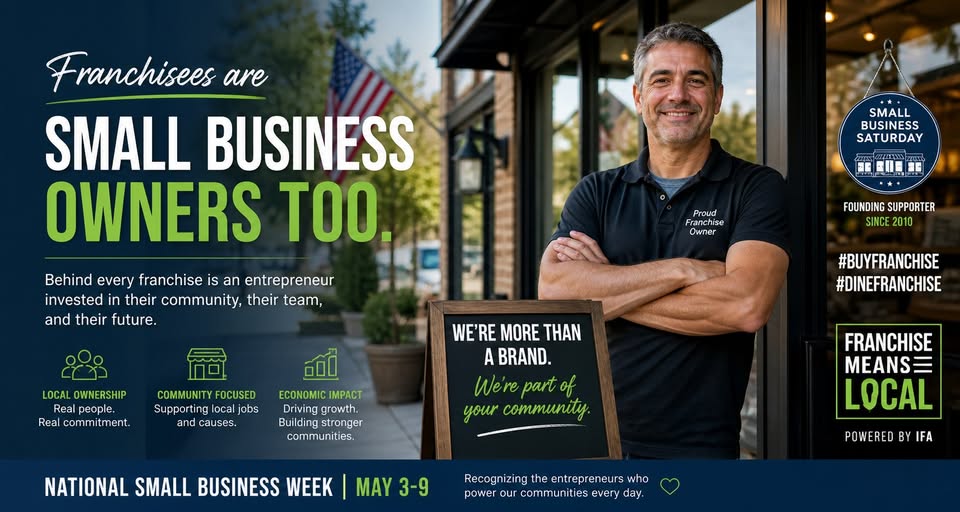
As National Small Business Week approaches May 3–9, there will be countless stories shared about entrepreneurship, startups, family-owned businesses, local economic development, and the importance of supporting small business owners across America.
And rightfully so.
Small businesses remain the backbone of the American economy.
Yet, year after year, one of the largest segments of small business ownership continues to be overlooked in the broader conversation: franchisees.
Somehow, franchising has gradually become disconnected from the public perception of “small business,” despite the fact that the overwhelming majority of franchise locations across America are independently owned and operated by local entrepreneurs.
The person who owns the neighborhood sandwich shop.
The family operating a quick-service restaurant.
The husband-and-wife team running a home services business.
The local operator employing 15, 30, or 100 people in the community.
These are small business owners.
They sign leases. They hire employees. They manage payroll. They sponsor local Little League teams. They support schools, charities, churches, and community organizations. They carry the stress and responsibility that every entrepreneur carries.
Yet too often, franchise businesses are viewed simply as “corporate chains.”
That perception problem matters.
And franchisors themselves have an opportunity, and arguably a responsibility to help change it.
National Small Business Week presents one of the best opportunities each year for franchise organizations to elevate the role franchisees play in entrepreneurship and local economic development.
The reality is that franchising has long served as one of the most accessible pathways into entrepreneurship for aspiring business owners. For many individuals and families, franchising represents a bridge between employment and business ownership. It provides systems, support, brand recognition, training, operational guidance, and infrastructure that can significantly reduce some of the risks associated with starting a business entirely from scratch.
But ownership is still ownership.
Risk is still risk.
Leadership is still leadership.
And local impact is still local impact.
Franchisors should be aggressively leaning into that narrative during National Small Business Week, not from a public relations standpoint alone, but from a positioning standpoint for the future of franchising itself.
For years, I have personally been a very vocal advocate for recognizing franchisees for what they truly are: small business owners.
In fact, since 2010, I have actively promoted franchising’s inclusion and awareness within the American Express Small Business Saturday initiative and the broader small business conversation. I have long believed that franchise businesses deserve a far more visible seat at the table when America celebrates entrepreneurship and local business ownership.
Franchise Means Local: Why Franchise Businesses Deserve a Spotlight on Small Business Saturday
That belief also led me to become a creator of movements like #BuyFranchise and #DineFranchise, efforts designed to help consumers better understand that supporting a franchise location often means supporting a local entrepreneur, local jobs, and local families within their own communities.
The Franchise Dilemma in Small Business Saturday by American Express
Additionally, initiatives such as the Franchise Means Local campaign by the International Franchise Association continues to play an important role in helping reshape public perception around franchising. The initiative reinforces a simple but critically important truth: franchise businesses are deeply woven into the fabric of local communities. Behind national brands are local owners employing local residents, supporting local causes, investing locally, and serving the communities in which they live and work every day.
Happily, we are making progress.
Consumers are becoming more aware. Communities are beginning to better understand the role franchisees play in local economies. More franchisors are embracing the entrepreneurial stories behind their brands.
But despite that progress, there remains a significant perception gap.
Even many highly educated individuals still struggle to separate the franchise brand from the franchise owner. Too often, franchise businesses are viewed solely through the lens of national branding, while the local entrepreneur behind the business becomes invisible.
The reality is that franchisees face many of the very same challenges as any independent Mom & Pop business owner across America.
They invest their life savings. They take personal financial risks. They worry about payroll. They navigate inflation, labor challenges, rent increases, competition, regulations, and economic uncertainty. They work long hours. They sacrifice time with family. They carry the emotional weight that comes with business ownership.
In many ways, the entrepreneurial journey is exactly the same.
The only difference is that franchisees choose to build their businesses within an established system and brand framework.
This week presents another opportunity for franchisors to more aggressively showcase franchisees as entrepreneurs and local small business owners.
Franchisors should spotlight franchisees as entrepreneurs, not merely operators. The language matters. Many franchise organizations unintentionally over-corporatize their messaging. Marketing materials often emphasize systems, consistency, growth, and scale while failing to showcase the entrepreneurial stories behind the individual businesses themselves.
Yet consumers connect emotionally with people. They connect with stories. They connect with local ownership.
Franchise brands should spend National Small Business Week highlighting the journeys of franchisees:
Why they chose business ownership.
What challenges they overcame.
Why they invested in their communities.
How many jobs they created locally.
What entrepreneurship means to their families.
This humanizes franchising.
Franchisors should also localize their messaging. Consumers increasingly want to support local businesses. Many simply do not realize that their local franchise restaurant, fitness center, child care business, salon, or service provider is independently owned.
Simple messaging can help reinforce this:
“Locally Owned and Operated.”
“Proud Small Business Owner.”
“Part of Your Community.”
These messages should not be hidden in fine print. They should become part of the identity of the franchise location itself.
Franchise systems should further encourage franchisees to engage visibly in local community leadership. National Small Business Week should become a coordinated systemwide initiative involving community partnerships, chamber involvement, entrepreneurship seminars, local events, school programs, and small business roundtables.
When franchisees become more visible as local leaders, the perception of franchising changes naturally.
Franchisors should also invest more heavily in entrepreneurship education. Many aspiring entrepreneurs still fail to recognize franchising as a legitimate pathway into business ownership. Too often, people believe they either have to start a business entirely from scratch or remain employees indefinitely.
Franchising sits in the middle as a hybrid model of entrepreneurship—independent ownership supported by an established system.
That message deserves greater visibility.
Ironically, some franchise systems spend years trying to look less like small businesses and more like major corporations, when in reality, their greatest strength may be their local ownership structure.
Large national brands with local owners create a unique economic model:
National recognition.
Local entrepreneurship.
Community-level economic impact.
That is powerful.
And it deserves far more attention during National Small Business Week.
The future of franchising may very well depend on how effectively the industry reconnects itself to the broader entrepreneurial narrative in America, especially as younger generations increasingly seek independence, flexibility, purpose, and pathways to ownership.
Franchising should not sit outside the small business conversation.
It should be at the center of it.
Because behind nearly every successful franchise location is not simply a brand.
There is an entrepreneur.
There is a family.
There is a local employer.
There is a small business owner pursuing the American Dream.
As National Small Business Week reminds us of the vital role entrepreneurs play in shaping communities and strengthening the economy, it should also remind us that franchising remains one of the most powerful and proven pathways to small business ownership in America.
If you’re a franchisor looking to strengthen franchisee engagement, elevate your brand’s entrepreneurial positioning, or further align your organization with the small business movement, I’d welcome the opportunity to have a conversation. Likewise, if you’re an aspiring entrepreneur exploring franchising as a path to business ownership, let’s connect.
Please connect with me to continue the discussion around entrepreneurship, franchising, and the future of small business ownership in America.
 A look at today’s
You must be logged in to post a comment.