Tag: Social Media

Talking PR, Franchising & Social Media with Arment Dietrich CEO, Gini Dietrich

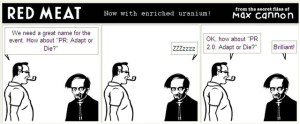
PR Adapt or DieAs we do quite often, Gini Dietrich, CEO at Arment Dietrich PR, and I, communicate on Twitter, on Facebook, by email and by phone, about a multitude of things, both business and personal. Sure, we banter and kid a great deal along the way. But when the discussion turns to franchising, communications and social media, the kidding quickly subsides, and the conversation turns serious. Okay, not completely serious, because we’re both smart-asses. But serious to the point that we’re anxious to share our ideas with each other, and determine ways to share them with our franchise clients and the franchise community.

Recently, I turned one of our discussions into an informal interview, and asked Gini to share some of her thoughts, so I could share the same with the franchisEssentials readers. Always being shy and not wanting to be in the limelight (yeah, right!), Gini fired off her responses without hesitation, further demonstrating her passion, and conviction in her thoughts. I just loved her response when asked about the future of public relations, as we know it today. Well, decide for yourself as you read some of the Q & A below.

Paul: “How important is a communications strategy to franchise organizations today?”

Gini: “It’s not at all important. Ha! Just kidding. To use one of my favorite quotes by NPS senior news analyst Daniel Schorr, “If you don’t exist in the media, for all practical purposes, you don’t exist.” But in today’s age of digital technology, it’s not just the traditional media strategy that a franchise needs to have. I love the case study of the companies that made it through the Great Depression. Know what they all had in common? They didn’t cut their communication. In fact, they increased it. And the companies that did that then are still around today while their competitors, who cut their communication budgets, went out of business. Like Daniel Schorr says, if you’re not communicating, how will your customers know you exist now and into the future?”

Paul: “Is it important for local franchisees to have a communications strategy in place or is it sufficient to only have it at the franchisor level?”

Gini: “I’m a HUGE proponent of local franchisees having a strategy in place that is complementary to what the franchisor is doing. Consider most reporters won’t cover your business unless there is a local angle. Most local baseball teams are sponsored by local businesses. The Mayor won’t show up to your ribbon cutting if you’re not giving back to the community. Add into the mix social media and you know that people buy from people and want to have a relationship with the people they do business with…not the company or the brand. The person who buys your product or service in his/her community, wants to have a relationship with the person running that entity, not the corporate monster.”

Paul: “Is public relations, as we have known it over the years, changing to adapt to a more “connected” society?”

Gini: “There has been a lot of discussion about whether or not public relations, as an industry, is dying. Most PR people (as evidenced by a recent IABC poll) deny it’s happening and are content with doing their jobs as they’ve always known them. I contend social media is changing the way we communicate and PR, as we know it, is dying. Regardless of PR professionals thinking social media affects the way they do their jobs, someone has to own it – be it marketing, PR, or advertising. I’d rather jump on it now and own it. After all, social media is about developing and fostering relationships with customers, stakeholders, employees, influencers, and individuals. Traditional PR is about developing and fostering relationships with media and influencers. Makes sense to me that it fit in with PR.”

Paul: “What role do you see social media playing within the franchise community?”

Gini: “I love, love, love what Tasti D-Lite is doing with social media. I use this example all the time. They have a store in the Empire State Building. Whenever someone tweets that they are in or near the Empire State Building, @tastidlite sends them an offer to come into the store. In some cases, they offer a free frozen dessert. In others, a discount. This has helped them build in-store profitability, loyal customers, and their intensely passionate following. This is SO EASY to do at the franchisee level. This is just one example of how social media helps build a franchisee following. Get out there and try it. It works!”

CEOs and Social Media

Today, Gini Dietrich, CEO at Arment Dietrich PR presented an interesting question on the company blog, F.A.D.S. (the Fight Against Destructive Spin), “Should CEOs Spend Time On Social Networking?” Of course, always having to add my two cents, I responded accordingly.

CEO“I would be surprised if any CEO of a publicly-traded company had a social media presence. The reason I say this is because of the SEC and FTC.
The SEC has certain rules about information being presented and disclosed to the public and the CEO would need to be extremely careful as to what he or she communicates, even through his or her own personal social networking efforts. From a liability standpoint, I’m not sure the benefits outweigh the potential downside.

With respect to the FTC, the issue here is the marketing message and how it can and may be perceived. Currently, the FTC is considering guidelines and rules about marketing messages being conveyed through social media. Again, as the leader of a public company, the CEO must tread carefully and, even in conveying a marketing message, must be very careful not to break any SEC rules. Again, the benefits need to be weighed against potential consequences.

All that being said, I stongly believe public companies should have a major presence in social media, including social networking, letting the marketing experts spearhead the activity and content. While doing so, I do believe the CEO could, and should, participate strategically with key, well-defined content, more to enhance the overall effort as opposed to being front and center.

Now the flipside, private companies. I do believe CEOs of private companies need to be as transparent as possible. They’re usually the vision and drive behind the company. His or her thoughts and statements lend a great deal of credibility to the company, which ultimately may be defining factors in a customer, client, vendor or partner doing business with the company.

Often, the CEO, “is” the company which why we see companies named after the Founder and CEO. Many times, the CEO is actually the “commodity” being sold by the company. This is especially true with professional organizations, consulting companies, etc.

Service and product driven companies are different as there are usually consumers or clients as end-users. As such, they rely on the “personal guarantees” of the CEO and that message usually needs to be promoted to drive business. I’m thinking along the lines of George Zimmer, CEO of Men’s Wearhouse.

When it’s all said and done, there are few, more efficient ways of promoting a business, large or small, than through social media, and social networking. The messages are concise and clear, and often present the human side of the business. And, clients and customers alike, feel more confident “knowing” the CEO and his or her thoughts, feeling more comfortable with their decision to do business with the company or organization.

Here’s a simple, yet totally unscientific rule of thumb: If a business needs to have the CEO’s personal guarantee on loans and lines of credit, then the CEO should be very active in social media and social networking activities. If the company can enter into loan and credit agreements without any personal guarantees, it’s best to leave the social media and social networking efforts to the marketing experts.”

Please note: CEOs of franchise organizations also need to be careful not to present inadvertent earnings claims in any social media activities.

Understanding Social Media Metrics

bubblus-social-mediaSocial media is exciting, and is finally being embraced by franchise organizations. Many are beginning to test the waters, albeit very cautiously. Some have been pleasantly surprised and wonder why they didn’t venture in this direction sooner. Others, have been quite confused but are reluctant to give up. Perhaps if they could quantify and analyze their efforts, they would be more confident in their efforts. But where do they start?

First, they must understand some key factors regarding the metrics of social media in order to be able to plug in numbers that make sense. Certain elements of social media metrics need to be defined, that may ultimately convince them and the rest of their management team, there is value in creating “noise” online.

So, let’s take a look at key social media metrics as the first step towards quantifying and analyzing social media efforts. Once understood, it will be easier to track trends and results.

Volume – The number of comments, blogs, posts, tweets, links, etc., about the brand, the competition, and the industry segment.

Sentiment – The positive, negative, or indifferent consumer reaction to the brand or a topic, which can be measured by text analytics and natural-language processing.

Emotion – The reasons that a consumer felt, good, bad, or indifferent that point how the company can resolve his / her problem or how the business can change and improve.

Topic / Issue – The context (e.g., product, customer service, advertising, competitor, etc.) in which the brand is being discussed. Nielsen’s Brand Association Map helps visually associate the relationship between terms; a Google AdWords keyword-expansion tool helps improve the relevancy of the company’s selections.

Source – Where the conversation is occurring (e.g., Twitter, blog, discussion board).

Author (Influencer) – The people talking about the brand and their social media impact (e.g. number of followers, readers, commenters).

Virality – The reach of the brand and relevant topics around the brand (e.g., how many people are reading, posting, linking, and sharing).

Source: Alex Burmaster, Nielsen Online

Controlling Brand & Trademark within Social Media: What to do if franchisees got there first

trademark protectionI was recently asked to share my point of view on how a franchise brand can — or even should — wrest control of their brand on social media destinations when franchise holders have been early entrants.

Here are my initial thoughts:

As is typical in most franchise agreements, there’s most likely a clause regarding use of the brand name and trademark. It may need some interpretation to Web 2.0 usage, but there should be no problem applying the language in this regard. Also, online branding falls into marketing, and ultimately, advertising. I’m certain franchise agreements provide typical clauses that prohibit franchisees from utilizing non-authorized ads, etc.

All that being said, it’s always best to convince rather than demand. If the organization is large, it may be more effective to work through advertising cooperatives and franchisee advisory councils in pushing anything regarding social media. One strategy could see the franchisor contributing financially to a social media strategy. (Much cheaper than legal expense to enforce clauses in franchise agreement; not to mention “expense” of diminished morale) As incentive to initiate the same, franchisees would need to voluntarily relinquish their online identities so the parent company may establish one facebook page, one twitter id and one website.

I would recommend developing a template for franchisees to use that would piggyback off the national identity. For example, if corporate identity is Zippy Lube, the franchisee could use Zippy Lube NY or Zippy Lube NY 101 or Zippy Lube Jamaica NY and so on. Each franchisee could have their own web page linked to company website. It’s important to maintain uniformity and a sense of organization when attached to company brand or when linked together.

Please share your thoughts below. Thank you.

Social Media ROI: Is It Worth The Effort?

Many of our readers and clients have asked about quantifying social media results and determining a return on investement. The following article by Julie Keyser-Squires, APR provides a great perspective of the subject along with some suggestions that can be utilized in various franchise businesses. Ultimately, social media can improve the bottom line for franchisors and franchisees, alike.

Franchisors, Owners, Operators: Questions You Always Wanted to Ask | By Julie Keyser-Squires, APR
as posted June 3, 2009 on HospitalityNet.org

If you are a franchisor, owner or operator, you may be asking these four questions about social media:

ROI1.What is the ROI of social marketing?
2.How aggressively do we want to play on the social media front?
3.Is it enough for the brand to communicate on behalf of hotels or do franchisees want their hotels to provide individual promotions and unique offerings?
4.What kind of manpower does it take to stay in touch with “followers”? Can hotels feasibly dedicate the resources individually, or should the responsibility be with a brand marketing and eBusiness effort?

Here are the answers, with a focus on social media sites Twitter and Facebook. First, however, would you consider one more question that could jump start your participation in social media:

“How did you create your revenue management strategy and processes?”

1.What is the ROI on your revenue management program?
2.How aggressively do you deploy it?
3.Is it owned at the brand level, the property level, or both?
4.What are the manpower commitments? 100% to 25% of one — or more – person’s time?

Revenue management and marketing are two sides of the same coin. Both are integral to every area of the enterprise; each requires internal consensus and a cultural shift; and both can positively impact top line revenue. You might be able to leverage an earlier learning curve as you consider these questions about your social media involvement.

1. What is the ROI of social media (or “Want a cheap hotel? Just give up the bed.”)

In social marketing, is Return on Investment becoming Return on Engagement? Possibly. Although among franchisors, owners and operators it is still in the early adoption phase, Kimpton Hotels & Restaurants and luxury resort The Rancho Bernardo Inn already realize measurable success.

•Since engaging in social media in 1Q ’09, visits to the Kimpton website have increased 500 percent and 600 percent (year over year) from its Facebook fan page and Twitter, respectively. Look for the goldfish icon.

· General Manager John Gates (@GMGoneMad on Twitter) at the luxury destination resort Rancho Bernardo Inn realizes two to three responses per offering of his pop up specials on Twitter, including the Inn’s exciting “Survivor Packages” below:

o Posted 8:50 AM May 15th . “Check out our new “Survivor” Package: Just $219 per night,including deluxe accommodations and breakfast for 2. Stay tuned for details…”

o And eight posts later with each “tweet” shaving $20 to $30 off the rate:

o Posted 7:30 PM May 15th. “My FINAL offer: Stay for $19 without breakfast, honor bar, A/C, heat, pillows, sheets, lights, linens, toiletries or bed!”

· Fairmont Hotels & Resorts is on both Twitter and Facebook to create a greater awareness and understanding of its brand.

A quick search on Twitter.com reveals that companies like Wyndham Worldwide Corporation, Choice Hotels International, Inc., Hilton Hotels Corporation, Best Western International, Inc., and InterContinental Hotels Group are starting to have a presence as well.

2. How aggressively do we want to play on the social media front?

•Depends on your business. A personality driven sales approach like Kimpton’s, which is not a hard sell, may be a good fit.
•• Consider a balance between exploring social marketing venues and executing on your existing marketing and Internet public relations plan.

3. Is it enough for the brand to communicate on behalf of hotels or do franchisees want their hotels to provide individual promotions and unique offerings?

•Both.
•Facebook lets individual hotels share tips about their cities and local promotions.
•On Facebook, people post interesting content three to four times a week, which is manageable for most hotels (Twitter posts can stream into Facebook, too, which lets you repurpose content.).
•Twitter, where the norm is three posts per day, could be a better fit for corporate communications teams, although many properties are on Twitter as well.
•Franchisors, owners and operators that allow any employee to start a Twitter account might consider instituting corporate social computing guidelines. IBM’s social marketing guide is a good example and may be modified [http://www.ibm.com/blogs/zz/en/guidelines.html].

4. What kind of manpower does it take to stay in touch with “followers”? Can hotels feasibly dedicate the resources individually, or should the responsibility be with a brand marketing and eBusiness effort?

•Consider carving resources out of your existing communications — or revenue management — team.
•During the learning curve, maintaining a presence on Facebook and Twitter can take from 15 to 30% of one person’s time for a brand the size of Kimpton. Tools like TweetDeck, which let you categorize the people you follow on Twitter, can streamline tracking “followers.”
•Some brands, like Fairmont, have a different individual dedicated to each social media touch point. Team members can spend from 30 to 50% of their time on social media and the remainder on traditional marketing.

If you are a franchisor, owner or operator, you may be guiding your team to tighten the relationship between revenue management and marketing. You know that promotions which include precisely targeted incentives can drive incremental revenue to the top line; social media gives you tools to serve them up in engaging ways.

Julie Keyser-Squires, APR, and CFO, vice president of Softscribe Inc., is passionate about using technology to connect people and ideas. You can give her a shout at Julie@softscribeinc.com, on twitter @Juliesquires, make a comment on her business blog, “First Light, and sign up for her free quarterly video email snack at www.marketingsnacks.com.

Franchise Lead Generation via Social Media

The following article about franchising and social media is being reposted with permission from its author, Christine Mudd, Founder of Frandeavor, a franchise development company dedicated to growing franchisors through effective lead generation, in-market franchise sales, and real estate assistance. Christine’s article reinforces many of the principles discussed in franchisEssentials recent series Franchise Development via Social Media.

unicornI Sold A Franchise To A Unicorn
as Posted on Frandeavor Blog April 29th, 2009

I sold a franchise to a Unicorn. Yep, last week I closed a lead that was generated from a blog posting: AKA: Social Media. We’ve all heard stories of mythical leads generated by “free” postings on blogs and social sites, but until last week I hadn’t actually seen one.

If you are like me, you’ve got your twitter account, Facebook fan page, linkedin profile, but how do you convert these medias into active live leads?

1. Make sure your website is rock solid. All social media efforts point in one direction, straight back to your website. As a result, your franchise offering needs to be clear, easy to navigate, and compelling. Don’t waste one dime or one minute on social media until your website is powerful enough to convert any traffic into a lead.

2. Social Media is not free. You need a staff member and a brand champion to lead your social media efforts. This person needs to be a skilled writer, fluent in the language of social media, and they need to be an authentic FAN of your brand. You need to pay for their dedicated time in executing your social media plan. Don’t assign your social media efforts to the intern or the receptionist; assign it to a key member of your team.

3. Know your target franchisee. You’ve got to know everything about your target franchisee. By identifying where your target prospect shops, listens to music, and gets their news and hobbies, you can easily target the right blogs and social sites to engage in conversation.

4. Finally, be authentic. The great thing about social media is that it’s the people’s media. It’s not sponsored by Coke, or littered with pop ups. Social Media is like-minded people sharing ideas on a given topic. As a result, if you post a sales pitch or canned response readers will see right through it. Be passionate, be relevant, and you’ll become a member of the community.

Christine Mudd joined the franchise industry in 2000 as an Executive with Quiznos Sub. Since that time, Christine has worked in all aspects of franchise development including brand expansion and lead generation, franchise sales, real estate, and construction. Christine held many positions with Quiznos Sub including Vice President of Development and Vice President of Non-Traditional Development and Operations. In March of 2008 Christine founded FRANDEAVOR.

Act Like It’s A Party!

Party TimeJust finished reading my “Get to the Point” email from Marketing Profs and smiled when I saw the headline “Be Professional. Act Like It’s A Cocktail Party.” As you may know from reading my four part series “Franchise Development via Social Media” on this blogsite, I referred to social networking sites as “Virtual Party Rooms” and instructed people to act the same as they would if they were in-person at a party. Mingle. Participate in discussions. Share information. And, shhh!, sales effort should be subtle.

Anyway, I’ve reposted the Marketing Profs email below as it reinforces what we’ve been discussing all week about social media.

Be Professional: Act Like It’s a Cocktail Party
as distributed by Marketing Profs via email (May 22, 2009)

You might have seen the PSA in which a teenage cyber-bully reads her hateful words from the podium of a school assembly. The absurdity of the scene illustrates a disconnect that often exists between our online and offline behavior—when emboldened by the impersonal buffer of a social network, we might say or do things we never would in person.

In a post at his Web Ink Now blog, David Meerman Scott encourages readers to treat social-networking sites as if they’re cocktail parties. In other words, to interact with others in the same way you would at a face-to-face industry mixer. To make his point, he asks questions like these:

Do you go into a large gathering filled with a few acquaintances and tons of people you do not know and shout “BUY MY PRODUCT”?

Do you go into a cocktail party and ask every single person you meet for a business card before you agree to speak with them?

Do you listen more than you speak?

“Sure, you can go to a cocktail party and hit everyone up as a sales lead while blabbing on about what your company does,” says Scott. “But that approach is unlikely to make you popular.”

Your Marketing Inspiration: Before you say something at Facebook or elsewhere, ask yourself if you’d say it to the person standing next to you. Unless you’re really obnoxious, a “yes” means it’s probably okay.

Social Media to Franchise Sales: Fantasy or Reality?

Let’s assume you’ve followed the advice and quidelines in the first three segments of the series on Franchise Development via Social Media. You’ve established your “Virtual Meeting Room” as a Facebook group page and requests to join are submitted everyday. Customers of your franchisees are joining and posting comments about how much they enjoy the experience at the franchise locations. Franchisees have posted some testimonials that really do complement the Founder’s video about his passion and vision for the business. You’re even surprised at how many corporate and franchisee employees have participated and posted comments and photos. All-in-all, you’re proud of the Facebook page and proud of the effort put into developing and maintaining the page.

You’re now looking at you’re social media strategy and you preview the company blog. You feel the content may be all over the board, touching on franchise development, expansion into the Southeast, a new franchisee in Santa Fe, community activity at the franchise location in Seattle and even an article submitted by one of your franchisees about one of his long-time customers, but then you stop a realize how much this menagerie of topics, text, graphics and photos portrays the true face of the franchise concept. You make a note to have your social media administrator issue a press release on just that thought.

twitter imagesA quick review of Twitter puts a smile on your face as you see the number of people following the concept increasing everday. Then you recall the blog stats revealed a sharp increase in visits from Twitter. Wow, there’s a positive trend here we need to watch. Come to think of it, you’ve noticed an increase in franchise inquiries and wonder if there’s a correlation here. You then look closely at the new people following on Twitter and you backtrack to the company’s recent posts and discussions in several LinkedIn and Facebook groups that just so happen to consist of educators, and realize many of the new franchise inquiries have educational backgrounds. Hmmm, you decide to cross-check the names against LinkedIn profiles and smile again as you notice they’re members of LinkedIn, are in the specific groups you’ve targeted, and many have actually participated in the group discussions where the social media administrator posted some very interesting discussions about careers after teaching and about moms returning to the workforce or exploring career alternatives. It sure is coming together.

You note there are some qualified candidates frequently visiting your Facebook group page, checking out the same information repeatedly and posting specific questions about your franchise opportunity. You’ve even noticed some candidates posting comments about the customer testimonials and some personal messages about the Founder’s video. Now what? Certainly this social media thing isn’t magical that it’ll actually close a few franchise deals, right?

personaltouchJust like you’ve integrated traditional marketing strategies with social media strategies, you need to be integrating personal interaction as well. However, instead of an aggressive, focused sales approach, the interaction should be subtle and guiding. Use the social media tools to make your points and make the experience enjoyable and interesting. Your candidates will most likely marvel at the new technology and feel comfortable learning about the technology AND the franchise concept. And yes, they’ll be more comfortable with you and be fully at ease working through disclosure and the finer points of the concept itself.

The rest comes down to guiding your candidates towards making a decision as it will now fully be an informed decision that has been validated by the social media experience AND the franchisees the candiates have contacted. Hmmm, your franchisees actually feel more part of the franchise sales process than ever before. You smile again as you realize it did make the process easier than in the past. Yes, it’ll be very nice to achieve your franchise development goals once again. Maybe next year, you’ll actually exceed them!

Fantasy or Reality? Achieveable or Not? Easy or Hard? That’s up to you and your team. It comes down to personal accountability, diligent execution of your strategy and plan, professional handling of franchise candidates at all times and above all, NO SHORTCUTS!

Personal accountability is necessary in monitoring your social media activity, updating blog content and keeping things fresh. Nobody will stay at a dull party, right? Putting off things for tomorrow that should be done today is just not acceptable. It becomes a reflection of how you handle even the simplest things and the a lack of urgency and poor attention to detail will translate into how you’ll handle the franchise sale and ultimately, your franchisees.

Diligent execution of your strategy and plan is essential. Certainly, you’ll make adjustments along the way. But your plan is your roadmap. Follow it as closely as possible. Allow extra time and resources as necessary for roadblocks and detours, but stay on course. Monitor your progress. How fast did you get from point A to point B. How fast did a candidate get from point A to Point B? Is the process slowing down or speeding up? Why? Do you need to do some system maintenance to the social media vehicle? Maybe your videos aren’t playing correctly? Maybe the photos aren’t laoding fast enough? Maybe it’s time to bring in a technician so you can get back on the road as quickly as possible?

Professional handling of candidates means working with each candidate as you would want to be worked with and treated if you were the one on the verge of making a substantial investment, maybe putting your life savings on the line! It means converying a sense of urgency when asked for information. It means paying attention to detail in something as simple as pronouncing their name correctly all the way to something complex such as full disclosure of the franchise concept. And, it means having the right attitude and conveying the same at every moment of working with the candidate at every point of “contact” including by email, on the phone, in-person, and yes, in the virtual world. Keep in mind, at all points of contact, your attitude will shine through so make sure it shines bright and your franchise future will shine bright as well!

Thank you for travelling with me on this exciting, eye-opening journey. It will be an experience you should be able to relive everytime an individual expresses interest in your concept. At that point, it’s time to smile, focus on the resources you’ve invested, the time you’ve dedicated, and the vision and passion you had when you first started in franchising, and share it with your candidate just as you would share your life with a new addition to your family.

If you have any questions or comments, please feel free to submit them in the space below. If you would like to contact me directly, my email is segreto.paul@gmail.com. In any case, I will respond promptly.

Transitioning Interested Parties to Franchise Candidates

In continuing your journey of Franchise Development via Social Media, it’s important I point out that social media for typical business to business (B2B) or business to consumer (B2C) purposes is much different than social media for franchise development purposes. In a typical B2B or B2C scenario, social media efforts would be directed to the entity or individual you’re attempting to do business with. Your business with them may be a single transaction, or as with restaurants, it may include repeat business where you’re seeking customer loyalty. Regardless, your position is strictly focused on attracting and keeping your customer, and the transactions are usually relative to a specific, tangible product or service. They buy. You sell. And the cycle continues the same or it abruptly ends.

intangibleIn the franchise development arena, your social media efforts will be considerably different as your objective is different. The franchise sales transaction consists of a substantial upfront fee for an intangible item, franchise rights. The transaction is only the beginning of the additional cash outlay or credit commitment, that’s triggered by the initial fee and signing of the franchise documents. Yet, the relationship is not one that’s just based upon that one single transactional experience. Instead, it’s only a small step in an ongoing relationship where the new franchisee becomes dependent upon the franchisor and the concept. Buyer’s remorse is not an option. The social media efforts must progress and build upon each other with the objectives gradually changing and progressing “as” the relationship builds, and not just “because” the relationship builds.

Yesterday, we discussed establishing the Virtual Party Room. Today, we’ll discuss how to interact with the individuals within the room and with the new people we’re introducing to the party. Our objective will be to learn, through utilization of powerful Web 2.0 technology and tools, how we can transition interested parties into franchise candidates by just “holding their hands” and letting the experience guide them along until they’re ready to make a decision. Easier said than done? Well, it’s not rocket science, but I’ll still try to be as fundamental as possible in my explanations.

Transitioning Interested Parties to Franchise Candidates

When the interested party enters the Virtual Party Room, he or she is basically just tire-kicking. Oh, they may have expressed significant interest in your concept, or maybe they’re just inquisitive. It really doesn’t matter at this point. Your objective was to introduce the individual to the party. That’s it. It wasn’t to push them immediately towards the franchise sale. It’s wasn’t about discussing the fine points of the franchise concept. It certainly wasn’t about closing the deal. Your only objective at this point was to introduce the individual to the party so he or she could learn more, interact with others in the party and gather enough information to make an informed decision at their own pace. Remember, social media is not about selling!

hostessAs with any popular party, it’s important to have a host or hostess. In your party room, this person is essentially in charge of accepting member requests, posting new information, updating various features and keeping the “conversations” flowing. I think you now fully understand the party analogy so let’s transition to reality and make reference to specifics with respect to your franchise concept.

The host or hostess is the person you install as being in charge of your social media efforts. This person is key to making your social media efforts a success or failure as this individual must be on their “A” game. They must pay attention to detail and exhibit a sense of urgency when necessary. Starting at the very beginning, this individual will set up the company page in a specific social network. I highly recommend utilizing Facebook, but it can work in other social newtorks as well.

In Facebook there are general, basic information sections that need to be completed. Once completed, you’ll need to start building your site with information about your franchise concept. Videos, a strong Web 2.0 tool, work extremely well in conveying messages to individuals interested in your concept. The founder’s statements about vision and passion for the concept goes a long way towards generating excitement. A few video testimonials from franchisees, placed strategically within the site, provide a balance between the concept as a franchise opportunity and the concept as a consumer experience.

Photos, placed throughout the site along with comments, are a great visual affect as well. These photos may be of franchise locations, the equipment used in daily operations, the original locations from which the concept was derived, the founder, personnel, the product or service sold at the franchise locations, etc. All should include comments with each post explaining the photo. Additional comments from other group members will enhance the experience behind the photos.

A media section should be established to include press releases, audios and videos of important speeches, photos of company spokespersons, online and print news and feature stories, highlights of community events, etc. Comments about each must accompany the posts. Again, additional comments will further enhance the experience.

All individuals having anything at all to do with the franchise concept should be invited to join and participate in the group. These should include company executives, managers and personnel at all levels, franchisees and their personnel, franchise customers, company vendors and suppliers, and all interested parties in the franchise concept. In place, and participating, this group creates the buzz and excitement of the group.

Now, when individuals that have expressed interest in your franchise concept join the group, they may interact with group members, asking questions and seeking information. They’ll start to “experience” the concept from all angles as if they were at the franchise locations or within the corporate office. At any time they can jump into the conversations and add their own comments. Sometimes in the forms of questions and as they get more comfortable within the group, as their own personal comments and views.

Over a short period of time, and through monitoring the group’s activities, it’s relatively easy to “see” which individuals are interested in becoming franchisees of the system. Their questions and comments will dictate their interest. This is where the individual in charge of the social media efforts increases their interaction with the interested parties and provides even more information that moves them along in the process. This is usally done through site messages, or responses or comments to their comments. Ideally, the best way is a timely instant message as provided on the Facebook page.

The system basically moves itself up to a point. From there it needs to be guided and ultimately directed towards the latter stages of the franchise sale. Now, don’t get me wrong, an email or phone call throughout the process helps, but only as a guide or reference to a real person. Another Web 2.0 tool that works great in this regard is a video email (vidmail) program that brings a real person right to their desktop. It’s both a professional and effective use of Web 2.0 technology.

Okay, the site is up and running, you have interested parties joining the group, they’re interacting within the group and all is going according to plan. What next? Certainly there’s more to this social media thing, isn’t there? Yes there is. Ever hear about Twitter? Do blogs sound familiar? How about You Tube and Flickr? Ah, now we’re getting somewhere.

twitter-logoOn Twitter you’ll post frequent bits and pieces of information about franchising and entrepreneurship in general and along with a few “personal” tweets, yes they call them tweets, you’ll post links to various parts of your concept including the Facebook group page, your website which will have a link to your Facebook page and to your blog, which will also have links back to your Facebook page. So you see, all activity will ultimately be directed back to your concept’s Facebook page because that’s where you can monitor and control the flow of information and interest because it’s interactive. There, that answers the question of why shouldn’t everything be directed to the website? Let me clarify. Facebook is interactive. Websites are not.

Remember the videos you developed for the Facebook page and the photos you posted to the Facebook page? Well, you’re now going to post the videos on You Tube and the photos on Flickr. Each post will have a desciption, and guess what, a link back to your Facebook page! This way, you’ll be able to direct individuals from your Twitter and Blog to these sites as a redirection to your group page or you may be able to generate interest in your concept by individuals exploring these other Web 2.0 sites. Keep in mind, I’m only scratching the surface on the different Web 2.0 sites as there are hundreds. Using as many as possible in cross-referencing and click-throughs will enhance your efforts many times over. By the way, it won’t hurt your search engine optimization either.

Additionally, you will take your Facebook group identity and join other Facebook groups where individuals with interests in franchising, entrepreneurship, specific business type and that may have the criteria of your ideal franchise candidate, congregate and share information. During the course of discussion and sharing of information, it’s relatively easy to guide these individuals to your Facebook group page and the cycle begins on your “turf” with them. The same holds true with LinkedIn groups, Twitter groups and other social network groups.

As you can see, the limits of social media are endless and are only limited by discouraging imagination, holding back creativity and not dedicating ample time to administer, execute and monitor the process. The potential benefits are far reaching throughout the organization including creating brand awareness with franchise candidates and consumers alike, generating qualified franchise leads and subsequent franchise sales, and establishing an interactive environment of communications and information sharing at all levels of a franchise organization.

In tomorrow’s third segment of Franchise Development via Social Media, we’ll discuss how to integrate social media with traditional franchise marketing and development strategies, and some non-traditional strategies as well. In the meantime, please submit any and all questions below, and I will respond accordingly prior to posting the next series segment.

Establishing the “Virtual Party Room”

In the recent article, Enter the Fourth Horsemen, published in the April 2009 issue of Franchise Times, Mark Siebert, Chief Executive Officer of the iFranchise Group identified Social Media as the next internet [franchise] lead generation site. In the article, Mark wrote, “The problem is that far too many franchisors view social media like guerilla marketing on steroids – easy opportunities for free publicity that can drive leads. But marketing on social media is neither free nor easy – and the shear number of people using the social media will not dictate the size of the opportunity.”

Let’s see what else has been written about Social Media and Franchising. Actually, in the same issue of Franchise Times, where Mark’s article was published, Nancy Weingartner, Franchise Times Editor wrote about it in her article, Citizen Marketing. At the end of the article, was a text block with the title, “The Top Five Social Media Mistakes” from Nick Powills of No Limit Media Consulting. The mistakes, clearly with franchising in mind, but applicable to other business segments as well, were identified as follows:

Five1. Not changing your franchise agreement to cover social media. Just like franchisors took control of their Web sites a decade or so ago, now they need to control what’s being said about the brand in social networking sites. In addition, start now to secure your company’s name in conjunction with YouTube, etc., just like you did URLs just a few years ago.

2. Not maintaining and updating your Facebook, Twitter, LinkedIn or blogs. Once you train the public to visit your sites for updates or to post a comment, you’re obligated to follow through. Nothing is worse than ticking off the new citizen journalists.

3. Thinking you can do social marketing on your own. While you may have a marketing team in-house, they’re also charged with traditional advertising, PR and marketing. “You need someone to do it daily,” contends Nick Powills. And you also want someone who knows what they’re doing. Social media is not just PR in a trendy wrapper. You need someone who knows franchising and the “social” lingo.

4. Overpaying to outsource this service. Since it’s still fairly new, it’s hard to quantify how much a lead from social media actually is worth. Are you looking for franchisees or long-term customers? Do your due diligence – sound familiar?

5. Thinking Facebook, etc., are just for kids. Facebook may have started as networking for younger people, but take a look at who’s on it now. Some of the original kids’ grandparents are living their lives on their Facebook pages. Powills describes it as “LinkedIn on speed.”

So, does all this have your head spinning yet? Well, it should unless you take the journey of Franchise Development via Social Media one step at a time. You see, the real beauty of social media is the ability to start slow and progress at your own pace. And, there’s opportunity to learn each step of the way. Unlike developing website content, where a mistake glares at you and is difficult to correct, a mistake or error in social media is relatively easy to correct, and usually provides enough time to make the correction. Okay, enough of that but I just wanted to put your minds at ease in case you’re phobic about new technology, and new methods and processes. As for the top five social media mistakes listed above, please keep those in mind and use it as a reference as you progress on the journey of Franchise Development via Social Media.

Franchise Development via Social Media – Part One

Most people believe the first step in social media is to start networking right away. That’s is not the case but is a mistake made by most individuals and companies attemting to use social media as a way to grow a business. The first step is developing the strategy to begin social media marketing of which networking eventually becomes an essential element of the same.

So, the first step is to establish objectives in what you’re attemting to achieve by venturing into social media. The common reason I hear from franchisors is their desire to generate leads so they have candidates in the franchise sales pipeline. Actually, the main goal is to increase franchise sales so let’s call it what it is. Let’s take it a step further and identify the primary goal and objective as “generating qualified franchise leads that ultimately will lead to franchise sales and at a level that makes the social media effort worthwhile.”

Step two then, would be to identify your concept’s ideal franchise candidate profile. Who would be most likely to succeed as a franchisee in your system? If your system already has a relative number of franchisees, a profile of the most successful franchisees would help in this regard. Once, it is fully understood what type of individual you’re looking for as a franchise candidate, we’ll need to explore where to locate these individuals online. Do not shortcut this step as identifying your ideal franchise candidate is critical to the process.

The next step, will find you exploring various social networks and establishing company pages and profiles. Remember, you’re not networking yet. You’re just working on developing your social media infrastructure. Establishing company pages and profiles are key elements to the overall strategy because one of these sites will ultimately be your concept’s “virtual party room.” This party room, or “meeting place” or “landing page”, as I’ve referred to it in the past (“meeting place” is not exciting and “landing page” is too technical), is the place where all your social media efforts will culminate and turn an interested party into a franchise candidate. (For another perspective, may I refer you to another article on this site “Franchise Sales & Space Mountain: An Odd Comparison?”)

Group of peopleIt’s in this virtual party room that you’ll encourage attendance and participation by interested parties, franchisees, franchisee personnel, franchise customers, franchise company executives and personnel, and the concept’s vendors and suppliers. The goal is to establish a party where conversations about the concept, and its products and services, are happening all over the place. For instance, a discussion is started by a franchise candidate and is addressed by corporate personnel. A question is posted by a franchisee and several answers are submitted by various individuals. A video by the CEO is posted and is viewed and commented on by various individuals with different interests in the group and concept providing distinct perspectives. Positive comments (testimonials) are posted by customers. There are a hundred, two hundred, four hundred or more members of the group. There’s an information section listing the concept’s website, blogsite and other pertinent links. There may even be a media section with recent press releases or news stories about the concept and the franchisees.

Imagine now, directing your qualified franchise candidates, one at a time, to this party room. Picture it in-person as opposed to virtual and think about the conversations, the buzz in the room, and the excitement generated. The same is true in this virtual party room. Except, the virtual party continues to grow and grow over time and franchise candidates can visit over and over again, interacting with group members, developing key relationships and sharing information. All key components towards making an informed decision about your franchise concept. Mind you, we’ve jumped ahead and explored what the party would look like down the road a bit. But for now, we’re just establishing the place to hold the party.

The next step is to locate where the ideal franchise candidates are congregating online. For example purposes, let’s identify your ideal franchise candidate as female, with mid to upper level management experience within the financial services industry, and with school-age children. Now, let’s assume a few things. Individuals meeting this criteria may be re-entering the workforce after five or six years as a stay-at-home Mom. She may be exploring entrepreneurship as opposed to working in Corporate America once again. By virtue of her mid to upper level management experience it’s most likely safe to assume this indiviudal is well-educated and may have an advanced degree. Using these assumptions and criteria let’s find your ideal franchise candidates.

facebook_v_linkedinUsing LinkedIn or Facebook, you can explore various groups consisting of executives and relating to the financial services industry. You can also explore groups that pertain to startups, entrepreneurship and small busines ownership. Now, you will join a few of these groups and monitor the discussion groups. Again, you’re not networking yet but you are starting to participate in discussions, answering general questions, getting a feel for the “land” and exposing the group to small busines ownership, entrepreneurship and finally, to your concept. Once, members in the group start to request to connect, that’s when the actual networking begins. This is key. The networking only starts when individuals request to connect with you or your company, not the other way around by you asking them.

As you connect with individuals, you have access to their profile which includes work experience, level of expertise, recommendations, education, hobbies, etc. This host of information will provide you with the missing pieces to the ideal franchise candidate profile. It will also provide you a snapshot of other groups they’re involved in and may even include other social networks. If not, a Google search provides a wealth of additional information that can be explored. (When you have an opportunity, perform a Google search of Paul Segreto and you’ll see 10-12 pages of search results with 8-10 results on each page – you’ll be able to determine how I spend my time, who I’m working with and where I’m involved)

Over a short period of time, you’ll start referring individuals to your virtual party, asking them to invite their connections and so on. Simultaneously, you’ll introduce these individuals to your website and ask them to follow you on Twitter because you’ll already have established a Twitter ID. They’ll see how you promote other people on Twitter interact with you and will be exposed to how you promote yourself and your concept in that social network. At some point, you’ll have established a blog and will be referring individuals to your blogsite, and be able to track their interest and activity.

You’ve now built this multi-level web of social media activity that connects from one point to the other, backtracks to other relevant points and eventually winds up at the party. While enroute to the party, you’re learning a great deal about these people individually and they’re learning a great deal about your concept. As all this is occurring, you’re also increasing your concept’s search engine optimization but that is another story for another day. But it is an added benefit.

Tomorrow we’ll discuss interacting with the individuals within the virtual party and explore various methods of generating further interest in your concept while basically just “holding hands.”

I encourage you to leave any and all comments and questions below. I will respond accordingly prior to posting tomorrow’s segment in this four part series that is scheduled to run through Thursday.