Tag: Startups

Culture as the Guiding Light in Brand Development and Expansion

In the realm of highly entrepreneurial organizations, where calculated risk is not just accepted but actively embraced, culture stands as the guiding light that illuminates the path from inception to sustained expansion. Unlike traditional corporate environments, where caution often tempers ambition, these organizations thrive on agility, bold decision-making, and an unwavering commitment to innovation. In such an ecosystem, culture is more than a set of values—it is the foundation upon which every decision is made, the lens through which opportunities are evaluated, and the force that shapes not only internal operations but also the brand’s external presence in the marketplace.

From the earliest stages of brand development, culture serves as both a compass and a catalyst. It is woven into the company’s mission, vision, and identity, influencing everything from product development to customer engagement. A brand’s culture dictates its approach to problem-solving, defines its appetite for disruption, and sets the tone for how it interacts with stakeholders. In an entrepreneurial landscape where uncertainty is a given, culture provides stability, ensuring that the brand’s core essence remains intact even as it adapts to new challenges and market shifts.

At the heart of brand development lies the mission statement—far more than a formal declaration, it is a bold proclamation of purpose that encapsulates the organization’s identity and aspirations. For companies where entrepreneurship thrives and risk-taking is an integral part of their DNA, the mission must reflect a pioneering spirit, a relentless drive to push boundaries, and an unyielding commitment to creating value beyond conventional business models. It must be clear enough to inspire confidence, yet flexible enough to evolve without losing its authenticity. This balance between vision and adaptability is critical, as it allows the brand to maintain its core identity while continuously innovating in response to market demands.

Beyond mission and vision, culture shapes the very identity of the brand. From its visual elements to its tone of voice, every touchpoint must reflect the company’s entrepreneurial spirit. The brand must exude confidence, project agility, and communicate a willingness to embrace change. Authenticity is non-negotiable—customers, investors, and partners alike must see and feel the company’s culture in action. A culture built on calculated risk-taking must manifest in the way the brand interacts with its audience, whether through marketing, customer service, or strategic partnerships. This identity cannot be manufactured or merely imposed from the top down—it must be embedded in the organization’s DNA and lived daily, from leadership to frontline employees.

As the brand scales, whether through franchising, strategic partnerships, or direct market expansion, the role of culture becomes even more pronounced. Growth in an entrepreneurial organization is rarely linear; it is dynamic, often requiring quick pivots, bold moves, and the courage to seize opportunities that others might hesitate to embrace. Unlike large corporations, where expansion often follows rigid playbooks and structured frameworks, entrepreneurial brands must approach growth with a mindset of adaptability. Expansion strategies must align with the culture that fuels the brand, ensuring that as the company reaches new markets, it does so without compromising its essence.

However, scaling a brand while preserving its cultural identity is not without challenges. The very nature of rapid growth can dilute the core values that made the brand successful in the first place. As new markets open, leadership must take deliberate steps to ensure that the brand’s cultural DNA remains intact. This means carefully selecting partners and team members who not only understand but also embody the company’s ethos. Training and operational structures must be designed to encourage innovation rather than stifle it. Processes should be flexible enough to allow for market-specific adaptations while still maintaining the integrity of the brand’s overarching vision.

Ultimately, for a highly entrepreneurial brand, culture is not just a guiding principle—it is the driving force behind every decision, every risk, and every milestone achieved. It informs the brand’s approach to growth, fuels its ability to innovate, and strengthens its resilience in the face of uncertainty. Organizations that embed culture into their DNA from the very beginning create brands that are not only recognized but respected, not just followed but believed in. In an ever-evolving marketplace, where the only constant is change, culture remains the anchor that ensures a brand’s longevity, relevance, and continued success.

Culture Over Concept: Why Some Businesses Just Can’t Replicate Buc-ee’s

Make today a great day. Make it happen. Make it count!

About the Author

With more than 40 years of experience in small business, restaurant, and franchise management, marketing, and development, Paul Segreto is a respected expert in the entrepreneurial world, dedicated to helping others achieve success. Whether you’re an aspiring or current entrepreneur in need of guidance, support, or simply a conversation, you can connect with Paul at paul@acceler8success.com.

About Acceler8Success Group

Acceler8Success Group empowers entrepreneurs and business leaders with personalized coaching, strategic guidance, and a results-driven approach. Whether launching, scaling, or optimizing a business, we provide the tools, mentorship, and resources to drive long-term success. Explore entrepreneurship coaching at Acceler8Entrepreneurship.com or business ownership resources at OwnABizness.com. For more information on our business advisory services or expert content for your company, brand, or personal needs—whether for blogs, articles, newsletters, or special projects—in English, Spanish or French, please inquire at https://acceler8success.com/contact.


Partners in Progress: Patriotism & Entrepreneurship

Patriotism and entrepreneurship, though different in nature, are deeply intertwined, especially in the context of economic recovery and growth. From an entrepreneur’s perspective, these two ideals are intrinsically linked, each reinforcing and supporting the other.

At the heart of patriotism lies a profound love and commitment to one’s country, a sentiment that resonates strongly with entrepreneurs, particularly those running small businesses. These ventures go beyond profit; they represent a dedication to the welfare of the society and the nation. Entrepreneurs are often driven by a desire to solve local problems, create jobs, and improve the quality of life in their communities, a form of patriotism in its own right.

In challenging economic times, such as recessions or post-crisis periods, entrepreneurs and small businesses play a pivotal role. They act as catalysts for economic rejuvenation, displaying agility and responsiveness that large corporations often lack. This ability to adapt and innovate is critical during recovery, where traditional economic models may falter.

Entrepreneurs also embody the patriotic ideal of self-reliance. Building a business requires independence and confidence, reflecting the ethos of a strong, self-sufficient nation. This mindset contributes to a resilient national economy, bolstering the country’s capacity to withstand and recover from economic challenges.

The relationship between patriotism and entrepreneurship also shapes a nation’s identity. Successful local businesses become symbols of national pride, showcasing the innovation and entrepreneurial spirit of a country. They reinforce the narrative of a nation that values creativity, hard work, and perseverance.

Entrepreneurs rooted in their communities often reinvest in the local economy. This reinvestment isn’t merely financial; it includes job creation, nurturing local talent, and supporting community projects. Such actions demonstrate a patriotic desire to uplift and improve the nation from the grassroots level.

The interplay between patriotism and entrepreneurship, particularly in small businesses, is fundamental in driving economic recovery and building a resilient economy. Entrepreneurs, in their pursuit of innovation and community development, are not just contributing to the economy but are also advancing the overall well-being and progress of their nation, making them invaluable in times of prosperity and recovery alike.

Make it a great day. Make it happen. Make it count!

Today’s Entrepreneurs

The world around us has become so noisy that it’s easy to not hear opportunity knocking. In the past, opportunity presented itself in only a few ways… job offers, a referral, an ad in the paper. Business was regimented… 9 to 5, straight forward processes, slow to change, staying inside the box.

Well, technology along with our lost feeling of security, job and otherwise has provided us opportunities and reason that we must keep our eyes open, explore beyond our comfort zones. We must maintain an open mind to create things of value, to control our own destiny, to diversify our income, to take calculated risk, and to think and act outside the box (of complacency, fear and procrastination).

We’re in an environment where the visionaries continue to create the playing field but it’s only doers who will win.

Acting swiftly, yet decisively, albeit deliberately, often throwing caution to the wind, caring little about what others think of them and their decisions, maintaining a laser-focus to not only succeed, but to thrive.

These individuals not only make things happen, but they also make them count, and in a big way.

They are today’s entrepreneurs.

The Truth About Startups

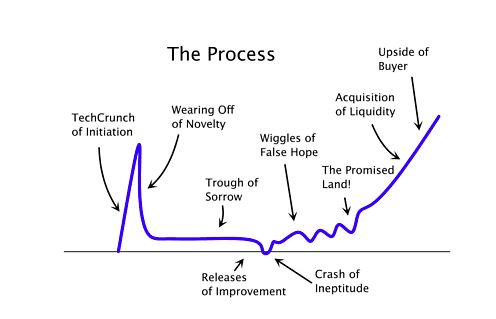
The process

Many people think startups are up and to the right all the time. But more exhibit this startup curve than any other growth pattern. Of course, some never get past the “trough of sorrow”. But many do. Mostly by staying focused on the problem they are trying to solve and working diligently to get to the promised land.

Would love to hear some thoughts on this from today’s entrepreneurs!

50 Inspirational Quotes for Startups and Entrepreneurs

“Your work is going to fill a large part of your life, and the only way to be truly satisfied is to do what you believe is great work. And the only way to do great work is to love what you do.”

Steve Jobs, Co-Founder, Chairman and CEO, Apple

Visit Acceler8Success Daily at https://paper.li/Acceler8Success-Daily

Visit Acceler8Success Group website at www.Acceler8Success.com

Opinions, Insight and Perspectives on Franchising

I recently posted a question on Linkedin that addressed the primary reasons to explore franchising. Below please find several of the responses from a cross-section of industry and non-industry professionals . As I have done in the past, the names of the responding individuals will be kept confidential. Instead, they will only identified by their Linkedin statement or profile.

doors-optionsWhat is your opinion of franchising as a business model, business expansion strategy and as a career alternative?
as posted in the Q & A section on LinkedIn under Franchising

An SAP Consultant with some franchising experience obviously has done his homework and offered valuable advice as well as sharing some real life experiences.

“I have studied business and many individual businesses personally. I read many business cases and books and have a deep interest in business models and how they work in the current market.

First of all, check out the book ‘The E-myth Revisited?’ It is a very interesting way of viewing a business model. It describes the benefits of the franchise way of doing business.

I also have been involved in a few franchise opportunities, most recently, I was looking to purchase a tanning franchise. The business model was highly tuned, the computer system was revolutionary and perfectly adapted to the business through many years of iterations. The computer system alone would allow you to manage multiple stores with very little hands on control. The power of the franchise itself brought purchasing power and brand recognition which would have been difficult to built independently. The small percentage of revenues to fund regional advertising brought in enough business that I could have been almost completely hands off while still turning a sizable profit.

In short, most entrepreneurs work IN their business, but at a point you need to delegate so you can work ON your business. And franchising is a marvelous way (for most businesses) to grow exponentially.”

This next response if from a business coach that specializes in guerilla marketing strategies. Before I even read her response i knew I would agree with her perspective of franchisees needing to be prepared to work hard despite buying into a system. How true, indeed.

“I think that Franchises represent an great opportunity for some people. They can provide an excellent template for success, as well as resources and support as you are growing your business. That said, opening a franchise is just like starting any other business from the standpoint that you must have a clear idea as to how you will drive customers to your product/service. A franchisor will provide you with the tools and a blueprint, but you are going to have to do a lot of the heavy-lifting yourself. Make sure you are prepared!

Before committing to any franchise, talk to some of their current (and former!) franchisees. Don’t just call the people the franchisor tells you to call; reach deeper into their list of franchisees. Develop a list of questions that you can ask that help you to understand whether this particular franchise is going to be a good fit for you.

Lastly, if you are someone who doesn’t really like “rules”, you may want to think twice about franchising. What makes franchises work is that things are delivered consistently. That can be a good thing, or a bad thing, depending on how well you follow rules!”

An entrepreneur who previously founded a small franchise company offered his view which it appears may have been formed by some entrepreneurial types that entered into a franchise agreement with his franchise company. Personally, I do not believe true entrepreneurs make very good franchisees. On the flip-side, is he referring to true entrepreneurs or franchisees that just had buyer’s remorse and had to blame someone for their poor performance and/or failure?

“I could wax on for hours on the subject and don’t have the finger skills to type it all, but…

First, my qualifications: I founded/own a successful retail business for over 15 years. I have created multiple businesses, some successful, some not, but all independent. I also created a retail concept that I franchised. So I have the unique view of being an independent and a franchisor.

Here are some quotes:
-A franchise is like a bicycle with training wheels. Once you learn how to ride, you won’t want training wheels anymore.
-Franchising is for those who want you to help them…but, then to leave them alone. In other words they want to be indies, but in a community.
-A franchise is only as good as it’s support.
-If a franchise operation doesn’t give back in value more than royalties paid in, the franchisee will eventually resent writing a check to “the mother ship”.
-A franchise is a business model that people expect to have it all figured out – no one has it all figured out.”

A very well-respected and experienced franchise consultant offered his perspective from having worked with individuals explore franchising as a career alternative. I agree that many explore business ownership options because they cannot find a career position that will compensate them as they have grown accustomed to in the past. the choice between franchise and startup often comes down to risk.

“As a business model I think that franchising is or has taken the place of corporate expansion in a lot of cases. Especially in the startup sector. I don’t know how many times recently I have been contacted from a startup that wants to expand via franchising.

I am talking to a lot of people that are looking at franchising as an alternative career path. Most of them are coming to me because they can’t find a job, it isn’t that they don’t want one, but they can’t find one making the money they were making before.

So they turn to owning a business and a logical choice for some of them is a franchise. For others it is starting their own business.

I think it comes down to personal preference and ability to cope with risk factors. I think most of the people that buy a franchise do so to help reduce their risk, so if they were really looking for a job and then had to buy a business, a franchise is probably a one choice.

About 1/3 of my clients are people in this situation that were looking for a new career, due to recent economic conditions, and they couldn’t find what they were looking for.”

An upstart franchise founder offers her views from the perspective of being new to franchising but quite experienced in running her own business. She appears to be spot on about ideal franchise relationships but I look forward to discussing her thoughts after she awards her first four or five franchises.

“As a career alternative, franchises are not for entrepreneurs, whose M.O. is ‘anything you can do, I can do better’. As an expansion strategy, it depends on the industry, product, service and system. For those that rely heavily on outside sales, for instance, hiring salespeople is more risky and time consuming than offering the opportunity for ownership.

I agree that franchising is a great way to grow by working on your business instead of in it.

Franchises offer franchisees:
– Self direction (while some do, many don’t have too-stringent rules)
– Higher income potential than a fixed salary or most sales positions, and often even more than business ownership because growth may be better supported
– Proven solutions to problems that exist in the market, the basis for any startup
– Elimination or reduction of what can often be years or decades of research, development, relationship building and trial and error and financial investment
– SUPPORT”