Tag: sustainable-franchising

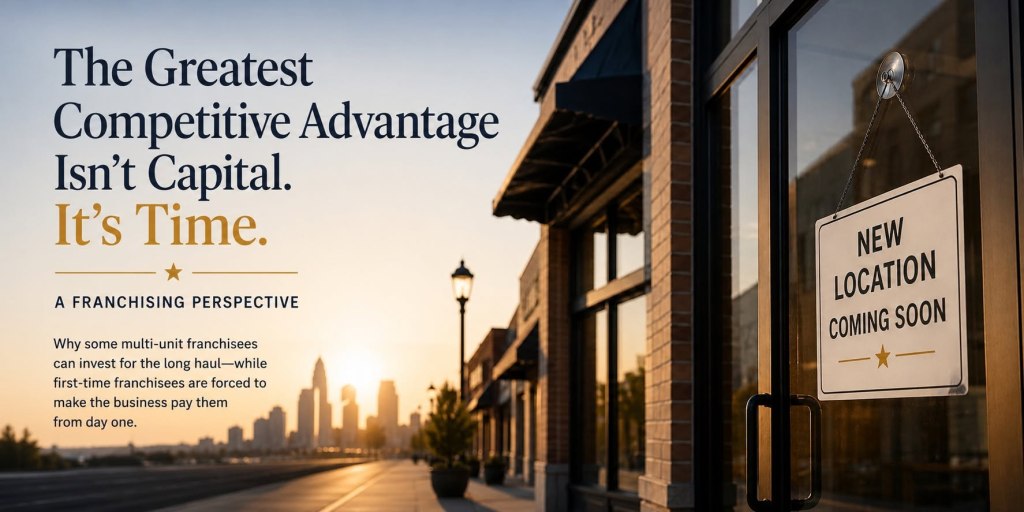
The Missing Investment: Have We Been Financing Franchising the Wrong Way?

For much of my professional life, I have believed that franchising represents one of the most effective pathways to business ownership ever created. It takes many of the uncertainties associated with starting a business from scratch and replaces them with a proven operating system, established branding, training, purchasing power, operational support, and the collective experience of others who have already traveled the same road.

That doesn’t eliminate risk. Nothing in entrepreneurship does. But it improves the odds.

Over more than four decades in franchising, I’ve had the privilege of working with startup franchisees, multi-unit operators, emerging franchisors, mature franchise systems, restaurant companies, investors, lenders, and entrepreneurs from virtually every stage of the business lifecycle. Along the way, I’ve watched extraordinary success stories unfold. I’ve also witnessed businesses with every reason to succeed struggle to gain traction, despite capable owners who worked tirelessly and did many of the right things.

Like most people in our industry, I’ve often attributed those outcomes to familiar variables: site selection, capitalization, operational execution, leadership, marketing, labor, local competition, economic conditions, or franchisor support. All of those factors matter, and each can influence the trajectory of a business.

Lately, however, I’ve found myself wondering whether we’ve overlooked something much more fundamental.

What if many startup businesses are not undercapitalized because they lack sufficient working capital?

What if they are undercapitalized because the entrepreneur is?

The distinction may seem subtle, but I believe it deserves serious discussion.

When a new franchise is developed, the financial model is typically built with remarkable precision. Franchise fees, leasehold improvements, equipment, furniture, technology, signage, professional services, opening inventory, pre-opening marketing, and working capital are all carefully estimated. The numbers are reviewed by lenders, evaluated by franchisors, scrutinized by accountants, and debated by prospective franchisees.

Every anticipated expense is assigned a value.

Every anticipated obligation is accounted for.

Yet there is one question that rarely receives the same level of attention.

How will the franchisee personally sustain themselves while giving the business the time it needs to become financially healthy?

For many first-time business owners, the answer is simple.

“The business will pay me.”

At first glance, that sounds perfectly reasonable. After all, most people start businesses hoping to create both wealth and income. The expectation isn’t irrational. It’s natural.

The challenge is that a startup business is being asked to perform two very different jobs at the same time.

First, it must become a profitable enterprise capable of serving customers, building a team, establishing a reputation, and creating long-term value.

Second, it must immediately become the primary source of financial support for the entrepreneur and their family.

Those two objectives are not always compatible.

Every dollar distributed to support the franchisee’s household is a dollar that cannot remain in the business to strengthen operations, improve marketing, invest in technology, hire additional staff, increase inventory, build reserves, or simply provide breathing room while the business matures.

None of this suggests the franchisee is making poor decisions.

In many cases, they have little choice.

The business isn’t simply funding itself.

It is funding an entire household.

That reality has led me to another question, one that has become increasingly difficult to ignore after years of observing franchise systems and restaurant companies.

Why do so many experienced multi-unit operators seem able to expand into new markets with patience and confidence while first-time entrepreneurs often find themselves under extraordinary financial pressure almost immediately after opening?

Certainly experience plays a role.

So do operational systems.

Relationships matter.

Access to capital matters.

Yet I wonder if another explanation receives far less attention than it deserves.

Experienced entrepreneurs often have something first-time entrepreneurs do not.

Time.

Or perhaps more accurately, they have purchased the ability to give a new business time.

Consider the successful multi-unit franchisee opening another restaurant in an emerging market.

Perhaps the community surrounding the location is still under development. New homes are being constructed. Retail centers are only partially occupied. Traffic counts are expected to increase steadily over the next several years.

Everyone involved understands that the location’s greatest years likely lie ahead rather than immediately after opening.

The entrepreneur proceeds anyway.

Why?

Because they are investing.

Not depending.

Their existing businesses already support their personal lifestyle. Mature locations pay the mortgage, provide health insurance, fund family expenses, and create personal financial stability. The new business is free to retain virtually every dollar it generates because the entrepreneur is not relying on it to meet next month’s household obligations.

Cash remains inside the business.

Operations improve.

Marketing continues.

Employees are retained.

Customer relationships deepen.

Reserves accumulate.

The business becomes stronger because it has the financial freedom to become stronger.

It is easy to look at that entrepreneur and conclude they simply execute better.

Perhaps they do.

But I suspect there is something equally important happening beneath the surface.

They have separated their personal financial needs from the immediate financial demands placed upon the new business.

Now consider the first-time franchisee.

There are no existing businesses generating income.

No mature assets producing cash flow.

No portfolio of successful operations quietly subsidizing the next venture.

The startup must accomplish everything at once.

It must pay rent.

It must cover payroll.

It must satisfy suppliers.

It must meet debt obligations.

It must invest in marketing.

It must build a customer base.

And somehow, almost immediately, it must also provide enough income to support the franchisee’s family.

Those are extraordinary expectations for any young business.

This observation raises what may be the most important question of all.

Is this one of the hidden reasons we have witnessed such a widening gap within franchising and the restaurant industry?

At one end of the spectrum stand sophisticated multi-unit operators, institutional investors, private equity-backed organizations, and experienced entrepreneurs who continue acquiring businesses and opening new locations. At the other end stand independent operators, first-time franchisees, and family-owned businesses working extraordinary hours simply trying to make ends meet.

We often explain that gap through operational sophistication, purchasing power, economies of scale, or superior management. Those explanations certainly contain truth.

But perhaps they do not tell the entire story.

Perhaps one of the greatest competitive advantages enjoyed by larger operators is not merely that they know how to build businesses.

Perhaps it is that they no longer require every new business to support their personal lives from the day it opens.

If that is true, then the implications extend far beyond franchising.

They touch entrepreneurship itself.

For generations we have taught entrepreneurs how to capitalize businesses.

Perhaps we have spent far less time teaching them how to capitalize themselves.

That distinction matters.

Maybe startup capitalization should no longer be viewed as a single exercise.

Perhaps every entrepreneurial venture actually requires two distinct forms of capital.

The first is business capital—the funds required to develop, launch, and operate the enterprise.

The second might best be described as entrepreneur capital.

Not additional working capital.

Not contingency funds.

Not emergency reserves.

Rather, a deliberate plan that enables the entrepreneur to devote themselves fully to building long-term enterprise value without requiring the business to become their paycheck before it is capable of doing so sustainably.

How that entrepreneur capital is created will differ for every entrepreneur.

For one family it may come from savings accumulated over many years.

For another it may come from a spouse’s income.

Someone else may continue consulting while building the business. Another entrepreneur may secure investment specifically intended to support personal financial stability during the startup years. Some may deliberately maintain outside employment longer than originally planned.

The source is less important than the principle.

The entrepreneur’s financial sustainability should not be treated as an afterthought.

It should be treated as an integral part of the startup strategy.

This is not a recommendation that entrepreneurs should never pay themselves.

Nor is it a suggestion that lenders should simply increase loan amounts or that franchisors assume greater financial responsibility.

Rather, it is an invitation to reconsider the assumptions upon which many startups are built.

Perhaps we have been asking prospective franchisees the wrong question.

Instead of asking, “Do you have enough money to open the business?”

Perhaps we should also be asking, “Do you have enough resources to allow the business to mature before it must support your household?”

Those are profoundly different questions.

One measures the ability to open.

The other measures the ability to endure.

After forty years in this industry, I have become increasingly convinced that endurance is one of entrepreneurship’s greatest competitive advantages.

Businesses rarely fail because owners lack passion.

They rarely fail because owners stop working.

More often than not, they fail because time runs out.

Cash runs out.

Options disappear.

Pressure forces decisions that would never have been made under healthier financial circumstances.

The irony is that many of those same businesses may have become remarkably successful had they simply been afforded more time.

Perhaps the greatest gift we can give a new entrepreneur is not another operations manual, another marketing program, or another technology platform.

Perhaps it is the ability to let the business become a business before expecting it to become a livelihood.

I don’t present these thoughts as settled conclusions. In many respects, they remain questions—questions shaped by decades of observing businesses succeed, struggle, recover, and sometimes disappear altogether.

But they are questions I believe our industry should be willing to ask.

If we genuinely want to strengthen franchising, improve startup success rates, and create more sustainable entrepreneurial ventures, perhaps it is time to broaden the conversation beyond startup costs and working capital.

Perhaps the conversation should include the entrepreneur.

Because maybe the missing investment in every startup isn’t another piece of equipment, another month of operating capital, or another marketing campaign.

Maybe the missing investment has been the entrepreneur all along.

And if that’s true, then we may discover that the future of entrepreneurship depends not simply on financing better businesses, but on creating better conditions for entrepreneurs to build them.
I Love Franchising, But… The Conversation Continues

Yesterday’s article, “I Love Franchising, But…”, was written from a place of respect for an industry that has given so many entrepreneurs a proven path to business ownership and has given so many brands the ability to scale with speed and confidence. Two weeks earlier, “Deliberate Franchising: Why the Smartest Brands Choose Local Dominance Before National Expansion” explored a different but related idea: that restraint, focus, and patience are not weaknesses in franchising, but strategic strengths. Sitting with both pieces, one idea continues to rise to the surface with clarity and conviction. Deliberate Franchising is Responsible Franchising, and it is also Sustainable Franchising.

This is not about rejecting growth or dismissing ambition. Franchising, at its best, is a powerful multiplier of opportunity. It aligns capital, talent, systems, and brand promise in a way few business models can. The concern is not with franchising itself, nor with growth as an objective. The concern is with pace, readiness, and intent. When growth becomes the goal rather than the outcome of doing the fundamentals well, brands can find themselves expanding faster than their infrastructure, culture, and leadership can realistically support.

The phrase “throwing the baby out with the bath water” comes to mind because that is not what this conversation is about. There is nothing here that suggests franchisors should abandon development efforts or retreat from opportunity. What is being suggested is a pause, not a stop. A pause to think now, while there is still room to choose, rather than later, when circumstances force decisions under pressure. Proactive leadership in franchising has always been about seeing around corners, not reacting to walls once they are already in front of you.

Local dominance before national expansion is one of the clearest expressions of responsible franchising. When a brand saturates a market thoughtfully, it learns faster. Operations are tested under real-world conditions. Support systems are refined in close proximity. Franchisees feel seen, supported, and protected rather than isolated. Marketing dollars work harder. Brand awareness compounds rather than scatters. Mistakes happen closer to home, where they can be corrected without damaging the broader system.

Sustainability in franchising is not just about financial endurance. It is about emotional endurance, operational endurance, and relational endurance. Franchisees who feel rushed into immature systems burn out faster. Corporate teams stretched too thin lose clarity and consistency. Vendors, trainers, and field support begin operating in catch-up mode. None of this happens overnight, and that is precisely why it is dangerous. Unsustainable growth often looks successful right up until it doesn’t.

Responsible franchising asks harder questions earlier. Are we building a brand that franchisees can thrive in five and ten years from now, or are we optimizing for near-term unit count? Are we adding locations faster than we are adding leadership depth? Are we expanding because the model is ready, or because the market is hot and the phones are ringing? These questions are not meant to slow ambition. They are meant to protect it.

The healthiest franchise systems are rarely the loudest in the room. They are usually the most disciplined. They understand that credibility is built one franchisee at a time, one market at a time, one promise kept at a time. They recognize that growth earned is more valuable than growth chased. They accept that saying “not yet” can sometimes be the most strategic decision a franchisor makes.

This is ultimately an invitation, not a declaration. An invitation to talk. To share thoughts, perspectives, and even disagreements about where franchising is headed and where it should be headed. To discuss what responsible growth looks like in different sectors, stages, and market conditions. To explore related and even unrelated ideas that challenge assumptions and sharpen thinking.

If we care about the future of franchising, we owe it to ourselves and to the entrepreneurs who invest their lives into these brands to think deliberately today. Proactive conversations now can prevent reactive decisions later. That is how better systems are built. That is how stronger brands endure. That is how franchising creates a better tomorrow.


About the Author

Paul Segreto brings over forty years of real-world experience in franchising, restaurants, and small business growth. Recognized as one of the Top 100 Global Franchise and Small Business Influencers, Paul is the driving voice behind Acceler8Success Café, a daily content platform that inspires and informs thousands of entrepreneurs nationwide. A passionate advocate for ethical leadership and sustainable growth, Paul has dedicated his career to helping founders, franchise executives, and entrepreneurial families achieve clarity, balance, and lasting success through purpose-driven action.


About Acceler8Success America

Acceler8Success America is a comprehensive business advisory and coaching platform dedicated to helping entrepreneurs, small business owners, and franchise professionals achieve The American Dream Accelerated.

Through a combination of strategic consulting, results-focused coaching, and empowering content, Acceler8Success America provides the tools, insights, and guidance needed to start, grow, and scale successfully in today’s fast-paced world.

With deep expertise in entrepreneurship, franchising, restaurants, and small business development, Acceler8Success America bridges experience and innovation, supporting current and aspiring entrepreneurs as they build sustainable businesses and lasting legacies across America.

Learn more at Acceler8SuccessAmerica.com

Why Responsible and Sustainable Franchise Growth Starts With Restraint

Franchising is often framed as a pathway to scale. In reality, it is a decision to permanently intertwine the fate of a brand with the financial lives of independent business owners. That distinction is not philosophical; it is practical, ethical, and enduring. As 2026 unfolds amid economic recalibration, heightened franchisee awareness, and increased scrutiny of franchise systems, the most responsible form of growth is also the most sustainable one: deliberate franchising.

Responsible franchising and sustainable franchising are not abstract ideals. They are the direct outcome of leadership that thinks beyond speed and short-term valuation. Deliberate franchising sits at the intersection of these principles. It recognizes that growth achieved without discipline may be impressive in the moment, but it is rarely durable. Systems built deliberately, by contrast, are designed to support franchisees through cycles, not just expansions. The question leaders must ask themselves is not whether they can grow, but whether they can do so in a way that deserves long-term trust.

Every franchise system begins with an entrepreneur who believes their business is ready for replication. That belief is often well-earned, but belief is not the same as preparedness. Deliberate entrepreneurs pause before franchising to ask questions that go beyond enthusiasm. Is the model genuinely transferable, or does it still rely on founder-driven decision-making and informal problem-solving? Are unit economics resilient enough to support average operators, not just exceptional ones? Would this business remain viable if market conditions tightened or costs rose unexpectedly? Responsible franchising requires confronting these questions before inviting others to invest.

Once franchising begins, leadership obligations change permanently. Decisions no longer affect only the corporate entity; they directly impact franchisees who have committed capital, signed personal guarantees, and structured their lives around the system. Deliberate franchisors understand that every mandate, every required investment, and every strategic shift must be evaluated through the lens of franchisee sustainability. Sustainable franchising is not about maximizing franchisor control. It is about ensuring franchisees can remain healthy, profitable, and engaged over the long term.

Development is where the consequences of nondeliberate franchising are most often revealed. Growth pursued without discipline can strain support infrastructure, dilute culture, and create misalignment that lingers for years. Deliberate franchisors ask whether the system is ready for additional units before approving them. Are training resources scalable? Are field teams positioned to support new locations effectively? Are markets being awarded based on strategic fit rather than availability? Responsible development prioritizes system health over unit count.

At the same time, deliberateness is not an excuse for stagnation. Sustainable franchising requires leadership that can make timely, informed decisions. Avoiding necessary changes, delaying difficult conversations, or postponing strategic shifts in the name of caution ultimately undermines trust. Franchisees expect clarity, not perfection. Deliberate leaders accept uncertainty, act with intention, and communicate openly about trade-offs and risks.

Diligence is the foundation of deliberate franchising. Responsible franchisors stay close to unit-level performance, not just aggregated metrics. They listen to franchisees with discernment, separating patterns from outliers. They invest in infrastructure before growth demands it. This diligence creates readiness, allowing leadership to act decisively when conditions change. Sustainable systems are not reactive; they are prepared.

Being informed is equally critical. The franchising environment is crowded with innovations, advisors, and promised accelerants to scale. Deliberate franchisors resist the urge to adopt solutions simply because they are popular or available. They ask whether proposed initiatives strengthen the franchise relationship or introduce unnecessary complexity. Sustainable franchising values simplicity, clarity, and execution over novelty.

Trust remains the defining currency of franchising. Responsible and sustainable systems are built on consistent, transparent leadership. Deliberate franchisors earn trust by explaining decisions, acknowledging their impact, and taking accountability for outcomes. Franchisees are more willing to align, invest, and adapt when they believe leadership is acting with long-term stewardship rather than short-term gain.

Culture is the natural byproduct of these choices. A deliberate franchise culture prioritizes clarity over ambiguity and accountability over avoidance. It does not rush change without preparation, nor does it allow unresolved issues to linger. When leadership models thoughtful decision-making and disciplined execution, the system becomes more resilient, more aligned, and better positioned to endure market shifts.

As 2026 continues to test assumptions across franchising, the distinction between fast growth and sound growth will become increasingly clear. Responsible franchising, sustainable franchising, and deliberate franchising are not separate philosophies. They are the same commitment expressed in different ways. The central question for franchisors and aspiring franchisors alike is whether they are willing to lead with the foresight, restraint, and accountability that shared risk demands. Growth achieved deliberately may take longer, but it is far more likely to last—and far more worthy of the trust franchisees place in the system.


About the Author

Paul Segreto brings over forty years of real-world experience in franchising, restaurants, and small business growth. Recognized as one of the Top 100 Global Franchise and Small Business Influencers, Paul is the driving voice behind Acceler8Success Café, a daily content platform that inspires and informs thousands of entrepreneurs nationwide. A passionate advocate for ethical leadership and sustainable growth, Paul has dedicated his career to helping founders, franchise executives, and entrepreneurial families achieve clarity, balance, and lasting success through purpose-driven action.


About Acceler8Success America

Acceler8Success America is a comprehensive business advisory and coaching platform dedicated to helping entrepreneurs, small business owners, and franchise professionals achieve The American Dream Accelerated.

Through a combination of strategic consulting, results-focused coaching, and empowering content, Acceler8Success America provides the tools, insights, and guidance needed to start, grow, and scale successfully in today’s fast-paced world.

With deep expertise in entrepreneurship, franchising, restaurants, and small business development, Acceler8Success America bridges experience and innovation, supporting current and aspiring entrepreneurs as they build sustainable businesses and lasting legacies across America.

Learn more at Acceler8SuccessAmerica.com