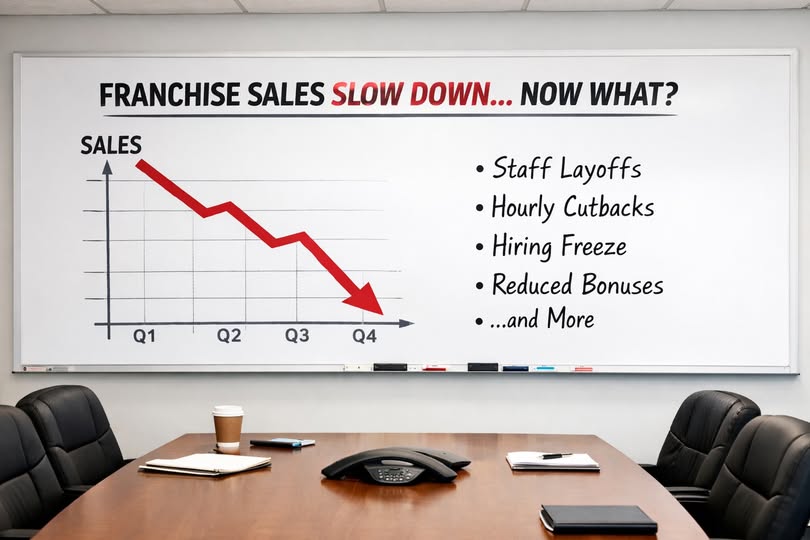
Economic cycles have a way of exposing the truth behind a franchise system. Not the story told in Item 19. Not the momentum created through development deals. The truth.
And the truth is rarely found in growth charts or development maps. It is found in the day-to-day performance of the units. It is found in the strength of the franchisee. It is found in whether the business works when stripped down to its core fundamentals.
Over more than four decades in franchising, through recessions, downturns, and periods of uncertainty, I’ve witnessed a consistent pattern. Franchise sales slow down. Sometimes it’s a dip in interest. Sometimes lenders tighten. Sometimes deals simply take longer to get across the finish line. Often, it’s all of the above at once.
What used to take 60 to 90 days suddenly stretches to six months or more. Candidates become more cautious. Lenders become more selective. Discovery Days become fewer and further between. The energy that once fueled development begins to fade.
And when that happens, something critical is revealed.
The franchisors who built their systems on franchise sales revenue feel it immediately. The pipeline dries up. Cash flow tightens. Pressure builds. Decisions become reactive. Support suffers. Confidence across the system begins to erode.
You begin to see cost-cutting measures that were never part of the long-term plan. Field support gets reduced. Marketing budgets are trimmed. Hiring freezes go into effect. In some cases, leadership begins looking inward, not toward strengthening the system, but toward protecting the business at the top.
Franchisees feel it.
And once franchisees feel it, the ripple effect begins. Morale drops. Execution slips. Customer experience weakens. Revenue follows.
On the other side are the franchisors who are royalty sufficient.
They are not immune to economic pressure, but they are stable. Grounded. Focused. Their business is not dependent on selling the next franchise. It is supported by the performance of the current system.
They don’t panic when development slows. They lean in.
They understand that their responsibility is not to sell franchises. It is to build a system that performs. And when that system performs, growth becomes a natural outcome, not a forced initiative.
That distinction matters more than most realize.
Royalty sufficiency is not just a financial metric. It is a reflection of operational strength. It means your units are performing. It means your franchisees are generating revenue. It means your brand is delivering value at the unit level. And when that is the case, the franchisor has the ability to reinvest into the system rather than chase the next deal out of necessity.
It also creates alignment.
When a franchisor is royalty sufficient, their success is directly tied to the success of their franchisees. There is no dependency on upfront fees to fund the business. There is no misalignment between development and operations. There is only one focus: unit-level performance.
In uncertain times, the priority must shift.
Away from aggressive development for the sake of growth. Toward strengthening the core.
This is where discipline comes into play. It requires stepping back and asking hard questions about what is working and what is not. It requires being honest about unit economics. It requires a willingness to make adjustments, even when those adjustments are uncomfortable.
Improving operations is not optional. It is foundational. Every process, every system, every touchpoint with the customer must be evaluated. Efficiency matters. Consistency matters. Profitability matters. The brands that win in these periods are the ones that tighten execution without compromising the experience.
This includes everything from labor models and cost controls to training programs and technology adoption. It means revisiting your playbooks. It means ensuring that what is written is actually being executed in the field. It means closing the gap between intention and reality.
At the same time, increasing revenue cannot be left to chance.
This is where many systems fall short. They rely on franchisees to “figure it out” locally. But in times like these, leadership must step in with clarity and direction.
Strategic marketing becomes essential, not optional. Messaging must be relevant to the current environment. Promotions must be thoughtful, not reactive. Pricing strategies must reflect both value and profitability. Local store marketing must be structured, not improvised.
Franchisees should not be guessing.
They should be guided.
They should be supported with tools, frameworks, and proven strategies that drive traffic and increase ticket averages. Partnerships should be explored. Community engagement should be encouraged. Innovation should be purposeful and aligned with consumer behavior.
Operations and revenue are not separate conversations. They work together. Better operations lead to better customer experiences. Better experiences lead to stronger revenue. Stronger revenue reinforces the entire system.
This is how resilience is built.
Not through growth for the sake of growth, but through performance that sustains the business regardless of external conditions.
But here is the question every franchisor needs to ask, and answer honestly.
Can your brand survive without franchise sales revenue?
Not theoretically. In reality.
If development slowed significantly tomorrow, would your organization remain stable? Would you still be able to support your franchisees at the level they expect and deserve? Would your infrastructure hold up? Would your team remain intact? Would your brand continue to grow through unit-level performance rather than unit count?
Would your franchisees still believe in the system?
If the answer is uncertain, then the work is clear.
Build toward royalty sufficiency.
Strengthen unit economics. Focus on same-store sales growth. Improve margins. Refine your support systems. Invest in your existing franchisees as if they are the only path forward, because in times like these, they are.
That may mean slowing development intentionally. It may mean reallocating resources away from sales and into operations. It may mean making difficult decisions in the short term to create long-term stability.
But that is what leadership requires.
Growth will return. It always does. Markets stabilize. Confidence rebuilds. Capital loosens. And when that happens, the brands that emerge stronger are the ones that used the downturn to get better, not just to get through.
They are disciplined. They are deliberate. They are built on substance, not momentum.
And when franchise sales begin to accelerate again, they do so from a position of strength, with a system that is proven, resilient, and aligned.
The question is not whether another slowdown will come. It will.
The question is whether your franchise organization is built to withstand it.
If this is a conversation worth having for your brand, let’s start there.
Reach out directly at paul@acceler8success.com and let’s take a hard look at where your system stands today and where it needs to go.
Discover more from Acceler8Success Cafe
Subscribe to get the latest posts sent to your email.

You must be logged in to post a comment.