Category: Entrepreneurship

A Few Things You Should Know as You Explore Franchise Ownership

For many individuals that explore franchising as the next step in their career, as a way to control their own destiny or as a way to create a family business understanding the process can be quite overwhelming. Below are several articles by franchise experts that will help interested parties diligently navigate the process to help create a playing field that is best for them as opposed to seeing them aimlessly tiptoe through a minefield consisting of franchising’s good, bad and ugly.

If you’re thinking of becoming a franchisee, how should you prepare yourself?

Buying a franchise can be a great move for a would-be entrepreneur who doesn’t want to create a new business from scratch. In theory, franchisees acquire a model that already works on every level, from branding to pricing to marketing. A ready clientele eagerly spends on Dunkin’ Donuts, McDonald’s and 7-11. The market has tested the best recipes for glazed crullers, Egg McMuffins and the right combo of energy drinks to stock next to the register. But making a go as a successful franchisee can be a lot more complicated than simply finding an appealing brand and plunking down some cash. For a taste of what can go wrong, see Forbes’ piece about the problems at sandwich franchise Quiznos, which paid $206 million to settle a suit brought by franchisees who claimed the chain had oversold its markets and excessively marked up supplies.

Read more…

How to Buy A Franchise

Contrary to popular belief, the process of buying a franchise isn’t really difficult-but it is a process. I’ve found, (through working one-on-one with thousands of potential franchise owners) that it’s really important to tackle a major life decision like the purchase of a franchise business-or any type of business, in a very methodical way. (Even if you’re not a methodical person!)

But you need to realize that buying a franchise is a big deal. It could potentially be life-changing. That’s what you want, isn’t it?

After all, you probably wouldn’t be reading this if you wanted to just go out and find a new job -or keep the one you have.

With that in mind, kick off your shoes and grab your favorite beverage. In this article, Joel Libava, The Franchise King shows exactly how to buy a franchise.

Read more…

Why Owning A Franchise Business Is Good For Your Family

Many entrepreneurs choose to become small-business owners with an exit strategy of turning over the business to their children one day — a strategy that takes on more importance in an era where young people are struggling to find gainful employment. Children who begin working in the family business at a young age will typically start an ascension into management after college, with an eye on purchasing some or all of the family business as their parents head into retirement. Often, the parents will retain a percentage of the business as a revenue stream in retirement, adding an extra level of responsibility for the child as a steward of their parents’ nest egg.

Even if they don’t stay in the family business, studies show that parental entrepreneurship increases the probability of children’s entrepreneurship by about 60%. Children of entrepreneurial parents have already experienced many of the ebbs and flows of small-business ownership, which helps to mitigate their fears and raise their risk tolerance.

Read more…

Learning About Franchising

During research for Franchise Bible, 8th Edition, author, Rick Grossman found that the franchise industry had changed in many ways over the years. Technology has had the biggest impact by modifying buying behaviors. Not too many years ago, franchise buyers would find an opportunity in Entrepreneur magazine or by attending a franchise expo in-person. They would then go through the franchisor’s respective step-by-step process to qualify, purchase and launch their franchises. But today, buyers can find a plethora of information online about nearly any franchise they want to learn about. This has leveled the playing field for new innovative companies to compete favorably with the “big boys” in the marketplace.

Read more…

Below are a few links to additional information about franchise ownership in previous editions of Acceler8Success Cafe:

Confusion About Franchising

An Important Decision About Business Ownership – Startup or Franchise?

Things You Should Know & Info You Should Have BEFORE Investing in a Franchise

Have a great day. Make it happen. Make it count!

Is it possible for an entrepreneur to completely shut down for the weekend?

Entrepreneurs & Weekends: Do What’s Best for YOU! (July 2022)

If you were to do a Google search for ‘entrepreneurs and weekends’ or any combination of words including both of these words, one would find more than could be read in a day that appears to have relevance. Although, that relevance is on both sides of the coin.

One side showcases the necessity and desire of entrepreneurs working seven days a week. The other side presents the case of work / life balance and necessary rest. Both philosophies could be looked at as the right way with a laundry list of successful entrepreneurs listed on both sides. If the lists were determined by reason or justification, additional lists would be required.

How to Care for Yourself as an Entrepreneur

Sure, times have changed, and the business environment has kept pace. A push for a 4-day workweek certainly appears counterintuitive to entrepreneurs working weekends. Yet, working remotely could be embraced by the entrepreneurs that desire to seemingly work 24/7 without having to ‘waste’ time commuting to an office.

On the flip side, is it possible for an entrepreneur, creative and innovative as is typical of a successful entrepreneur’s traits and characteristics to actually shut down for two or three (holiday weekends) days at a time? Or if they did take the weekend to enjoy some rest & relaxation, would that time be spent exclusively on non-business activities?

I guess we’d have to identify ‘business activities’ to have a true understanding. Apart from actually crunching numbers, drafting proposals, outlining strategies and reading reports, do business activities include spending time thinking about new ideas, reflecting upon decisions, thinking ahead and even reading business-related books & publications?

Is it possible for an entrepreneur to completely shut down for the weekend? And truly shut down without a glimpse at or about anything that is even closely related to business? Is it possible to clear one’s mind?

The Entrepreneur’s Guide to Meditation – What Every Entrepreneur Can Gain From This Practice

Further, considering an entrepreneur’s passion and commitment to his or her venture, is it really possible for them to turn on a dime and focus elsewhere?

I believe the true answer to these questions comes down to balance. After all, it’s impossible to run 24/7 without burning out and / or adversely affecting one’s health. That’s a given. By the same token, is it practical to completely shift for the weekend and then shift back just two days later?

And is it really two days or are we ignoring the often-recommended practice of preparing for the week ahead Sunday evenings? And when does the weekend start – Friday nights or Saturday mornings?

Yes, balance is the answer but also essential is developing one’s business in a way to not control the entrepreneur’s every waking minute. The entrepreneur’s mindset must also adjust to delegate accordingly. Building a team is key. As is developing the right culture.

Basically, there must be a Yin and yang structure within the entrepreneur’s mind to allow, ensure work and life co-exists, as opposed to a this or that scenario.

So, sleep a little later than usual this weekend. Work out a little longer and harder. Spend quality time with your loved ones. Grab an afternoon nap. Take a few hours for a leisurely lunch or dinner. Hit the links with your friends. Do it all or do nothing at all as that’s okay.

Golfing For Entrepreneurs- Why It Can Be Good For Your Business

However, don’t feel like you have to do any of it and certainly don’t do things out of guilt or doubt or because some articles say you should do things a certain way and within a certain schedule. Do what makes you feel well-rested physically AND mentally. Do what you enjoy and what makes you happy.

And if entrepreneurship or your venture isn’t making you happy, it may be time to re-evaluate what it is that you do moving forward.

Have a great weekend. Make it happen. Make it count!

Whether a Winner or Loser, a Choice was Made!

In today’s society there are winners, and there are losers. That may seem somewhat harsh, but it’s the reality of the world we live in. Human beings by nature are ego driven and competitive, it’s in our nature to always compete with others, even on a subconscious level, no matter how trivial the matter.

A winner looks up to where he or she is going. A loser looks down at those who’ve not yet achieved the position he or she has. A winner respects those who are superior to him and tries to learn from them. A loser resents those who are superior to him and tries to find fault…

“Winners and losers aren’t born, they are the products of how they think.” – Lou Holtz

The Winner is always part of the answer; The Loser is always part of the problem.

The Winner always has a program; The Loser always has an excuse.

The Winner says, “Let me do it for you”; The Loser says, “That is not my job.”

The Winner sees an answer for every problem; The Loser sees a problem for every answer.

The Winner says,” It may be difficult, but it is possible”; The Loser says,” It may be possible, but it is too difficult.”

When a Winner makes a mistake, they say,” I was wrong”; When a Loser makes a mistake, they say,” It wasn’t my fault.”

A Winner makes commitments; A Loser makes promises.

Winners have dreams; Losers have schemes.

Winners say,” I must do something”; Losers say, “Something must be done.”

Winners are a part of the team; Losers are apart from the team.

Winners see the gain; Losers see the pain.

Winners see possibilities; Losers see problems.

Winners believe in win/win; Losers believe for them to win someone has to lose.

Winners see the potential; Losers see the past.

Winners are like a thermostat; Losers are like thermometers.

Winners choose what they say; Losers say what they choose.

Winners use hard arguments, but soft words; Losers use soft arguments, but hard words.

Winners stand firm on values, but compromise on petty things; Losers stand firm on petty things, but compromise on values.

Winners follow the philosophy of empathy: “Don’t do to others what you would not want them to do to you”; Losers follow the philosophy, “Do it to others before they do it to you.”

Winners make it happen; Losers let it happen. – Author Unknown

Have a great day. Make it happen. Make it count!

Franchise Success Strategy

As we’re quickly approaching the very busy conference season in franchising with event after event until June, I believe it’s the perfect time to again share my thoughts on franchise success. I’m of the mindset it’d be most beneficial for emerging franchise brand founders and entrepreneurs considering franchising as a growth strategy for their service business or restaurant.

At Acceler8Success Group, we focus on developing strategies for healthy, sustainable growth. Unlike many consultants and advisors in our field, we know that this must be more than just a focus on franchise development to acquire and convert leads.

That strategy is based on a concept of a hierarchy of franchise success requiring certain needs be met as a foundation to the next level and ultimately sustainable growth. Our approach is much like the Maslow model of human motivation.

The first level of success to be achieved is establishing and maintaining franchisee profitability. The next level is to maintain a healthy relationship with the franchise network. Sustainable growth in franchise development relies on a solid foundation of profitable franchisees that believe in the management team guiding their future because sustainable growth relies on validation from the existing network for future franchise development.

Once that foundation is in place, a strategy for growth relies on the third level of success. A robust marketing and management approach must be developed to generate leads, develop prospects, and convert franchise candidates to open and operate a successful franchise location or territory. This development will be designed to maximize the impact of the positive validation from the existing franchisees.

The fourth level requires a constant vigilance of the management to team to understand and react to changes within the marketplace. The evolution of the offering and the brand creates a continuous improvement cycle that continues to support and sustain unit profitability, the franchisee/franchisor relationship, and thereby continued success in franchise development.

90% of organizations continue to miss their strategic targets. Poor planning is at the root, but you are only as good as your culture. James Milsom, Head of Marketing, i-Nexus regarding ‘True North’ companies

We believe our approach to franchising is in accord with the simple and constant philosophy of True North companies:

• We provide outstanding companies the tools for improved performance.

• We partner with management to provide new opportunities for growth.

• We believe that the most important assets in any business are the people who run them and work at them every day (including the franchisees).

• We develop strategies built on a solid foundation and continuous improvement for long-term success

• And of course, we reflect and maintain the highest standard of integrity.

We start with an introductory meeting to determine the pain points of our clients and the pain points of their franchisees. The next step involves a complete evaluation of the franchise system to help the franchisor identify the actual root causes of the problems that have hindered or reversed its growth pattern. Once we have determined the root cause(s) of the issues, in coordination with the existing management, we develop a strategic plan to strengthen every level within the hierarchy of success.

The strategic plan is designed to be cyclical in nature allowing continuous improvement at each level so as you reach the evolution level the cycle starts again with an evaluation of how the changes have affected the unit economics of the franchises and the relationship. Again that will impact validation and the foundation for growth through franchise development. This cyclical approach for continuous improvement provides the strategy a plan for sustainable growth.

For more information about our Franchise Success Strategy, please reach out to me via email at Paul@Acceler8Success.com. As well, please visit our website to learn more about our comprehensive services. Our initial consultation is complimentary as it’s necessary for us to fully understand your goals as well as current challenges. And if you’re interested in one-on-one entrepreneurship coaching please visit Entrepreneurship411.com.

Have a great day. Make it happen. Make it count!
Change is Necessary!

Of course, if you win the $1,000,000,000 Mega Millions drawing tonight, you’ll be quick to map out significant changes for your new life. 

But what about necessary changes for your life without luck and fortune? I believe we refer to that as everyday life. The norm, if you will.

It’s interesting that most people plan more for a vacation than for their future. Yet, proper planning for the future could enable you to have multiple vacations each year. 

But something has to change from the normal course of business, career, life. You can’t just keep doing the same things over and over again and expect different results. That’s referred to as insanity. 

Change allows us to move forward in life and experience new and exciting things. When you don’t actively work on evolving yourself, life can become stagnant. For instance, learning new skills or working on your inner self can bring about changes you never knew were possible.

Why is change necessary in life?

Change ensures that bad situations end. So long as you embrace change, you will find that your situation does not have to last forever and you will progress on to something bigger and better. If you reject change, experiences and opportunities in your career are likely to pass you by.

Is change necessary for growth?

Change is inevitable. There is comfort in predictability, but the truth is, without change, there is no growth. Without change you will keep making the same mistakes.

What is the purpose of change?

To evolve is to change. You may believe that you are subject to change; that things are outside of your control (determinism). Alternatively, you may believe that you create change; that you are the master of your actions (free will).

Why must we embrace change?

Change pushes you to become a more evolved person. You learn how to adapt to new circumstances, think of unique approaches and work to accept yourself. These adventures come together to promote personal growth.

Why is change hard, but necessary?

Evolving takes courage. And we must use this courage to keep surviving and feeling good about our choices in life. We are adaptable creatures.

What stops us from changing?

Fear of discomfort, pain or effort all stop us from changing. These fears prevent us from exercising, as it may hurt, from eating healthy, from changing career or starting our own business, from embarking on a new relationship, or leaving behind an old or negative one.

What are the 3 elements of change?

Author Dallas Willard tells us that successful change takes three elements: vision, method, and will.

  • Vision. Successful change hinges on a picture of a desirable future.
  • Method. Once you have a vision, the next thing you need is a method.
  • Will. The last item is intention or will.

Why is everyone afraid of change?

Confusion. People fear change if they don’t understand the reason for it – and then they resist it. Change causes uncertainty and means pushing people out of their comfort zones. However much we might complain about them, it’s our ‘routines’ that make us feel secure.

Let’s recap…

Change is necessary.

Change must be planned. 

Change must be ignited.

Change must be faced. 

Change must be embraced. 

Change must not be feared.

Change must not be ignored.

Change is an investment.

Change is inevitable. 

Change is constant. 

Change is good. 

Change is necessary. 

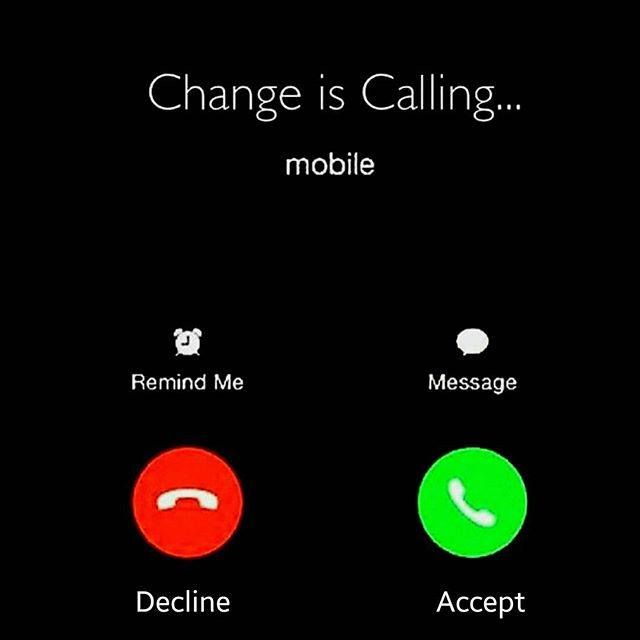
Just wondering, that since so much time is spent glued to a smart phone these days, if CHANGE were calling you, would you answer or just let it go to voice mail?

Have a great day. Make it happen. Make it count! 

Exploring Solutions to Labor Woes in the Restaurant Industry

Marcus Lemonis of The Profit on CNBC refers to key components of a business as People, Product & Process. When consulting with restaurant owners we talk about these components and find the ‘people’ component to be the most challenging. Mainly, being understaffed or poorly staffed is an issue that has a ripple effect throughout a restaurant. Often, we find staffing to be reactive to immediate needs as opposed to proactive to a plan and goals. 

Try this exercise. Build your restaurant on paper as if you were starting in business today. Determine your break even point based upon today’s market for construction, cost of goods, etc. Now compare the numbers to your current operations. Adjust according to the current market, not against what it took to operate your restaurant profitably pre-pandemic. Make changes and move forward. After all, if you started today, you’d have nothing to compare against except to the current market. 

Of course, this isn’t the only solution to a challenging labor market for restaurant operators. To that end, below please find several articles that I have found very enlightening on the subject.

Restaurant Industry Labor Shortage

Good people are hard to find and even harder to keep in today’s restaurant labor market. Even prior to the pandemic, recruitment and retention have long been major challenges for restaurant owners and operators.

COVID-19 pandemic ushered in massive change in the restaurant industry. Many restaurants were forced to close, and others had to make the challenging decision to let go of valued staff and reduce their workforce. 

Now industry is up against a volatile environment riddled with surging inflation, soaring restaurant food costs, and continued supply chain and commodities volatility.

Great food and service are at the core of successful restaurants. Both factors require skilled employees — and a lack of which leads to real challenges. So how do you manage in a market with a labor shortage and record employee churn? Check out the Restaurant Industry Labor Shortage guide by Toast HERE.

Labor Shortages for Restaurants: A Look at A Long-Term Solution

Walk into nearly any restaurant and the effects of the labor shortage can be felt. Servers covering impossibly large sections, with long wait times revealing the kitchen is undoubtedly just as short-staffed. Understanding customers have actually become better tippers, with tipping increases out-stripping inflation, but such kindness can only go so far. To help counteract the skeleton crews and increased prices caused by inflation, employers rely ever more on their staff to provide quality service to keep customers coming back.

Even before the Great Resignation hit the workforce, restaurants had difficulty staying fully staffed. However, while many industries have been able to overcome the impact of the pandemic by increasing remote work, these options are simply unavailable to the restaurant industry. While other industries were able to offer remote work to coerce employees back to their computers, such options are not available for restaurants. Read the full article HERE.

Three Staffing Solutions to Help Restaurants & Hotels Thrive

Turnover in the restaurant and hotel industries has been a costly and time-consuming challenge for management long before the pandemic ensued. Serving as one of the world’s largest employers of part-time labor, the annual turnover rate in the restaurants and accommodations sector exceeds 74%  – much higher than the national average, which sits between 10 and 15%. Combining the costs of recruiting, onboarding, training, and even productivity loss associated with the quick churn, the cost of employee turnover averages at around $5,864 per person. Read more HERE.

Let’s keep this important conversation moving along. Thank you in advance for submitting your insight and perspective below or directly to me at Paul@Acceler8Success.com.

Have a great day. make it happen. Make it count!

What is “balance”​ in the mind of today’s entrepreneur?

A common thought about entrepreneurs and weekends is that entrepreneurs need rest and relaxation just the same as others.

But as we know all too well, entrepreneurs always keep their eyes and ears open for possibilities and opportunities. They always keep their minds sharp in order to be able to evaluate and act upon the same. They always strive to stay fit to be prepared for grueling schedules and long days.

Nevertheless, taking care of mental and physical health certainly does not mean being complacent and lazy. Success is about balance… and focus on achieving goals! 

An article at Entrepreneur.com shares that successful entrepreneurs have a passion for what they do, so working hard is part of their DNA. But anyone who is successful also recognizes that life and work are a marathon, not a sprint. Even they need downtime on the weekend to ensure they’re up to the task of being creative problem solvers and innovators Monday through Friday.

Sure, they may spend some time catching up on administrative work. They may spend time on a big project that needs special attention. And they should definitely spend time thinking about the future and considering the big picture.

But what successful entrepreneurs don’t do is spend the entire weekend buried under work. We all need a break, and entrepreneurs are no less immune to burnout than anyone else. Their weekends are spent restoring their bodies and minds and getting prepared to function optimally come Monday.

Read about nine things successful entrepreneurs do over the weekend to unwind and re-energize for the week ahead HERE.

Another article about entrepreneurs and weekends, and one that I highly recommend reading was written by The Franchise King, Joel Libava, In quintessential Joel-style he shares his personal perspective. Read One Entrepreneur’s Love-Hate Relationship With Weekends HERE.

I agree with all that is shared in the articles referenced above and there are many good points made about entrepreneurs and work-life balance. However, I believe entrepreneurs should do what is best for themselves every day. Sticking a square peg in a round hole just doesn’t work. Nor does a cookie-cutter approach.

Meaning, entrepreneurs should not and would not do something just because they’re told that it is what they should be doing. That would be against the grain of the entrepreneurial mindset. Their schedule or whatever must work for them. It must be aligned with what makes them most effective.

Each entrepreneur has a unique mindset and as such, balance for them may mean working all weekend as they can focus uninterrupted. For some waking up at 9AM is better for them than awaking at 4:30AM. Others may prefer working late hours. In the world of entrepreneurship, there is no one-size-fits-all formula. It comes down to what works best for them that will help create balance.

A Google search of the question, What is balance in life? defines it best… Balanced living means considering all aspects of your life: relationships, work, fitness and health, and emotional well-being. We all get bogged down with work and family responsibilities from time to time, but making time for yourself is necessary so that you can keep up with all your responsibilities.

And another search, What does balance mean in a person? provides the foundation of balance in life from the perspective of mental health… mental steadiness or emotional stability; habit of calm behavior, judgment, etc.

After all, the answers listed above are foundational components of a strong mindset and along with a unique skillset, are essential to success as an entrepreneur.

Take a few minutes to ponder the question… What works best for you to achieve balance in your life and that enables you to maintain your edge as an entrepreneur?

I’m sure you’ll agree, there is no universally correct answer. The best answer is only such as it pertains to you!

Have a great day. Make it happen. Make it count!
Change is Inevitable. Change is Constant.

“This is a formative time for you in which you realize that the conventional ways of doing things aren’t working anymore. Spread the word.” This statement was part of my horoscope this morning. Yes, I do read my horoscope daily albeit I do so only because it makes me think. I find it enjoyable, unlike the news of the day. And sometimes it has me asking myself ‘what if’ questions, especially if today’s horoscope would be something I wish would be true.

Possibly you may not be superstitious. Yet, you think twice about a black cat crossing your path. Or you may cringe if you break a mirror. And certainly, you’ll walk around a ladder instead of walking under it. You may not be superstitious but you may think, why take a chance in creating bad luck for myself when I can easily avoid a situation?

I have similar thoughts when reading my horoscope. If it states that something great will happen if I close a deal today, sure I’ll see if I can make that come true. As well, if the message is to avoid something that day, I’ll most likely heed that advice. More so, I do love things that get me thinking as thought spur creativity and innovation. At times it enables me to see things in a different light, outside the box, if you will.

Today my horoscope has reinforced my thoughts about the strategy and action plans necessary from which to move from pandemic-related challenges as well as from shifts in the way business had been conducted before the pandemic. Essentially, many of the conventional ways of doing things aren’t working anymore. Yes, changes are necessary not only to survive, but also to thrive.

“Change is inevitable. Change is constant.” Benjamin Disraeli

Through the pandemic, change had been looked at as the New Normal. Before we dive into how the New Normal had quickly become the norm, I’d like to spur some thought regarding change with two questions:

How are you currently handling change? How will you handle change moving forward?

Maybe if we take look at the definition of change, it may help better understand change:

change (verb) – 1. make (someone or something) different; alter or modify. 2. replace (something) with something else, especially something of the same kind that is newer or better; substitute one thing for (another).

Change, has changed!

In the past, business leaders predicted threats and planned responses with a risk-management strategy. Today, however, the nature of risk itself is different… It’s right upon us, and repeatedly at that! Change, in and of itself has changed. Instead of a single occurrence, change has become a fluid, recurring event. As such, change has become constant.

Changes being implemented today to survive will continue to be necessary through recovery and beyond. Most likely, repeated change will be key to future success as customers and clients will become accustomed to changes and look for them to continue. This will be the case even if it means changes are to run alongside what was once viewed as standard operations.

For example, think about the focus over the past two years on take-out & delivery in the restaurant industry. Customers are now expecting these welcomed additions to continue long after standard operations have resumed. So, what was described as the New Normal is now normal.

Actually, these additions to the business model have helped many businesses to recover faster, going from surviving to thriving as processes have been perfected and improvements have been made along the way. On the flip side, businesses that had considered the shift as a temporary solution for the times, have either continued to struggle, or have already closed their doors.

A proactive approach to change is key.

As businesses continue to face, seemingly one challenge after another, many have settled into a perpetual survival mode. Unfortunately, that will hurt more in the long run than the very challenges believed to be the sole reason for diminishing sales & profits.

Are these businesses just putting off the inevitable by essentially having become complacent and numb to recurring challenges? Most likely, yes. But it’s not too late to act in a proactive manner. Adjusting to challenges, offsetting or making drastic changes is the right strategy – one that is more inclined to work than just reacting. Often, just reacting is often too late.

Business owners must [always] be thinking about the next steps in addressing challenges, lest they fall short and lose the war (long-term survival) despite winning battles (short-term survival) along the way. In a world of constant change, non-adaptive behavior is inevitably a kiss of death for many businesses. Quite frankly, I’m very tired of the funerals!

Have a great day. Make it happen. Make it count!

Employee to Entrepreneur: Making the Transition

How To Switch From An Employee To An Entrepreneur Mindset

Being an entrepreneur is an exciting and rewarding undertaking and, if you’re motivated by the thought of being your own boss, don’t be put off by the changes you’ll need to make to become a success. Not having one boss can mean you now have many, when you’re answering to your customers, your bank manager and the large number of people who are going to be looking to you for answers.

Being an entrepreneur isn’t the same as being an employee – no matter how high up the career ladder you’ve climbed. But the freedom you get as an entrepreneur means that you can develop your business, and run your life, in the way you think is best.

Read more about making the transition from employee to entrepreneur easier HERE.

From Employee to Entrepreneur: Seven Success Tips for New Business Owners

After you’ve been employed for a few years, you probably have job security, a regular income, benefits, and a bright future. Even so, you may want more out of life, and starting your own business may be the way to get it. However, moving from employee to entrepreneur requires planning, a clear understanding of your career objectives, and confidence that you can do the job as an independent business owner.

Read about some suggestions for creating a smooth transition from employee to entrepreneur, increasing your chances for the success of your new company HERE.

Making The Transition From Employee To Business Owner

Does your passion lie in working in the corporate world for the rest of your life, or are you ready to venture out in an entrepreneurship role?

Transitioning from employee to business owner is as exciting as it is difficult. You have spent your career in a corporate job that gives you income and stability, or at least perceived stability. But it also means you’re going to spend your life building somebody else’s dream. Every day that passes is another day that you have not created something for yourself.

Working as an employee comes with risks, no matter how good and/or loyal you are, that you cannot control. For example, the company could go through a merger or get bought out, downsize or go out of business. There could be a change in management or in the direction of the company that results in an elimination of your position, division etc, and so on.

Read more about making the transition from employee to entrepreneur HERE.

The Ten Most Common Types of Entrepreneurship

While the basic principles of entrepreneurship are the same—planning, starting and operating a business—the distinct nuances and skills needed vary depending on the type of business you plan to start. Becoming an entrepreneur requires the ability to define these differences and pinpoint the unique elements that are needed.

Traditionally, entrepreneurship is categorized into four main types: small businesses, scalable startups, large companies and social entrepreneurs. These models cover the fundamentals of starting a business and focus more on the company itself, rather than the qualities of the entrepreneur.

“However, just as the world continues to change, so do businesses. This means new opportunities for risk-taking and innovative game changers to pave the way in diverse entrepreneurial ways.”

With this in mind, even though there are quite a few similarities when it comes to the challenges that all business owners will face, there are certain types of entrepreneurship defined by the skills, characteristics, and personality traits of the entrepreneur. At the end of the day, it is the way you choose to run your business that makes them differ from one another.

Read more about the various types of entrepreneurship HERE.

Check HERE for books about entrepreneurship. 

Have a great day. Make it happen. Make it count!

Why is there reluctance in dreaming and setting goals? Or at least speaking about them?

What better way to start the New Year at Acceler8Success Cafe than to focus on dreams and goals. After all, isn’t that what we had been programmed to do at the beginning of each year. At least that was the case pre-pandemic. Seemingly, and possibly due to individuals being in somewhat of a survival mode, dreams and goals appear to be on hold – or individuals are reluctant to discuss the same.

Is it due to fear of not being able to achieve goals or make those dreams come true? Or is it due to guilt and not wanting to share their thoughts as there are still individuals having a difficult time recovering from the throes of the pandemic?

So, today I’m sharing a post that I originally published January 2010 and then again in early-2022. I believe similarities between the economic challenges faced in 2010 and in 2022-2023 make this post, with minor edits still relevant today!

What Happened to Our Dreams and Goals?

I recently came across an interesting discussion in one of the LinkedIn groups that I found quite intriguing, and downright enjoyable to read. It wasn’t about franchising. Nothing about social media. There was no mention of business or entrepreneurship. Money or finances weren’t a major part of the equation. And, surprisingly, just a few mentions about current economic challenges. The discussion was actually about the concept of dreams and goals.

It was enlightening that there were well over one hundred responses in a relatively short period of time. Definitely a considerable amount when compared to other discussions within the same group. Often, the responses were being posted one right after the other. It seemed like people wanted to talk about their dreams and goals, almost as if they had been prohibited from doing so of late.

In light of the economic uncertainty surrounding us today, it seems the subject of dreams and goals has hibernated like a bear for winter. During good times, dreams and goals are out in the open, shared by many. Actually, bragged about by some, and the end results, often materialistic, flaunted by others.

It’s ironic that we’re taught that in order to achieve a goal, a key element in doing so is to enlist the assistance of people that can help us achieve the goal. Yet, in the current economic climate, discussions about dreams and goals have subsided, and have almost disappeared. It’s almost like we feel guilty to have such discussions at this time. Or, that we should just be thankful for what we have and dismiss our dreams and goals as frivolous.

What about the dreams and goals that are not financially driven or rewarding? Why have they been put on the back burner? Well, to all of this, I say “enough is enough.” Yes, enough of the poor me attitudes. Enough of the pity parties. And, enough of the social “rubbernecking.” (Social rubbernecking is when people excitedly talk about other people’s miseries – i.e., neighbor lost his job, their house was foreclosed on, he was having an affair – it’s just like slowing down to look at the horrific car wreck!)

NOW is definitely the time to put all the negatives aside and re-ignite the passion behind our dreams. It’s the perfect time to pull out those lists of goals and remember why we wrote them down in the first place. Why they’re important. How they’re important to people close to us. And how our lives would be positively affected upon achieving our goals and making our dreams come true.

Certainly, it’s time to face the realization that it’s up to us to make our dreams and goals a reality. They’re ours. We own them. No one can take them from us. To paraphrase a quote that I’ve seen many times (in many different forms) in discussions about success, “There are people that make things happen, some that watch things happen, and others that wonder what the hell happened?” Could you tell which group of people are most successful at achieving their goals and making their dreams come true?

And I’ll leave you with my favorite quote to ponder:

The best way to predict your future is to create it. – Abraham Lincoln

Have a great day. Make it happen. Make it count!