Category: Franchise Assistance

The 5th Annual Franchisee Satisfaction Awards

FBR awardsThe Franchisee Satisfaction Awards sponsored by Franchise Business Review are the industry’s most prestigious awards, honoring excellence in franchising. Each year, Franchise Business Review conducts thousands of independent surveys of franchisees across the industry. The Franchisee Satisfaction Awards recognize the leading franchise companies with the highest levels of overall satisfaction among their franchise operators.

Franchise Business Review presents awards to the top rated franchises in 17 industry categories: Advertising & Sales, Automotive, Business Services, Child Services, Cleaning & Maintenance, Financial & Tax, Food, Health & Beauty, Home Services, Pet Services, Real Estate, Specialty Retail, Senior Care, Services, Sports & Recreation, Technology and Travel & Hospitality. The top franchise within each category is also honored with a Best Franchise in Category award. Additionally, franchise companies are recognized in other categories including investment level, overall system size, most improved satisfaction, and Franchise of the Year.

Since 2005, nearly 500 leading franchise systems have participated in Franchise Business Review’s annual Franchisee Satisfaction Awards. 150 of those franchise businesses have been recognized for their system’s excellence, as rated and reviewed by their own franchisees.


FOR MORE INFORMATION

REGISTER HERE


Bookmark and Share

Growing Your Franchise in Today’s Climate – Now Available On-Demand

According to research, 70-75% of new franchisors fail over a 10 year period. Do you know the key factors that lead to a franchise succeeding or failing? Do you know the impact of strong communications and accountability on franchisee buy-in and therefore on franchise growth?

VIEW WEBINAR HERE

THIS WEBINAR HELPED ATTENDEES:

*Learn the most important factors in franchise success or failure
*Explore key societal trends that will affect franchising in the next 12 months
*Get concrete solutions to improve communications and accountability with your franchisees
*Discuss best practices around effective communications in the franchise marketplace and how these can be implemented in the areas of social media, franchisee communications, and operations management.

Attendees left with concrete tips they can implement as well as an understanding of how they can strengthen their franchise operations and a renewed understanding of the critical importance of good communication in franchise development.

VIEW WEBINAR HERE

THIS WEBINAR WAS ATTENDED BY:

Franchise company owners

* Presidents and CEOs
* Vice Presidents, Directors of Business Development, Strategy, Marketing, and Operations

This webinar was considered ideal for Franchisors who are in rapid growth, considering rapid growth or experiencing growth challenges, and who want to increase franchisee satisfaction and improve accountability within their franchises.

VIEW WEBINAR HERE

ABOUT THE SPEAKERS:

Katryn Harris, President, CEO & Founder, Open Box Integration Inc.

Since 2005, Katryn has been working with franchisors to implement best practices and help them grow their franchises faster and better. Clients appreciate her pragmatic approach and how often they hear the question: ‘What are you trying to accomplish here?’ She sees a huge opportunity for many growing franchises to take better advantage of tools that improve communications, automate accountability and measure and improve brand consistency.

Katryn has spoken at international conferences and written articles for online sites, blogs and magazines. She enjoys the challenges and rewards of working with small and growing franchises as they develop their growth plans and set themselves up on the path to franchise success.

Katryn Harris has been involved in management and organizational development since 1996. She has experience creating and realizing strategic plans, controlling finances, managing and training staff, and ensuring organizational accountability. Katryn founded Open Box in 2004 with the vision of setting people free to do what they do best.

Blog http://growfromhere.com
Twitter http://twitter.com/katrynharris
LinkedIn http://linkedin.com/in/katrynharris

Paul Segreto, President, CEO & Founder, franchisEssentials

Paul Segreto, President, CEO and Founder of franchisEssentials, a Division of 21st Century CEO, brings unique perspective, entrepreneurial spirit and extensive industry experience to franchise marketing and development. For over twenty years he has exclusively served the franchise industry as consultant and coach, senior-level corporate executive, activist, multi-unit franchisee and area developer.

Understanding the franchise sales process from lead generation through franchise award, and the importance of forming an interdependent relationship between franchisee and franchisor, Paul has successfully developed and executed marketing and development strategies for franchisors across a variety of franchise segments. As franchise candidates and consumers have become more sophisticated and technologically advanced, Paul has embraced Web 2.0 technology and social media marketing, and has identified both as essential to future franchise growth at all levels.

A recognized franchise and small business expert,, Paul frequently serves as a guest speaker / topic leader for focus groups, strategy and sales planning meetings, training sessions and industry panels. He is frequently called upon to utilize his expertise in the development of articles for industry newsletters and blogs, and training programs for companies and organizations within the industry.

LinkedIn http://linkedin.com/in/segreto
Facebook http://facebook.com/paulsegreto
Twitter http://twitter.com/paulsegreto

Judy Brooks, Co-Founder, President & CEO, Blo Blow Dry Bar Inc., and Managing Director, Head Company Inc.

It was 2006, and Judy Brooks was in her 4th year of building out ProActive ReSolutions a company that works with organizations to build respectful workplaces. ProActive had opened offices in Vancouver, Sydney (Australia) and Edmonton and was at the height of developing the team, when a shiraz-fueled conversation between Judy and her daughter, Devon, posed a very vital question: “Why the heck can’t women get a great, affordable blow out in this city!?”.

The first Blo Blow Dry Bar location was born June 6th, 2007. The concept was simple: no cuts, no color — just wash-blow-go. Blo opened three locations in under a year, including one in the Four Seasons Hotel Vancouver. Since opening, Blo has received over 100 franchise requests from around the world and had over 85 editorial features. Being first to market in the category of Blow Dry Bar has had its advantages. Blo’s cheeky brand has been aggressively built. Blo has a big vision and Judy is working with the young team to capitalize on the success with a well-developed growth strategy.

Blo recently merger with Melonhead, Canada’s biggest kids cutting stores, to form Head Company Inc, a company Building Brands with Brains.

In the last 6 years Judy has sold a company she founded 15 years ago, launched two new ones, and has had the pleasure of working with a number of small businesses as an advisor.

Website: http://www.blomedry.com/
Email: judy@blomedry.com

VIEW WEBINAR HERE


Bookmark and Share

Franchise Failure: A Dose of Reality

success or failureThe other day, Donald Cranford, Editor at Franchise Direct, posted an article about the benefits and risks of multi-unit ownership. Subsequently, he followed it up with the post, “Considering Franchise Failure” and referenced one of my articles that related to my own experience of franchise failure, and the fear and consequences thereof. I cannot thank Donald enough for posting these articles as they may assist franchisees that are experiencing difficulties, explore their options and keep their heads out of the sand.

Considering Franchise Failure
by Donald Cranford
as posted July 30, 2009 (Franchise Direct)

Yesterday we wrote about the benefits and risks of multi-unit franchise ownership. With a bit of research and pragmatism, multi-unit ownership can work for you. That said, business can be difficult sometimes and sometimes franchises fail.

Especially given the state of the economy at the present, failure is something that every franchisee and franchisor must confront. There’s no point in tip-toeing over the truth. Times are tough in the small business world. Only by acknowledging the chance of failure can we overcome it.

For a thoughtful meditation on the causes of failure in franchising and ways of overcome the stigma of watching your business collapse, we’d like to recommend the writing of Paul Segreto, who has a run multi-unit franchise and now blogs at franchiseEssentials.

We recently came across Paul’s thoughts on the subject of franchise failure and thought they were illuminating.

In this blog post, Paul frankly discusses how his franchise failed, and does not avoid pointing the blame at himself.

“Let me clarify something. I failed as a franchisee. Not because of anything the franchisor did or didn’t do but because I put and kept my head in the sand and did not face reality. I could go on and make excuses about things that happened around me but at the end of the day I could have turned things around if I got my own head out of the sand, made some difficult decisions and took full, immediate responsibility.”

Ultimately, though, having experienced the ups and downs of franchise ownership, Paul states that failure is something that he has learned from and the experience has inspired him in business.

“Yes, it was a tremendous learning experience but not one I would bestow or wish on anyone. Now, all I can do is to offer my experience to anyone in the franchise industry that needs assistance. As we’ve entered 2009 in the realms of economic uncertainty, I’m certain already difficult situations have been compounded but I’m confident a snap back to reality could only help. If just one franchise business is saved from the consequences of failure, then we’ve made progress. Progress we’ll continue to build upon.”

A dose of reality can prove quite beneficial when considering buying a franchise.

Local Marketing Challenges: What is a Franchisee to do?

No TomorrowI believe the most common local marketing challenges in a franchise organization are the typical franchisee’s lack of marketing 101 skills, their inability to develop a defined marketing strategy, and certainly their inability to execute any marketing plan. However, let’s be fair. They may not have learned about marketing and marketing strategies.

Now, here’s something that franchisees do know something about, and that’s making things happen. Unfortunately, many franchisees don’t have the drive to do whatever it takes to make it happen as it sometimes means integrating their local marketing efforts with grassroots, guerilla, word-of-mouth, or as I like to refer to it as “get off your ass” marketing.

Many franchisees find it necessary to stand behind the counter and serve the customer when they would better serve the business by getting out from behind the counter and mingling with the customers, visiting other businesses, participating in community events, etc.

The major challenge is that most franchisees refuse to take this approach, feeling they’ve made a large investment and the business should come to them, or put the responsibility on the franchisor, or are just lazy and would rather wait for tomorrow. Well, as Garth Brooks sings, “if tomorrow never comes…” Instead, they need to make it happen today and forget tomorrow, as if there is no tomorrow!

Mobile Marketing Can “Mobilize” Franchising

SGC BannerThe following article was written by Guest Author, Linda Daichendt. Linda is Founder, CEO and Managing Consultant at Strategic Growth Concepts, a consulting firm specializing in start-up, small and mid-sized businesses. She is a recognized expert with 20+ years experience in providing Marketing, Operations, HR, and Strategic planning services to start-up, small and mid-sized businesses. Linda can be contacted at linda@strategicgrowthconcepts.com and the company website at www.strategicgrowthconcepts.com.

Mobile Marketing Can “Mobilize” Franchising

Given the precarious state of today’s economy, franchise organizations are on ‘high alert’ for new ways of increasing their franchise development capabilities and helping their franchisees to increase revenues. While recent technology advances provide a variety of methodologies that can be useful in achieving these goals, there is one that has only recently come to the forefront of marketer’s awareness – Mobile Marketing. While you may not yet have heard a lot about it, be assured that in the very near future, you will need to know as much about it as you previously needed to know about direct mail, telemarketing, radio or TV.

Consider the cell phone and its capabilities if you will: recent studies indicate that there are currently more than 272 million mobile phone users in the U.S. (89% of the total population); of those phones, 99% are text capable and 57% of those mobile subscribers use texting on a regular basis; 15% of active mobile phones have the ability to utilize mobile web applications and 44 million people regularly access the mobile web from their cell phones; and over 84% of cell phone owners won’t leave home without the device. These statistics lend legitimacy to the school of thought that indicates that Mobile Marketing is likely to become a substantial portion of corporate marketing budget expenditures within the next few years.

mobilemarketingpanelGiven that, marketers will likely be intrigued by the following facts about Mobile Marketing derived from recent studies: over 80% of consumers respond to SMS messages within 1 hour; 23% of SMS campaign messages are forwarded and become viral; and the messages sent via mobile are actionable and trackable thru specific consumer replies.

I recently gave a presentation to a group of franchisors and franchisees on the topic of Mobile Marketing for franchises, and how its use can aid franchise growth and profitability. I was very pleased by the group’s positive response and interest in the topic, and the many excellent questions that were posed by the event attendees. Given the high level of interest by that group, I thought blog readers from the franchising industry might have an interest in the topic as well. Therefore, I wanted to share some basic Mobile Marketing information, as well as provide several ideas for how it can be utilized in a franchising environment.

First, let’s review what it is. Mobile Marketing is a simple to use, targeted and measurable method of reaching consumers anywhere, anytime via their mobile phones. There are a variety of methods of Mobile Marketing, among them are:

• SMS (short message service)
o Also known as ‘texting’
• MMS (multi-media message service)
o Messages that contain multi-media objects such as images, video and audio
• Mobile Web
o Browser-based web services such as the World Wide Web using a mobile device
• Bluetooth (short-range wireless technology; up to approx. 33 ft)
o Also known as proximity marketing
o The localized wireless distribution of advertising content associated with a particular place. In other words, if you have a cell phone in the proximity of a marketing broadcast, you would be able to receive a message or advertisement
• Location-Based Marketing
o Delivers multi-media directly to the user of a mobile device dependent upon their location via GPS technology
• QR Codes (quick-response barcodes)
o Two-dimensional barcode
• Voice

Next, let’s review several ways in which franchise organizations can utilize Mobile Marketing; these ideas include:

• a franchisor can communicate with all franchisees in their organization at one time via text message to remind them about an upcoming deadline or special event, insuring a timely and consistent message delivery
• a fitness club franchise can post class schedules or let potential customers sign up for an initial free visit on their mobile device
• a restaurant franchise can post seasonal menus or send coupons to their customer database
• a plumbing franchise can list rates and emergency numbers for consumer referral
• a franchisor can send voice messages to a group of prospective franchisees taking part in the franchise development process all at once; the franchisor can insure that all receive the same accurate version of the message, and they can save payroll costs because it takes only moments to have the message sent once instead of hours for personnel to make the calls directly
• many, many other ways that will drive business growth thru franchise development and/or increased consumer demand

Mobile Marketing is extremely cost-effective and results in very satisfactory ROI; with a typical ROI of 10 – 12% and returns as high as 30% reported on some campaigns. According to Nielsen Mobile, half of all U.S. mobile data users, or 28 million people, who recall seeing mobile advertising in the previous 30 days say they responded to a mobile ad.

Driving Customers to Franchise Locations with Mobile Marketing

Strategic Marketing Concepts, a Strategic Partner of franchisEssentials, is a leading expert on Mobile Marketing. Below is a quick glance at how a small business can use mobile marketing as described on the Strategic Marketing Concepts website and blog. We highly recommend visiting these sites to learn more about this exciting technology, and trust you’ll find the information valuable enough to share with your franchisees individually, or through your franchise organization’s advertising cooperatives.

mobile-marketingHow Can a Small Business Use Mobile Marketing?
•a fitness club can post class schedules
•a restaurant can post seasonal menus or coupons
•a school can send voice messages to parents to remind them to attend parents’ night
•a locksmith can list after-hours contact numbers
•a manufacturer can survey customers about a new product
•a plumber can list rates and emergency numbers
•a bookstore can post special events such as guest appearances by well-known authors
•a theater can post movie schedules
•a nightclub can promote appearances by various entertainers
•a grocery store can post weekly coupons and special offers
•a bank can notify customers if their account is going to be overdrawn
•a radio station can have listeners enter a contest
•many, many other ways that will drive business

FOR MORE INFORMATION

Employee Training: The Key to Controlling Workers Compensation Cost

The following article has been submitted by franchisEssentials Guest Author, Margaret Spence, CWC, RMPE – President/CEO of Douglas Claims & Risk Consultants, Inc. and WorkCompSeminars.com. Margaret is a Board Certified Workers’ Compensation Consultant, Speaker and Trainer who ranks among the experts in the field of injury management and return to work implementation. For more than two decades, she has managed workers’ compensation claims for Fortune 500 Corporations, Public Entities and small businesses. She is an expert at showing companies how to slash their workers’ compensation cost by implementing strategies that drastically reduce injury rates, increase productivity and energize employees to work safely. She also is the author of – From Workers’ Comp Claimant to Valued Employee. Margaret pioneered adding National Return to Work Week to the 2009 US calendar – this week highlights the importance of implementing Return-to-Work or Stay-at-Work Programs. To learn more about Margaret please visit her website at www.cdouglasrms.com.

Employee Training: The Key to Controlling Your Workers Compensation Cost

Imagine if you could hire the right candidate, keep them safe and retain them for years to come? As your company grapples with layoffs, budget shortages and declining profits – is this realistic? Can you balance employee retention, injury prevention and economic sustainability? The answer is easy – in tough economic times businesses can not afford to overlook retention and injury prevention. Training is the key to sustaining profits, decreasing workers’ compensation cost and retaining employees.

How would you rate your company’s training program? (a) Exceptional – (b) Great – (c) Adequate – (d) Needs Improvement

Most employers rate their training programs as Great to Adequate; in reality most programs need drastic improvement.

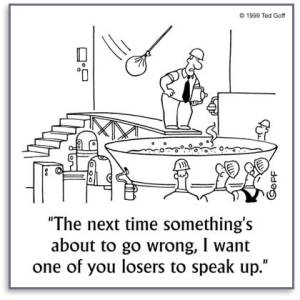
Insurance cartoonThe typical employer describes their training program in the following manner: “Well, we have new employees come in to the HR Department to complete the hire package, then we go over their benefits, we show them a safety video and then we send them to their department for job-specific training.” What the employer is actually saying – new employees are put into a buddy situation, you are asking their co-workers to train them to do the job. Guess what —this is not training! That is passing the torch from Employee A to Employee B.

With this scenario, you are hoping that Employee A, your superstar employee, will pass down all of the requirements for the job. In reality, Employee A is frustrated because she has to train all of the new employees without additional pay, and she passes down her bad habits, her frustrations and what I like to call her accumulated employee baggage to Employee B. Before Employee B has a chance to get her feet wet, she is already forming a negative opinion of your company. Before long, you are totally surprised when Employee B is injured and out on workers’ compensation. What went wrong? You failed to provide the employee with adequate training to prevent the injury – you created a “tribal training program”.

As employers, you have to stop passing the torch – or doing what I call “tribal training”. In the olden days information was passed down from generation to generation using verbal queues, thousands of years later, employers are still doing this every day when they hire new employees. Employers have to recognize that “tribal training” is not training at all – job specific, formal, documented training is what prevents injuries. Like a cookie cutter, every employee in the same job should have the same training – Consistency.

Where should you start?

a. Determine the specifics tasks required to do the job.
b. Determine the essential functions and demands of the jobs.
c. Write a clear job description that addresses the minimum requirements to do the job safely.
d. Determine the safety rules that should apply to the job or work areas.
e. Determine the minimum competency required to do the job safely.

Use this information to create a Training Matrix that charts the job task, minimum competency required to do the job, the safety requirements and a time table for the employee to achieve competency in the position. Then use this information to develop your training classes and start training your employees – Simple.

Do not accept experience for training, even if employees come to your job site with impressive amounts of experience. The previous employer may have done things the right way, but they may not have; the employee may have been adequately trained to perform the job, but he or she may not have been. It is up to you to provide training specific to your work environment and the job tasks you are asking your employees to perform.

Remember training should be an ongoing initiative, not a one shot deal. It should be Simple, Specific and Consistent. As the Employer you must recognize that bad hiring decisions and improper training programs can increase the likelihood that an employee will be injured. Spend the money to train your employees correctly—from the beginning. If you evaluate the overall cost of one workers’ compensation claim—including: the loss of manpower, the administrative cost to manage an injured employee, the workers’ compensation premium cost and the overtime to cover jobs that would have been done by the injured worker—you will see the cost benefits of integrating an effective training program that emphasizes safety into your workplace.

osha messageThe Occupational Safety and Health Administration (OSHA), mandates that you provide training to your employees. In today economic climate, most employers are asking their employees to do more with less staffing, it is imperative that your employees are highly trained and remain injury free. The most cost effective scenario is preventing injuries not managing them. In this economy, you can not afford to continue the training scenarios of the past. Job specific training will ensure that your company moves from one that is trying to survive, to one that is looking for new ways to thrive.