Let’s assume you’ve followed the advice and quidelines in the first three segments of the series on Franchise Development via Social Media. You’ve established your “Virtual Meeting Room” as a Facebook group page and requests to join are submitted everyday. Customers of your franchisees are joining and posting comments about how much they enjoy the experience at the franchise locations. Franchisees have posted some testimonials that really do complement the Founder’s video about his passion and vision for the business. You’re even surprised at how many corporate and franchisee employees have participated and posted comments and photos. All-in-all, you’re proud of the Facebook page and proud of the effort put into developing and maintaining the page.
You’re now looking at you’re social media strategy and you preview the company blog. You feel the content may be all over the board, touching on franchise development, expansion into the Southeast, a new franchisee in Santa Fe, community activity at the franchise location in Seattle and even an article submitted by one of your franchisees about one of his long-time customers, but then you stop a realize how much this menagerie of topics, text, graphics and photos portrays the true face of the franchise concept. You make a note to have your social media administrator issue a press release on just that thought.
 A quick review of Twitter puts a smile on your face as you see the number of people following the concept increasing everday. Then you recall the blog stats revealed a sharp increase in visits from Twitter. Wow, there’s a positive trend here we need to watch. Come to think of it, you’ve noticed an increase in franchise inquiries and wonder if there’s a correlation here. You then look closely at the new people following on Twitter and you backtrack to the company’s recent posts and discussions in several LinkedIn and Facebook groups that just so happen to consist of educators, and realize many of the new franchise inquiries have educational backgrounds. Hmmm, you decide to cross-check the names against LinkedIn profiles and smile again as you notice they’re members of LinkedIn, are in the specific groups you’ve targeted, and many have actually participated in the group discussions where the social media administrator posted some very interesting discussions about careers after teaching and about moms returning to the workforce or exploring career alternatives. It sure is coming together.
You note there are some qualified candidates frequently visiting your Facebook group page, checking out the same information repeatedly and posting specific questions about your franchise opportunity. You’ve even noticed some candidates posting comments about the customer testimonials and some personal messages about the Founder’s video. Now what? Certainly this social media thing isn’t magical that it’ll actually close a few franchise deals, right?
 Just like you’ve integrated traditional marketing strategies with social media strategies, you need to be integrating personal interaction as well. However, instead of an aggressive, focused sales approach, the interaction should be subtle and guiding. Use the social media tools to make your points and make the experience enjoyable and interesting. Your candidates will most likely marvel at the new technology and feel comfortable learning about the technology AND the franchise concept. And yes, they’ll be more comfortable with you and be fully at ease working through disclosure and the finer points of the concept itself.
The rest comes down to guiding your candidates towards making a decision as it will now fully be an informed decision that has been validated by the social media experience AND the franchisees the candiates have contacted. Hmmm, your franchisees actually feel more part of the franchise sales process than ever before. You smile again as you realize it did make the process easier than in the past. Yes, it’ll be very nice to achieve your franchise development goals once again. Maybe next year, you’ll actually exceed them!
Fantasy or Reality? Achieveable or Not? Easy or Hard? That’s up to you and your team. It comes down to personal accountability, diligent execution of your strategy and plan, professional handling of franchise candidates at all times and above all, NO SHORTCUTS!
Personal accountability is necessary in monitoring your social media activity, updating blog content and keeping things fresh. Nobody will stay at a dull party, right? Putting off things for tomorrow that should be done today is just not acceptable. It becomes a reflection of how you handle even the simplest things and the a lack of urgency and poor attention to detail will translate into how you’ll handle the franchise sale and ultimately, your franchisees.
Diligent execution of your strategy and plan is essential. Certainly, you’ll make adjustments along the way. But your plan is your roadmap. Follow it as closely as possible. Allow extra time and resources as necessary for roadblocks and detours, but stay on course. Monitor your progress. How fast did you get from point A to point B. How fast did a candidate get from point A to Point B? Is the process slowing down or speeding up? Why? Do you need to do some system maintenance to the social media vehicle? Maybe your videos aren’t playing correctly? Maybe the photos aren’t laoding fast enough? Maybe it’s time to bring in a technician so you can get back on the road as quickly as possible?
Professional handling of candidates means working with each candidate as you would want to be worked with and treated if you were the one on the verge of making a substantial investment, maybe putting your life savings on the line! It means converying a sense of urgency when asked for information. It means paying attention to detail in something as simple as pronouncing their name correctly all the way to something complex such as full disclosure of the franchise concept. And, it means having the right attitude and conveying the same at every moment of working with the candidate at every point of “contact” including by email, on the phone, in-person, and yes, in the virtual world. Keep in mind, at all points of contact, your attitude will shine through so make sure it shines bright and your franchise future will shine bright as well!
Thank you for travelling with me on this exciting, eye-opening journey. It will be an experience you should be able to relive everytime an individual expresses interest in your concept. At that point, it’s time to smile, focus on the resources you’ve invested, the time you’ve dedicated, and the vision and passion you had when you first started in franchising, and share it with your candidate just as you would share your life with a new addition to your family.
If you have any questions or comments, please feel free to submit them in the space below. If you would like to contact me directly, my email is segreto.paul@gmail.com. In any case, I will respond promptly.
 Not convinced that a social media strategy will help you achieve your franchise development objectives? That’s understandable as it is certainly new, and as such, is difficult to measure for complete efficiency and effectiveness. Basically, there really isn’t anything to measure it against. So, if it doesn’t work, for whatever reason, you need to be prepared and have a back up plan. Is that your thinking? If it is, you’re partially correct in thinking this way. I say, partially, because you should transition into any new marketing approach, and the best way to do so, is to integrate the old with new, the traditional with the innovative.
  Traditional strategy: Tapping your current franchise network for customers that may be interested in your franchise concept. Various costly marketing tools include newsletters, post cards, in-store signage and printed materials. Approaching customers should be effective as they’re basically the low-hanging fruit that should be easily picked. Customers know the concept and are generally satisfied with the product or services. They’ve seen how busy the franchise unit is and have experienced the growth of the brand in the market.
  Traditional strategy: Portal websites became very popular as the internet gained steam in both popularity and daily usage. Unfortunately, now there are so many portals that regurgitate leads across the internet that many portal leads have been contacted by 10-20-30 different “franchise experts.” This has created a “used car salesman” effect that has actually turned people that may have been interested in franchising, totally against the industry.
  Social media strategies: Welcome to video email marketing. Or, as is commonly referred to as vidmail marketing. Actually, let’s call it email on steroids! Videos, an essential Web 2.0 tool, can be transfered to blogs and social networks to enhance the experience and more importantly, convey a consistent message in a dynamic form. People remember 10% of what they read. 20% of what they hear. And 30% of what they see. But, remember 50% of what they see AND hear together. So, which is it, email or vidmail?
 In the franchise development arena, your social media efforts will be considerably different as your objective is different. The franchise sales transaction consists of a substantial upfront fee for an intangible item, franchise rights. The transaction is only the beginning of the additional cash outlay or credit commitment, that’s triggered by the initial fee and signing of the franchise documents. Yet, the relationship is not one that’s just based upon that one single transactional experience. Instead, it’s only a small step in an ongoing relationship where the new franchisee becomes dependent upon the franchisor and the concept. Buyer’s remorse is not an option. The social media efforts must progress and build upon each other with the objectives gradually changing and progressing “as” the relationship builds, and not just “because” the relationship builds.
 As with any popular party, it’s important to have a host or hostess. In your party room, this person is essentially in charge of accepting member requests, posting new information, updating various features and keeping the “conversations” flowing. I think you now fully understand the party analogy so let’s transition to reality and make reference to specifics with respect to your franchise concept.
 On Twitter you’ll post frequent bits and pieces of information about franchising and entrepreneurship in general and along with a few “personal” tweets, yes they call them tweets, you’ll post links to various parts of your concept including the Facebook group page, your website which will have a link to your Facebook page and to your blog, which will also have links back to your Facebook page. So you see, all activity will ultimately be directed back to your concept’s Facebook page because that’s where you can monitor and control the flow of information and interest because it’s interactive. There, that answers the question of why shouldn’t everything be directed to the website? Let me clarify. Facebook is interactive. Websites are not.
  1. Not changing your franchise agreement to cover social media. Just like franchisors took control of their Web sites a decade or so ago, now they need to control what’s being said about the brand in social networking sites. In addition, start now to secure your company’s name in conjunction with YouTube, etc., just like you did URLs just a few years ago.
 It’s in this virtual party room that you’ll encourage attendance and participation by interested parties, franchisees, franchisee personnel, franchise customers, franchise company executives and personnel, and the concept’s vendors and suppliers. The goal is to establish a party where conversations about the concept, and its products and services, are happening all over the place. For instance, a discussion is started by a franchise candidate and is addressed by corporate personnel. A question is posted by a franchisee and several answers are submitted by various individuals. A video by the CEO is posted and is viewed and commented on by various individuals with different interests in the group and concept providing distinct perspectives. Positive comments (testimonials) are posted by customers. There are a hundred, two hundred, four hundred or more members of the group. There’s an information section listing the concept’s website, blogsite and other pertinent links. There may even be a media section with recent press releases or news stories about the concept and the franchisees.
  Using LinkedIn or Facebook, you can explore various groups consisting of executives and relating to the financial services industry. You can also explore groups that pertain to startups, entrepreneurship and small busines ownership. Now, you will join a few of these groups and monitor the discussion groups. Again, you’re not networking yet but you are starting to participate in discussions, answering general questions, getting a feel for the “land” and exposing the group to small busines ownership, entrepreneurship and finally, to your concept. Once, members in the group start to request to connect, that’s when the actual networking begins. This is key. The networking only starts when individuals request to connect with you or your company, not the other way around by you asking them.
 Why Are Franchise Sales Lagging?
 So, we’ve already defined “Social Media” in a blog post earlier this week. Let’s take it a step further and see how
  As more and more women explore franchising as a career alternative, choosing to control their own destiny, franchisors must market directly to this rapidly-growing group of opportunity seekers. Joining the force of today’s more sophisticated, educated and technologically advanced transitioning corporate executives, women will use social media to explore and investigate franchise opportunities. Tending to be more diligent and thorough than men in general, women relish relationship building and sharing of information making social media marketing perfect to attract female franchise candidates.
 With all the recent discussion on Facebook and Twitter about Social Media guidelines, we have received many inquiries from the franchise community about Social Media training for their employees and franchisees. During these conversations, it was quite evident that many did not understand Social Media and some did not know what it is. So, we thought we’d take it to a basic level and explore the various definitions of Social Media as it is defined by different sources online. Here’s what we found:
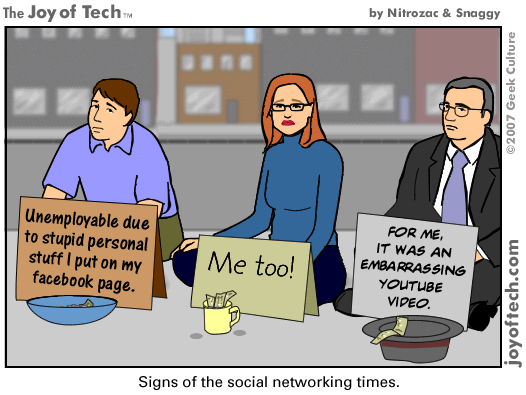 We’ve seen stories in the news and on television about workers being fired for comments and photos they’ve posted on Twitter, Facebook and MySpace. We’ve heard about companies conducting online searches of potential employees in the same social networking sites claiming they want to know how a potential employees acts outside the workplace.
  Getting started on Twitter
You must be logged in to post a comment.