3 Key Questions to Consider Before Becoming a Franchisee

The dream of owning your own business is alive and well for most Americans. The only problem is that many people don’t know where to start on the journey to becoming self-sufficient. There are a million different options, but first and foremost each potential entrepreneur must decide if he or she wants to become a franchisee or start a business independently.

Each route has its benefits; therefore, it’s critical to take the time to consider both options before making a decision. What it initially comes down to is asking yourself the following questions:

1. Do you understand every aspect of the business or do you thrive in one area?

When starting a business from scratch, entrepreneurs should be well versed in every single element of the enterprise. They need to create systems and procedures and test whether these work for that particular business. This process of ironing out the details deters some from choosing to own an independent business but excites and challenges others.

Conversely someone who buys a franchise knows that someone else has already done the “dirty work” and found the most effective systems for that particular business. A franchisee must simply thrive at correctly running the system while adding their own personal management touch.  

2. Are you an expert at making a name for yourself or would you like to be associated with an already strong brand?

When purchasing a franchise, you are also inheriting the reputation of that brand. For example, if you open your own Dunkin’ Donuts shop, you will encounter customers who already recognize the pink and orange logo. Many people will know whether they like the brand and will expect speedy service providing them doughnuts and steaming hot coffee.

On the other hand, those starting a business from scratch have a chance to create a unique brand identity. But consumer trust and awareness don’t come easily; they need to be earned through time, consistency and excellence.

3. Are you the kind of person who likes to go it alone or do you appreciate a sense of community?

Owning a business — whether it’s a franchise or not — can be risky. Some people prefer to be self-reliant and want to manage potential problems using past experiences and premonitions as guides. An entrepreneur must solve the issues that arise.

Others prefer enlisting the support and help of others to ensure that their business runs smoothly. A franchisee has many built-in allies, including the franchisor and other franchisees within the system.

The most important factor for success is making sure that problems are identified, and steps are taken in the right direction.

Culture Is A Work In Progress

Work in ProgressI do believe, in many cases, the level of business success contributes to the decision on whether or not a high performer is let go because their style is detrimental to the culture. In the case of a high performer in a business that is barely making it, that high performer probably stays. This situation works for the immediate time being but not for long-term growth. It’s difficult to build a team in this scenario. A high performer with a bad attitude in an environment with other high performers, probably should go. But not without trying to get the person in line first. Bad attitudes are detrimental to team building. However, often times a bad attitude actually develops as a result of how people are treated by management, or by a particular manager. There are various other scenarios as well.

Culture lives and breathes in all organizations. It must be nurtured – fed and taken care of. If sick, the virus causing the sickness must be addressed. In the case of cancer, it must be identified, isolated and removed – making sure to properly treat closely affected areas to be sure of total elimination. If healthy, it must continue to be fortified – an immune system built, and new well-being programs developed.

At the end of the day, Culture is a work in progress! It must be fluid. It must fill in the cracks and gaps and reach its own level. It must be understood by all. It must be allowed to grow. But it must be managed. The key is whether you do so reactively or proactively!

Recently, I read an interesting article about strategy and its effect on culture. Key paragraphs and link to the article follows…

Does strategy matter?

If you do not think that it matters, then you are in good company. There are many who question the value of strategy. And I see many companies where there is no formal strategy; the informal strategy is to keep doing what has worked in the past or to chase what is fashionable today.

Strategy v Execution

When it comes to questioning strategy there are two schools that are particularly prominent. First, there is the school of execution. The execution school which says that strategy is waste of time. Why? Because strategies are generic-obvious and what matters is execution. The ability to turn strategy into the daily live of the organization. Clearly, there is some truth in this school. Strategy which cannot be operationalized is waste of time-resource.

Strategy v Culture

Then there is the school that says, “culture eats strategy for breakfast”. Yes, culture is powerful. Culture determines what gets done and how it gets done. A strategy that does not take into account the fit with culture will meet lots of resistance. Getting people to enact such a strategy will be like fighting a guerilla war with an enemy who is patient and cunning. What is forgotten is that culture can be and is influenced-shaped-shifted through strategy.

To see strategy and culture as being separate and distinct is a gross misunderstanding. This misunderstanding arises due to our reductionist-analytical thinking. Strategy and culture are interlinked. Put differently, if you change strategy, you will take actions that will influence the culture. And if you change culture, it will eventually influence the strategy.

Read more HERE.

Entrepreneurial Mindset: Consultant’s Friend or Foe?

failureSometimes, no matter what you do, no matter what you try, it just doesn’t work, or work to the level it needs to in order to help turn around a failing business. Not all consulting opportunities leave us smiling even though we gave it our all… and then some.

It’s sad, but we must learn from the experience to be better, even just a little bit better for the next time, for the next person, the next client, the next entrepreneur.

Certainly, we must be better for the next opportunity if we are to make a difference. In the end, we must not second guess. Instead, reflect upon the experience and move forward. It does leave me with a question, Does having an entrepreneur’s mindset help or actually hinder being an effective consultant?

#reflection #entrepreneurship

Organizational Skills All Small Business Owners Should Possess

Organizational skillsWho hasn’t seen the phrase “organizational skills” listed as a requirement of a position? It might seem excessive that this vague term is so in demand, but the possession of organizational skills can make or break your career success.
While this is true for any role, it is even more integral for a small business owner.* Because there are so many tasks to juggle on any given day, keeping everything organized is the best way to ensure you’re getting the most out of your working hours.

Read on for a look at the essential organizational skills to propel your small business toward success:

Scheduling. More than just scheduling shifts and meetings, as a small business owner you’ll be expected to schedule every aspect that goes into running your business. From scheduling progress check-ins for projects to scheduling incentive programs for sales goals, the ability to create a schedule and stick to it is essential to running your business.

Delegation. It’s impossible for one person to handle everything that needs to happen to keep a business running smoothly—that’s why delegation is key. By delegating, you’re lightening the load on your own shoulders while empowering your team to tackle the difficult tasks.

Time Management. In many jobs, your time is managed for you. You’re provided with small goals on the way to larger accomplishments and project timelines are completed at your own manager’s discretion. However, as a small business owner, those project timelines and daily tasks are set by you.

People Management. Managing is commonly regarded as a “people skill,” but it takes organizational savvy as well. Planning evaluations, building a successful team and orchestrating group meetings may not be the leadership tasks that get all the attention, but they’re just as integral to being a respected and regarded manager.

Preparation. Being prepared is the key to staying on top of your business routine. Whether it’s taking notes before a meeting with your staff, franchisor, or banker or jotting down the next to-do list at the end of the day, starting off on the right foot will keep you from playing catch-up when you should be looking ahead.

*Note: Small business owners include small independent business operators (Mom & Pop), franchisees, restaurant operators, professional services providers (law offices, medical offices) and even solopreneurs with staff.

Visit Acceler8Success Daily at https://paper.li/Acceler8Success-Daily

Visit Acceler8Success Group website at www.Acceler8Success.com

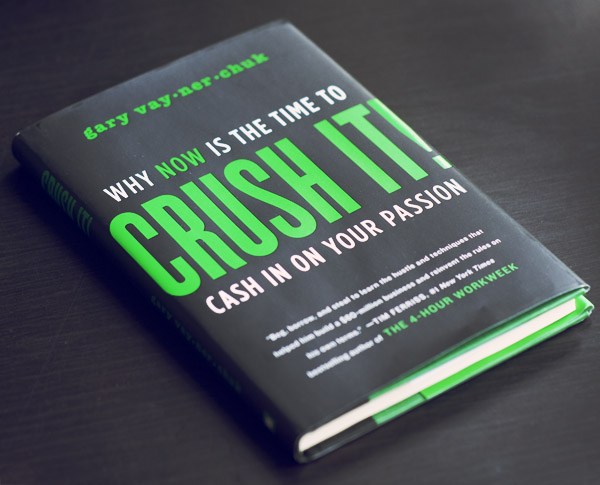
Crush It!

I’ve recently re-read for the umpteenth time a fascinating book, Crush It! by Gary Vaynerchuk. He has posted, tweeted, and videoed himself, and his business, to unbelievable success in a very short period of time. The book is a relatively short read, so there should be no excuses for not reading it asap, as it can only help you improve yourself and your business. The following is directly from one of the tabs from the book’s original website. Upon reading the book, I’m sure you’ll further explore Crush It!

Crush It!
By Gary Vaynerchuk

Everything has changed. The social media revolution has irreversibly changed the way we live our lives and conduct our business. There are billions of dollars in advertising moving online, waiting to be claimed by whoever can build the best content and communities. Despite this change, most people keep working at jobs that don’t make them happy and businesses continue to ignore the major marketing and public relations benefits that can be found online.

crush_it

Myth #1

I’m not passionate about something sexy or popular like wine so these lessons don’t apply to me.

The internet has drastically decreased the costs of building communities around niche subjects, allowing for even the most obscure subjects to draw enough eyeballs to command advertising attention. Starting a video blog about tortilla chips may seem farfetched until Doritos gives you a call and offers $40,000 a year to sponsor and advertise on your blog.

Myth #2

My business already has a Twitter account and a Facebook page, we’re set in the social media department.

This is the equivalent of claiming twenty years ago that just because your business bought a TV spot and a few ads in the newspaper, you didn’t need to pay attention to your advertising department. Social media isn’t about joining in, it’s about being involved.

Myth #3

I’m happy at my job so this book is irrelevant to me.

First of all, congratulations on finding work that makes you happy! However, the lessons in this book are valuable to anyone, regardless of their employment status. Crush It will show you how to utilize high level and platform specific social media and marketing strategies that will improve your work. It will also show you how to build a personal brand so that even if you’re forced to leave your job, a situation that’s especially relevant today, you’ll be able to easily find employment elsewhere in a field you’re passionate about.

Myth #4

I need to quit my job to take advantage of this book’s entrepreneurial lessons.

While the entrepreneurial strategies in this book do take time, it’s completely reasonable to start the effort as an after-work project to build up until you’re able to replace your current income with the income from your online presence. While you may have to fall behind on the current season of Lost or let your Madden 2010 game suffer, because you’ll be doing something you love you won’t mind putting in the extra effort.

In Crush It, Gary Vaynerchuk shows how anyone can build a career around what they’re passionate about. He also delivers both high-level and platform specific strategy and analysis, allowing you to take advantage of the current business environment while preparing you to succeed as it changes and evolves.

This book isn’t interested in making unrealistic promises while glossing over the work involved. Making a living by building content around your passion isn’t simple and it doesn’t happen overnight. What it is, however, is fulfilling and in most cases just as profitable, if not more so, than your previous job.

Furthermore, a business can’t just pay lip service to social media and expect it to return results. The transparency and accountability inherent in its structure necessitates a comprehensive and dedicated strategy in order to reap its tremendous benefits.

By combining practical analysis and strategy with the same passion and humor that’s made Gary one of the most in demand keynote speakers in the U.S. as well as network television’s go to wine expert, Crush It is essential reading for anyone who wants to understand and harness the future of business and work.

Learn: Why social media has evened the playing field, destroying the “gate-keepers” who had previously dictated the distribution of content.

Learn: How to beat unemployment and create wealth-building opportunities by building and maintaining a personal brand.

Learn: Why storytelling is the most important business concept in the current marketplace.

Learn: How you can build an online business around your passion without quitting your day job.

Learn: Why Twitter and Facebook are just tools and not a social media strategy.

Learn: How to take advantage of the half-billion dollars in advertising that are moving to the internet

Learn: Why transparency and being true to yourself are now winning marketing formulas

Learn: How to build and maintain an online community around your passion and brand

Learn: Strategies for turning attention into money

Learn: Why the legacy element of the internet era is so underrated

Visit Acceler8Success Daily at https://paper.li/Acceler8Success-Daily

Visit Acceler8Success Group website at www.Acceler8Success.com

Lead, Follow or Get Out of the Way!

inspirational-leadership-quotes-618x330

What Makes Great Leaders?

Everyone has their own opinions on what a great leader is and what makes one.

When it comes to great leaders, we believe that it’s not how rich or popular one is, but rather how they reach out to others, how they stand up for what they believe in, and the character they have.

For although society often wishes to glorify and put on a pedestal those who have fame, wealth and power, it is often the ordinary, common, every day people they overlook, the underdogs in life so to speak that rise above to become some of the greatest leaders…

..making some of the most important changes and biggest differences in the world.

From… Lifestyle By My Own Design

Leadership is a Habit That Requires Practice

It is probably fair to say that the argument over whether leaders are born or made has been settled. The fortune spent every year by organizations of all sorts and sizes on executive development is evidence enough for the idea that, while certain attributes of leadership may be genetic, much of what it takes to be a leader can be learned. However, that begs another question. How?

Read more…

They’re Always Watching You as a Leader!

“People have to buy into the leader before they buy into the vision.”
— John Maxwell

Humans are tribal people. As much as we want to think of ourselves as individuals, we have an innate need to run with the pack. We follow leaders. We are constantly watching their words and actions.

And we are hardwired from an early age to look for inconsistency in behavior in those around us. In a recent training session with leaders, we were discussing the level of distraction all of us experience today.

Read more… 

When Entrepreneurs Are Faced With Failure

dont-quit.jpg

Sometimes no matter how well we plan and how much effort we dedicate to something, we fall short of our goal and the end-result causes a variety of challenges and problems. Ultimately, it can adversely affect financial position, reputation, relationships, team spirit and much more. It can also start to spiral into personal life and affect family, health and overall well-being.

Unfortunately, such situations are often perpetuated by denial by placing one own’s head in the sand.

Well, when our head is in the sand, our most vulnerable ass-et is sticking out in plain view. Some will laugh. Others will point and snicker, definitely telling others. And a few will take advantage of the situation and current position of vulnerability. Sadly, we put ourselves in that position. Not because we swung and missed. Not because we didn’t see the forest for the trees. And not because we just flat-out saw something that wasn’t there. Instead, it’s because we didn’t keep our head high, accept the situation, learn from it and move on, and with laser-focus. That is exactly what entrepreneurs do when faced with failure.

Visit Acceler8Success Daily at https://paper.li/Acceler8Success-Daily

Visit Acceler8Success Group website at www.Acceler8Success.com

From the Great Resignation to the Next Entrepreneurial Boom!

The Great Resignation is already drastically reshaping the corporate landscape, but its impact could have repercussions far beyond big businesses.

new survey indicates that the sizable number of people who are considering leaving their jobs aren’t just looking for new ones with better benefits or salaries. Some see it as a chance to start their own companies – and the result could be a massive influx of entrepreneurs and start-ups.

Since mid-2021, Americans had filed paperwork to start 3.2 million businesses, according to the Census Bureau. That’s a 41% increase over the same time frame in 2020 (which saw the most applications since the Bureau began tracking them) – and a 61% increase over the same period in 2019.

There have been more than 6 million filings since the pandemic began.

Read the Entrepreneurial Boom Could Be Looming HERE.

The Ten Most Common Types of Entrepreneurship

While the basic principles of entrepreneurship are the same—planning, starting and operating a business—the distinct nuances and skills needed vary depending on the type of business you plan to start. Becoming an entrepreneur requires the ability to define these differences and pinpoint the unique elements that are needed.

Traditionally, entrepreneurship is categorized into four main types: small businesses, scalable startups, large companies and social entrepreneurs. These models cover the fundamentals of starting a business and focus more on the company itself, rather than the qualities of the entrepreneur.

“However, just as the world continues to change, so do businesses. This means new opportunities for risk-taking and innovative game changers to pave the way in diverse entrepreneurial ways.”

With this in mind, even though there are quite a few similarities when it comes to the challenges that all business owners will face, there are certain types of entrepreneurship defined by the skills, characteristics, and personality traits of the entrepreneur. At the end of the day, it is the way you choose to run your business that makes them differ from one another.

Read more about the various types of entrepreneurship HERE.

How To Switch From An Employee To An Entrepreneur Mindset

Being an entrepreneur is an exciting and rewarding undertaking and, if you’re motivated by the thought of being your own boss, don’t be put off by the changes you’ll need to make to become a success. Not having one boss can mean you now have many, when you’re answering to your customers, your bank manager and the large number of people who are going to be looking to you for answers.

Being an entrepreneur isn’t the same as being an employee – no matter how high up the career ladder you’ve climbed. But the freedom you get as an entrepreneur means that you can develop your business, and run your life, in the way you think is best.

Read more about making the transition from employee to entrepreneur easier HERE.

Check HERE for books about entrepreneurship.

Acceler8Success Group

To learn more about comprehensive services and resources for current and aspiring entrepreneurs, please visit Acceler8Success Group website HERE.

Visit Acceler8Success Daily at https://paper.li/Acceler8Success-Daily

Entrepreneurship: Ideas and the Courage (Nerve) to See Them Through

“I always thought you needed to be innovative, original, to be an entrepreneur. Now I have a different perception. Entrepreneurs are the ones that make things happen. (That) takes focus, diligence, discipline, flexibility and perseverance. They can take an innovative idea and make it impactful. … successful entrepreneurs are also ones who take challenges in stride, adapt and adjust plans to accommodate whatever problems do come up.”

Steve Blank launched the Lean Startup movement. His work has changed how startups are built, how entrepreneurship is taught and how existing companies and the U.S. government innovate.

Read more…

Entrepreneurs Who Create Startup Businesses Have to Be Crazy

People who start companies are, without a doubt, just a little bit crazy. And people who start more than one company? Deranged lunatics — all of them! Why? Because it’s insanely hard! You’re signing up for a ridiculous amount of work. Your startup journey will be the wildest ride of your life.

Read more…

Poker or Chess?

Do you plan your business strategy like you’re playing chess or poker? But, before you answer, consider the following…

“Industry executives and analysts often mistakenly talk about strategy as if it were some kind of chess match. But in chess, you have just two opponents, each with identical resources, and with luck playing a minimal role. The real world is much more like a poker game, with multiple players trying to make the best of whatever hand fortune has dealt them. In industry, Bill Gates owns the table until someone proves otherwise.”

– Deep thoughts by David Moschella

Is Courage a Necessary Trait for Success?

dreams.jpg2

We never really hear enough about courage. The courage to take a risk, to stretch limits, to push forward, to go beyond, to keep moving… to make things happen regardless of the challenges in front of us.

Think about the early-day pioneers crossing the Midwest when they first caught a glimpse of the Rocky Mountains and stared at them getting bigger and bigger as they approached over a few days. What unbelievable courage they must’ve had to continue not only towards the mountains, but up into them and through them, often having to go north or south for awhile to keep making progress forward, and despite the elements of weather and resulting hardships. They believed in their dreams and as a result of their relentless courage, their goals were achieved.

The Cowardly Lion’s Thoughts on Courage

In his most famous song, the Lion muses on what it would be like if he had ​any courage (not realizing he already has plenty):

Cowardly Lion: [singing]
I’m afraid there’s no denyin’
I’m just a dandy-lion
A fate I don’t deserve
I’m sure I could show my prowess
Be a lion, not a mouse
If I only had the nerve.

Visit Acceler8Success Daily at https://paper.li/Acceler8Success-Daily

Visit Acceler8Success Group website at www.Acceler8Success.com

The Truth About Startups

The process

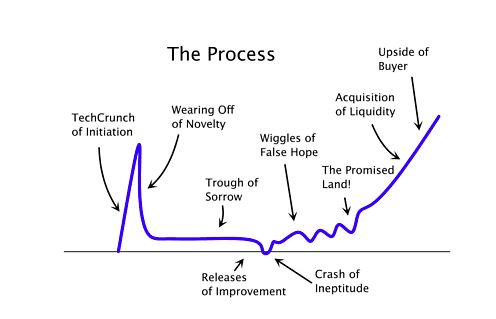
Many people think startups are up and to the right all the time. But more exhibit this startup curve than any other growth pattern. Of course, some never get past the “trough of sorrow”. But many do. Mostly by staying focused on the problem they are trying to solve and working diligently to get to the promised land.

Would love to hear some thoughts on this from today’s entrepreneurs!

50 Inspirational Quotes for Startups and Entrepreneurs

“Your work is going to fill a large part of your life, and the only way to be truly satisfied is to do what you believe is great work. And the only way to do great work is to love what you do.”

Steve Jobs, Co-Founder, Chairman and CEO, Apple

Visit Acceler8Success Daily at https://paper.li/Acceler8Success-Daily

Visit Acceler8Success Group website at www.Acceler8Success.com