Tag: emerging brands

Franchising Is Not a Prize. It Is a Responsibility.

When development of a business to a franchise brand begins with gimmicks, inflated promises, and manufactured excitement, the people who ultimately pay the price are often the future franchisees who believed the story.

There is something deeply troubling about the way franchising is increasingly marketed to independent business and restaurant owners. Instead of beginning with the difficult but necessary question—Is this business truly ready to be franchised?— too many conversations begin with a sales pitch. A restaurant generating $1 million in annual revenue is suddenly described as a potential $3 million franchise brand, as though a multiple pulled from the air can transform one successful location into a scalable enterprise. Another seductive claim suggests that an owner can go from one location to a multimillion-dollar exit simply by converting the business into a franchise, as though declaring an intent to scale automatically creates enterprise value, qualified buyers, or a future transaction. Business owners are invited to enter contests to “win” a franchise launch package, as if creating a franchise system were comparable to winning a website makeover or a year of free advertising. Franchising is promoted as a low-risk, low-capital way to expand, while the enormous obligations that come with becoming a franchisor are minimized, glossed over, or omitted altogether. There are countdowns, limited-time offers, discounted development packages, financing hooks, promises of rapid national growth, and images of maps filling with territories. The message is designed to excite. It is designed to flatter. It is designed to make the business owner believe that the next logical step is not merely expansion, but franchising… and that anyone questioning the timing may simply lack vision. At some point, however, we must ask whether it is really necessary to sell entrepreneurs on franchising this way. If a business is genuinely prepared to become a franchise system, why should gimmicks be necessary at all?

The truth is that franchising is not a prize, a promotion, a valuation shortcut, or a magical conversion of one operating business into a multimillion-dollar brand. A million-dollar restaurant is a restaurant with a million dollars in sales. That fact alone tells us very little about profitability, cash flow, owner dependence, management depth, unit economics, transferability, market demand, operational consistency, or whether the concept can produce acceptable returns for an unrelated owner in another market. It certainly does not establish that the business is worth three times its revenue simply because someone packages it as a franchise. Nor does one franchised location, or even a handful of them, create a multimillion-dollar exit. A meaningful exit requires durable royalty revenue, healthy franchisee economics, responsible growth, brand strength, reliable systems, capable leadership, clean legal and financial records, and a buyer who believes those advantages will endure without the founder. Until those elements exist, the promised exit is not a valuation; it is a marketing story about a transaction that may never occur.

A business may be successful because of its founder’s personality, relationships, instincts, reputation, location, work ethic, or constant personal involvement. Those qualities can make an excellent local business, but they are not automatically transferable. Franchising requires the founder to turn experience, judgment, and daily improvisation into a documented and teachable system that another person can execute. It requires the economics to work not only for the original owner, but for a franchisee who must pay an initial fee, royalties, marketing contributions, financing costs, occupancy expenses, opening costs, and often a higher total development cost than the founder ever faced. If the concept cannot survive that added economic burden while still providing the franchisee with a reasonable opportunity to build a sustainable business, then it is not ready to be franchised… regardless of how attractive its sales volume may look in a headline.

Yet the franchise-system-development marketplace often rewards speed over readiness. The entrepreneur is told that franchising allows expansion using other people’s capital, but is not told nearly enough about the corresponding duty attached to accepting that capital. The founder hears about collecting franchise fees and royalties, but not about the cost of recruiting responsibly, training effectively, supporting consistently, protecting the supply chain, monitoring compliance, investing in technology, developing marketing resources, maintaining the franchise disclosure document, managing the franchise relationship, and helping franchisees navigate inevitable operational challenges. The founder is encouraged to imagine dots appearing on a national map, but not to calculate the infrastructure required to support those dots. “Low risk” may describe the franchisor’s reduced need to finance every new location directly, but it does not describe the risk transferred to the franchisee who may invest savings, pledge a home, sign a lease, take on an SBA-backed loan, or personally guarantee hundreds of thousands of dollars. Franchising does not eliminate risk. It distributes risk, and too often, it concentrates the most devastating financial and personal consequences on the party with the least control over the system.

The contest model may be one of the clearest examples of how misplaced the industry’s priorities have become. What exactly does it mean to “win” a franchise launch package? Does the winner also receive proven unit economics, tested systems, experienced leadership, sufficient working capital, a support team, a defensible market position, franchisee recruitment standards, and the willingness to remain accountable for years? Of course not. At best, the winner receives a collection of documents, branding, consulting hours, and development services. Those things may be necessary components of building a franchise offering, but they do not make the underlying business franchisable. Legal documents can disclose a system; they cannot create one. An operations manual can record processes; it cannot prove they work across different owners and markets. A polished franchise sales website can attract candidates; it cannot ensure that the opportunity deserves their investment. When the packaging comes before the proof, the industry risks manufacturing franchisors instead of developing franchise systems.

The likely outcome is rarely included in the promotional message. The prospective franchisor is shown the possibility of becoming the next nationally recognized brand, but not the much greater possibility of remaining a very small franchise organization, perhaps with only a handful of units sold to existing customers, friends, relatives, employees, or people already emotionally connected to the founder. There is nothing inherently wrong with a small franchise system if it is healthy, adequately supported, economically sound, and honestly represented. The problem arises when a modest local concept is sold a vision of rapid scale that bears little relationship to its capitalization, market appeal, leadership capability, or readiness. Too many emerging brands sell several franchises, struggle to open them, lack the revenue to build support infrastructure, and then enter a dangerous cycle: they need more franchise fees to fund the obligations created by the franchises already sold. Franchise sales become the source of operating cash rather than the result of a strong and sustainable system. Growth is no longer strategic; it becomes a means of survival.

When that cycle collapses, the franchisor may close, dissolve, stop answering calls, cease providing support, or simply disappear. The franchisees, however, do not disappear with it. They remain responsible for their leases, loans, payroll, vendor obligations, equipment financing, and personal guarantees. They may still have signs on their buildings, branded materials in their stores, proprietary products they can no longer obtain, technology systems that no longer function, and customers who assume the brand continues to stand behind the business. In some cases, franchisees continue flying the flag long after the franchisor has vanished in the night, not because the system remains viable, but because removing the name, converting the business, or closing the doors would require money they no longer have. The public may see an operating location and assume the franchise system still exists. The franchisee knows otherwise. They are operating inside the shell of a promise.

I raise this issue not as a theoretical concern, nor as someone opposed to franchising. Quite the opposite: I have spent decades in and around franchising, and I believe deeply in what a responsible franchise relationship can accomplish. I raise it because we are currently working with several franchisees whose franchisors disappeared during the earliest stages of their systems. These franchisees did not merely lose the benefit of an aspirational brand story. They were left with hundreds of thousands of dollars in debt and, in some instances, without even the basic premise of a functioning business. The systems, resources, products, support, or infrastructure upon which their investments depended were never adequately delivered or simply ceased to exist. One of these franchisees has filed for bankruptcy while another is now contemplating the same. The third is considering his options. Behind these franchisees are families, homes, retirement savings, damaged credit, strained marriages, sleepless nights, and years of financial recovery. Those realities should be present in every serious conversation about franchise system development, because they are the consequences when a franchise is sold before a system is ready or when people who know better choose promotion over responsibility.

This is also where the industry must confront an uncomfortable truth: compliance does not necessarily equal integrity. A franchise disclosure document may satisfy the technical requirements of disclosure and still describe a weak, undercapitalized, or unproven system. A franchisor may comply with the required waiting period and still exert enormous emotional pressure on a candidate. A development firm may complete every item in its contracted package and still leave behind a founder with no realistic ability to recruit, open, train, support, or retain franchisees. Attorneys, consultants, brokers, sales organizations, lenders, suppliers, and marketers can each perform their narrow function while the broader venture remains fundamentally unsound. When everyone is paid for completing a transaction or advancing a launch, but no one is accountable for asking whether the launch should occur, the process itself becomes part of the problem.

What must change begins with replacing persuasion with qualification. The first phase of any franchise-system-development engagement should be a rigorous readiness assessment conducted before the founder is sold legal documents, marketing campaigns, lead-generation programs, or franchise sales services. That assessment should examine profitability and cash flow at the unit level; whether compensation for an owner-operator has been properly accounted for; the performance of more than one location when possible; the degree of founder dependence; the repeatability of operations; supply-chain stability; management capacity; technology; training requirements; market differentiation; franchisee capitalization needs; and the likely economics after all franchise-related fees and expenses are included. It should also assess the founder personally. Does this individual genuinely want to support other business owners, or merely want to expand the brand? Can the founder accept accountability, share control, communicate consistently, resolve conflict, and invest ahead of royalty revenue? Becoming a franchisor is not merely a growth strategy. It is an entirely new business built around supporting the success of franchisees.

The industry must also stop implying that every successful business should franchise now. For many founders, the most responsible recommendation may be to wait twelve, twenty-four, or thirty-six months. It may be to open a second or third company-owned location, stabilize margins, reduce dependence on the founder, document operations, strengthen management, build reserves, test another market, or correct weaknesses that the first location’s sales have concealed. For others, joint ventures, management agreements, company-owned expansion, strategic partnerships, or simply remaining an outstanding independent business may be the better path. Saying “not yet” or even “not through franchising” is not a failure of franchise-system-development. It is evidence of professional judgment. Any advisor who never advises a prospect not to franchise is not evaluating readiness; that advisor is selling a product.

Greater integrity also requires radical honesty about likely outcomes. Prospective franchisors should see more than best-case projections and stories of brands that reached hundreds of locations. They should understand how many emerging franchise systems remain small, how long responsible growth can take, what adequate support costs, how difficult qualified franchisee recruitment can be, and how little initial franchise fee revenue remains after commissions, onboarding, training, legal obligations, and opening support. They should be required to build conservative capitalization plans that do not depend on continuous franchise sales to remain solvent. They should establish contingency plans for supporting existing franchisees if sales slow or stop. Most importantly, they should understand that the first franchisees are not test subjects whose capital finances the franchisor’s learning curve. They are business owners who have relied upon the franchisor’s representations and entrusted a substantial portion of their financial future to the system.

Franchisee recruitment must change as well. The objective should not be to sell a territory to every candidate who qualifies financially. It should be to award a franchise only when the candidate, market, capitalization, expectations, and system are aligned. Salespeople and brokers should not be rewarded solely for completed transactions without regard to whether locations open, survive, and perform. Emerging franchisors should resist selling distant or scattered territories simply because a check is available. The first few franchisees require more support, not less, and their locations should ordinarily be close enough for the franchisor to observe, assist, learn, and respond. Controlled growth may not produce the dramatic map used in marketing presentations, but it creates something far more valuable: evidence that the system works beyond the founder’s original location.

There must also be clearer accountability across the franchise-system-development ecosystem. Those who promote franchise development should disclose how they are paid, what their services can and cannot accomplish, and whether their financial incentives depend on persuading a founder to proceed. Franchise brokers and sales organizations should evaluate the capitalization and support capacity of emerging brands before presenting them to candidates. Lenders should look beyond the existence of franchise documents and examine whether the franchisor has the infrastructure to deliver what the borrower’s business requires. Attorneys should continue to protect their clients legally, but the broader advisory team must ensure founders understand that disclosure is not the same as validation. No single participant can guarantee success, but every participant can refuse to help create the illusion that franchising is easy, fast, or inherently low risk.

If the industry does not correct these practices, the damage will not remain confined to individual failed brands. Every franchisee abandoned by an underprepared or vanished franchisor becomes a story shared with family members, employees, lenders, landlords, other entrepreneurs, journalists, regulators, and online communities. Each bankruptcy, lawsuit, shuttered location, and allegation of misleading promotion creates a ripple that reaches responsible franchise systems as well. Public perception rarely distinguishes neatly between a poorly conceived emerging franchise and franchising as a whole. Enough stories of people losing their savings under the banner of “business ownership with support” can erode confidence in the entire model. That erosion invites more negative publicity, greater skepticism, tighter financing, increased litigation, and potentially more aggressive regulation. Responsible franchisors will then bear part of the cost created by those who treated franchise development as little more than a marketing funnel.

Protecting the integrity of franchising does not require eliminating ambition, innovation, or emerging brands. It requires restoring seriousness to the decision. Franchising can be a powerful method of expansion when a proven business, properly capitalized franchisor, capable leadership team, disciplined growth strategy, and well-qualified franchisees come together in alignment. It can create generational wealth, local ownership, jobs, and enduring brands. But those outcomes are not produced by contests, inflated valuations, artificial urgency, or declarations that franchising is a low-risk shortcut to growth. They are produced by preparation, patience, transparency, capitalization, accountability, and an unwavering recognition that the franchisor’s decisions affect other people’s lives.

Final Thoughts

We do not need to become better at selling entrepreneurs on franchising. We need to become better at telling them the truth about it. We need to be willing to say that a strong business may not yet be a franchise, that high revenue does not automatically create transferable value, that expansion funded by franchisees is not the same as expansion without risk, and that the privilege of accepting another person’s investment creates a responsibility that extends far beyond signing an agreement. Before we help another starry-eyed business owner become a franchisor, we should ask whether the system is ready, whether the founder is prepared, whether adequate capital exists, and whether we would feel comfortable recommending the opportunity to someone investing our own family’s savings. If the answer is no, the franchise-system-development services should not be sold, packaged, launched, or given away as a prize. The integrity of franchising and the financial futures of the people who believe in it, demands nothing less.

An Open Letter: What We Believe About Entrepreneurship, America, Faith, and the American Dream

There are moments when an organization should clearly state what it believes.

Not because everyone must agree. Not because business should become political. And not because values should ever become a test of who belongs.

But because values matter.

They influence how an organization serves people, how it approaches opportunity, how it defines success, and ultimately the contribution it hopes to make.

At Acceler8Success America, our values are reflected in our name, our work, and our purpose.

We believe in entrepreneurship.

We believe in business ownership.

We believe in free enterprise and capitalism.

We believe in America and the American Dream.

We believe in responsibility, perseverance, optimism, service, and opportunity.

And yes, faith and the words “In God We Trust” have meaning to us.

These beliefs do not require everyone who works with us, learns from us, or becomes part of our entrepreneurial community to believe exactly as we do.

They explain something much more fundamental:

Why we do the work we do and what we want Acceler8Success America to represent.

A Time of Growth… and Reflection

Over the past several months, we have spent a great deal of time thinking about the future of Acceler8Success America.

That reflection has become particularly important as we have launched the Entrepreneurship Coaching & Advisory Suite by Acceler8Success America, creating new pathways for experienced professionals to guide aspiring entrepreneurs, early-stage business owners, and others pursuing business ownership.

And with the Acceler8Success America Entrepreneurship Coaching & Advisory Franchise Opportunity launching September 1st, this has become about much more than introducing another program, service, or business opportunity.

We are preparing other people to represent the brand.

To serve entrepreneurs under our name.

To share our methodologies, resources, experience, and philosophy.

To become trusted guides to individuals making some of the most consequential business and financial decisions of their lives.

That responsibility has caused us to ask deeper questions.

What exactly should Acceler8Success America stand for?

What do we want someone to experience when they encounter our brand?

What principles should guide our coaches, advisors, licensees, franchisees, leadership, and strategic partners?

What should remain true as the organization grows beyond the people who originally created it?

And perhaps most importantly:

What are we ultimately trying to deliver?

We have spent considerable time reflecting on those questions and solidifying the answers.

The result isn’t simply a collection of corporate values.

It is a clearer understanding of the organization we intend to build.

This Open Letter is part of that process.

We Believe in Entrepreneurship

Entrepreneurship is about far more than starting a business.

It represents independence, initiative, creativity, responsibility, perseverance, optimism, and the willingness to pursue possibility.

Every entrepreneurial journey begins with a belief that something can be created, improved, solved, or built.

Sometimes that vision becomes a company capable of changing an industry.

Sometimes it becomes a neighborhood restaurant, a franchise location, a family business, a professional practice, an online venture, or a small business serving its local community.

All matter.

The significance of entrepreneurship should never be measured solely by the size of the company eventually created.

For many people, business ownership represents something deeply personal: greater control over their future, financial independence, the opportunity to provide for their family, the ability to create generational wealth, the opportunity to contribute to a community, or simply the satisfaction of building something of their own.

We believe those aspirations are worth encouraging.

More importantly, we believe aspiring entrepreneurs deserve access to experienced people who will help them pursue those aspirations thoughtfully, responsibly, and with their eyes open to both the opportunities and the challenges ahead.

That belief is at the heart of our Entrepreneurship Coaching & Advisory platform.

We Believe in the American Dream

The American Dream is sometimes misunderstood as a promise of success.

It is not.

It is the opportunity to pursue success.

The opportunity to imagine something better.

To take a risk.

To build.

To succeed.

To fail.

To learn.

To rebuild.

And to try again.

For 250 years, America has been shaped by individuals willing to do exactly that.

Entrepreneurs, inventors, immigrants, small business owners, family businesses, farmers, tradespeople, restaurateurs, franchisees, founders, and countless others have transformed ideas into businesses and businesses into opportunity.

Their efforts created jobs.

Supported families.

Built communities.

Generated wealth.

Advanced innovation.

And helped create one of the most dynamic entrepreneurial cultures in the world.

That entrepreneurial spirit is part of the American story.

We believe it must also remain part of America’s future.

And as America celebrates 250 years, we have an opportunity to do more than commemorate what previous generations built.

We have an obligation to consider what our generation will build next.

We Believe in Free Enterprise and Capitalism

We believe in capitalism.

We believe in saying that plainly.

Free enterprise provides individuals with the opportunity to create, compete, invest, innovate, build wealth, own businesses, and determine their own economic path.

It gives someone with an idea the possibility of transforming that idea into something tangible.

It allows a small business to become a larger one.

An employee to become an employer.

A first-generation entrepreneur to begin building generational wealth.

An individual to take control of his or her economic future.

But we also believe capitalism works best when accompanied by responsibility.

Business cannot simply be about what an individual can accumulate.

Successful businesses create ripple effects.

They employ people.

They support families.

They purchase from suppliers.

They create opportunities for other businesses.

They develop leaders.

They strengthen communities.

They solve problems.

They create products and services people value.

And sometimes they create generational opportunity extending far beyond the individual who originally founded the company.

There is nothing wrong with creating wealth.

We believe wealth creation should be encouraged.

But we also believe the most meaningful entrepreneurial success creates opportunity beyond the entrepreneur.

Prosperity becomes even more powerful when it creates the opportunity for others to prosper as well.

We Believe Success Comes With Responsibility

Entrepreneurship celebrates independence, but independence does not eliminate responsibility.

Business owners accept responsibility when they decide to build something of their own.

Responsibility to customers.

Responsibility to employees.

Responsibility to partners.

Responsibility to investors and lenders.

Responsibility to vendors.

Responsibility to communities.

Responsibility for the decisions they make.

Entrepreneurship involves risk, and not every decision will be correct.

Businesses encounter setbacks.

Plans change.

Markets shift.

Opportunities disappear.

Mistakes happen.

The true measure of entrepreneurial leadership is not perfection.

It is how people respond when things do not go according to plan.

Learn.

Adapt.

Accept responsibility.

Make things right whenever possible.

And continue moving forward wiser than before.

These are not merely business principles.

They are character principles.

And they matter to the type of coaches and advisors we want representing Acceler8Success America.

We Believe Coaching and Advisory Must Mean More Than Giving Advice

The launch of our Entrepreneurship Coaching & Advisory Suite has also caused us to think deeply about what the words coach and advisor should mean.

We do not believe aspiring entrepreneurs simply need cheerleaders.

Entrepreneurs certainly need encouragement, but encouragement without perspective can become dangerous.

A trusted entrepreneurship coach or advisor must sometimes ask difficult questions.

Challenge assumptions.

Identify risks.

Encourage greater preparation.

Help someone recognize when an opportunity may not be right.

And sometimes say what a person needs to hear rather than merely what they want to hear.

At other times, that same advisor may be the person who says:

You can do this.

That combination matters.

Experience and encouragement.

Optimism and realism.

Opportunity and responsibility.

Strategy and accountability.

Listening and leadership.

We believe entrepreneurship coaching and advisory should help people make better decisions, not simply more decisions.

That is the standard we intend to build around.

We Believe Experience Should Be Shared

Those who have traveled the entrepreneurial road possess something extremely valuable:

Experience.

And experience includes much more than success.

It includes mistakes.

Missed opportunities.

Bad decisions.

Difficult lessons.

Unexpected setbacks.

Relationships that succeeded and others that did not.

Strategies that worked and assumptions that proved wrong.

Every generation of entrepreneurs should not have to learn every lesson from the beginning.

Those who have gone before have an opportunity… and we believe a responsibility to reach back and help those who are beginning their journey.

That does not mean telling aspiring entrepreneurs that business ownership will be easy.

Quite the opposite.

Responsible entrepreneurial guidance requires honesty.

Entrepreneurship can be extraordinarily rewarding.

It can also be difficult, uncertain, expensive, frustrating, and humbling.

Experience can be an extraordinary teacher.

Sometimes the tuition is very expensive.

If sharing that experience helps another entrepreneur make a better decision, recognize a warning sign, avoid an unnecessary mistake, or discover a better path forward, then the lesson acquires even greater value.

That philosophy is fundamental to Acceler8Success America.

It is also fundamental to the Entrepreneurship Coaching & Advisory Suite we are now building and expanding.

We Believe Optimism Matters

Every entrepreneur possesses some degree of optimism.

They have to.

Starting or acquiring a business requires believing something can exist tomorrow that does not exist today.

Optimism creates momentum.

It helps people see possibility when circumstances are uncertain.

It encourages entrepreneurs to search for another solution, another opportunity, another approach, and another way forward.

But optimism must be accompanied by discipline, judgment, accountability, preparation, and reality.

Optimism should never become an excuse for ignoring problems.

It should become the motivation for solving them.

We believe entrepreneurs need both:

The optimism to believe something is possible and the discipline to do the work required to make it possible.

Our responsibility as coaches and advisors is not to diminish someone’s dream.

It is to help give that dream a stronger foundation.

We Believe Faith Has a Place

Faith is part of the values upon which Acceler8Success America has been built.

For us, faith represents gratitude, purpose, humility, service, and recognition that success is about something greater than any individual business transaction or financial accomplishment.

The words “In God We Trust” have meaning to us.

We do not believe those words require an apology or qualification simply because they are expressed within a business environment.

At the same time, America is a nation of many faiths, cultures, traditions, backgrounds, and experiences.

We respect that.

Our belief in God is not a requirement imposed upon anyone else.

People do not need to share a particular religion—or any religion—to participate in the entrepreneurial community we are building.

Our table is open to people who believe opportunity matters, responsibility matters, character matters, and helping others succeed matters.

Faith should strengthen our commitment to service.

It should never narrow the circle of those we are willing to serve.

We Believe the American Dream Belongs to Everyone Willing to Pursue It

One of America’s greatest strengths has always been its ability to attract and inspire people who believe tomorrow can be better than today.

Some were born here.

Others arrived here.

Some come from generations of entrepreneurs.

Others will become the first business owner in their family.

Some begin with capital, education, connections, and experience.

Others begin with little more than an idea, determination, and the willingness to work.

Their starting points may be dramatically different.

Their opportunity to dream should not be.

The American Dream is strengthened when more people have access to knowledge, resources, mentorship, capital, business ownership, and opportunity.

That is why entrepreneurial education matters.

That is why coaching matters.

That is why advisory matters.

That is why mentorship matters.

That is why access matters.

And that is why experienced business leaders reaching back to help aspiring entrepreneurs matters.

Opportunity grows when it is shared.

We Believe Entrepreneurship Can Be a Profession of Service

As we prepare to franchise Acceler8Success America, this belief has become particularly important.

We are creating an opportunity for experienced professionals to build businesses of their own by helping other people pursue businesses of theirs.

Think about that for a moment.

The entrepreneur becomes the guide to another entrepreneur.

Experience becomes intellectual capital.

Perspective becomes a resource.

Lessons become tools.

Relationships become bridges.

And helping others succeed becomes both a purpose and a profession.

That is what we believe the Entrepreneurship Coaching & Advisory business can become.

Not merely consulting.

Not simply coaching.

Not another business opportunity centered primarily on selling something.

But a platform through which experienced professionals can help aspiring and early-stage entrepreneurs evaluate opportunities, make better decisions, build stronger businesses, overcome obstacles, access resources, and accelerate their own entrepreneurial journey.

That is a responsibility we take seriously.

And as the franchise opportunity launches September 1st, these values will become increasingly important.

Because ultimately, we are not simply expanding a brand.

We are expanding the number of people representing what that brand stands for.

America’s Next 250 Years

As America celebrates 250 years, there is much to honor about the entrepreneurial spirit that helped build this nation.

But perhaps the more important question is:

What will we build next?

Somewhere today, someone is sitting at a kitchen table thinking about starting a business.

Someone is considering buying a franchise.

Someone is planning to acquire an existing company.

Someone is building a side business after finishing a full day’s work.

Someone is preparing to leave corporate America.

Someone who recently arrived in this country is imagining building something here.

Someone is recovering from a business failure and wondering whether to try again.

Someone has an idea but does not yet know where to begin.

And somewhere, a future entrepreneur is looking at a problem and thinking:

There has to be a better way.

Those individuals will help write America’s next chapter.

They will build companies we cannot yet name.

Create jobs that do not yet exist.

Develop technologies we cannot yet imagine.

Open restaurants, franchises, stores, professional practices, service businesses, and family companies across communities throughout America.

Some will build organizations employing thousands.

Others will proudly operate businesses employing five.

Both matter.

Because entrepreneurship is not defined solely by scale.

It is defined by the willingness to create.

And many of those entrepreneurs will need someone to turn to along the way.

Someone experienced.

Someone willing to listen.

Someone willing to ask difficult questions.

Someone willing to challenge them.

Someone willing to encourage them.

Someone willing to share experience without pretending to have all the answers.

Someone willing to help them move forward.

We intend for Acceler8Success America to help develop more of those people.

What We Believe

At Acceler8Success America, we believe the American Dream remains alive.

We believe entrepreneurship is one of its greatest expressions.

We believe business ownership can change lives.

We believe in free enterprise and capitalism.

We believe wealth creation is something to encourage, particularly when prosperity creates opportunity for others.

We believe success comes with responsibility.

We believe character matters.

We believe mistakes should become lessons.

We believe optimism must be accompanied by accountability.

We believe experience should be shared.

We believe entrepreneurship coaching and advisory should help people make better decisions.

We believe those who have traveled the entrepreneurial road should help those beginning their journey.

We believe faith, gratitude, humility, and service have a place in business.

We believe people of different backgrounds, cultures, experiences, and beliefs can sit at the same entrepreneurial table.

We believe entrepreneurship can become a profession of service for those willing to turn their experience into guidance for others.

And we believe America’s entrepreneurial future can be even greater than its entrepreneurial past.

The next great businesses have not all been created.

The next generation of entrepreneurs has not yet fully emerged.

And the next generation of coaches, advisors, mentors, and entrepreneurial leaders who will help guide them is only beginning to take shape.

As we launch the Entrepreneurship Coaching & Advisory Suite by Acceler8Success America and prepare for the September 1st launch of our franchise opportunity, we know more clearly than ever what we want this brand to deliver.

Knowledge.

Perspective.

Opportunity.

Guidance.

Accountability.

Encouragement.

Community.

And a genuine commitment to helping people move forward.

America’s next 250 years are waiting to be built.

The American Dream is not merely something to remember.

It is something to pursue.

Something to build.

Something to protect.

Something to expand for others.

And something each generation has a responsibility to pass forward.

That is what we believe.

That is what Acceler8Success America is being built to represent.

And as we enter this next chapter of our own growth, we are committed to ensuring those beliefs remain at the center of everything we do.

The American Dream. Built. Scaled. Accelerated.

Acceler8Success America

The Emerging MUMBO: Building a Portfolio Before the Spotlight

The acronym sounds big. It feels institutional. It carries the weight of scale, sophistication, and capital. The rise of the MUMBO. The Multi-Unit, Multi-Brand Operator has quickly become one of the most talked-about shifts in franchising and restaurant growth strategy.

We’re seeing portfolios come together in ways that would have been rare just a decade ago. Private equity firms are actively acquiring and assembling these platforms, creating diversified brand holdings with dozens, sometimes hundreds of units across concepts. Nine-figure deals are no longer outliers. In some cases, billion-dollar transactions are entering the conversation with surprising regularity.

But here’s the question worth asking. Is MUMBO only for the big players, or is there a version of this strategy that exists at the emerging level?

Because beneath the headlines and the capital raises, there is a quieter opportunity forming. One that may be far more accessible, and in some ways, more strategic for the right kind of entrepreneur.

Before going further, let me be clear. This is my perspective. My opinion, shaped by decades of experience in franchising, restaurants, and working alongside entrepreneurs at every stage. There are many ways to approach growth. This is one I believe deserves serious consideration.

The Emerging MUMBO

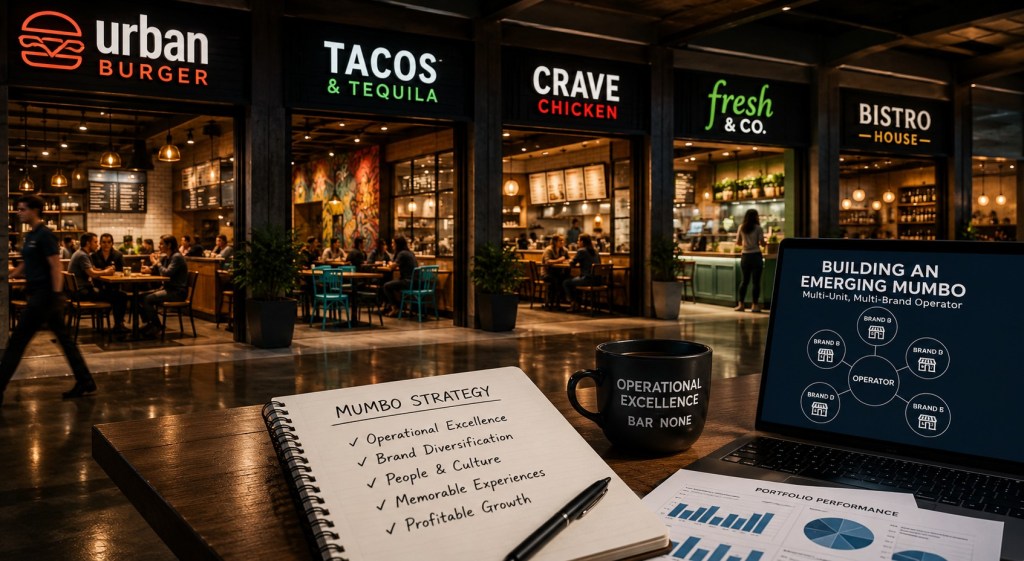
An emerging MUMBO doesn’t look like a private equity-backed platform with 200 locations. It may look like an operator with four or five brands, each with three to five units. It’s smaller, more hands-on, less institutional. But that doesn’t make it less meaningful. In fact, it may be one of the most practical paths to building a diversified and resilient portfolio in today’s market.

While not a Multi-Unit Multi-Brand Operator, the closest high-profile example is Gregg Majewski and his success developing Craveworthy Brands. While the scale at this multi-brand franchisor exceeds what we’d call “emerging,” the philosophy is similar. Multiple brands. Shared infrastructure. Strategic growth. Portfolio thinking.

The difference is that emerging operators don’t start with capital. They start with discipline.

Why This Model Matters Now

Single-brand, single-unit ownership has always carried risk. Market shifts, operational challenges, brand stagnation, or simple saturation can limit growth or create vulnerability. At the same time, going “all in” on a single brand with aggressive multi-unit development can expose an operator to concentrated risk.

An emerging MUMBO approach introduces diversification early. Not as a luxury, but as a deliberate strategy.

Different brands serve different dayparts. Different customer segments. Different real estate profiles. One brand may thrive in dense urban corridors. Another in suburban retail strips. One may be highly operationally intensive. Another more streamlined.

When done right, the portfolio begins to balance itself.

But that only works if it’s built with intention.

What It Actually Takes

There’s a tendency to think in terms of “adding brands.” That’s the wrong starting point. The real work is building a platform that can support multiple brands without collapsing under complexity.

The operator has to think like a portfolio manager, not just a franchisee.

It starts with infrastructure. Shared services become critical; accounting, HR, marketing, supply chain coordination, technology platforms. Without this foundation, managing even two brands can feel chaotic. With it, five brands can begin to operate with cohesion.

Then comes leadership. You cannot run every unit. You cannot be the operating system. An emerging MUMBO must invest early in people; general managers, district leaders, and eventually brand-level oversight. The bench has to be built before it feels comfortable to do so.

Capital discipline becomes non-negotiable. Growth cannot be driven by excitement. It must be driven by unit economics. Each brand, each location, has to stand on its own merits. If a concept isn’t working, it has to be addressed quickly. Portfolio thinking does not mean carrying underperforming assets indefinitely.

Brand selection may be the most overlooked piece. Not all brands belong in the same portfolio. Some compete for the same customer. Others require entirely different operational DNA. The emerging MUMBO has to be selective… choosing brands that complement rather than conflict.

And then there is patience.

This is not a sprint to ten brands. It is a disciplined progression from one brand to two, from two to three, with each addition strengthening, not weakening the overall structure.

Not So Different After All

There’s an important point that often gets overlooked in this conversation. This model is not much different than a seasoned restaurateur opening or acquiring five or six independent restaurants over time.

For decades, successful operators have built small portfolios of independent concepts, sometimes different cuisines, different service styles, different locations, all under one umbrella. They didn’t call it MUMBO. They called it building a restaurant group.

The difference today is largely structural. Franchising provides brand systems, operating frameworks, and scalability. But the core principle remains the same.

Build multiple revenue streams. Diversify thoughtfully. Operate each unit with precision.

And most importantly, do not confuse access to capital with a strategy.

Too many ventures, large and small, fall into the trap of believing growth can be bought. That capital alone will solve operational challenges. My belief is the opposite.

Capital can accelerate a well-run operation.

It cannot fix a poorly run one.

Operational Excellence… Bar None

If there is one belief I hold above all else, it’s this: operational excellence is non-negotiable. Bar none.

Without it, a multi-brand portfolio doesn’t diversify risk… it multiplies it.

An emerging MUMBO cannot hide behind brand names, marketing, or even strong locations. Execution at the unit level is everything. Consistency. Cleanliness. Speed. Hospitality. Food quality. Team engagement. These are not “nice to haves.” They are the foundation.

And this is where I believe we can take a page from the playbook of Tilman Fertitta, the sole owner and CEO of Fertitta Entertainment, Inc., which owns the restaurant giant Landry’s, Inc., the Houston Rockets, and the Golden Nugget Hotel and Casinos. He is a reality TV star, New York Times Best-selling author, speaker, frequent guest on popular TV business networks and is recognized as a world leader in the dining, hospitality, entertainment, and gaming industries.

Fertitta has built the Landry’s empire not just by acquiring strong assets, but by identifying underperforming ones and turning them around through disciplined operations and a relentless focus on the guest experience. He understands that value is often created not in what you buy, but in how you operate what you own. Learn more in his best-seller, Shut Up and Listen!: Hard Business Truths that Will Help You Succeed

For an emerging MUMBO, this mindset is powerful.

There will be opportunities to acquire struggling units or underperforming locations within good brands. The instinct may be to avoid them. My belief is that, with the right operational discipline, those can become some of the most valuable assets in the portfolio.

But only if you can deliver consistently positive, memorable experiences.

That’s the standard.

The Strategic Advantage

An emerging MUMBO who builds correctly creates optionality.

They are not dependent on a single franchisor. They are not locked into one growth path. They can allocate capital where returns are strongest. They can shift focus based on market conditions. They can become attractive to larger platforms or private equity groups looking for well-structured, diversified operators.

In time, they may become the very portfolios that are being acquired today.

But more importantly, they build something durable.

Because the goal is not just scale. It’s sustainability.

A Different Way to Think About Growth

For decades, the conversation in franchising has centered around “more units.” More locations within a brand. More territory. More buildouts.

The MUMBO model challenges that thinking. It introduces a new question.

Not just how many units, but of what mix, under what structure, and toward what long-term objective.

For the emerging entrepreneur, this is an invitation. Not to chase scale prematurely, but to build intelligently. To think beyond a single brand. To approach growth as a portfolio from the very beginning.

It requires a shift in mindset. From operator to architect.

From unit growth to enterprise design.

That shift may very well define the next generation of successful franchise operators.

And the ones who get it right at the emerging level won’t just participate in the MUMBO conversation.

They’ll shape where it goes next.

Final Thought and Invitation

As MUMBO continues to emerge as a major trend and increasingly popular topic within franchising and restaurant growth, I genuinely look forward to hearing your insight and perspective.

Of course, if you’re thinking about growth, whether that means your second unit, your second brand, or something more ambitious, I’d welcome that conversation, as well. After all, there is no one-size-fits-all path here. But there is a right path for you, your goals, and your vision.

Please feel free to reach out directly via direct message or by email at paul@acceler8success.com.