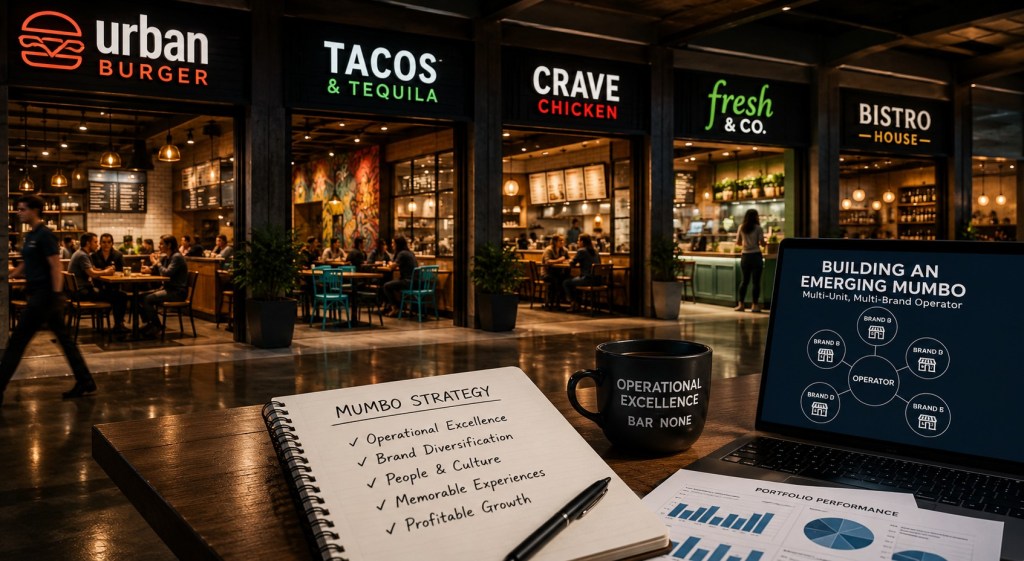
The acronym sounds big. It feels institutional. It carries the weight of scale, sophistication, and capital. The rise of the MUMBO. The Multi-Unit, Multi-Brand Operator has quickly become one of the most talked-about shifts in franchising and restaurant growth strategy.
We’re seeing portfolios come together in ways that would have been rare just a decade ago. Private equity firms are actively acquiring and assembling these platforms, creating diversified brand holdings with dozens, sometimes hundreds of units across concepts. Nine-figure deals are no longer outliers. In some cases, billion-dollar transactions are entering the conversation with surprising regularity.
But here’s the question worth asking. Is MUMBO only for the big players, or is there a version of this strategy that exists at the emerging level?
Because beneath the headlines and the capital raises, there is a quieter opportunity forming. One that may be far more accessible, and in some ways, more strategic for the right kind of entrepreneur.
Before going further, let me be clear. This is my perspective. My opinion, shaped by decades of experience in franchising, restaurants, and working alongside entrepreneurs at every stage. There are many ways to approach growth. This is one I believe deserves serious consideration.
The Emerging MUMBO
An emerging MUMBO doesn’t look like a private equity-backed platform with 200 locations. It may look like an operator with four or five brands, each with three to five units. It’s smaller, more hands-on, less institutional. But that doesn’t make it less meaningful. In fact, it may be one of the most practical paths to building a diversified and resilient portfolio in today’s market.
While not a Multi-Unit Multi-Brand Operator, the closest high-profile example is Gregg Majewski and his success developing Craveworthy Brands. While the scale at this multi-brand franchisor exceeds what we’d call “emerging,” the philosophy is similar. Multiple brands. Shared infrastructure. Strategic growth. Portfolio thinking.
The difference is that emerging operators don’t start with capital. They start with discipline.
Why This Model Matters Now
Single-brand, single-unit ownership has always carried risk. Market shifts, operational challenges, brand stagnation, or simple saturation can limit growth or create vulnerability. At the same time, going “all in” on a single brand with aggressive multi-unit development can expose an operator to concentrated risk.
An emerging MUMBO approach introduces diversification early. Not as a luxury, but as a deliberate strategy.
Different brands serve different dayparts. Different customer segments. Different real estate profiles. One brand may thrive in dense urban corridors. Another in suburban retail strips. One may be highly operationally intensive. Another more streamlined.
When done right, the portfolio begins to balance itself.
But that only works if it’s built with intention.
What It Actually Takes
There’s a tendency to think in terms of “adding brands.” That’s the wrong starting point. The real work is building a platform that can support multiple brands without collapsing under complexity.
The operator has to think like a portfolio manager, not just a franchisee.
It starts with infrastructure. Shared services become critical; accounting, HR, marketing, supply chain coordination, technology platforms. Without this foundation, managing even two brands can feel chaotic. With it, five brands can begin to operate with cohesion.
Then comes leadership. You cannot run every unit. You cannot be the operating system. An emerging MUMBO must invest early in people; general managers, district leaders, and eventually brand-level oversight. The bench has to be built before it feels comfortable to do so.
Capital discipline becomes non-negotiable. Growth cannot be driven by excitement. It must be driven by unit economics. Each brand, each location, has to stand on its own merits. If a concept isn’t working, it has to be addressed quickly. Portfolio thinking does not mean carrying underperforming assets indefinitely.
Brand selection may be the most overlooked piece. Not all brands belong in the same portfolio. Some compete for the same customer. Others require entirely different operational DNA. The emerging MUMBO has to be selective… choosing brands that complement rather than conflict.
And then there is patience.
This is not a sprint to ten brands. It is a disciplined progression from one brand to two, from two to three, with each addition strengthening, not weakening the overall structure.
Not So Different After All
There’s an important point that often gets overlooked in this conversation. This model is not much different than a seasoned restaurateur opening or acquiring five or six independent restaurants over time.
For decades, successful operators have built small portfolios of independent concepts, sometimes different cuisines, different service styles, different locations, all under one umbrella. They didn’t call it MUMBO. They called it building a restaurant group.
The difference today is largely structural. Franchising provides brand systems, operating frameworks, and scalability. But the core principle remains the same.
Build multiple revenue streams. Diversify thoughtfully. Operate each unit with precision.
And most importantly, do not confuse access to capital with a strategy.
Too many ventures, large and small, fall into the trap of believing growth can be bought. That capital alone will solve operational challenges. My belief is the opposite.
Capital can accelerate a well-run operation.
It cannot fix a poorly run one.
Operational Excellence… Bar None
If there is one belief I hold above all else, it’s this: operational excellence is non-negotiable. Bar none.
Without it, a multi-brand portfolio doesn’t diversify risk… it multiplies it.
An emerging MUMBO cannot hide behind brand names, marketing, or even strong locations. Execution at the unit level is everything. Consistency. Cleanliness. Speed. Hospitality. Food quality. Team engagement. These are not “nice to haves.” They are the foundation.
And this is where I believe we can take a page from the playbook of Tilman Fertitta, the sole owner and CEO of Fertitta Entertainment, Inc., which owns the restaurant giant Landry’s, Inc., the Houston Rockets, and the Golden Nugget Hotel and Casinos. He is a reality TV star, New York Times Best-selling author, speaker, frequent guest on popular TV business networks and is recognized as a world leader in the dining, hospitality, entertainment, and gaming industries.
Fertitta has built the Landry’s empire not just by acquiring strong assets, but by identifying underperforming ones and turning them around through disciplined operations and a relentless focus on the guest experience. He understands that value is often created not in what you buy, but in how you operate what you own. Learn more in his best-seller, Shut Up and Listen!: Hard Business Truths that Will Help You Succeed
For an emerging MUMBO, this mindset is powerful.
There will be opportunities to acquire struggling units or underperforming locations within good brands. The instinct may be to avoid them. My belief is that, with the right operational discipline, those can become some of the most valuable assets in the portfolio.
But only if you can deliver consistently positive, memorable experiences.
That’s the standard.
The Strategic Advantage
An emerging MUMBO who builds correctly creates optionality.
They are not dependent on a single franchisor. They are not locked into one growth path. They can allocate capital where returns are strongest. They can shift focus based on market conditions. They can become attractive to larger platforms or private equity groups looking for well-structured, diversified operators.
In time, they may become the very portfolios that are being acquired today.
But more importantly, they build something durable.
Because the goal is not just scale. It’s sustainability.
A Different Way to Think About Growth
For decades, the conversation in franchising has centered around “more units.” More locations within a brand. More territory. More buildouts.
The MUMBO model challenges that thinking. It introduces a new question.
Not just how many units, but of what mix, under what structure, and toward what long-term objective.
For the emerging entrepreneur, this is an invitation. Not to chase scale prematurely, but to build intelligently. To think beyond a single brand. To approach growth as a portfolio from the very beginning.
It requires a shift in mindset. From operator to architect.
From unit growth to enterprise design.
That shift may very well define the next generation of successful franchise operators.
And the ones who get it right at the emerging level won’t just participate in the MUMBO conversation.
They’ll shape where it goes next.
Final Thought and Invitation
As MUMBO continues to emerge as a major trend and increasingly popular topic within franchising and restaurant growth, I genuinely look forward to hearing your insight and perspective.
Of course, if you’re thinking about growth, whether that means your second unit, your second brand, or something more ambitious, I’d welcome that conversation, as well. After all, there is no one-size-fits-all path here. But there is a right path for you, your goals, and your vision.
Please feel free to reach out directly via direct message or by email at paul@acceler8success.com.
Discover more from Acceler8Success Cafe
Subscribe to get the latest posts sent to your email.

One thought on “The Emerging MUMBO: Building a Portfolio Before the Spotlight”
Comments are closed.