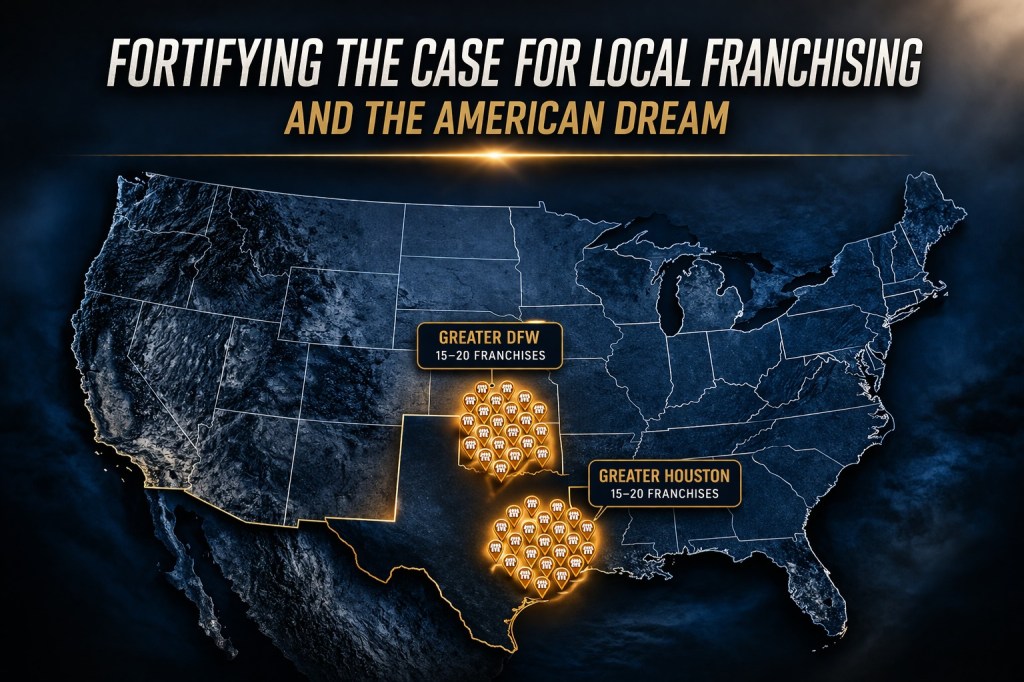
In franchising, growth is often spoken about in sweeping, almost romantic terms. Coast to coast. Nationwide presence. Hundreds or thousands of locations dotting the map. Those aspirations sound impressive, and in some cases they are justified. But there is a quieter, more disciplined ambition that rarely gets talked about publicly, even though many of the strongest franchise systems ultimately follow it. That ambition is not to be everywhere, but to be unmistakably dominant somewhere.
You rarely hear franchisors say their goal is to become the largest franchise brand in a city, a state, or a region. Yet when you look closely at brands that are truly healthy, profitable, and operationally sound, many of them first focused on saturating a defined market until the brand became a household name. This is not accidental. It is deliberate franchising.
Deliberate franchising starts with the recognition that scale is not just about distance, it is about density. A brand with ten locations spread across five or six states may technically be “multi-state,” but it is not truly scaled. It is scattered. Each unit operates in isolation, franchisees are often far removed from one another, and the franchisor’s support team is stretched thin trying to serve operators who may be hundreds or even thousands of miles apart. The optics of expansion exist, but the infrastructure rarely keeps pace.
Contrast that with a brand that chooses to dominate a city or a state. Multiple locations within a tight geographic footprint create operational leverage almost immediately. Field support becomes more effective because visits are efficient and frequent. Training improves because new franchisees can learn from nearby peers, not just manuals and webinars. Best practices spread faster when operators see them working down the street rather than hearing about them on a monthly call.
Marketing is where localization truly shines. A concentrated market allows a franchisor to build real brand awareness instead of fragmented impressions. Advertising dollars work harder when multiple locations benefit from the same message in the same media market. Local PR becomes meaningful because the brand shows up repeatedly, consistently, and visibly. Over time, the brand stops being “a franchise in town” and starts becoming “the brand” in that category. That kind of recognition is almost impossible to achieve when locations are scattered across distant markets with small, disconnected budgets.
There is also a franchisee confidence factor that often goes overlooked. Prospective franchisees are far more comfortable investing in a brand they see everywhere locally than one they have to imagine succeeding from afar. Existing franchisees feel supported when they know the franchisor’s attention is not diluted by distant outposts. Performance benchmarks become more accurate when units operate under similar market conditions, rather than trying to compare results from vastly different regions.
Deliberate franchising does not reject growth. It simply reframes it. The goal is not to rush toward a national footprint but to build a repeatable model of market dominance. If a brand can successfully saturate a city or a state, refine its systems, prove its unit economics, and establish itself as a local authority, that success can be replicated. One state becomes two. Two become four. Each expansion is intentional, supported, and informed by real experience rather than ambition alone.
This approach also forces franchisors to mature faster. Weak operations are exposed quickly when locations are clustered. Ineffective marketing cannot hide behind geography. Support gaps become obvious when franchisees are close enough to compare notes. While this can feel uncomfortable early on, it ultimately strengthens the system and prepares it for broader expansion when the time is right.
Scaling locally before scaling nationally is not a lack of vision. It is a different kind of vision, one grounded in sustainability, brand strength, and long-term franchisee success. Becoming coast to coast is not a strategy. It is a result. And more often than not, the brands that get there are the ones that first chose to win at home.
About the Author
Paul Segreto brings over forty years of real-world experience in franchising, restaurants, and small business growth. Recognized as one of the Top 100 Global Franchise and Small Business Influencers, Paul is the driving voice behind Acceler8Success Café, a daily content platform that inspires and informs thousands of entrepreneurs nationwide. A passionate advocate for ethical leadership and sustainable growth, Paul has dedicated his career to helping founders, franchise executives, and entrepreneurial families achieve clarity, balance, and lasting success through purpose-driven action.
About Acceler8Success America
Acceler8Success America is a comprehensive business advisory and coaching platform dedicated to helping entrepreneurs, small business owners, and franchise professionals achieve The American Dream Accelerated.
Through a combination of strategic consulting, results-focused coaching, and empowering content, Acceler8Success America provides the tools, insights, and guidance needed to start, grow, and scale successfully in today’s fast-paced world.
With deep expertise in entrepreneurship, franchising, restaurants, and small business development, Acceler8Success America bridges experience and innovation, supporting current and aspiring entrepreneurs as they build sustainable businesses and lasting legacies across America.
In my more than forty years in franchising, I have had the opportunity to serve in a wide range of leadership roles, including CEO, COO, and President, across organizations that experienced mergers and acquisitions, turnarounds, aggressive growth phases, and periods of steady, disciplined expansion. While those roles placed me squarely in the middle of strategic decision-making, I was always clear-eyed about where my greatest strengths lived and where they did not. My expertise was built through operations, franchise relations, marketing, and franchise development. When it came to complex financial engineering, capital structures, valuation models, and exit scenarios, I leaned heavily on what I often refer to as the smartest people in the room: seasoned Chief Financial Officers and highly capable financial consulting firms. That balance between operational leadership and financial rigor shaped many of the outcomes I was part of.
Over the years, I have also consulted with and advised a broad spectrum of franchise organizations, which has given me a better-than-average understanding of private equity’s expanding role in franchising. I have seen it from multiple vantage points: inside the boardroom, across leadership teams, through the eyes of franchisees, and from the perspective of founders who suddenly found themselves accountable to investors rather than to the systems they spent years building. What follows is written through that lens. It is not meant to be definitive, nor is it intended to indict or defend private equity as a category. There is certainly more to add and gaps to fill. But it is a conversation worth having, especially as private equity continues to shape the future of franchising in ways that are both powerful and deeply consequential.
Private equity’s growing presence in franchising is one of those topics that resists a simple yes-or-no conclusion. Like most things in business, it carries clear advantages alongside equally clear risks. Setting aside debates around deal structures, leverage ratios, and valuation multiples, the more important question is whether private equity ownership is truly compatible with franchising as a long-term system built on relationships, shared risk, and mutual success. That distinction matters because franchising, at its core, is not simply a growth strategy. It is a partnership model that depends on trust, alignment, consistency, and patience over long periods of time.
There is no denying the upside. Private equity has elevated franchising’s profile and reinforced what many operators and founders have long understood: franchising, when executed well, is a powerful and scalable business model. Institutional capital brings visibility, credibility, and access to resources that many brands could not achieve on their own. In numerous cases, private equity ownership has helped modernize legacy systems, professionalize leadership teams, improve financial reporting, introduce data-driven decision-making, and accelerate growth. From an enterprise perspective, franchising has benefited from being taken seriously as an asset class rather than being viewed as a fragmented collection of small, independently owned businesses.
But the same spotlight that brings credibility also exposes fault lines that have always existed beneath the surface of the franchise model.
Private equity firms are driven by return on investment. That is not a criticism; it is their mandate. Most funds operate on a three- to five-year investment horizon with a disciplined focus on increasing EBITDA, improving margins, tightening unit economics, and positioning the brand for a successful exit. Franchise agreements, by contrast, typically span ten years, often with renewal options that extend the relationship even further. Franchisees commit capital, sign personal guarantees, take on long-term leases, and structure their lives around businesses they expect to operate for decades. These timelines do not naturally align, and the consequences of that misalignment are very real.
Once a private equity firm acquires a franchise brand, the clock begins ticking almost immediately. Strategic decisions are filtered through the lens of exit readiness. Growth targets, cost controls, staffing models, technology investments, fee structures, and system-wide initiatives are evaluated based on how they enhance valuation within a relatively short window. Financial discipline and accountability matter, but problems arise when near-term financial optimization begins to outweigh the long-term health of the franchise system and the people who operate it every day.
Franchisees are not short-term investors. They are operators, employers, and community members. They have invested their savings, taken on debt, and tied their livelihoods to a brand they expect to grow with over time. When decisions are driven primarily by what a future buyer wants to see rather than by what franchisees need to succeed over the next decade, strain shows up quickly. Support resources may be reduced. Growth may outpace training and operational infrastructure, and other core areas can be impacted as well. Individually, these changes may appear manageable. Collectively, they can quietly erode trust.
This dynamic plays out very differently depending on whether the brand is a mature, legacy franchise system or an emerging franchise concept, and the chasm between those two realities is significant.
Legacy brands often have decades of operating history, substantial unit counts, established training platforms, experienced field teams, and strong consumer awareness. While franchisees in these systems are not immune to the pressures created by private equity ownership, the brand’s scale and maturity can provide a buffer. There is institutional knowledge, proven economics, and operational depth that can absorb disruption and ownership transitions with less volatility.
Emerging franchise brands operate without those safety nets. These systems are still being built. Unit economics are evolving. Processes are being refined in real time. Early franchisees are often taking on disproportionate risk in exchange for belief in the concept and the leadership team. When private equity enters at this stage, the margin for error narrows dramatically. Aggressive growth mandates can push systems to scale before the foundation is solid. Cost controls can strip away critical support functions at precisely the moment franchisees need them most. Strategic decisions may prioritize optics over durability. For emerging brands, private equity ownership can either accelerate maturation responsibly or magnify weaknesses that ultimately destabilize the system.
This reality leads to a difficult but necessary question: who is the true steward of the brand under private equity ownership?
Is stewardship held by individuals who have built businesses, understand the realities of operating a location, and feel personal accountability for franchisee outcomes? Or does it rest with boards and investment committees whose expertise is rooted primarily in financial modeling and portfolio performance? Many of the latter have never met payroll, negotiated a lease, or managed frontline employees. When stewardship shifts from builders and operators to financial overseers, culture often becomes abstract, decision-making more distant, and franchisees begin to feel like data points rather than partners.
The issue becomes even more pronounced at exit. If a franchisee has several years remaining on their agreement when a private equity firm sells the brand, they are suddenly partnered with someone new and often without a voice in that transition. The strategy they originally bought into may change overnight. The new owner may have entirely different priorities, growth expectations, or operational philosophies. Yet the franchisee remains bound by the same agreement, often living with decisions made years earlier by owners who have long since moved on.
This is where long-term risk quietly accumulates. Cost-cutting that weakens franchise support, aggressive development that overwhelms training and operations, fee increases without value creation, or a shift from partnership to extraction can damage trust in ways that are difficult to reverse. Franchising only works when trust exists. Once that trust erodes, even strong financial performance cannot fully compensate for the loss.
There is also a human and historical dimension that deserves acknowledgment. Many industry veterans remember a time when founders and franchisees built brands together in a more direct and personal way. Leaders such as Bud Hadfield, Fred DeLuca, and Anthony Martino were not distant figures hidden behind layers of management and investor relations teams. They were builders and stewards who thought in decades, not exit multiples. Franchisees felt seen, heard, and supported, and the success of the brand and the success of the franchisee were inseparable.
That era was not perfect, and mistakes were certainly made. But alignment was clearer. Long-term health mattered. Today, with some franchise brands changing ownership multiple times within a single franchise term, that sense of shared destiny can feel diluted, particularly for emerging systems still searching for their identity.
This is not an argument against private equity. It is a call for balance, responsibility, and awareness. Private equity can be a positive force in franchising when it respects the long-term nature of franchise relationships, honors the commitments embedded in franchise agreements, and treats franchisees as true partners rather than line items on a spreadsheet. When capital and stewardship work together, franchising can thrive.
But when short-term exit strategies collide with long-term franchise agreements, both the math and the trust begin to unravel. Franchising was never meant to be a flip. It was meant to be a relationship. And the further the industry moves away from that principle, especially across the wide gap between emerging and legacy brands, the more fragile the model becomes, regardless of how strong the numbers may look on paper.
If you are a franchisor, franchisee, investor, advisor, or industry professional who has lived through private equity ownership, explored possibilities, or deliberately chosen to avoid it, I invite you to share your perspective. What have you seen work well? Where have you seen tension or breakdowns occur? How do you believe private equity can better align with the long-term nature of franchising? This conversation matters, and the future of the franchise model will be shaped not just by capital, but by the collective insight and experience of those who are part of it every day.
About the Author
Paul Segreto brings over forty years of real-world experience in franchising, restaurants, and small business growth. Recognized as one of the Top 100 Global Franchise and Small Business Influencers, Paul is the driving voice behind Acceler8Success Café, a daily content platform that inspires and informs thousands of entrepreneurs nationwide. A passionate advocate for ethical leadership and sustainable growth, Paul has dedicated his career to helping founders, franchise executives, and entrepreneurial families achieve clarity, balance, and lasting success through purpose-driven action.
About Acceler8Success America
Acceler8Success America is a comprehensive business advisory and coaching platform dedicated to helping entrepreneurs, small business owners, and franchise professionals achieve The American Dream Accelerated.
Through a combination of strategic consulting, results-focused coaching, and empowering content, Acceler8Success America provides the tools, insights, and guidance needed to start, grow, and scale successfully in today’s fast-paced world.
With deep expertise in entrepreneurship, franchising, restaurants, and small business development, Acceler8Success America bridges experience and innovation, supporting current and aspiring entrepreneurs as they build sustainable businesses and lasting legacies across America.
Franchising is often framed as a pathway to scale. In reality, it is a decision to permanently intertwine the fate of a brand with the financial lives of independent business owners. That distinction is not philosophical; it is practical, ethical, and enduring. As 2026 unfolds amid economic recalibration, heightened franchisee awareness, and increased scrutiny of franchise systems, the most responsible form of growth is also the most sustainable one: deliberate franchising.
Responsible franchising and sustainable franchising are not abstract ideals. They are the direct outcome of leadership that thinks beyond speed and short-term valuation. Deliberate franchising sits at the intersection of these principles. It recognizes that growth achieved without discipline may be impressive in the moment, but it is rarely durable. Systems built deliberately, by contrast, are designed to support franchisees through cycles, not just expansions. The question leaders must ask themselves is not whether they can grow, but whether they can do so in a way that deserves long-term trust.
Every franchise system begins with an entrepreneur who believes their business is ready for replication. That belief is often well-earned, but belief is not the same as preparedness. Deliberate entrepreneurs pause before franchising to ask questions that go beyond enthusiasm. Is the model genuinely transferable, or does it still rely on founder-driven decision-making and informal problem-solving? Are unit economics resilient enough to support average operators, not just exceptional ones? Would this business remain viable if market conditions tightened or costs rose unexpectedly? Responsible franchising requires confronting these questions before inviting others to invest.
Once franchising begins, leadership obligations change permanently. Decisions no longer affect only the corporate entity; they directly impact franchisees who have committed capital, signed personal guarantees, and structured their lives around the system. Deliberate franchisors understand that every mandate, every required investment, and every strategic shift must be evaluated through the lens of franchisee sustainability. Sustainable franchising is not about maximizing franchisor control. It is about ensuring franchisees can remain healthy, profitable, and engaged over the long term.
Development is where the consequences of nondeliberate franchising are most often revealed. Growth pursued without discipline can strain support infrastructure, dilute culture, and create misalignment that lingers for years. Deliberate franchisors ask whether the system is ready for additional units before approving them. Are training resources scalable? Are field teams positioned to support new locations effectively? Are markets being awarded based on strategic fit rather than availability? Responsible development prioritizes system health over unit count.
At the same time, deliberateness is not an excuse for stagnation. Sustainable franchising requires leadership that can make timely, informed decisions. Avoiding necessary changes, delaying difficult conversations, or postponing strategic shifts in the name of caution ultimately undermines trust. Franchisees expect clarity, not perfection. Deliberate leaders accept uncertainty, act with intention, and communicate openly about trade-offs and risks.
Diligence is the foundation of deliberate franchising. Responsible franchisors stay close to unit-level performance, not just aggregated metrics. They listen to franchisees with discernment, separating patterns from outliers. They invest in infrastructure before growth demands it. This diligence creates readiness, allowing leadership to act decisively when conditions change. Sustainable systems are not reactive; they are prepared.
Being informed is equally critical. The franchising environment is crowded with innovations, advisors, and promised accelerants to scale. Deliberate franchisors resist the urge to adopt solutions simply because they are popular or available. They ask whether proposed initiatives strengthen the franchise relationship or introduce unnecessary complexity. Sustainable franchising values simplicity, clarity, and execution over novelty.
Trust remains the defining currency of franchising. Responsible and sustainable systems are built on consistent, transparent leadership. Deliberate franchisors earn trust by explaining decisions, acknowledging their impact, and taking accountability for outcomes. Franchisees are more willing to align, invest, and adapt when they believe leadership is acting with long-term stewardship rather than short-term gain.
Culture is the natural byproduct of these choices. A deliberate franchise culture prioritizes clarity over ambiguity and accountability over avoidance. It does not rush change without preparation, nor does it allow unresolved issues to linger. When leadership models thoughtful decision-making and disciplined execution, the system becomes more resilient, more aligned, and better positioned to endure market shifts.
As 2026 continues to test assumptions across franchising, the distinction between fast growth and sound growth will become increasingly clear. Responsible franchising, sustainable franchising, and deliberate franchising are not separate philosophies. They are the same commitment expressed in different ways. The central question for franchisors and aspiring franchisors alike is whether they are willing to lead with the foresight, restraint, and accountability that shared risk demands. Growth achieved deliberately may take longer, but it is far more likely to last—and far more worthy of the trust franchisees place in the system.
About the Author
Paul Segreto brings over forty years of real-world experience in franchising, restaurants, and small business growth. Recognized as one of the Top 100 Global Franchise and Small Business Influencers, Paul is the driving voice behind Acceler8Success Café, a daily content platform that inspires and informs thousands of entrepreneurs nationwide. A passionate advocate for ethical leadership and sustainable growth, Paul has dedicated his career to helping founders, franchise executives, and entrepreneurial families achieve clarity, balance, and lasting success through purpose-driven action.
About Acceler8Success America
Acceler8Success America is a comprehensive business advisory and coaching platform dedicated to helping entrepreneurs, small business owners, and franchise professionals achieve The American Dream Accelerated.
Through a combination of strategic consulting, results-focused coaching, and empowering content, Acceler8Success America provides the tools, insights, and guidance needed to start, grow, and scale successfully in today’s fast-paced world.
With deep expertise in entrepreneurship, franchising, restaurants, and small business development, Acceler8Success America bridges experience and innovation, supporting current and aspiring entrepreneurs as they build sustainable businesses and lasting legacies across America.
AI fluency is emerging as one of the most consequential strategic capabilities for franchise organizations, particularly for emerging brands and companies considering franchising as a growth initiative. This is not a discussion about adopting tools or chasing efficiencies. It is a leadership-level issue tied directly to scalability, alignment, franchisee success, brand integrity, and long-term enterprise value. In franchising, where complexity multiplies with every new unit, intelligence embedded into the system is no longer optional.
Franchising works when replication is disciplined and decision-making improves as the system grows. Yet growth naturally introduces friction: more locations, more data, more variables, and greater distance between leadership and day-to-day operations. AI addresses that tension by allowing insight to scale alongside unit count, rather than eroding visibility as the system expands. The real question is no longer whether AI belongs in franchising, but whether a franchise system can realistically mature without it.
This moment should feel familiar to anyone who has spent time in the franchise industry. I recall hearing Erik Qualman speak at one of the Franchise Update conferences roughly a decade ago, when social media was still being debated across franchise systems. His message stood out because it avoided tactics and platforms and went straight to relevance and survival. He framed digital change not as a marketing option, but as a business imperative.
Two of his statements cut through the room then and remain remarkably relevant today. “The ROI of social media is that your business will still exist in 5 years.” And, “We don’t have a choice on whether we DO social media, the question is how well we do it.” At the time, those words felt provocative. With hindsight, they read more like an early warning.
Those ideas were reinforced through Qualman’s influential book Socialnomics, which challenged leaders to recognize that technology reshapes behavior long before organizations adapt structurally. Franchising learned that lesson the hard way. Systems that delayed social media adoption spent years rebuilding consistency, credibility, and control across their networks. Some never fully recovered.
AI represents a similar inflection point for franchising, but with far less patience built into the curve. Social media adoption unfolded over years. AI adoption is unfolding over quarters. The operational impact is deeper, expectations are higher, and the cost of delay compounds far more quickly.
From the franchisor’s perspective, AI fluency increasingly determines whether a system can scale without becoming fragile. Corporate teams are expected to support more locations, analyze more data, and deliver better guidance without proportionally increasing overhead. AI enhances system-wide visibility, enabling earlier identification of performance gaps, sharper insight into unit economics, more effective training, and more informed decisions around pricing, territories, marketing, and labor models.
For emerging franchise brands, the implications are even more significant. Early-stage systems often rely heavily on founder intuition and a small leadership team’s experience. While that may fuel early growth, it does not scale indefinitely. AI helps convert intuition into process and experience into repeatable insight. That transition is critical not only for operational stability, but for credibility with sophisticated franchise candidates, lenders, private equity groups, and future acquirers.
This reality raises difficult but necessary questions for franchisor leadership. How dependent is system performance on a handful of individuals? How quickly can best practices be identified and shared across the network? How early can underperformance be detected and addressed before it becomes systemic? And how attractive is the brand to next-generation franchisees who increasingly expect data-driven support rather than anecdotal guidance?
From the franchisee’s perspective, AI fluency is becoming inseparable from profitability, resilience, and quality of life. Franchisees operate under pressure from rising labor costs, staffing volatility, supply chain complexity, and ever-evolving customer expectations. AI does not replace the operator’s judgment, but it strengthens it. It supports better demand forecasting, smarter labor decisions, tighter inventory control, real-time reputation monitoring, and clearer evaluation of local marketing performance.
This leads to a more fundamental question for franchisees. How much time is spent reacting versus leading? How many decisions are driven by habit rather than insight? And how sustainable is that approach as competition intensifies and margins tighten? AI does not remove responsibility from the operator. It provides better tools to carry it.
Alignment between franchisor and franchisee around AI adoption is therefore critical. When AI is left to ad hoc experimentation, inconsistency and confusion follow. When it is embedded intentionally into systems, standards, and support structures, it creates shared language, shared metrics, and shared accountability. It strengthens trust by replacing ambiguity with clarity and support with substance.
For companies exploring franchising as a growth initiative, AI fluency should be foundational from day one. Franchising a business that is already AI-enabled increases the likelihood that early franchisees succeed, which ultimately determines whether a system gains momentum or stalls. It forces essential questions to be answered early. Are operating systems truly repeatable? Can training scale without dilution? Can performance be monitored without micromanagement? Is the concept designed for today’s operator and tomorrow’s market?
The risks of ignoring AI are not hypothetical. Franchise systems that delay become slower, more reactive, and less attractive to high-quality franchise candidates. Corporate teams spend more time managing noise than driving strategy. Franchisees operate in silos. Competitors that embrace AI position themselves as more sophisticated, more supportive, and more future-ready. Over time, the gap widens, not because one brand is inherently smarter, but because one chose to adapt sooner.
The lesson from social media remains instructive. Franchise organizations do not get to decide whether transformational shifts occur. They only decide how prepared they will be when those shifts reshape the competitive landscape. Today, the most important question in franchising is no longer whether AI delivers a return. It is whether a franchise system without AI fluency can remain relevant, competitive, and valuable in the near future.
For additional perspective on this parallel and why waiting is such a costly mistake, read my article on Substack, “Ignoring AI Is the New Ignoring Social Media: Why Waiting Even a Few Years Could Cost You Your Business”, available HERE.
AI is not a future upgrade for franchising. It is a present-day capability. The franchise organizations that recognize this now will build stronger systems, healthier unit economics, and brands designed to scale with intention rather than scramble under pressure.
About the Author
Paul Segreto brings over forty years of real-world experience in franchising, restaurants, and small business growth. Recognized as one of the Top 100 Global Franchise and Small Business Influencers, Paul is the driving voice behind Acceler8Success Café, a daily content platform that inspires and informs thousands of entrepreneurs nationwide. A passionate advocate for ethical leadership and sustainable growth, Paul has dedicated his career to helping founders, franchise executives, and entrepreneurial families achieve clarity, balance, and lasting success through purpose-driven action.
About Acceler8Success America
Acceler8Success America is a comprehensive business advisory and coaching platform dedicated to helping entrepreneurs, small business owners, and franchise professionals achieve The American Dream Accelerated.
Through a combination of strategic consulting, results-focused coaching, and empowering content, Acceler8Success America provides the tools, insights, and guidance needed to start, grow, and scale successfully in today’s fast-paced world.
With deep expertise in entrepreneurship, franchising, restaurants, and small business development, Acceler8Success America bridges experience and innovation, supporting current and aspiring entrepreneurs as they build sustainable businesses and lasting legacies across America.
For franchisors, few decisions shape the long-term health of a brand more than who represents it during the franchise sales process and how those conversations unfold. Long before a franchisee signs an agreement, pays a fee, or opens their doors, the relationship has already begun. It starts with dialogue, positioning, tone, and expectations. As franchisors look toward a new year, this is not simply a sales issue to manage. It is a leadership issue that directly influences culture, trust, and the integrity of the system.
Franchise development sits at a difficult intersection of optimism and obligation. On one hand, the role is to inspire confidence, communicate opportunities, and attract qualified candidates. On the other, it carries a responsibility to ensure alignment, accuracy, and long-term fit. Franchise sellers must provide information that is accurate, complete, and fully aligned with proper disclosure. Anything stated, implied, or framed in a way that could be interpreted otherwise introduces risk. Culture is shaped not only by what is written in manuals or stated in mission statements, but by how people talk when no one is listening and how opportunities are described when candidates are excited and appear ready to move forward, even prepmaturely.
The most common friction points rarely come from what is written in the Franchise Disclosure Document. They come from everyday conversations. Earnings potential discussed without full context. Ramp-up timelines portrayed as easier or faster than reality. Support levels implied rather than clearly defined. Flexibility is suggested where consistency is required. Over time, these conversations do more than create misaligned expectations. They quietly establish a culture of interpretation rather than clarity. When that happens, franchisees do not just feel misled. They enter the system with a mindset that exceptions are normal and standards are negotiable.
In-house franchise development teams play a powerful role in setting cultural tone. The language they use, the stories they tell, and the behaviors they model signal what truly matters inside the organization. If internal franchise sellers feel pressure to prioritize volume over fit, that pressure becomes embedded in the culture. Franchisees sense it immediately. As franchisors plan for the year ahead, it is worth reflecting on whether development teams are being rewarded for the right outcomes or simply the fastest growth.
Third-party brokers and franchise sellers are often overlooked as cultural ambassadors, yet their impact can be just as significant. Even though they operate outside the organization, they represent the brand at its most influential moment: the decision to invest. If brokers are not aligned with the franchisor’s values, standards, and expectations, they can unintentionally introduce a culture of overpromising, comparison-driven selling, or transactional thinking. That culture does not stop at the sale. It enters the system with the franchisee and influences how they interact with the franchisor, other franchisees, and their own teams.
As important as this is for the franchisor, there is an equally important obligation to the franchisee. Franchise sales are not only about brand protection or system growth. It is about ensuring franchisees move forward informed, prepared, and confident in the reality of the business they are entering. This responsibility exists because franchising is inherently an interdependent relationship. Interdependence in franchising means the franchisor and franchisee rely on one another for success. The franchisor depends on franchisees to execute the brand, protect the customer experience, and represent the system in their local markets. The franchisee depends on the franchisor for the brand, systems, training, support, innovation, and leadership that make the business viable. Culture is the connective tissue that allows interdependence to function effectively.
When franchisees enter the system oversold or underinformed, the interdependent model weakens. Franchisees may become defensive or disengaged. Franchisors may experience increased support strain, resistance to standards, and erosion of trust. That breakdown does not stay contained. It creates a trickle effect. Field teams feel the tension. Operations become reactive. Support resources stretch thin. Other franchisees observe the friction and question alignment. Even customers can feel inconsistency at the unit level. What began as a development issue becomes a system-wide cultural issue.
Strong franchise systems understand that culture is not established after onboarding. It is established during the sales process. The healthiest brands treat franchise development as the first cultural handshake. They ensure that anyone representing the brand, internal or external, understands not just the economics, but the values, expectations, and responsibilities that come with ownership. They create a shared language that emphasizes realism, accountability, and partnership over hype and urgency.
As franchisors look toward a new year, this is an ideal time to reflect on the culture being reinforced through franchise development. Are franchise sellers modeling transparency or optimism at any cost? Are brokers aligned with the brand’s long-term vision or simply its commission structure? Are franchisees entering the system with a mindset of collaboration or entitlement? These questions are cultural in nature, and they deserve thoughtful consideration in annual planning discussions.
Alignment between leadership, operations, legal compliance, franchise development, and third-party sellers does not happen by accident. It requires intention, clarity, and consistent reinforcement. When development messaging mirrors operational reality and cultural expectations, franchisees enter the system grounded and prepared. They are more receptive to coaching, more committed to standards, and more invested in the success of the broader network.
Ultimately, franchise development either establishes a culture of trust and interdependence or one of skepticism and transaction. Every conversation matters. Every promise, implication, or omission contributes to the culture franchisees carry forward into their businesses. As franchisors plan for the year ahead, the most important growth strategy may not be the number of units sold, but the culture being built through the way those units are sold and the ripple effect that culture has on every stakeholder connected to the brand.
About the Author
Paul Segreto brings over forty years of real-world experience in franchising, restaurants, and small business growth. Recognized as one of the Top 100 Global Franchise and Small Business Influencers, Paul is the driving voice behind Acceler8Success Café, a daily content platform that inspires and informs thousands of entrepreneurs nationwide. A passionate advocate for ethical leadership and sustainable growth, Paul has dedicated his career to helping founders, franchise executives, and entrepreneurial families achieve clarity, balance, and lasting success through purpose-driven action.
About Acceler8Success America
Acceler8Success America is a comprehensive business advisory and coaching platform dedicated to helping entrepreneurs, small business owners, and franchise professionals achieve The American Dream Accelerated.
Through a combination of strategic consulting, results-focused coaching, and empowering content, Acceler8Success America provides the tools, insights, and guidance needed to start, grow, and scale successfully in today’s fast-paced world.
With deep expertise in entrepreneurship, franchising, restaurants, and small business development, Acceler8Success America bridges experience and innovation, supporting current and aspiring entrepreneurs as they build sustainable businesses and lasting legacies across America.
This interview was generated using artificial intelligence, shaped by thousands of real-time signals across today’s franchising landscape as we head into a new year, drawing from current franchise and business news, technology trends, economic reporting, founder and franchisor interviews, policy discussions, market data, and the lived experiences being shared online by franchise leaders and operators around the world. It also reflects the growing regulatory and advocacy conversations shaping franchising’s future, including the American Franchise Act and industry-led initiatives such as Franchise Means Local championed by the International Franchise Association.
Rather than reflecting a single brand or system, this interview synthesizes recurring patterns, pressures, and opportunities emerging across franchising. What follows is a forward-looking snapshot of how today’s franchisors are entering the new year, how technology and innovation are reshaping franchise systems, how regulatory clarity and advocacy are influencing strategy, and where opportunity is forming beneath the surface. The value lies in perspective: by stepping back from individual systems and looking at the collective story, we gain clearer insight into what franchisors must prioritize to build resilient, scalable, and franchisee-focused brands in the year ahead.
Q: As you head into the new year, how would you describe the current environment for franchisors? A: The environment is demanding, but it’s also full of opportunity. Franchisors are entering the new year carrying forward lessons from economic pressure, labor challenges, and rapidly changing consumer behavior. What makes this moment different is that franchise systems must now balance growth with responsibility and clarity, not just operationally, but structurally and legally as well. Expansion is still a priority, but it has to be smart, disciplined, and aligned with the long-term health of the brand and its franchisees. There’s also heightened awareness around protecting the franchise model itself, as conversations like the American Franchise Act aim to clearly define franchising and preserve the independence of franchise owners.
Q: What challenges are franchisors bringing with them into the new year? A: Alignment remains one of the biggest challenges. Franchisors must support franchisees dealing with rising costs, staffing issues, and local market variability while still driving system-wide standards and performance. At the same time, franchisors are navigating increased scrutiny around employment classification, joint employer risk, and regulatory interpretation. These pressures force franchisors to be more deliberate about how systems are structured and supported. Decision-making around what to standardize, what to localize, and how fast to move has real implications across an entire system.
Q: How has the role of the franchisor evolved heading into this next year? A: Today’s franchisor is no longer just a brand steward or development organization. The role has evolved into that of a systems leader and advocate. Franchisors are expected to provide strategic guidance, operational support, technology infrastructure, cultural leadership, and increasingly, a strong voice in protecting franchisee independence. Initiatives like Franchise Means Local underscore a growing emphasis on educating policymakers and the public that franchise owners are local business owners, deeply embedded in their communities. Franchisors who embrace this broader leadership role are building stronger trust across their systems.
Q: Technology continues to accelerate. How should franchisors be thinking about it in the year ahead? A: Technology must serve the system, not complicate it. Franchisors are under pressure to roll out AI, automation, advanced POS platforms, and data analytics, but the real test is whether those tools improve franchisee profitability and customer experience without creating unintended control or compliance risk. The smartest franchisors are taking a measured approach, asking what problems technology solves and how it integrates across locations. Technology should enhance visibility, consistency, and insight while preserving the independence that defines franchising.
Q: Innovation is often discussed at the franchisor level. What does meaningful innovation look like right now? A: Meaningful innovation in franchising is practical and system-focused. It’s about improving unit economics, simplifying operations, strengthening supply chains, and enhancing the customer experience in ways that can be repeated across markets. Innovation might appear in menu optimization, service models, marketing strategies, or smaller-format real estate rather than dramatic reinvention. Franchisors that innovate with franchisee input, and with an eye toward maintaining the proper franchisor-franchisee balance see stronger adoption and better outcomes.
Q: How important is mindset for franchisors entering the new year? A: Mindset is critical. Franchisors must think long-term while managing short-term pressure. The coming year will reward franchisors who are adaptable, transparent, and willing to course-correct. Viewing challenges, whether operational, economic, or regulatory as system data rather than failure allows for smarter decision-making. A growth mindset at the franchisor level sets the tone for the entire system and directly impacts franchisee confidence and engagement.
Q: What advice would you offer franchisors as they set priorities for the new year? A: Start with system health. Strong unit economics, engaged franchisees, and consistent execution matter more than aggressive unit growth. Be clear about your franchisee value proposition and how you support local ownership. Invest in communication, training, and field support, while staying informed and involved in industry advocacy efforts that protect the franchise model. The new year should be about strengthening the foundation so growth is sustainable, defensible, and mutually beneficial.
Q: Looking ahead, what does the future of franchising look like as this new year unfolds? A: The future of franchising will favor brands that are flexible, data-informed, and franchisee-centric. We’ll see more hybrid formats, smarter territory strategies, and continued investment in technology that supports—not replaces—local operators. At the same time, relationships will remain at the heart of franchising. Trust, transparency, and alignment between franchisors and franchisees, reinforced by clear legal definitions and strong advocacy, will determine which systems thrive.
Q: Final thoughts as franchisors step into the new year? A: This new year represents both responsibility and opportunity for franchisors. Decisions made at the franchisor level ripple through franchisees, employees, customers, and communities. While the environment remains complex, franchising continues to be one of the most powerful models for scalable growth when done right. Franchisors who lead with clarity, protect the integrity of the model, listen to their systems, and act with intention will help shape a stronger, more resilient future for franchising in the year ahead.
About the Author
Paul Segreto brings over forty years of real-world experience in franchising, restaurants, and small business growth. Recognized as one of the Top 100 Global Franchise and Small Business Influencers, Paul is the driving voice behind Acceler8Success Café, a daily content platform that inspires and informs thousands of entrepreneurs nationwide. A passionate advocate for ethical leadership and sustainable growth, Paul has dedicated his career to helping founders, franchise executives, and entrepreneurial families achieve clarity, balance, and lasting success through purpose-driven action.
About Acceler8Success America
Acceler8Success America is a comprehensive business advisory and coaching platform dedicated to helping entrepreneurs, small business owners, and franchise professionals achieve The American Dream Accelerated.
Through a combination of strategic consulting, results-focused coaching, and empowering content, Acceler8Success America provides the tools, insights, and guidance needed to start, grow, and scale successfully in today’s fast-paced world.
With deep expertise in entrepreneurship, franchising, restaurants, and small business development, Acceler8Success America bridges experience and innovation, supporting current and aspiring entrepreneurs as they build sustainable businesses and lasting legacies across America.
Franchising has long been celebrated as one of the most proven pathways to entrepreneurship. For decades, the franchise model balanced opportunity, scalability, and shared success. But today, a growing number of franchisees, franchisors, suppliers, lenders, and industry observers are asking a difficult question: Does modern franchising still work the way it was intended to work? Or has the financial and operational reality of the franchise relationship shifted so dramatically that the model itself needs updating, transforming, or even rethinking entirely?
Margins in many segments are tighter than ever. Buildout costs have climbed from the $250,000–$350,000 range of a decade ago to $500,000–$750,000 or more. Labor costs have risen significantly. Commodities fluctuate at levels that were once considered outliers but now feel permanent. Royalties and required spend commitments often remain fixed regardless of market pressures. And the time to reach ROI, once measured in two to four years for many concepts, now too often stretches into five, six, or even eight years, if it arrives at all. When an owner invests half a million dollars only to generate income that resembles job-level wages, many cannot help but ask whether they purchased a business or simply bought themselves a job. And when the day comes to exit and the resale value barely exceeds depreciated assets plus $25,000 to $30,000, the question becomes even more uncomfortable.
This is not an indictment of franchising. It is a call to confront reality. The franchise model remains powerful when the unit economics support real wealth creation. But when they do not, the system becomes strained. Trust erodes. Misalignment grows. And the relationship that should be mutually beneficial becomes adversarial, defensive, and transactional. The franchise community, franchisors, franchisees, advisors, and suppliers, must decide whether to accept the status quo or rethink the structure in ways that create healthier, more resilient outcomes for everyone involved.
What should be considered? Perhaps the future of franchising requires more than incremental adjustments. Perhaps it requires a reimagining of how risk and reward are shared. Maybe royalties evolve from fixed percentages to performance-based, margin-aware models. Maybe franchisors participate more meaningfully in local profitability rather than simply top-line revenue. Maybe franchisees are offered hybrid structures that lower upfront capital burdens in exchange for shared equity, giving both sides deeper alignment and a shared stake in long-term brand value. Maybe multi-unit pathways become more accessible not through aggressive financing, but through structured internal growth programs that reward operators who consistently perform. Maybe supplier and franchisor rebates, often a sore point for franchisees, are restructured so value flows more transparently and equitably throughout the system. And maybe franchise development itself becomes less about awarding units and more about cultivating entrepreneurs who are prepared for the realities of running high-cost, thin-margin businesses in a competitive and unforgiving market.
There is also space for entirely non-traditional concepts that blend franchising, licensing, partnership, and revenue-sharing arrangements. Models that reduce upfront capital requirements through modular builds, micro-footprints, shared kitchens, or neighborhood partnerships. Models that use technology to reduce labor dependency. Models that allow experienced operators to earn their way into ownership rather than buy their way into it. Models that align franchisor success not simply with brand expansion but with the financial stability of its franchisees.
These ideas are not meant as prescriptive answers. They are starting points. And perhaps the most important question the franchise community must ask is not “What needs to be fixed?” but “What are we willing to change?” Because the market is already changing, consumer behavior is already changing, and the economics of operating a small business—franchised or otherwise—are already changing. The question is whether franchising will evolve proactively or react when forced.
Franchising remains one of the most powerful economic engines in America and around the world. But engines require maintenance. Systems require updates. Relationships require honesty. And business models, even successful ones, eventually require reinvention. The future of franchising will belong to the brands, advisors, franchisees, and leaders who are willing to rethink not just the operational pieces, but the philosophical ones: fairness, alignment, opportunity, accessibility, sustainability, and shared success.
If the franchise community wants a stronger tomorrow, now is the moment for candid conversation. What do you believe needs to change? How do you see the future of franchise relationships? What innovations, structures, or bold ideas would you like to see tested? Whether you are a franchisor, franchisee, supplier, lender, consultant, or industry observer, your perspective matters. Add your voice, your experience, and your vision. This is a dialogue the industry needs—and one only the community itself can lead.
About the Author
Paul Segreto brings over forty years of real-world experience in franchising, restaurants, and small business growth. Recognized as one of the Top 100 Global Franchise and Small Business Influencers, Paul is the driving voice behind Acceler8Success Café, a daily content platform that inspires and informs thousands of entrepreneurs nationwide. A passionate advocate for ethical leadership and sustainable growth, Paul has dedicated his career to helping founders, franchise executives, and entrepreneurial families achieve clarity, balance, and lasting success through purpose-driven action.
About Acceler8Success America
Acceler8Success America is a comprehensive business advisory and coaching platform dedicated to helping entrepreneurs, small business owners, and franchise professionals achieve The American Dream Accelerated.
Through a combination of strategic consulting, results-focused coaching, and empowering content, Acceler8Success America provides the tools, insights, and guidance needed to start, grow, and scale successfully in today’s fast-paced world.
With deep expertise in entrepreneurship, franchising, restaurants, and small business development, Acceler8Success America bridges experience and innovation, supporting current and aspiring entrepreneurs as they build sustainable businesses and lasting legacies across America.
The franchise relationship is one of the most talked about, most misunderstood, and most emotionally charged relationships in business. It starts innocently enough with language. How the parties refer to each other. How the documents define them. How they speak about themselves in meetings, conferences, and discovery days. Words matter because words shape expectations, and expectations, when misaligned, quietly erode trust long before conflict ever surfaces.
Are franchisors and franchisees partners? In spirit, many would like to believe so. Partnership implies shared goals, mutual respect, aligned incentives, and a belief that success is created together. Legally, though, they are not partners. The franchise agreement is explicit about that. No equity is shared. No joint ownership exists. No implied partnership is intended. That distinction is not accidental. It is foundational. Yet the emotional expectation of partnership often lingers, especially on the franchisee side, and sometimes on the franchisor side as well. That tension alone is worth sitting with.
Is a franchisee a business owner? Yes, unequivocally. The franchisee owns a business entity, assumes financial risk, signs personal guarantees, hires employees, pays rent, pays vendors, manages cash flow, and is responsible for success or failure within the four walls of their operation. Is a franchisee a franchise owner? That answer becomes more nuanced. The brand, the trademarks, the systems, and the intellectual property are not owned. They are licensed. The right to use them is governed, controlled, and conditional. Ownership of the business exists, but ownership of the brand does not. That distinction is often glossed over until conflict arises, at which point it becomes painfully clear.
Perhaps that is why the term “Franchise Business Owner” feels more accurate. It acknowledges autonomy without overstating control. It recognizes ownership without blurring the legal reality of a license-based relationship. Still, the question lingers. If we struggle to clearly name the relationship, how can we reasonably expect both sides to instinctively understand what the relationship should entail?
The franchise relationship is not an employer-employee relationship. Every franchise agreement says so. Every disclosure document reinforces it. Yet in practice, some franchisors, or more commonly managers within franchise organizations, treat franchisees as if they were employees. Mandates delivered without context. Corrections issued without collaboration. Expectations communicated without listening. The irony is that this behavior often stems not from malice, but from uncertainty. When leaders do not fully understand how to lead independent business owners, they default to the management styles they know best. Control replaces influence. Enforcement replaces alignment.
At the same time, some franchisees unconsciously drift toward employee-like thinking. Waiting to be told what to do. Expecting protection from market realities. Assuming the franchisor will solve problems that live squarely inside the franchisee’s own business. That mindset quietly undermines the very independence that drew many people to franchising in the first place.
What, then, is the relationship really? Interdependent feels close, but even that word deserves scrutiny. The success of the franchisor depends on franchisee performance, brand consistency, and system-wide health. The success of the franchisee depends on the strength of the brand, the relevance of the system, and the quality of leadership and support. And yet, the dependence is not absolute. A franchisor can survive the loss of individual franchisees. A franchisee can sometimes survive despite a weak franchisor, at least for a while. Interdependence exists, but only to a point.
And just when we think we have our arms around the core relationship, we introduce a new layer of complexity: third parties involved in the franchise sales and development process. Broker. Consultant. Coach. Advisor. Agent. These titles are used interchangeably, often casually, sometimes strategically, and rarely with precision. Each implies a different role, a different duty, and a different set of loyalties. Yet how often are those distinctions clearly explained to a prospective franchisee? How often does the industry pause to define who truly represents whom, and in what capacity?
Is a broker advocating for the buyer, the seller, or the transaction itself? Is a consultant independent, or compensated by the brand? Is a coach preparing someone for ownership, or nudging them toward a deal? Is an advisor offering objective guidance, or operating under an agency relationship that carries fiduciary implications? If the people closest to the process cannot clearly articulate these roles, what chance does a first-time franchise buyer have?
Then there is the language around the transaction itself. Are franchises bought and sold? Are they awarded? Granted? Approved? Earned? Each word carries weight. Buying suggests ownership. Selling implies a transferable asset. Awarding implies selectivity and merit. Granting reinforces the licensing nature of the relationship. The industry uses all of these terms, often in the same conversation, without stopping to reconcile the contradictions.
And then we wonder why so many people misunderstand franchising. Why expectations clash. Why disappointment follows excitement. Why litigation replaces collaboration. Why trust erodes where optimism once lived.
This gray space is where most franchise tension resides. Too much control and franchisees feel suffocated. Too little leadership and they feel abandoned. Too much ambiguity and misunderstanding thrives. Somewhere in between is a relationship that works, but it requires intentional effort, disciplined language, and a shared commitment to clarity.
Maybe the real question is not what we call the relationship, but whether the behavior on all sides matches the reality of what it is and what it is not. Independent, but not isolated. Guided, but not managed. Supported, but not controlled. Transparent, but not romanticized.
If franchising is to evolve, perhaps it starts with more honest conversations about language, roles, power, responsibility, and respect. Perhaps franchisors need to ask themselves whether they are leading business owners or managing locations. Perhaps franchisees need to ask themselves whether they are thinking like owners or waiting like employees. And perhaps the industry as a whole needs to take a hard look at the words it uses every day and the expectations those words create.
What do you call the franchise relationship today, and does the way it is lived match the way it is defined?
About the Author
Paul Segreto brings over forty years of real-world experience in franchising, restaurants, and small business growth. Recognized as one of the Top 100 Global Franchise and Small Business Influencers, Paul is the driving voice behind Acceler8Success Café, a daily content platform that inspires and informs thousands of entrepreneurs nationwide. A passionate advocate for ethical leadership and sustainable growth, Paul has dedicated his career to helping founders, franchise executives, and entrepreneurial families achieve clarity, balance, and lasting success through purpose-driven action.
About Acceler8Success America
Acceler8Success America is a comprehensive business advisory and coaching platform dedicated to helping entrepreneurs, small business owners, and franchise professionals achieve The American Dream Accelerated.
Through a combination of strategic consulting, results-focused coaching, and empowering content, Acceler8Success America provides the tools, insights, and guidance needed to start, grow, and scale successfully in today’s fast-paced world.
With deep expertise in entrepreneurship, franchising, restaurants, and small business development, Acceler8Success America bridges experience and innovation, supporting current and aspiring entrepreneurs as they build sustainable businesses and lasting legacies across America.
Darren Hardy once said, “If people can’t feel your message, they won’t follow your mission.” Few statements speak more directly to the heart of franchising.
Maya Angelou expressed the same truth from a human perspective: “People will never forget how you made them feel.”
For franchisors, franchisees, and the customers who experience the brand every day, these two insights form the foundation of sustainable success. In franchising, people don’t simply follow a system, they follow what moves them. They follow what they feel.
Franchising is often viewed through the lens of operations, manuals, technology, unit economics, and scalability. All important. All necessary. Yet none of these elements alone inspire belief, loyalty, or lasting brand culture. What people remember most, what creates momentum within a system is how the brand makes them feel.
A franchisee won’t recall every metric or every detail of the financial model. But they will remember whether the franchisor made them feel supported, respected, and set up for success.
A franchisor won’t remember every question a candidate asked in discovery day. But they will remember whether the candidate showed passion, alignment, and belief in the brand’s purpose.
Employees on the front lines won’t remember every policy or training video. But they will remember whether their franchise owner made them feel valued and part of something meaningful.
And customers, the lifeblood of every franchise system, won’t remember every feature of a menu item or every element of a service package. But they will remember whether the brand made them feel welcomed, cared for, and understood.
That emotional connection is everything.
A franchise system comes to life when every stakeholder — franchisor, franchisee, employee, and customer — can feel the mission. It grows when franchisees feel connected not just to a business model, but to a purpose greater than their individual location. It becomes a brand when people feel emotionally aligned with the story it tells and the experience it promises. And it becomes a movement when customers feel seen, heard, and delighted in ways they don’t experience anywhere else.
This is why the franchisor’s most important responsibility isn’t just to build a strong system — it’s to communicate a meaningful one. It’s to lead with clarity and conviction so franchisees don’t simply follow processes; they follow purpose.
Maya Angelou’s wisdom reminds us that emotion is not optional in franchising… it’s essential. Logic may convince someone to buy a franchise, but emotion is what inspires them to stay, grow, and thrive. Trust is the currency of franchisor–franchisee relationships, and it is earned through how people feel interacting with the brand.
Many brands talk endlessly about what they do. Very few communicate why it matters and even fewer ensure every franchisee, every manager, every team member understands that why. But that is what transforms a franchise from a business model into a shared mission. It’s what turns customers into loyalists. It’s what turns a brand into a community.
If the franchisor’s message is polished but cold, franchisees won’t be inspired. If the franchisee’s culture is efficient but emotionally empty, employees won’t commit. If the customer experience is consistent but disconnected from real human warmth, the brand will not be remembered.
The strongest franchise brands don’t simply deliver products or services, they deliver experiences. They tell stories rooted in real values, real challenges, and real aspirations. They create a sense of belonging. They make people feel part of something bigger.
People don’t follow operations manuals. They don’t follow marketing calendars. They don’t follow strategies alone.
They follow leaders who make them feel confident. They follow brands that make them feel seen. They follow missions that make them feel inspired.
If you want your franchise system to thrive, lead with clarity. If you want your brand to resonate, lead with connection. If you want your company to become a movement, lead with emotion and with intention.
Because when your franchisees, your employees, and your customers can feel your message, they won’t just follow your mission. They will champion it. They will live it. They will bring others into it.
That is how franchise systems grow. That is how cultures deepen. That is how legendary brands are built.
By making people feel — and by giving them something truly worth believing in.
About the Author
Paul Segreto brings over forty years of real-world experience in franchising, restaurants, and small business growth. Recognized as one of the Top 100 Global Franchise and Small Business Influencers, Paul is the driving voice behind Acceler8Success Café, a daily content platform that inspires and informs thousands of entrepreneurs nationwide. A passionate advocate for ethical leadership and sustainable growth, Paul has dedicated his career to helping founders, franchise executives, and entrepreneurial families achieve clarity, balance, and lasting success through purpose-driven action.
About Acceler8Success America
Acceler8Success America is a comprehensive business advisory and coaching platform dedicated to helping entrepreneurs, small business owners, and franchise professionals achieve The American Dream Accelerated.
Through a combination of strategic consulting, results-focused coaching, and empowering content, Acceler8Success America provides the tools, insights, and guidance needed to start, grow, and scale successfully in today’s fast-paced world.
With deep expertise in entrepreneurship, franchising, restaurants, and small business development, Acceler8Success America bridges experience and innovation, supporting current and aspiring entrepreneurs as they build sustainable businesses and lasting legacies across America.
The question comes up often in conversations with small business owners and restaurant operators who wonder where they actually fit on the entrepreneurial spectrum. They ask if owning a single location automatically makes them an entrepreneur. They ask if franchising their business suddenly elevates them to the status of founder. They ask if moving from startup to brand to franchise system makes them a true franchisor. What they’re really asking is something deeper: What am I becoming on this journey?
The answer is rarely simple because the journey itself is anything but simple. It is not linear. It does not move cleanly from Point A to Point B. It looks much more like the childhood game of Chutes & Ladders. One moment you’re climbing a ladder—hiring a great general manager, landing a strong commercial lease, hitting consistent profitability, earning glowing customer reviews. The next moment you’re staring at a chute—staff turnover, equipment failure, a dip in sales, a bad location choice, a supply chain issue, a lawsuit, or simply burnout from trying to do everything alone. The path forward is full of ups, downs, leaps, stalls, and sudden slides backward. Yet, for those who persist, it’s also full of transformation.
A small business owner or restaurant operator absolutely is an entrepreneur because running a business is one of the purest forms of entrepreneurship. They take risks every day. They solve problems in real time. They innovate out of necessity. They learn to lead, sometimes without even realizing it. They build something that wasn’t there before. Entrepreneurship isn’t measured by scale. It’s measured by intent, courage, and action. Still, many operators hesitate to call themselves entrepreneurs because they associate the term with investors, founders, tech startups, or multi-unit empire builders. In reality, the owner of a neighborhood restaurant or a local service business who hires, fires, markets, budgets, and hustles is doing the work that defines entrepreneurship more authentically than many in the startup world.
When a small business owner decides to franchise their business model, something shifts. They don’t become a founder because they franchise. They become a founder because they created something that others believe is worth replicating. They built a brand with a promise. They built an operating system that can live outside their building. They built intellectual property, a vision, and a blueprint for success. Scaling through franchising means the business owner evolves into a brand steward, a leader of leaders, a teacher, and an architect of systems. They’re no longer simply running a business. They’re building a pathway for others to run businesses too. That’s when the title of founder begins to make sense. It signals the transition from operator to originator.
If the franchising effort succeeds, the next evolution emerges: becoming a franchisor. This is a significant shift because being a franchisor is a completely different business altogether. It is no longer about selling pizzas, tacos, roofing services, home cleaning, or fitness classes. It becomes about franchise development. Training. Support. Culture. Quality assurance. Compliance. Technology platforms. Supply chain. Brand governance. Territory mapping. Strategic growth. Franchise relations. The franchisor journey introduces entirely new ladders—signing your first franchisee, onboarding the first out-of-state operator, launching a national marketing fund, hiring a VP of operations, achieving profitability from franchise royalties. It also introduces new chutes—legal disputes, underperforming franchisees, premature national expansion, growing too fast, growing too slow, running out of capital, losing brand consistency, discovering the business model doesn’t replicate easily.
The road from small business owner to franchisor is not for the faint of heart. It demands reinvention at every step. It chisels away ego and replaces it with resilience. It forces a shift from “me doing everything” to “others depending on me.” It replaces the adrenaline of daily operations with the responsibility of building a scalable ecosystem. It replaces certainty with courage, because scaling a business through franchising is one of the greatest entrepreneurial leaps a founder can take.
The milestones are exhilarating. Opening a first location. Becoming profitable. Developing a second location. Documenting processes. Building manuals. Protecting trademarks. Creating the initial FDD. Selling the very first franchise. Training the very first franchisee. Watching the system grow beyond your city, your state, your imagination. These moments become markers that the ladders are working. You’re climbing. You’re moving. You’re becoming someone new.
Yet the chutes remain. A franchisee fails. A system flaw reveals itself. A new competitor emerges. The cost of capital spikes. A national crisis hits. A supply issue threatens margins. A key employee leaves. A legal review uncovers a misstep. That’s the nature of the game. You slide, regroup, learn, and climb again.
This journey invites reflection. Are you ready to be more than an operator? Are you willing to let go of total control in exchange for scalable impact? Are you prepared to build systems, not just sales? Are you committed to consistency even when creativity feels more natural? Are you comfortable leading people who bought into your vision and now rely on your guidance? Are you willing to shift from doing the work to teaching the work? Are you ready to be accountable for the success or failure of entrepreneurs who bet their future on your brand?
Most importantly, are you prepared for the truth that the journey of entrepreneurship—especially through franchising—never really ends? There is no final square on the board. There’s always another ladder to climb or chute to navigate. There’s always another opportunity to leap forward or a challenge that forces you to pause and rethink. The beauty of the entrepreneurial path is that it changes you. The small business owner learns to be an entrepreneur. The entrepreneur grows into a founder. The founder transforms into a franchisor. Each step reshapes your identity, broadens your vision, and deepens your impact.
In the end, the titles matter far less than the journey itself. What matters is that you keep moving. You keep climbing. You keep choosing the next square with intention. Because somewhere on that board—sometimes ahead of you, sometimes behind you, sometimes directly under your feet—you discover who you’re becoming. And that discovery is the real win in the game of entrepreneurship.
About the Author
Paul Segreto brings over forty years of real-world experience in franchising, restaurants, and small business growth. Recognized as one of the Top 100 Global Franchise and Small Business Influencers, Paul is the driving voice behind Acceler8Success Café, a daily content platform that inspires and informs thousands of entrepreneurs nationwide. A passionate advocate for ethical leadership and sustainable growth, Paul has dedicated his career to helping founders, franchise executives, and entrepreneurial families achieve clarity, balance, and lasting success through purpose-driven action.
About Acceler8Success America
Acceler8Success America is a comprehensive business advisory and coaching platform dedicated to helping entrepreneurs, small business owners, and franchise professionals achieve The American Dream Accelerated.
Through a combination of strategic consulting, results-focused coaching, and empowering content, Acceler8Success America provides the tools, insights, and guidance needed to start, grow, and scale successfully in today’s fast-paced world.
With deep expertise in entrepreneurship, franchising, restaurants, and small business development, Acceler8Success America bridges experience and innovation, supporting current and aspiring entrepreneurs as they build sustainable businesses and lasting legacies across America.
You must be logged in to post a comment.