Tag: Franchising

The Franchise Fee Is Temporary. The Franchisee Is Not.

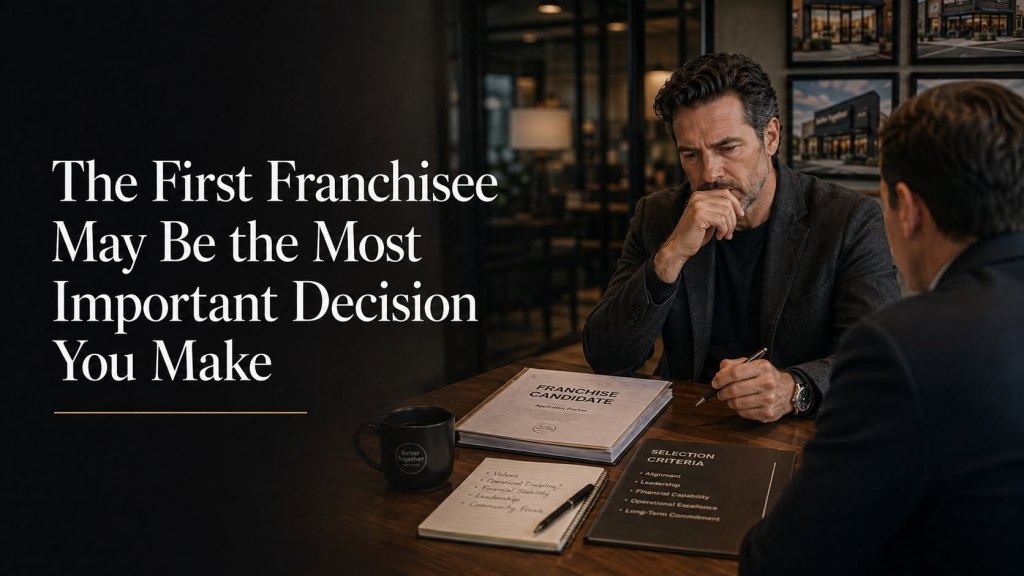
The first franchisee is more than your first sale. That person may help define your culture, shape future validation, influence system credibility, and establish the kind of franchise organization you ultimately become.

There is a peculiar kind of pressure that comes with becoming a franchisor, and it often arrives long before the first franchise location ever opens. The founder has already spent months, sometimes years, getting to this point. The business has been analyzed, documented, packaged, positioned, and presented as something that can be replicated. Attorneys have been paid. Manuals have been written. Financial models have been reviewed. Websites have been built. Development materials have been prepared. People around the founder have heard the vision repeatedly: this is no longer just one successful business; this can become a system. And then, finally, someone expresses serious interest. Not casual curiosity. Not a customer saying, “You should open one near me.” A real prospect. Someone willing to invest. Someone prepared to sign. Someone who may become the first franchisee. It is at precisely this moment that an emerging franchisor faces one of the most consequential tests of judgment in the entire franchise journey, because the temptation is to see that first franchisee as proof that the concept works. In reality, that person is not proof of anything yet. They are simply the first person willing to believe enough in your story to place money behind it. Whether that belief becomes validation or regret will depend in large part on whether you chose the right person in the first place.

That distinction matters because early-stage franchisors are especially vulnerable to confusing sales with progress. A signed franchise agreement feels like momentum. It is tangible. It can be announced. It can be celebrated internally. It can be shown to investors, employees, advisors, and future prospects. It says, at least superficially, that the market has responded. But one of the most dangerous habits a new franchisor can develop is using the number of franchise agreements signed as the primary measure of success. A franchise sale is not a successful franchise. It is merely the beginning of an obligation. The real test begins afterward, when the franchisee must find a site, secure financing, complete construction, attend training, hire employees, open the business, attract customers, manage costs, navigate setbacks, and operate within a system that the franchisor is still learning how to support. The first franchisee is not simply buying a territory. That person is stepping into an emerging organization that is still discovering what it means to be a franchisor. And that makes the selection of the first few franchisees fundamentally different from recruiting into a mature system with years of operating history, experienced field support, established franchisee councils, and dozens or hundreds of owners who already understand the culture.

The first franchisee is, in many ways, joining you while the cement is still wet. That person will experience the gaps in your training before you know they exist. They will encounter questions your operations manual did not anticipate. They will test whether the support model you designed actually works in the real world. They will show you whether the business can be taught to someone who did not grow up inside it. They will reveal whether your assumptions about startup costs, staffing, technology, marketing, vendor relationships, and day-to-day operations are truly transferable. They may identify things you missed entirely. That does not mean the system was poorly developed. It means no amount of planning can substitute for seeing another independent owner attempt to execute what you created. This is why the first franchisee cannot simply be someone with enough money and enough enthusiasm. The first franchisee needs a temperament that can withstand the inevitable imperfections of an emerging system without turning every issue into a crisis, and enough maturity to distinguish between a legitimate flaw in the franchise system and the normal difficulty of business ownership.

That is a very different standard from financial qualification.

And yet, because the franchise fee arrives up front and the consequences arrive later, emerging franchisors are often tempted to lower the standard just enough to get the first deal done. A candidate appears and there are concerns, but they seem manageable. Perhaps the person is undercapitalized, but financing may solve it. Perhaps the spouse is not fully supportive, but that feels like a private matter. Perhaps the candidate has never managed people, but they are energetic. Perhaps they are already asking for exceptions before the agreement is signed, but the market they want is attractive. Perhaps they appear to expect far more support than the system can reasonably provide, but everyone hopes expectations can be reset later. These rationalizations are understandable because the founder wants movement. The founder wants validation. The founder may also need revenue. But a red flag does not become less red because the franchise fee is needed.

In fact, the need for that fee may be the very reason to become more cautious.

The wrong first franchisee can be extraordinarily expensive. Not necessarily in one dramatic event, but through the accumulated cost of distraction, support, conflict, lost credibility, poor validation, legal fees, wasted management time, customer dissatisfaction, operational inconsistency, and reputational damage. A difficult franchise relationship consumes energy far beyond one unit. It distracts leadership from improving the system. It affects the corporate team. It influences other franchisees. It can slow franchise development because every new prospect eventually asks to speak with existing owners, and those conversations are often more influential than anything contained in a sales presentation. The franchisor may control the website, the marketing materials, and the discovery process. The franchisor does not control what an existing franchisee says when a prospect asks, “If you had to do it over again, would you still buy this franchise?”

That question may be one of the most important in franchising.

It is also why the first few franchisees carry disproportionate influence. In a system with one hundred franchisees, one operator’s experience is one voice among many. In a system with three franchisees, one person’s experience represents one-third of the franchisee community. If two are unhappy, you do not have a small validation problem. You have a systemic perception problem. Prospective franchisees are sophisticated enough to understand that business ownership is difficult and that not every operator succeeds equally, but they also look for patterns. If the earliest franchisees speak positively about communication, training, support, leadership, and the overall relationship, that creates confidence. If they consistently express frustration, uncertainty, or distrust, the franchisor will spend an enormous amount of time trying to explain why those experiences are exceptions. Sometimes they are. But in a young system, there may not be enough evidence to prove otherwise.

This is why I have always believed that early franchise development should look much more like selection than selling. The language matters because it shapes the behavior. When the objective is to sell a franchise, the conversation naturally focuses on moving the prospect forward. Objections must be overcome. Concerns must be answered. Momentum must be maintained. But when the objective is to select a franchisee, the questions change. Do we actually want this person in the system? Can this person lead people? Can they manage money? Can they tolerate uncertainty? Are they coachable? Do they accept personal accountability? Do they understand that a franchise provides structure, not guarantees? Do they possess enough capital to survive a slower-than-expected opening? Are their expectations realistic? Will they respect the system when they disagree with it? Can we have a difficult conversation with this person without the relationship immediately becoming adversarial? Would we want this person interacting with our next franchisee? Would we want them sitting on a franchise advisory council five years from now? Would we be comfortable with them representing the brand publicly in their community?

Those are not questions a salesperson asks at the end of a process. They are questions a franchisor should be asking throughout it.

The first franchisee also has an outsized role in shaping culture, and culture in a franchise system is created much earlier than many founders realize. It is not something developed later through conventions, advisory councils, awards, and brand values posted on a wall. Culture begins in the first few interactions between the founder and the earliest franchisees. It is created when the first problem occurs. It is created when a franchisee questions a decision. It is created when the franchisor must enforce a standard. It is created when something goes wrong with a vendor or technology platform. It is created when the franchisee needs support and the franchisor has to decide how responsive to be. Every early interaction becomes an informal precedent. If exceptions are granted too freely because the founder is afraid to upset the first franchisee, later franchisees may expect the same treatment. If standards are enforced selectively, people notice. If communication is open and direct, that becomes part of the culture. If difficult conversations are avoided, avoidance becomes part of the culture too.

In that sense, the first franchisee is not merely entering the culture. They are helping create it.

This is also why the first franchisee should not necessarily be the person who asks the fewest questions or seems the easiest to manage. In fact, a thoughtful, serious early franchisee may challenge assumptions and expose weaknesses that ultimately make the system better. Founders sometimes interpret questioning as resistance because they are accustomed to leading employees. But a franchisee who has invested significant capital should ask questions. They should want to understand the economics. They should want clarity around support. They should test whether the training makes sense. They should identify where processes are unclear. A franchisee who never questions anything may be agreeable, but agreement is not the same as understanding. An early franchisee who can challenge constructively, communicate honestly, follow the system, and accept accountability may be far more valuable than one who simply says yes to everything.

That person can become a partner in learning without becoming a partner in ownership.

There is an important distinction there. A franchisor should never confuse listening with surrendering control of the system. The founder remains responsible for protecting the brand, making systemwide decisions, and maintaining standards. But early franchisees provide a perspective the franchisor cannot manufacture internally. They are seeing the model from the outside for the first time. If they consistently misunderstand something, perhaps it is not because they are difficult. Perhaps the system is not clear enough. If training leaves them uncertain, perhaps the training needs improvement. If they encounter the same operational friction repeatedly, perhaps there is an issue worth examining. If the franchisor responds defensively to every piece of feedback, an enormous learning opportunity is lost.

The first few franchisees can become some of the most valuable sources of intelligence in the system precisely because they did not build the original business. They do not possess the founder’s assumptions. They cannot fill in the blanks from memory. They do not instinctively know what the founder knows. Their experience is therefore an early test of transferability. That makes them more than operators. They are evidence. They help answer whether the business has actually become a franchise system or whether the franchisor has simply documented the founder’s way of running the original business.

This is where patience becomes a strategic advantage.

Franchise culture frequently celebrates speed. Systems announce how many territories were awarded in the first quarter, how many agreements were signed before the first opening, how quickly the brand reached ten or twenty units. Those milestones can be meaningful, but they can also create a dangerous illusion. Selling franchises faster than the system can absorb them is not necessarily growth. It may simply be the accumulation of future obligations. Every signed agreement eventually requires real estate support, training, operational guidance, technology, communication, opening assistance, and ongoing leadership. If ten franchisees are sold before the franchisor has learned from the first one, the company may be multiplying assumptions before testing them.

There is nothing inherently impressive about awarding twenty territories if the first five operators struggle.

The more disciplined emerging franchisor may choose to grow more deliberately, not because the ambition is smaller but because the stakes are larger. Open the first location. Learn. Refine the training. Adjust support. Improve documentation. Understand what the franchisee actually needs. Open the next one. Compare. Learn again. This approach may not produce the most exciting early press release, but it may produce a much stronger franchise system three years later. The industry has no shortage of brands that sold rapidly and then spent years trying to repair the foundation beneath that growth. Expansion magnifies whatever already exists. If the system is strong, scale can be powerful. If the system is weak, scale simply distributes the weakness more widely.

This brings us back to the first franchisee and perhaps the most difficult question an emerging franchisor must answer: can you say no when you desperately want to say yes?

That is harder than it sounds. By the time the first serious candidate appears, the founder may have invested substantially in becoming a franchisor. Advisors may be asking about progress. Employees may be waiting for growth. Investors may expect development. The franchise sales team may be excited. The candidate is financially qualified. The territory is attractive. Everyone can see the announcement in their heads. There is enormous psychological pressure to move forward. Saying no can feel like failure.

Sometimes saying no is the first evidence that you are thinking like a franchisor.

Because the responsibility is no longer simply to generate a transaction. It is to protect the system you are trying to build. That may mean declining someone who has the money but lacks the temperament. It may mean walking away from someone whose expectations are impossible to meet. It may mean recognizing that a candidate who wants exception after exception before signing is showing you how they may behave afterward. It may mean acknowledging that someone technically qualifies financially but does not have enough cushion to absorb ordinary startup surprises. It may mean telling an enthusiastic candidate that the timing is not right.

The ability to reject money is one of the clearest tests of franchise discipline.

And it is particularly important early because the first franchisees eventually become the story the franchisor tells. They become the people future candidates call. They become the examples used to describe what success looks like. Their businesses become part of the early operating data. Their stories become part of brand credibility. If they grow into multi-unit owners, they may help define the system for years. If they become strong validators, development becomes easier. If they become dissatisfied, development becomes harder. If they contribute positively to the culture, future franchisees inherit that culture. If they normalize distrust, resistance, or constant exception-making, the system may spend years trying to reverse it.

That is why character matters just as much as operating ability.

The ideal early franchisee should not merely know how to run a business. They should be someone you want in the room when things are difficult. Someone who can disagree without becoming destructive. Someone who takes responsibility for their own decisions. Someone who can hear “no” without interpreting it as hostility. Someone who will follow a system while still contributing insight. Someone who respects other franchisees. Someone who understands that the relationship has obligations on both sides. Someone who does not expect the franchisor to guarantee success but does expect the franchisor to provide what was promised.

Those qualities are difficult to capture in a financial qualification form, but they may ultimately matter more than almost anything else.

There is another point emerging franchisors should think about carefully. The first franchisee is placing trust in you before the marketplace has fully validated your franchise system. Mature franchise brands have history. They have existing operators. They have data. They have a track record. The first franchisee does not have that luxury. They are relying more heavily on the founder’s credibility, the strength of the original business, the quality of the preparation, and their belief that the system will develop responsibly. In some ways, they are taking a greater leap of faith than franchisees who come later.

That deserves something from the franchisor in return.

Not special treatment in the sense of weakened standards or permanent exceptions. But seriousness. Transparency. Responsiveness. Respect. A recognition that this person is helping the system cross the line from theory to reality. The franchisor should want that first franchisee to succeed not because success makes the sales story easier, though it will, but because another entrepreneur has trusted the system enough to build a business within it.

The ethical weight of that decision should not disappear simply because there is a contract.

Someone has invested money.

Someone has taken risk.

Someone is building under your brand.

That should mean something.

It should also influence how the first franchisee is supported. Emerging franchisors sometimes become so focused on closing the next deal that the franchisee who already signed receives less attention than the prospect who has not. This is backwards. The first operating franchisees are the foundation of every future development effort. They are creating the evidence upon which future growth will rest. Their results, experiences, and opinions will matter more over time than any marketing copy the franchisor can create.

A franchisor that understands this will invest heavily in early franchisee success.

Not by running the franchisee’s business.

Not by shielding them from accountability.

But by ensuring that training is serious, support is available, communication is clear, expectations are realistic, and problems are addressed before they become permanent.

The strongest emerging systems understand that the first few franchisees are not simply revenue sources.

They are prototypes of the franchise relationship.

That relationship will eventually be repeated across the network.

If it is collaborative but accountable, that pattern can spread.

If it is distrustful, inconsistent, or overly dependent, that pattern can spread too.

This is why franchisee number one may influence franchisee number fifty in ways the founder cannot yet see.

People copy culture.

New franchisees watch existing ones.

They notice whether established owners participate in system initiatives or ignore them. They notice how openly franchisees communicate with the franchisor. They notice whether standards are taken seriously. They notice whether top performers are respected. They notice whether difficult franchisees appear to receive special treatment simply because they are loud. Over time, these observations become expectations.

That is how systems become what they are.

Not through mission statements.

Through repeated behavior.

The founder therefore has to think much further ahead than the first franchise fee. Imagine the system ten years from now. Perhaps there are one hundred locations. Perhaps several hundred. There is an annual meeting. Franchisees who joined years after the original concept was franchised are sitting in the room. There are sophisticated multi-unit owners. There are franchise advisory councils. There are high performers, emerging leaders, and new owners just beginning their journey.

And somewhere in that room is franchisee number one.

What do you want that relationship to look like?

Do you want that person to be able to say they were there at the beginning and helped build something meaningful? Do you want them to be someone newer franchisees seek out for advice? Do you want them to tell the story of how the franchisor listened, learned, improved, and kept its commitments? Do you want their success to become evidence that the original vision was real?

Or do you want to look across the room and remember that you saw the warning signs before the agreement was signed but needed the sale too badly to walk away?

No selection process can guarantee the first outcome or eliminate the second.

Business is too complicated for certainty.

People change.

Markets change.

Good franchisees can fail.

Good franchisors can make mistakes.

But uncertainty is not an excuse for carelessness. It is the reason diligence matters.

The first franchisee does not have to be perfect.

Neither do you.

What matters is whether the relationship begins with alignment, sufficient capital, realistic expectations, mutual respect, and a shared understanding of what both sides are responsible for delivering.

That is a much higher standard than “qualified buyer.”

It should be.

Because a franchise system is not built from agreements.

It is built from relationships between entrepreneurs.

The franchisor created the original business and now has to protect the system.

The franchisee chooses to invest in that system and has to execute within it.

Both sides are taking risk.

Both sides have responsibilities.

Both sides will make mistakes.

The quality of the relationship will often determine whether those mistakes become learning opportunities or lasting grievances.

And the first relationship may matter more than any of them because everything is still being established.

The culture.

The expectations.

The credibility.

The validation.

The story.

So when the first serious candidate finally appears, enjoy the moment. You should. It represents years of work and belief. There is something meaningful about another entrepreneur seeing enough potential in your business to consider investing their own future in it.

But do not let the excitement make the decision for you.

Look beyond the check.

Look beyond the territory.

Look beyond the announcement.

Think about who this person will be after the honeymoon period ends, after opening day, after the first difficult quarter, after the first disagreement, after the first systemwide change, after the first moment when the relationship is genuinely tested.

Then ask the question an emerging franchisor should be willing to ask every time:

Is this someone we want helping shape the future of the brand?

Because the first franchise fee may be deposited and spent quickly.

The first franchisee may influence the franchise system for years.

And sometimes the most consequential franchise sale you ever make is the one you have the judgment not to make.

From Boss to Franchisor

The leadership style that helped you build the original business may not be the leadership style that helps you build a franchise system. Franchisees are independent entrepreneurs, and leading them requires trust, transparency, communication, accountability, and respect.

If you are a founder preparing to become a franchisor, there is a leadership transition ahead of you that may ultimately prove more difficult than documenting your operations, building your training program, finalizing your franchise agreement, establishing territories, recruiting franchisees, or even adapting your business model for scale. It is the transition from leading employees to leading independent business owners. On the surface, that distinction sounds obvious. Of course franchisees are not employees. They own their businesses, invest their own capital, hire their own people, sign their own leases, manage their own financial obligations, and assume their own entrepreneurial risk. Yet understanding that intellectually is very different from living it every day as a franchisor. Many founders spend years building companies in which authority flows from them. They created the concept, developed the culture, established the standards, made the important decisions, hired the leadership team, and ultimately retained the ability to determine what happened next. Even when good founders encourage collaboration, listen carefully, and empower their people, the underlying organizational structure remains clear. Employees work within a business the founder owns. Managers report through a chain of command. Policies can be changed. Responsibilities can be reassigned. Performance can be evaluated. People who consistently refuse to follow direction can ultimately be replaced. That model of leadership becomes deeply familiar to a successful entrepreneur. Then franchising introduces an entirely different relationship, and founders who fail to recognize just how different it is can create tension before the franchise system has even had the opportunity to mature.

A franchisee enters your system as an owner, not as a subordinate. That distinction affects almost every conversation you will have with them. Yes, the franchise agreement establishes obligations. Yes, brand standards must be protected. Yes, franchisees agree to follow systems and procedures. Yes, franchisors need authority to maintain consistency across the network. None of that changes. What changes is the context within which those standards are being implemented. A franchisee is looking at your decisions through the lens of their own investment. When you change a technology platform, they may see a new expense. When you add operating requirements, they may see additional labor. When you introduce a supplier, they may examine the impact on their margins. When you adjust marketing strategy, they may wonder how it will affect their local customers. When you require remodeling, new equipment, or operational changes, they may be calculating what those decisions mean to their cash flow, debt obligations, and return on investment. Employees may evaluate a decision based on how it affects their job. Franchisees evaluate decisions based on how those decisions affect a business they own. That is not resistance. It is ownership.

And ownership changes the conversation.

This is where the founder must begin separating authority from leadership. Franchisors absolutely need authority. A franchise system without standards is not much of a system at all. The brand has to mean something. Customers should have reasonable expectations about what they will experience from location to location. Quality standards, operating procedures, trademarks, technology, products, services, and countless other components need consistency. There will be moments when the franchisor must make a decision that is unpopular with some franchisees because protecting the system requires it. Leadership does not mean putting everything to a vote. Franchising is not a democracy, nor should it be. But authority can compel only so much. A franchise agreement may force compliance with a standard; it cannot create trust. It can establish obligations; it cannot create engagement. It can provide remedies when someone fails to perform; it cannot create enthusiasm for where the brand is going. Those things come from leadership, and successful franchisors eventually discover that leadership among independent business owners requires far more communication, transparency, credibility, listening, patience, and persuasion than many founders initially expect.

That can be uncomfortable for entrepreneurs who built their original businesses by moving quickly. Founders often succeed because they are decisive. They recognize an opportunity and act. They see a problem and solve it. They do not always need committees, reports, or lengthy debate. In a young company, that speed can be an extraordinary advantage. The founder decides to change the menu, adjust pricing, revise the service model, adopt new technology, replace a vendor, move marketing dollars, or change operating hours, and the organization responds. There may be discussion, but ultimately everyone understands who owns the decision. As the same founder becomes a franchisor, the instinct to move quickly remains, but the environment around the decision has changed. A change that once affected one company-owned operation may now affect ten, fifty, or two hundred independently owned businesses. Each franchisee may have employees to retrain, inventory to replace, expenses to absorb, customers to communicate with, or financing considerations to address. Decisions still have to be made, sometimes quickly, but the process surrounding those decisions becomes more important. Franchisees will want to know what is changing, why it is changing, what information led to the decision, how implementation will work, what the costs may be, what support will be available, and what success is expected to look like. The founder who views those questions as insubordination will have a difficult time becoming an effective franchisor. The franchisor who sees those questions as part of responsible ownership will lead differently.

That difference matters because franchise systems are built on trust long before they are built on scale. Trust is an interesting business asset because it rarely appears on a balance sheet, yet it influences almost everything that happens in a franchise organization. When franchisees trust leadership, they tend to give the franchisor the benefit of the doubt when something does not go perfectly. They are more likely to bring problems forward before those problems become crises. They are more likely to accept difficult changes when they believe those changes were considered thoughtfully. They are more willing to share data, ideas, concerns, and lessons from their markets. They become stronger validators for prospective franchisees. They participate in system initiatives. They invest in additional locations. They help one another. They defend the brand because they feel connected to it. When trust is weak, the opposite happens. Every new program is viewed suspiciously. Every cost becomes evidence of motive. Every communication is examined for what is not being said. Franchisees begin relying on one another for information because they no longer trust what they hear from the franchisor. Rumors travel faster than facts. Small issues become symbolic of larger frustrations. Eventually, a franchise system can become divided into two worlds: the corporate office and the franchisees. Once that happens, even sound decisions become harder to implement because the relationship itself has become the issue.

Trust cannot be manufactured during a crisis. It has to be accumulated over time through hundreds of smaller moments. Did the franchisor return the call? Did someone follow up after promising to do so? Was the explanation honest? Was a mistake acknowledged? Were franchisees told the truth when the news was uncomfortable? Were commitments kept? Was the same standard applied consistently? Did leadership listen before responding? Did the franchisor appear genuinely interested in franchisee economics, or only in royalty collections and new franchise sales? Franchisees notice these things. They may not comment on each individual interaction, but collectively those experiences form their perception of leadership. And once that perception hardens, changing it can be extremely difficult.

This is why communication must be treated as infrastructure rather than public relations. Emerging franchisors often devote enormous attention to external communication because they are focused on growth. Websites are polished. Franchise recruitment materials are refined. Discovery Day presentations are rehearsed. Social media tells the story of the brand. Prospective franchisees hear about the vision, opportunity, support, culture, and future. That communication matters, but internal communication becomes even more important once someone has signed the agreement and invested their money. The franchisee who has already bought into the system deserves at least as much communication as the prospect being recruited into it. Yet some franchisors make the mistake of becoming less communicative after the sale. The courtship ends. The franchisee moves from prospect to operator, and suddenly much of the attention shifts toward recruiting the next franchisee. That is shortsighted. The people already in the system will ultimately determine whether the growth story is believable. Their experience will become the strongest evidence of what the franchise system actually is.

A founder becoming a franchisor should therefore think carefully about how information moves through the organization. How often will franchisees hear from leadership? How will major decisions be explained? How will operational updates be communicated? How will franchisees ask questions? How will difficult issues be addressed? How will rumors be corrected? How will franchisee accomplishments be recognized? How will problems affecting multiple locations be discussed? How will communication evolve as the system grows from five franchisees to fifty or five hundred? These are not administrative questions. They are cultural questions. Communication tells franchisees whether they are being treated as stakeholders in the success of the system or merely as recipients of instructions.

Transparency is closely connected to communication, but the two are not exactly the same. Transparency does not mean opening every corporate file or involving franchisees in every executive decision. There are legitimate reasons why certain information must remain confidential. There will be negotiations, personnel matters, legal issues, strategic plans, and competitive considerations that cannot be discussed freely. But transparency does mean being willing to explain the reasoning behind decisions that meaningfully affect franchisees. If a supplier is changed, why? If technology is being replaced, what problem is being solved? If prices are being adjusted, what data supports the change? If the system is facing a challenge, what is being done about it? Franchisees do not need every detail to appreciate candor. They need to believe they are being treated like serious business owners.

Credibility grows from that kind of transparency. It also grows from consistency between words and actions. A franchisor can say repeatedly that franchisee profitability matters, but if every new initiative appears designed primarily to generate additional franchisor revenue, franchisees will eventually notice the contradiction. Leadership can talk about partnership, but if decisions are consistently made without explanation or consideration of unit economics, the word partnership will become meaningless. A franchisor can claim that feedback is welcomed, but if criticism is punished, ignored, or dismissed, franchisees will learn very quickly what is actually expected. In franchise systems, credibility is not created through slogans. It is created through patterns.

The same is true of respect. Founders should never lose sight of what a franchisee has done by joining the system. That person has chosen to invest in something the founder created. They have accepted risk based on their belief in the business model, leadership, brand, and future of the organization. Some franchisees may have invested hundreds of thousands of dollars. Some may have signed personal guarantees. Some may have left stable careers. Some may have moved their families. Some may have put a large portion of their financial lives into the opportunity. None of that means the franchisor should excuse poor performance, overlook noncompliance, or surrender necessary authority. It does mean the relationship deserves respect. Franchisees should never be treated as though they should simply be grateful that they were allowed to buy into the system. The franchisor brings value. The franchisee brings value too. The franchisor provides the brand, systems, support, experience, and infrastructure. The franchisee contributes capital, local leadership, community presence, employees, customer relationships, and the daily execution that ultimately gives the brand meaning in the marketplace. Franchising works because both sides contribute.

This mutual dependence is one of the most fascinating aspects of the model. The franchisor cannot build the network envisioned without franchisees. Franchisees cannot access the benefits of the system without the franchisor. Yet because the franchisor owns the intellectual property and defines the system, founders can sometimes begin believing the relationship is inherently one-directional. That mentality may be reinforced when the brand is young and franchisees are especially excited to be part of something new. The founder may receive admiration. Franchisees may frequently seek advice. The entrepreneur who built the original concept becomes the person everyone looks toward for direction. That can feel natural, even deserved. But as the system matures, respect has to become reciprocal. Franchisees gain operating experience. Some become sophisticated multi-unit owners. Some will understand local markets better than the corporate team ever could. Some will develop expertise in areas where the founder is weaker. Some may eventually operate larger organizations than the founder operated before franchising. A mature franchisor learns to value that knowledge rather than feel threatened by it.

This is where the concept of franchisee voice becomes important. Giving franchisees a voice does not mean surrendering control of the brand. It means creating structured ways for the people operating the model every day to contribute information back into the system. Franchise advisory councils, regular operator meetings, surveys, field visits, peer groups, committees, conferences, direct access to leadership, and other mechanisms can all provide useful channels. The specific structure will vary by brand and size, but the principle remains the same: information should not flow only from the franchisor downward. It should also flow from franchisees upward and across the system.

Franchisees frequently see problems before the franchisor does because they are standing closest to the customer. They know when a product is not resonating. They know when a promotional program is creating confusion. They know when technology is slowing operations. They know when staffing requirements are unrealistic. They know when a vendor is failing. They know what customers are asking for. A founder who dismisses that feedback because “we know the system” is wasting one of franchising’s greatest strategic advantages: distributed entrepreneurial intelligence.

That does not mean franchisees are always right. They are not. A franchisee may advocate for something that makes sense within their own store but could damage the brand systemwide. A local operator may want to lower a standard, change pricing, eliminate an expense, alter a product, or avoid an investment because doing so solves an immediate problem. The franchisor has to consider the entire network, long-term positioning, customer expectations, and brand equity. This is where leadership becomes especially nuanced. Listening does not require agreement. Respecting someone’s perspective does not require adopting it. The franchisor must be able to say no while still demonstrating that the concern was heard and considered. That is very different from dismissing the franchisee simply because corporate has final authority.

In fact, healthy disagreement should not frighten a franchisor. A system where nobody ever disagrees with leadership is not necessarily healthy; it may simply be quiet. Franchisees who have invested substantial capital should care enough about their businesses to ask hard questions. They should question assumptions. They should challenge programs that are not working. They should push the franchisor to improve. The danger comes when disagreement becomes personal or adversarial, and that often happens because either side confuses questioning with disloyalty. Strong franchise cultures leave room for respectful dissent. They can debate vigorously and still remain aligned around the larger purpose of strengthening the brand and improving franchisee performance.

How a franchisor responds to criticism may ultimately become one of the clearest tests of leadership. It is easy to listen when franchisees are praising the company. It is easy to invite feedback when the feedback is positive. It is much harder when an operator says the support system is inadequate, a technology investment was poorly executed, a marketing program failed, or leadership made a mistake. The founder’s instinct may be to defend the organization. After all, criticism of the system can feel like criticism of something deeply personal. Founders often identify strongly with the businesses they created. But a franchisor has to develop enough emotional distance to separate critique from attack. Sometimes the franchisee is wrong. Sometimes the franchisor is wrong. Sometimes both sides have part of the truth. The objective should not be winning the argument. It should be understanding the problem well enough to improve the system.

That same mindset should shape franchise support. Supporting franchisees is often described as a collection of services: training, field visits, marketing assistance, technology, operational guidance, site selection, purchasing, and so forth. All of those matter, but support is ultimately a leadership function. The objective should not be to run the franchisee’s business for them. They are business owners and need to remain accountable for their own execution. Nor should support be reduced to a help desk where franchisees call only when something breaks. The strongest support systems help owners become better operators. They give franchisees information, tools, benchmarks, coaching, and context that improve judgment.

Imagine two franchisees who are each experiencing declining margins. A weak support system may simply tell them to cut labor or raise prices. A stronger system begins by understanding why the margins are declining. Is labor scheduling the problem? Has product cost increased? Is discounting excessive? Is average ticket falling? Is local marketing failing to generate sufficient traffic? Is management turnover affecting productivity? Is there a market-specific issue? Is the location performing differently from comparable units? Meaningful support turns information into insight. It helps the franchisee understand what is happening and what actions are likely to matter. That is not management by the franchisor. It is leadership through capability building.

As a franchise network grows, data can become one of the most powerful tools in that relationship. A franchisor with access to systemwide performance information can help operators understand their businesses in ways that would be difficult for independent owners operating alone. Benchmarks can identify strengths and weaknesses. Peer comparisons can reveal opportunities. Trends can show problems before they become obvious. But data has to be used carefully. If franchisees believe information is collected only to police them, they may become defensive. If they see it being used to improve performance and share best practices, the same data becomes valuable. Again, the difference is trust.

There is a deeply human dimension to this that numbers alone will never capture. Behind every franchise unit is a person. That may sound simplistic, but as systems grow, it becomes surprisingly easy to forget. Corporate conversations begin referring to unit numbers, territories, AUVs, compliance scores, and performance categories. Those measurements are necessary, yet they can unintentionally obscure the reality that every location represents someone’s business. An underperforming unit may represent a family worried about cash flow. A franchisee who seems frustrated may be dealing with employee turnover, debt, personal pressure, or fear that the business is not developing as expected. An owner who has stopped communicating may be embarrassed to admit things are going poorly. None of this eliminates accountability, but it does argue for empathy.

Empathy in franchising should not be confused with weakness. You can empathize with a struggling franchisee while still expecting standards to be met. You can understand financial pressure while still enforcing obligations. You can acknowledge frustration without agreeing with every complaint. In fact, empathy often makes difficult conversations more effective because people are more willing to hear uncomfortable truths when they believe the person delivering them actually understands the situation.

This becomes particularly important when dealing with underperformance. Founders transitioning into franchising sometimes fall into one of two extremes. They either become overly controlling, attempting to tell the franchisee exactly how to run every aspect of the business, or they withdraw too far, reminding the franchisee that they are an independent owner and therefore responsible for solving their own problems. Neither approach is especially helpful. The franchisor should create clear expectations, identify deviations from the system, provide relevant support, and hold the franchisee accountable for execution. The franchisee has to own the result, but they should not feel abandoned by the system they invested in.

Conflict will inevitably test this philosophy. Every franchise system will experience disagreement. A franchisee will object to a decision. The franchisor will believe an operator is not following standards. A supplier issue will create frustration. A new technology rollout will disappoint people. Marketing results will vary. Territories will become a source of concern. Communication will fail. Expectations will be misunderstood. The presence of conflict does not necessarily indicate a bad franchise system. It indicates that independent owners and a franchisor are navigating a complex commercial relationship. What matters far more is how those conflicts are handled.

Do you listen before you defend? Do you investigate the facts? Do you communicate directly? Do you apply standards consistently? Do you distinguish between a difficult personality and a legitimate issue? Are you willing to acknowledge when the franchisor contributed to the problem? Can you resolve disagreement without humiliating someone? Can you enforce the franchise agreement without turning every disagreement into a legal confrontation? Can you preserve the relationship while protecting the system? The answers to those questions will become part of your culture whether you intend them to or not.

Franchisees talk to one another.

That is another reality emerging franchisors should embrace rather than fear. Operators compare experiences. They discuss performance. They talk about corporate decisions. They share frustrations and successes. If the franchisor communicates poorly, informal franchisee communication will fill the gap. Trying to control those conversations rarely works. Building a culture where franchisees have accurate information and confidence in leadership works much better. The goal should not be to prevent franchisees from talking. The goal should be to create an environment where the truth travels faster than speculation.

As systems mature, peer relationships can become one of the strongest forms of support. Experienced franchisees can mentor newer owners. High performers can share practices. Operators can help one another solve problems. Multi-unit franchisees can contribute sophisticated insights. The franchisor should encourage that ecosystem while remaining aware that strong franchisee networks will also create collective expectations. That is not something to fear if the relationship has been built responsibly. A network of engaged franchisees can strengthen the system immensely.

All of this forces the founder to confront an important question about identity. For years, you may have been the center of the original company. The brand may be associated personally with you. Employees may look to you for answers. Customers may know your story. Advisors may defer to your experience. That role can become part of how you see yourself. Franchising challenges that identity because scale ultimately requires the organization to become less dependent on you personally.

That is not only an operational issue. It is a leadership issue.

If every franchisee needs direct access to you, you will eventually become a bottleneck. If every dispute requires your involvement, the system cannot scale. If nobody else can explain the culture, make decisions, coach franchisees, or represent leadership credibly, you have not built a franchise organization. You have simply extended the founder’s reach.

A scalable franchise organization needs leadership depth. It needs people capable of supporting franchisees without always escalating everything to the founder. It needs clear communication processes. It needs training for the franchisor’s own team. It needs people who understand that franchisees are customers, partners in brand execution, independent owners, and contractual participants all at once. That is a complex relationship, and the corporate team has to be trained to manage it.

The founder must therefore learn to let other leaders lead.

That can be difficult.

Entrepreneurs often derive satisfaction from being needed. They built the original company by solving problems other people could not solve. They may have become the person employees call when something goes wrong. Their instinct is to jump in, fix it, and move on. Franchising eventually requires a different instinct: build the structure so that the organization can solve problems without you.

That may feel like giving up control.

It is actually how scale begins.

Control and leadership are not the same thing. Control attempts to ensure that nothing happens without your involvement. Leadership creates clarity about what should happen even when you are not there. Control centralizes knowledge. Leadership distributes capability. Control can produce compliance. Leadership can create ownership.

That distinction becomes especially important as franchisees themselves grow. A franchisee who begins with one location may eventually own five, ten, or twenty. Their organization becomes more sophisticated. They may hire executives. They may understand certain aspects of operations better than people at the franchisor level. They may have substantial capital invested in the brand. The franchisor who still treats that person like an employee receiving instructions will eventually encounter friction. The relationship needs to mature as the franchisee matures.

This is one reason emerging franchisors should think about culture long before they think they are large enough to need one. Culture is not something you add when you reach fifty locations. It is being created when franchisee number one interacts with the founder. It develops through the first difficult conversation, the first policy change, the first disagreement, the first failed initiative, the first financial challenge, and the first time the franchisor has to choose between what is convenient and what is right for the system.

Those early decisions become precedent.

If early franchisees learn that leadership listens, later franchisees enter a system where listening is expected. If early franchisees learn that information is withheld, secrecy becomes normalized. If standards are enforced selectively, future operators will remember. If certain franchisees receive preferential treatment, others will notice. If leadership responds defensively to criticism, people will become cautious about speaking honestly.

Culture forms whether you design it or not.

The question is whether you will design it intentionally.

That means deciding what kind of relationship you want to have with franchisees before circumstances decide it for you. Do you want operators to feel comfortable challenging ideas respectfully? Do you want them to share financial data openly? Do you want multi-unit growth to be encouraged? Do you want franchisees mentoring one another? Do you want leadership to be accessible? Do you want transparency to be a defining characteristic? Do you want mistakes acknowledged openly? Do you want accountability to be firm but fair?

Those answers should influence the systems you build.

They should also influence who you select as franchisees.

Franchise recruitment is not simply about financial qualification and market availability. You are selecting entrepreneurs who will become part of this leadership environment. Some candidates want complete independence and will resent meaningful system standards. Others want so much support that they may struggle to accept responsibility for their own businesses. Some are excellent operators but poor collaborators. Some may be financially qualified but culturally misaligned. The emerging franchisor must think beyond whether someone can afford the investment. Can you lead this person? Can this person operate effectively within the system? Can you have difficult conversations with them? Will they contribute positively to the network? Will they accept accountability? Will they respect other franchisees?

The wrong franchisee can consume disproportionate leadership attention for years.

The right one can help build the culture.

That is another reason the first several franchisees matter so much. They are not merely early customers of the franchise opportunity. They become the initial community around the brand. They shape how future franchisees perceive the system. They establish informal norms. They become validators. They can strengthen or weaken leadership credibility. Emerging franchisors should therefore approach early franchisee selection with enormous care.

And once those people join the system, remember what they are.

They are not employees.

That phrase should become more than a legal distinction. It should become a leadership principle.

It should remind you to explain rather than merely instruct.

It should remind you to listen before assuming resistance.

It should remind you that capital has been invested on both sides.

It should remind you that your decision may affect someone’s business differently than it affects your corporate office.

It should remind you that respect strengthens accountability rather than weakening it.

It should remind you that franchisees need a voice even when they do not have a vote.

It should remind you that the people operating your brand are entrepreneurs too.

Perhaps that is the greatest shift of all.

You began this journey as the entrepreneur.

You created something where nothing existed.

You took the original risk.

You built the model.

Then franchising changes the equation because you begin inviting other entrepreneurs into that story. They did not create the concept, but they are creating businesses within it. They are putting their own capital, energy, reputation, and future behind the opportunity. They are building local organizations, hiring people, serving customers, and extending the reach of what you started.

The franchisor’s responsibility is therefore not to turn those entrepreneurs into employees.

It is to give them a system worthy of ownership and leadership worthy of their trust.

That may require you to communicate more than you ever had to communicate before.

It may require you to slow down occasionally when every entrepreneurial instinct tells you to move faster.

It may require you to explain decisions you once would have simply made.

It may require you to hear criticism you do not enjoy hearing.

It may require you to admit mistakes publicly.

It may require you to distinguish between protecting your ego and protecting your brand.

It may require you to build leadership capacity far beyond yourself.

It may require you to recognize that the strongest franchisee in the room may occasionally know something you do not.

None of those things weaken the founder.

They transform the founder into a franchisor.

And that is ultimately what this part of the journey demands.

A successful franchise system is not simply a collection of locations operating under the same name. It is a network of independent business owners aligned around a common brand, common standards, common systems, and a shared belief that the relationship creates greater opportunity than any of them could create alone.

That relationship will never thrive on authority alone.

It requires trust.

It requires transparency.

It requires communication.

It requires accountability.

It requires listening.

It requires support.

It requires respect.

And it requires a founder willing to make perhaps the most important leadership shift of the entire franchise journey: understanding that the people building businesses under your brand do not work for you.

They work for themselves.

Your job is to lead them anyway.

Rethinking Where Restaurant Franchises Grow Next

The future of restaurant franchising may depend less on abandoning America’s major cities, or betting on their comeback, and more on fundamentally rethinking where, how, and why brands grow.

For decades, expansion into America’s largest metropolitan markets carried an almost automatic assumption of success. New York. Chicago. Los Angeles. Seattle. San Francisco. Boston. Washington, D.C. These were markets brands wanted on their development maps, investors wanted in their portfolios, and emerging concepts often viewed as validation that they had arrived.

Population density was attractive. Tourism was attractive. Employment centers generated enormous daytime populations. Affluent neighborhoods offered strong consumer spending. Major universities, hospitals, airports, entertainment districts and convention centers created seemingly endless demand generators. And perhaps most importantly, visibility in a major American city carried prestige.

For franchisors, opening in Manhattan, downtown Chicago or Los Angeles could mean something beyond the economics of the individual restaurant. It could elevate the brand.

But prestige does not pay the rent.

And increasingly, the economics of operating restaurants in some of America’s largest cities are forcing franchisors, franchisees, investors and restaurant executives to ask a question that would have sounded almost heretical not long ago:

Do we still need to be there?

Perhaps an even more important question is this:

If we do need to be there, does the restaurant we put there need to look anything like the restaurant we have traditionally built?

Those are two very different questions, and the distinction between them may help determine where the next decade of franchise growth occurs.

The Restaurant Industry Is Growing. That Doesn’t Mean Every Market Works.

There is an important contradiction developing within the restaurant business.

On the national level, the industry remains enormous and remarkably resilient. The National Restaurant Association projects restaurant and foodservice sales of approximately $1.55 trillion in 2026. Consumers still want restaurants in their lives, and the Association continues to report strong underlying demand for dining out, takeout and delivery.

Yet underneath those impressive numbers is a much more difficult operating environment.

The National Restaurant Association estimates that total expenses for an average restaurant increased approximately 36% between 2019 and 2026. Food and labor alone each account for roughly one-third of restaurant sales, while occupancy, utilities, supplies, insurance, credit-card fees and other expenses have also risen substantially.

At the same time, traffic remains uneven. Consumers continue to eat out, but many are becoming more selective about where, when and how often they spend their restaurant dollars. Some nominal sales growth is being generated by higher prices rather than significantly more customers walking through restaurant doors.

That distinction matters enormously.

A restaurant can generate record sales and still produce disappointing returns.

A franchise system can report systemwide sales growth while individual franchisees experience deteriorating margins.

And a market can possess millions of consumers while becoming increasingly difficult to operate profitably.

That is where the discussion about America’s major cities must begin.

The Big-City Restaurant Equation Has Changed

Consider Seattle.

The city’s minimum wage is $21.30 per hour in 2026. That number alone doesn’t determine whether a restaurant succeeds or fails, nor should minimum wage policy become a convenient explanation for every struggling restaurant. Successful operators adapt, and wages are only one component of the restaurant P&L.

But labor costs do not exist in isolation.

Combine higher wages with elevated food costs, occupancy costs, insurance, utilities, delivery commissions, credit-card processing fees, permitting requirements and consumers who are themselves feeling squeezed, and the restaurant’s margin for error becomes extraordinarily thin.

Similar combinations of pressures are being felt differently across New York, Chicago, Los Angeles and other large metropolitan markets. Recent restaurant and longtime-business closures in Chicago provide another reminder that even established operators are not immune to changing economics.

Yet we should be careful about declaring America’s major cities dead.

They aren’t.

Los Angeles continues to produce new restaurant openings despite the extraordinary challenges operators there have confronted. New York remains one of the world’s great restaurant markets. Chicago remains a global food city. Seattle remains affluent, educated and economically important.

The opportunity has not disappeared.

The economics surrounding the opportunity have changed.

That should lead franchisors toward a more sophisticated conclusion than simply “cities are bad” or “cities will come back.”

The real issue is whether yesterday’s franchise development model still fits today’s urban economics.

In many cases, it does not.

Franchisors Must Stop Confusing Population With Opportunity

Franchise development has traditionally relied heavily upon familiar demographic measurements: population, household income, daytime population, traffic counts, competitive presence and trade-area characteristics.

Those metrics remain important.

But they are no longer sufficient.

A market containing 500,000 attractive consumers isn’t necessarily superior to one containing 100,000 if reaching those 500,000 requires dramatically higher occupancy costs, wages, taxes, insurance, buildout costs and regulatory complexity.

Franchisors should increasingly evaluate what I would describe as market friction.

How difficult is it to convert consumer demand into franchisee-level profitability?

That question changes site selection.

Instead of asking only how much revenue a restaurant might generate, development teams need to ask how much revenue remains after the cost of operating in that particular market.

Consider two hypothetical restaurants.

One generates $2 million in annual sales in a prestigious urban location.

Another generates $1.5 million in a secondary or tertiary market.

Historically, development teams might instinctively prefer the $2 million location.

But what if the first restaurant requires $300,000 more in annual occupancy and labor costs, substantially more initial capital, higher insurance expenses, greater management complexity and a longer permitting and construction period?

Suddenly, the $1.5 million restaurant may be the far superior investment.

The question isn’t simply Where can we generate the highest AUV?

It is increasingly:

Where can our franchisees generate the best return on invested capital with an acceptable level of operating risk?

That is a very different development philosophy.

Perhaps the Next Great Franchise Markets Are Places We Have Been Flying Over

For years, franchise expansion strategies have frequently followed predictable maps.

Major metropolitan areas first. Suburbs next. Secondary markets afterward. Smaller communities eventually—if ever.

That hierarchy deserves reconsideration.

Population and economic activity have been shifting across the United States for years. New employment centers are emerging. Manufacturing investment is creating new economic corridors. Logistics facilities, technology operations, healthcare systems and distribution centers are generating significant employment outside traditional downtown business districts.

Meanwhile, many smaller cities and suburban communities offer something franchise operators desperately need:

More manageable economics.

Lower occupancy costs can allow restaurants to operate with lower break-even points. More affordable real estate can support drive-thrus and parking. Development approvals may be easier. Employee commutes may be shorter. Franchise territories can be larger. Competition for prime sites may be less intense.

Most importantly, the franchisee’s investment may go considerably further.

This doesn’t mean franchisors should blindly abandon major markets for small-town America.

It means the old definition of a “secondary market” may itself be obsolete.

Some of tomorrow’s best franchise markets may be communities that development departments historically dismissed because they didn’t satisfy traditional population thresholds.

A 70,000-person community surrounded by growing suburbs, a regional hospital, a college campus, manufacturing facilities and highway traffic may offer a better restaurant opportunity than a dense urban neighborhood containing several times the population.

Franchisors need to start looking beyond dots on population maps and toward economic ecosystems.

Where are people working?

Where are families moving?

Where are houses being built?

Where are hospitals expanding?

Where are warehouses being constructed?

Where are universities growing?

Where are highways converging?

Where are new manufacturing facilities opening?

Where are consumers underserved?

Follow economic activity, not simply population.

The Opportunity Outside the Traditional Restaurant Box

There is another dimension to this conversation that may ultimately become even more important.

Perhaps franchisors shouldn’t only rethink which markets they enter.

Perhaps they should rethink what constitutes a location.

For decades, restaurant franchising has largely revolved around boxes: inline retail, endcaps, freestanding buildings and drive-thrus.

Those formats aren’t disappearing.

But restaurants increasingly have opportunities to operate where consumers already are rather than spending enormous amounts of money trying to attract consumers to where restaurants happen to be.

Airports.

Hospitals.

Universities.

Corporate campuses.

Travel centers.

Highway plazas.

Casinos.

Sports facilities.

Entertainment venues.

Military installations.

Convention centers.

Hotels.

Grocery stores.

Food halls.

Mixed-use developments.

Industrial and logistics campuses.

Ghost and shared kitchens where appropriate.

Smaller pickup-focused units.

Mobile formats.

These should no longer automatically be considered secondary extensions of the “real” franchise model.

For some brands, they could become an important component of the franchise model itself.

Imagine a franchise system whose traditional restaurant requires a $1.2 million investment and 2,500 square feet.

What happens if that franchisor develops a 900-square-foot version requiring substantially less capital?

Or a hospital format?

A university format?

A travel-center format?

A food-hall format?

A delivery-and-pickup-oriented format?

Suddenly, the addressable development universe changes dramatically.

More importantly, so does the potential franchisee universe.

Smaller Footprints May Become One of Franchising’s Greatest Competitive Advantages

For years, restaurant brands often grew their prototypes along with their ambitions.

Larger dining rooms. Bigger kitchens. More elaborate architecture. Expensive finishes. Large footprints designed to showcase the brand.

That approach made sense when construction, financing, labor and occupancy economics supported it.

Today, every square foot needs to justify itself.

A 3,000-square-foot restaurant isn’t necessarily more valuable than a 1,600-square-foot restaurant simply because it can accommodate more guests.

What percentage of those seats are occupied on Tuesday at 3:00 p.m.?

How much of the kitchen is actually required?

How much storage is necessary if supply-chain practices change?

Can technology reduce counter space?

Can ordering move partially or substantially digital?

Can a smaller menu increase throughput and reduce labor requirements?

Can a drive-thru, pickup window or dedicated digital-order area produce more revenue per square foot than additional dining-room seating?

These are no longer merely operations questions.

They are franchise development questions.

Every reduction in development cost potentially lowers the barrier to franchise ownership. Every improvement in unit economics potentially improves franchisee returns. Every reduction in required square footage potentially increases the number of viable sites.

Franchisors should be engineering prototypes around return on investment, not architectural tradition.

But Should Franchisors Give Up on America’s Great Cities?

Absolutely not.

That would be an equally dangerous overreaction.

Major cities have gone through economic cycles before. Neighborhoods decline and regenerate. Commercial rents rise and eventually reset. Consumer behavior changes. Political leadership changes. Businesses adapt. New generations rediscover neighborhoods previous generations abandoned.

Urban America has repeatedly reinvented itself.

And therein lies the opportunity.

When everyone wants into a market, landlords have leverage.

When everyone wants out, opportunity begins to shift toward tenants and buyers willing to look beyond today’s conditions.

That creates a fascinating strategic question for franchisors.

Could the current challenges eventually create one of the greatest urban restaurant acquisition opportunities in years?

Possibly.

But timing matters.

Franchisors should be studying distressed urban markets now—not necessarily because they should immediately begin opening dozens of restaurants, but because they should understand where conditions may eventually create opportunity.

Vacant restaurant spaces.

Second-generation kitchens.

Former franchise locations.

Reduced key money.

Landlords willing to provide tenant-improvement allowances.

Developers willing to renegotiate economics.

Existing operators looking to sell.

Independent restaurants whose owners want an exit.

Commercial districts preparing redevelopment initiatives.

Those conditions can change the economics dramatically.

A restaurant site that makes no sense at today’s rent may become very attractive after twelve months of vacancy and a landlord willing to negotiate.

A $1 million buildout becomes a different proposition when much of the restaurant infrastructure already exists.

Franchisors should therefore resist two extremes.

Don’t expand into difficult cities simply because “we need to be there.”

But don’t erase those cities from the development map either.

Prepare to reenter when the economics—not the prestige—justify the investment.

The Renaissance Strategy

If major cities experience a meaningful restaurant renaissance, franchise brands could actually possess advantages that many independent operators do not.

They have purchasing power.

Established supply chains.

Recognizable brands.

Training systems.

Technology platforms.

Marketing resources.

Operational standards.

Access to experienced franchise operators.

And potentially greater negotiating leverage with landlords and developers.

But franchisors interested in participating in an urban resurgence should begin preparing before the resurgence becomes obvious.

That means identifying neighborhoods worth watching.

Building relationships with landlords and developers.

Monitoring restaurant vacancies.

Studying consumer migration within cities.

Identifying franchisees capable of operating complex urban restaurants.

Developing smaller prototypes.

Creating urban-specific menus and labor models.

Exploring conversions of existing restaurant spaces.

And perhaps most importantly, determining exactly what economic conditions would trigger renewed development.

Strategy shouldn’t be, “We’ll go back when things improve.”

It should be, “Here are the five conditions that must exist before we deploy capital.”

That turns hope into strategy.

Franchise Development Must Become Portfolio Management

Perhaps the biggest shift franchisors need to make is psychological.

Development should no longer be viewed simply as selling territories and opening units.

It should increasingly resemble portfolio management.

A strong franchise system may need exposure to several different types of markets simultaneously.

Large metropolitan markets provide visibility, density and potentially enormous sales volumes.

Growth markets provide population and employment momentum.

Suburban markets provide households, accessibility and often stronger unit economics.

Secondary and tertiary markets may provide lower costs and less competition.

Nontraditional locations provide captive or semi-captive demand.

Travel corridors provide transient customers.

College towns provide concentrated populations.

Healthcare markets provide extraordinary daily populations.

The strongest franchise systems of the next decade may not choose one of these.

They may intentionally build across all of them.

Diversification isn’t only an investment concept.

It may become a franchise development strategy.

The Territory Map May Need to Be Torn Up

Traditional franchise territory planning frequently begins with population.

Perhaps future territory planning should begin with economic nodes.

A regional hospital employing 8,000 people is an economic node.

A university with 30,000 students is an economic node.

A logistics park employing 12,000 workers is an economic node.

A highway interchange serving tens of thousands of vehicles is an economic node.

A manufacturing corridor is an economic node.

A suburban entertainment district is an economic node.

An airport is an economic node.

A rapidly growing master-planned community is an economic node.

A military installation is an economic node.

Instead of asking, “How many people live within five miles?” franchisors should increasingly ask:

How many consumer occasions exist within this trade area every day?

That is what restaurants ultimately monetize—not population.

Occasions.

Breakfast on the way to work.

Lunch between meetings.

Dinner after youth sports.

A meal during a hospital shift.

Food before boarding a flight.

Dinner while traveling interstate.

Lunch between college classes.

Takeout on the way home.

Late-night food after an event.

Understanding occasions may reveal restaurant opportunities demographic reports alone miss.

Franchisors Should Be Doing the Work Now

Waiting for perfect economic conditions is not a strategy.

Neither is indiscriminate expansion.

The franchise brands positioned to win the next cycle should be using this period to rethink their development architecture.

That means stress-testing unit economics at different wage rates and occupancy costs. It means developing smaller prototypes. It means identifying markets previously excluded from development plans. It means mapping employment and population migration. It means examining second-generation restaurant opportunities. It means developing relationships with nontraditional venue operators. It means reconsidering franchise territory sizes. It means identifying multi-unit operators capable of entering distressed markets when the economics become attractive.

And it means being willing to say no.

No to a prestigious address whose economics don’t work.

No to a development agreement built around outdated assumptions.

No to a prototype that costs too much to build.

No to opening another restaurant simply because a territory schedule says it is time.

The franchisor’s responsibility is not merely to grow the number of units.

It is to create an environment in which franchisees have a reasonable opportunity to generate sustainable returns.

Those two objectives should align.

Too often, they don’t.

There May Never Have Been a More Interesting Time to Rethink Franchise Growth

The current environment shouldn’t necessarily be viewed as a retreat from restaurant franchising.

It may be an invitation to reinvent it.

America is changing.

Where people live is changing.

Where people work is changing.

How people commute is changing.

How consumers order food is changing.

How much restaurant development costs is changing.

How franchisees evaluate investment opportunities is changing.

And therefore, where franchise brands grow must change as well.

The future may include Manhattan.

It may also include a 900-square-foot restaurant inside a Texas medical complex.

It may include downtown Chicago.

It may also include a drive-thru outside a manufacturing plant in a community a development team previously overlooked.

It may include Los Angeles.

It may also include a travel plaza, college campus, suburban entertainment district, airport terminal or rapidly growing town that barely appeared on the franchise development map five years ago.

The choice doesn’t have to be cities or growth markets.

Traditional or nontraditional.

Urban resurgence or geographic diversification.

The more compelling strategy may be optionality.

Build a franchise system capable of succeeding in several environments rather than one dependent upon a single prototype, customer pattern or real-estate model.

And continue watching America’s great cities carefully.

Because there may come a point when today’s restaurant closures become tomorrow’s real-estate opportunities. When landlords who once dictated terms begin competing for quality tenants. When vacant second-generation restaurant spaces reduce development costs. When neighborhoods begin another cycle of reinvention.

When that moment arrives, the brands that benefit will probably not be those that suddenly decide to return.

They will be the ones that never stopped paying attention.

Final Thoughts

For years, franchise development was largely a race to plant flags.

More cities. More territories. More restaurants. More units.

The next era may require considerably more discipline.

The winners may not be the brands that open the most restaurants.

They may be the brands that become exceptionally good at understanding where a restaurant should exist, what that restaurant should look like, how much it should cost to build, and what economics must exist before a franchisee signs the lease.

Franchising does not need to abandon America’s major cities.

Nor should it wait passively for them to recover.

It should prepare for their reinvention while aggressively exploring the growth markets, smaller communities, economic corridors and nontraditional locations that may define the next chapter of restaurant expansion.

Perhaps the franchise development map of America isn’t shrinking at all.

Perhaps we’re simply discovering that we’ve been looking at the wrong map.

An Open Letter: What We Believe About Entrepreneurship, America, Faith, and the American Dream

There are moments when an organization should clearly state what it believes.

Not because everyone must agree. Not because business should become political. And not because values should ever become a test of who belongs.

But because values matter.

They influence how an organization serves people, how it approaches opportunity, how it defines success, and ultimately the contribution it hopes to make.

At Acceler8Success America, our values are reflected in our name, our work, and our purpose.

We believe in entrepreneurship.

We believe in business ownership.

We believe in free enterprise and capitalism.

We believe in America and the American Dream.

We believe in responsibility, perseverance, optimism, service, and opportunity.

And yes, faith and the words “In God We Trust” have meaning to us.

These beliefs do not require everyone who works with us, learns from us, or becomes part of our entrepreneurial community to believe exactly as we do.

They explain something much more fundamental:

Why we do the work we do and what we want Acceler8Success America to represent.

A Time of Growth… and Reflection

Over the past several months, we have spent a great deal of time thinking about the future of Acceler8Success America.

That reflection has become particularly important as we have launched the Entrepreneurship Coaching & Advisory Suite by Acceler8Success America, creating new pathways for experienced professionals to guide aspiring entrepreneurs, early-stage business owners, and others pursuing business ownership.

And with the Acceler8Success America Entrepreneurship Coaching & Advisory Franchise Opportunity launching September 1st, this has become about much more than introducing another program, service, or business opportunity.

We are preparing other people to represent the brand.

To serve entrepreneurs under our name.

To share our methodologies, resources, experience, and philosophy.

To become trusted guides to individuals making some of the most consequential business and financial decisions of their lives.

That responsibility has caused us to ask deeper questions.

What exactly should Acceler8Success America stand for?

What do we want someone to experience when they encounter our brand?

What principles should guide our coaches, advisors, licensees, franchisees, leadership, and strategic partners?

What should remain true as the organization grows beyond the people who originally created it?

And perhaps most importantly:

What are we ultimately trying to deliver?

We have spent considerable time reflecting on those questions and solidifying the answers.

The result isn’t simply a collection of corporate values.

It is a clearer understanding of the organization we intend to build.

This Open Letter is part of that process.

We Believe in Entrepreneurship

Entrepreneurship is about far more than starting a business.

It represents independence, initiative, creativity, responsibility, perseverance, optimism, and the willingness to pursue possibility.

Every entrepreneurial journey begins with a belief that something can be created, improved, solved, or built.

Sometimes that vision becomes a company capable of changing an industry.

Sometimes it becomes a neighborhood restaurant, a franchise location, a family business, a professional practice, an online venture, or a small business serving its local community.

All matter.

The significance of entrepreneurship should never be measured solely by the size of the company eventually created.

For many people, business ownership represents something deeply personal: greater control over their future, financial independence, the opportunity to provide for their family, the ability to create generational wealth, the opportunity to contribute to a community, or simply the satisfaction of building something of their own.

We believe those aspirations are worth encouraging.

More importantly, we believe aspiring entrepreneurs deserve access to experienced people who will help them pursue those aspirations thoughtfully, responsibly, and with their eyes open to both the opportunities and the challenges ahead.

That belief is at the heart of our Entrepreneurship Coaching & Advisory platform.

We Believe in the American Dream

The American Dream is sometimes misunderstood as a promise of success.

It is not.

It is the opportunity to pursue success.

The opportunity to imagine something better.

To take a risk.

To build.

To succeed.

To fail.

To learn.

To rebuild.

And to try again.

For 250 years, America has been shaped by individuals willing to do exactly that.

Entrepreneurs, inventors, immigrants, small business owners, family businesses, farmers, tradespeople, restaurateurs, franchisees, founders, and countless others have transformed ideas into businesses and businesses into opportunity.

Their efforts created jobs.

Supported families.

Built communities.

Generated wealth.

Advanced innovation.

And helped create one of the most dynamic entrepreneurial cultures in the world.

That entrepreneurial spirit is part of the American story.

We believe it must also remain part of America’s future.

And as America celebrates 250 years, we have an opportunity to do more than commemorate what previous generations built.

We have an obligation to consider what our generation will build next.

We Believe in Free Enterprise and Capitalism

We believe in capitalism.

We believe in saying that plainly.

Free enterprise provides individuals with the opportunity to create, compete, invest, innovate, build wealth, own businesses, and determine their own economic path.

It gives someone with an idea the possibility of transforming that idea into something tangible.

It allows a small business to become a larger one.

An employee to become an employer.

A first-generation entrepreneur to begin building generational wealth.

An individual to take control of his or her economic future.

But we also believe capitalism works best when accompanied by responsibility.

Business cannot simply be about what an individual can accumulate.

Successful businesses create ripple effects.

They employ people.

They support families.

They purchase from suppliers.

They create opportunities for other businesses.

They develop leaders.

They strengthen communities.

They solve problems.

They create products and services people value.

And sometimes they create generational opportunity extending far beyond the individual who originally founded the company.

There is nothing wrong with creating wealth.

We believe wealth creation should be encouraged.

But we also believe the most meaningful entrepreneurial success creates opportunity beyond the entrepreneur.

Prosperity becomes even more powerful when it creates the opportunity for others to prosper as well.

We Believe Success Comes With Responsibility

Entrepreneurship celebrates independence, but independence does not eliminate responsibility.

Business owners accept responsibility when they decide to build something of their own.

Responsibility to customers.

Responsibility to employees.

Responsibility to partners.

Responsibility to investors and lenders.

Responsibility to vendors.

Responsibility to communities.

Responsibility for the decisions they make.

Entrepreneurship involves risk, and not every decision will be correct.

Businesses encounter setbacks.

Plans change.

Markets shift.

Opportunities disappear.

Mistakes happen.

The true measure of entrepreneurial leadership is not perfection.

It is how people respond when things do not go according to plan.

Learn.

Adapt.

Accept responsibility.

Make things right whenever possible.

And continue moving forward wiser than before.

These are not merely business principles.

They are character principles.

And they matter to the type of coaches and advisors we want representing Acceler8Success America.

We Believe Coaching and Advisory Must Mean More Than Giving Advice

The launch of our Entrepreneurship Coaching & Advisory Suite has also caused us to think deeply about what the words coach and advisor should mean.

We do not believe aspiring entrepreneurs simply need cheerleaders.

Entrepreneurs certainly need encouragement, but encouragement without perspective can become dangerous.

A trusted entrepreneurship coach or advisor must sometimes ask difficult questions.

Challenge assumptions.

Identify risks.

Encourage greater preparation.

Help someone recognize when an opportunity may not be right.

And sometimes say what a person needs to hear rather than merely what they want to hear.

At other times, that same advisor may be the person who says:

You can do this.

That combination matters.

Experience and encouragement.

Optimism and realism.

Opportunity and responsibility.

Strategy and accountability.

Listening and leadership.

We believe entrepreneurship coaching and advisory should help people make better decisions, not simply more decisions.

That is the standard we intend to build around.

We Believe Experience Should Be Shared

Those who have traveled the entrepreneurial road possess something extremely valuable:

Experience.

And experience includes much more than success.

It includes mistakes.

Missed opportunities.

Bad decisions.

Difficult lessons.

Unexpected setbacks.

Relationships that succeeded and others that did not.

Strategies that worked and assumptions that proved wrong.

Every generation of entrepreneurs should not have to learn every lesson from the beginning.

Those who have gone before have an opportunity… and we believe a responsibility to reach back and help those who are beginning their journey.

That does not mean telling aspiring entrepreneurs that business ownership will be easy.

Quite the opposite.

Responsible entrepreneurial guidance requires honesty.

Entrepreneurship can be extraordinarily rewarding.

It can also be difficult, uncertain, expensive, frustrating, and humbling.

Experience can be an extraordinary teacher.

Sometimes the tuition is very expensive.

If sharing that experience helps another entrepreneur make a better decision, recognize a warning sign, avoid an unnecessary mistake, or discover a better path forward, then the lesson acquires even greater value.

That philosophy is fundamental to Acceler8Success America.

It is also fundamental to the Entrepreneurship Coaching & Advisory Suite we are now building and expanding.

We Believe Optimism Matters

Every entrepreneur possesses some degree of optimism.

They have to.

Starting or acquiring a business requires believing something can exist tomorrow that does not exist today.

Optimism creates momentum.

It helps people see possibility when circumstances are uncertain.

It encourages entrepreneurs to search for another solution, another opportunity, another approach, and another way forward.

But optimism must be accompanied by discipline, judgment, accountability, preparation, and reality.

Optimism should never become an excuse for ignoring problems.

It should become the motivation for solving them.

We believe entrepreneurs need both:

The optimism to believe something is possible and the discipline to do the work required to make it possible.

Our responsibility as coaches and advisors is not to diminish someone’s dream.

It is to help give that dream a stronger foundation.

We Believe Faith Has a Place

Faith is part of the values upon which Acceler8Success America has been built.

For us, faith represents gratitude, purpose, humility, service, and recognition that success is about something greater than any individual business transaction or financial accomplishment.

The words “In God We Trust” have meaning to us.

We do not believe those words require an apology or qualification simply because they are expressed within a business environment.

At the same time, America is a nation of many faiths, cultures, traditions, backgrounds, and experiences.

We respect that.

Our belief in God is not a requirement imposed upon anyone else.

People do not need to share a particular religion—or any religion—to participate in the entrepreneurial community we are building.

Our table is open to people who believe opportunity matters, responsibility matters, character matters, and helping others succeed matters.

Faith should strengthen our commitment to service.

It should never narrow the circle of those we are willing to serve.

We Believe the American Dream Belongs to Everyone Willing to Pursue It

One of America’s greatest strengths has always been its ability to attract and inspire people who believe tomorrow can be better than today.

Some were born here.

Others arrived here.

Some come from generations of entrepreneurs.

Others will become the first business owner in their family.

Some begin with capital, education, connections, and experience.

Others begin with little more than an idea, determination, and the willingness to work.

Their starting points may be dramatically different.

Their opportunity to dream should not be.

The American Dream is strengthened when more people have access to knowledge, resources, mentorship, capital, business ownership, and opportunity.

That is why entrepreneurial education matters.

That is why coaching matters.

That is why advisory matters.

That is why mentorship matters.

That is why access matters.

And that is why experienced business leaders reaching back to help aspiring entrepreneurs matters.

Opportunity grows when it is shared.

We Believe Entrepreneurship Can Be a Profession of Service

As we prepare to franchise Acceler8Success America, this belief has become particularly important.

We are creating an opportunity for experienced professionals to build businesses of their own by helping other people pursue businesses of theirs.

Think about that for a moment.

The entrepreneur becomes the guide to another entrepreneur.

Experience becomes intellectual capital.

Perspective becomes a resource.

Lessons become tools.

Relationships become bridges.

And helping others succeed becomes both a purpose and a profession.

That is what we believe the Entrepreneurship Coaching & Advisory business can become.

Not merely consulting.

Not simply coaching.

Not another business opportunity centered primarily on selling something.

But a platform through which experienced professionals can help aspiring and early-stage entrepreneurs evaluate opportunities, make better decisions, build stronger businesses, overcome obstacles, access resources, and accelerate their own entrepreneurial journey.

That is a responsibility we take seriously.

And as the franchise opportunity launches September 1st, these values will become increasingly important.

Because ultimately, we are not simply expanding a brand.

We are expanding the number of people representing what that brand stands for.

America’s Next 250 Years

As America celebrates 250 years, there is much to honor about the entrepreneurial spirit that helped build this nation.

But perhaps the more important question is:

What will we build next?

Somewhere today, someone is sitting at a kitchen table thinking about starting a business.

Someone is considering buying a franchise.

Someone is planning to acquire an existing company.

Someone is building a side business after finishing a full day’s work.

Someone is preparing to leave corporate America.

Someone who recently arrived in this country is imagining building something here.

Someone is recovering from a business failure and wondering whether to try again.

Someone has an idea but does not yet know where to begin.

And somewhere, a future entrepreneur is looking at a problem and thinking:

There has to be a better way.

Those individuals will help write America’s next chapter.

They will build companies we cannot yet name.

Create jobs that do not yet exist.

Develop technologies we cannot yet imagine.

Open restaurants, franchises, stores, professional practices, service businesses, and family companies across communities throughout America.

Some will build organizations employing thousands.

Others will proudly operate businesses employing five.

Both matter.

Because entrepreneurship is not defined solely by scale.

It is defined by the willingness to create.

And many of those entrepreneurs will need someone to turn to along the way.

Someone experienced.

Someone willing to listen.

Someone willing to ask difficult questions.

Someone willing to challenge them.

Someone willing to encourage them.

Someone willing to share experience without pretending to have all the answers.

Someone willing to help them move forward.

We intend for Acceler8Success America to help develop more of those people.

What We Believe

At Acceler8Success America, we believe the American Dream remains alive.

We believe entrepreneurship is one of its greatest expressions.

We believe business ownership can change lives.

We believe in free enterprise and capitalism.

We believe wealth creation is something to encourage, particularly when prosperity creates opportunity for others.

We believe success comes with responsibility.

We believe character matters.

We believe mistakes should become lessons.

We believe optimism must be accompanied by accountability.

We believe experience should be shared.

We believe entrepreneurship coaching and advisory should help people make better decisions.

We believe those who have traveled the entrepreneurial road should help those beginning their journey.

We believe faith, gratitude, humility, and service have a place in business.

We believe people of different backgrounds, cultures, experiences, and beliefs can sit at the same entrepreneurial table.

We believe entrepreneurship can become a profession of service for those willing to turn their experience into guidance for others.

And we believe America’s entrepreneurial future can be even greater than its entrepreneurial past.

The next great businesses have not all been created.

The next generation of entrepreneurs has not yet fully emerged.

And the next generation of coaches, advisors, mentors, and entrepreneurial leaders who will help guide them is only beginning to take shape.

As we launch the Entrepreneurship Coaching & Advisory Suite by Acceler8Success America and prepare for the September 1st launch of our franchise opportunity, we know more clearly than ever what we want this brand to deliver.

Knowledge.

Perspective.

Opportunity.

Guidance.

Accountability.

Encouragement.

Community.

And a genuine commitment to helping people move forward.

America’s next 250 years are waiting to be built.

The American Dream is not merely something to remember.

It is something to pursue.

Something to build.

Something to protect.

Something to expand for others.

And something each generation has a responsibility to pass forward.

That is what we believe.

That is what Acceler8Success America is being built to represent.

And as we enter this next chapter of our own growth, we are committed to ensuring those beliefs remain at the center of everything we do.

The American Dream. Built. Scaled. Accelerated.

Acceler8Success America

Who Should Lead a Franchise Brand? The Insider Who Helped Build It or the Executive Who Built Success Elsewhere?

Every so often, a franchise system reaches a crossroads that has nothing to do with new products, marketing campaigns, technology, or expansion. Instead, it comes down to a single decision that will influence virtually every aspect of the organization for years to come: Who should lead the brand?

Whenever a CEO transition occurs, the debate almost inevitably follows. Should the board or ownership look within the system and elevate someone who has lived the brand, perhaps a successful multi-unit franchisee who helped build it one location at a time? Or is the better choice an accomplished executive recruited from outside the organization, someone who has demonstrated success leading another franchise brand or comparable business?

It’s a fascinating discussion because both perspectives are compelling. More importantly, both have produced extraordinary leaders.

Perhaps the mistake is assuming there is a universally correct answer.

Franchising is unlike almost any other business model. A franchise CEO doesn’t simply lead a corporate office. They lead an ecosystem of independently owned businesses, each with its own employees, customers, financial realities, and local market challenges. Every decision made in the boardroom eventually finds its way into someone else’s business. That reality creates a level of complexity that is often underestimated by those outside the franchise world.

It’s one reason why the successful multi-unit franchisee is frequently viewed as an ideal candidate for senior leadership. They have lived the business in ways that cannot be replicated through reports, presentations, or field visits. They have experienced labor shortages, inflation, changing consumer preferences, equipment failures, difficult landlords, rising operating costs, and the daily responsibility of making payroll. They know firsthand that strategies rarely unfold exactly as planned once they reach the front lines.

Perhaps even more important, they understand how franchisees think because they’ve sat in those same seats. They recognize that behind every corporate initiative is another independent business owner trying to determine whether the change will improve operations, increase profitability, or simply create more work. That perspective creates credibility. Franchisees often listen differently when they know the person speaking has walked in their shoes.

Operational credibility is difficult to manufacture.

It is earned over years of opening stores, hiring managers, solving problems, adapting to changing markets, and consistently delivering results. It provides an instinct that often cannot be taught. Many successful franchisees develop an intuitive understanding of what will actually work in the field and what may look impressive in a PowerPoint presentation but prove difficult to execute across hundreds of locations.

Yet operating multiple successful businesses, regardless of how impressive those accomplishments may be, is not necessarily the same as leading an entire franchise organization.

The responsibilities change dramatically.

A CEO must think beyond today’s operations. The role requires balancing long-term strategy with short-term performance, attracting talent, allocating capital, managing organizational structure, strengthening franchise development, maintaining lender and investor confidence, overseeing legal and regulatory matters, evaluating acquisitions, protecting the brand, and ensuring that every department moves in the same direction. The lens becomes considerably broader than maximizing the performance of individual locations.

That is where the accomplished outside executive often brings tremendous value.

Leadership experience gained in another successful franchise organization should never be dismissed simply because it was earned elsewhere. Quite the opposite. Sometimes the greatest opportunity for a brand lies in introducing ideas, systems, technologies, or disciplines that have already proven successful in another organization. Fresh perspectives have a way of challenging assumptions that long-standing insiders may no longer recognize.

History has shown that many exceptional leaders have successfully transitioned from one company to another, bringing with them best practices that accelerated growth, improved culture, and strengthened organizational performance. Experience, after all, is transferable.

Or is it?

That may be the most important question of all.

Success at one franchise brand does not automatically guarantee success at another because franchise systems are far more than business models. They are cultures. Every brand develops its own personality, its own pace of decision-making, its own relationship between franchisor and franchisee, and its own expectations regarding collaboration and communication. Two organizations operating within the same industry may appear remarkably similar on paper while functioning entirely differently in practice.

What worked brilliantly in one system may create resistance in another.

Likewise, someone who spent decades inside a single organization may possess extraordinary institutional knowledge while finding it difficult to challenge long-held assumptions or introduce meaningful change. Familiarity can be an advantage, but it can also become a limitation if it discourages innovation or reinforces the belief that the current way is the only way.

Neither path is without risk.

Perhaps this is why framing the conversation as an either-or decision misses the bigger opportunity.

Maybe the strongest franchise organizations intentionally build executive leadership that reflects both perspectives. Imagine an accomplished CEO whose strengths include enterprise leadership, finance, strategic planning, capital formation, organizational development, and long-term vision working alongside a president whose experience was forged operating multiple franchise locations, leading franchisees, and understanding exactly how decisions affect day-to-day execution throughout the system.

One naturally focuses on where the organization should go.

The other instinctively understands what it will take to get there.

One views the business through the lens of enterprise value.

The other views it through the lens of operational reality.

Those perspectives are not competing.

They’re complementary.

The healthiest franchise organizations have always been partnerships between franchisor and franchisee. Why shouldn’t leadership reflect that same philosophy?

Having spent much of my career on both sides of that relationship, I’ve come to appreciate how dramatically perspective changes depending on where you’re sitting. Early in my career, serving within corporate leadership provided a comprehensive view of organizational growth, strategic planning, and system development. Later, becoming a multi-unit franchisee transformed that perspective entirely. Suddenly, every corporate initiative was filtered through staffing challenges, customer expectations, local market conditions, profitability, and execution. Decisions that once seemed relatively straightforward became considerably more nuanced when I was responsible for making them work inside my own businesses.

Perhaps one of the most rewarding experiences of my career was helping establish a Franchise Advisory Council from the corporate side, only to later serve as a multi-unit franchisee and ultimately be elected by fellow franchisees to lead that very same council. That journey reinforced something I continue to believe today: neither perspective tells the entire story. Each reveals insights that the other may never fully appreciate.

And maybe that’s exactly the point.

The future of franchise leadership shouldn’t be about choosing between operational experience and executive pedigree. Nor should it become a debate over whether insiders or outsiders make better CEOs. The more meaningful question may be whether franchise systems are intentionally building leadership teams that bring together operational wisdom, strategic vision, financial discipline, organizational leadership, and genuine franchise credibility.

Because at the end of the day, great franchise brands are rarely built by one perspective alone.

They are built when different perspectives challenge one another, respect one another, and ultimately work together in pursuit of something larger than themselves.

My Final Thoughts

As franchising continues to mature, I suspect this conversation will become even more relevant. More franchise systems will face leadership transitions. More boards will wrestle with these very questions. And more franchisees will wonder whether the person leading their brand truly understands what it takes to operate one location, or ten, or more.

I’m not convinced the answer lies exclusively with the insider who helped build the brand. Nor am I convinced it rests solely with the accomplished executive who built success elsewhere.

I believe the strongest franchise organizations recognize the value of both.

Perhaps the real competitive advantage isn’t deciding which leader is better.

Perhaps it’s creating a leadership culture where both perspectives are not only welcomed—but expected.

What do you think? If you were selecting the next CEO of a franchise organization, where would your confidence lie, with the insider who knows the brand intimately, the executive who has proven success elsewhere, or a leadership team intentionally built to leverage the strengths of both?

The Future of Entrepreneurship Needs More Than Dreamers. It Needs Guides.

One Mission. Three Paths. Unlimited Opportunity.

America has always been a nation built by entrepreneurs. From the neighborhood restaurant and family-owned retailer to innovative startups and iconic franchise brands, entrepreneurship has long represented freedom, opportunity, and the ability to shape one’s own future. It is woven into the fabric of the American Dream and has been the driving force behind innovation, job creation, and economic prosperity for generations.

Yet today’s entrepreneurial landscape is very different from that of previous generations. Economic uncertainty, inflation, corporate restructuring, technological disruption, artificial intelligence, and an evolving workforce are causing millions of individuals and families to rethink traditional career paths and ask a simple but profound question:

How can I take greater control of my future?

For many, the answer is entrepreneurship.

Some dream of starting a business from scratch. Others are attracted to the proven systems and support offered by franchising. Many recognize the opportunity to acquire an existing business rather than build one from the ground up. Whatever path they consider, they all share one common need… they need trusted guidance.

While information has never been more accessible through books, podcasts, online courses, YouTube videos, and artificial intelligence, information alone cannot replace experience, perspective, and practical advice. Entrepreneurship is one of the most important financial and personal decisions an individual or family will ever make. It deserves more than a Google search, ChatGPT inquiry, or conflicting opinions on social media. It deserves trusted professionals who can help aspiring entrepreneurs evaluate opportunities, avoid costly mistakes, ask better questions, and move forward with confidence.

America Needs More Entrepreneurs… and More Guides

As more Americans seek business ownership, another opportunity is emerging alongside them… the opportunity to become the trusted advisors who help entrepreneurs succeed.

Communities across the country need experienced professionals who understand entrepreneurship, franchising, business acquisitions, and small business development. They need people who can help individuals and families explore whether entrepreneurship is right for them, compare the advantages of starting a business versus investing in a franchise, evaluate the acquisition of an existing business, and develop practical strategies for long-term success.

The need doesn’t end once a business opens its doors.

Entrepreneurs need ongoing guidance as they grow, navigate challenges, build leadership teams, improve profitability, expand operations, and prepare for future opportunities. The future of entrepreneurship will depend not only on those willing to build businesses, but also on those willing to help others build them.

Imagine every community having trusted Entrepreneurship Coaches and Advisors dedicated to helping aspiring entrepreneurs and business owners make smarter decisions, avoid unnecessary setbacks, and create stronger businesses. The economic impact would extend far beyond individual companies, strengthening families, creating jobs, supporting local economies, and helping preserve the entrepreneurial spirit that has always defined America.

A New Pathway to Building an Entrepreneurial Career

That belief is the foundation of Acceler8Success America’s newest initiative.

Rather than offering a single business opportunity, we have created a progressive pathway that allows professionals to enter where they are today and grow as their experience, confidence, and ambitions evolve.

We recognize that not everyone is ready, or needs to invest in a full-scale franchise on day one. Entrepreneurship itself is built one step at a time, and we believe the opportunity to serve entrepreneurs should be as well.

Our Entrepreneurship Coaching & Advisory Certification Program provides an affordable entry point for professionals who want to develop the knowledge, credibility, and practical skills necessary to begin working with aspiring entrepreneurs and early-stage business owners. It is an investment in yourself, your professional development, and your ability to make a meaningful impact while creating additional income opportunities.

As experience grows, many professionals may choose to expand their existing businesses through our Entrepreneurship Coaching & Advisory License Program.

Business coaches, consultants, insurance agencies, CPA firms, financial advisors, commercial real estate professionals, business brokers, HR consultants, and many other professionals can integrate Acceler8Success America’s proven systems, methodologies, intellectual property, and trademarks into their existing businesses. Rather than starting over, they simply add a powerful new service offering that creates greater value for clients while generating new revenue opportunities.

For those whose vision extends even further, our Acceler8Success America Franchise Opportunity provides the ability to build an Entrepreneurship Coaching & Advisory business dedicated entirely to serving entrepreneurs throughout a local market.

This is where a professional practice can evolve into a thriving business with multiple advisors, recurring revenue, community partnerships, and long-term enterprise value. It’s an opportunity not only to create an income but to build a business that employs others, serves hundreds of entrepreneurs, creates meaningful equity, and ultimately becomes a valuable asset that can be grown, transferred, or sold.

Perhaps the greatest strength of this model is that these are not three unrelated programs.

They represent one scalable entrepreneurial journey.

Individuals can begin with an affordable investment through certification, expand into licensing as opportunities develop, and ultimately build a full-scale Entrepreneurship Coaching & Advisory business through franchising if and when the timing is right. There is no requirement to follow every step, but there is a clearly defined pathway for those who choose to grow.

Rather than requiring a significant investment from the beginning, Acceler8Success America allows professionals to progressively build knowledge, experience, clients, income, business value, and equity over time.

Building Businesses That Build Communities

Entrepreneurship has always been about more than owning a business.

It is about creating opportunities where none previously existed. It is about helping families achieve greater independence, creating careers for others, solving meaningful problems, strengthening communities, and building something that lasts.

The Entrepreneurship Coach & Advisor represents an emerging profession uniquely positioned to support this future. As more Americans pursue business ownership, the need for experienced professionals who can educate, mentor, and advise them will continue to grow.

Helping someone determine whether entrepreneurship is the right path.

Helping them evaluate a franchise opportunity.

Helping them acquire an existing business.

Helping them launch, grow, and scale.

Helping them avoid mistakes that experience has already taught us to anticipate.

These are not simply consulting services.

They are investments in people, families, businesses, and communities.

At Acceler8Success America, we believe the future belongs not only to entrepreneurs but also to those who dedicate themselves to helping entrepreneurs succeed.

Whether your journey is to Learn It, Add It, or Own It, our mission remains the same: to empower entrepreneurs, strengthen communities, and accelerate the American Dream.

Because entrepreneurship isn’t simply about building businesses.

It’s about building futures.

And perhaps there has never been a more important time or a greater opportunity to help others take control of their own.


Explore Entrepreneurship Business Opportunities

If you’re passionate about entrepreneurship and believe your experience could help others build, grow, or acquire businesses, we’d love to start the conversation.

Whether you’re interested in becoming a Certified Entrepreneurship Coach & Advisor, integrating our proven system into your existing business through our License Program, or building your own Acceler8Success America Franchise, there’s a pathway designed for you.

To learn more about our Entrepreneurship Business Opportunities, contact me directly at Paul@Acceler8Success.com or request info HERE.

The future of entrepreneurship needs more than dreamers. It needs guides. Perhaps that guide is you.

The Missing Investment: Have We Been Financing Franchising the Wrong Way?

For much of my professional life, I have believed that franchising represents one of the most effective pathways to business ownership ever created. It takes many of the uncertainties associated with starting a business from scratch and replaces them with a proven operating system, established branding, training, purchasing power, operational support, and the collective experience of others who have already traveled the same road.

That doesn’t eliminate risk. Nothing in entrepreneurship does. But it improves the odds.

Over more than four decades in franchising, I’ve had the privilege of working with startup franchisees, multi-unit operators, emerging franchisors, mature franchise systems, restaurant companies, investors, lenders, and entrepreneurs from virtually every stage of the business lifecycle. Along the way, I’ve watched extraordinary success stories unfold. I’ve also witnessed businesses with every reason to succeed struggle to gain traction, despite capable owners who worked tirelessly and did many of the right things.

Like most people in our industry, I’ve often attributed those outcomes to familiar variables: site selection, capitalization, operational execution, leadership, marketing, labor, local competition, economic conditions, or franchisor support. All of those factors matter, and each can influence the trajectory of a business.

Lately, however, I’ve found myself wondering whether we’ve overlooked something much more fundamental.

What if many startup businesses are not undercapitalized because they lack sufficient working capital?

What if they are undercapitalized because the entrepreneur is?

The distinction may seem subtle, but I believe it deserves serious discussion.

When a new franchise is developed, the financial model is typically built with remarkable precision. Franchise fees, leasehold improvements, equipment, furniture, technology, signage, professional services, opening inventory, pre-opening marketing, and working capital are all carefully estimated. The numbers are reviewed by lenders, evaluated by franchisors, scrutinized by accountants, and debated by prospective franchisees.

Every anticipated expense is assigned a value.

Every anticipated obligation is accounted for.

Yet there is one question that rarely receives the same level of attention.

How will the franchisee personally sustain themselves while giving the business the time it needs to become financially healthy?

For many first-time business owners, the answer is simple.

“The business will pay me.”

At first glance, that sounds perfectly reasonable. After all, most people start businesses hoping to create both wealth and income. The expectation isn’t irrational. It’s natural.

The challenge is that a startup business is being asked to perform two very different jobs at the same time.

First, it must become a profitable enterprise capable of serving customers, building a team, establishing a reputation, and creating long-term value.

Second, it must immediately become the primary source of financial support for the entrepreneur and their family.

Those two objectives are not always compatible.

Every dollar distributed to support the franchisee’s household is a dollar that cannot remain in the business to strengthen operations, improve marketing, invest in technology, hire additional staff, increase inventory, build reserves, or simply provide breathing room while the business matures.

None of this suggests the franchisee is making poor decisions.

In many cases, they have little choice.

The business isn’t simply funding itself.

It is funding an entire household.

That reality has led me to another question, one that has become increasingly difficult to ignore after years of observing franchise systems and restaurant companies.

Why do so many experienced multi-unit operators seem able to expand into new markets with patience and confidence while first-time entrepreneurs often find themselves under extraordinary financial pressure almost immediately after opening?

Certainly experience plays a role.

So do operational systems.

Relationships matter.

Access to capital matters.

Yet I wonder if another explanation receives far less attention than it deserves.

Experienced entrepreneurs often have something first-time entrepreneurs do not.

Time.

Or perhaps more accurately, they have purchased the ability to give a new business time.

Consider the successful multi-unit franchisee opening another restaurant in an emerging market.

Perhaps the community surrounding the location is still under development. New homes are being constructed. Retail centers are only partially occupied. Traffic counts are expected to increase steadily over the next several years.

Everyone involved understands that the location’s greatest years likely lie ahead rather than immediately after opening.

The entrepreneur proceeds anyway.

Why?

Because they are investing.

Not depending.

Their existing businesses already support their personal lifestyle. Mature locations pay the mortgage, provide health insurance, fund family expenses, and create personal financial stability. The new business is free to retain virtually every dollar it generates because the entrepreneur is not relying on it to meet next month’s household obligations.

Cash remains inside the business.

Operations improve.

Marketing continues.

Employees are retained.

Customer relationships deepen.

Reserves accumulate.

The business becomes stronger because it has the financial freedom to become stronger.

It is easy to look at that entrepreneur and conclude they simply execute better.

Perhaps they do.

But I suspect there is something equally important happening beneath the surface.

They have separated their personal financial needs from the immediate financial demands placed upon the new business.

Now consider the first-time franchisee.

There are no existing businesses generating income.

No mature assets producing cash flow.

No portfolio of successful operations quietly subsidizing the next venture.

The startup must accomplish everything at once.

It must pay rent.

It must cover payroll.

It must satisfy suppliers.

It must meet debt obligations.

It must invest in marketing.

It must build a customer base.

And somehow, almost immediately, it must also provide enough income to support the franchisee’s family.

Those are extraordinary expectations for any young business.

This observation raises what may be the most important question of all.

Is this one of the hidden reasons we have witnessed such a widening gap within franchising and the restaurant industry?

At one end of the spectrum stand sophisticated multi-unit operators, institutional investors, private equity-backed organizations, and experienced entrepreneurs who continue acquiring businesses and opening new locations. At the other end stand independent operators, first-time franchisees, and family-owned businesses working extraordinary hours simply trying to make ends meet.

We often explain that gap through operational sophistication, purchasing power, economies of scale, or superior management. Those explanations certainly contain truth.

But perhaps they do not tell the entire story.

Perhaps one of the greatest competitive advantages enjoyed by larger operators is not merely that they know how to build businesses.

Perhaps it is that they no longer require every new business to support their personal lives from the day it opens.

If that is true, then the implications extend far beyond franchising.

They touch entrepreneurship itself.

For generations we have taught entrepreneurs how to capitalize businesses.

Perhaps we have spent far less time teaching them how to capitalize themselves.

That distinction matters.

Maybe startup capitalization should no longer be viewed as a single exercise.

Perhaps every entrepreneurial venture actually requires two distinct forms of capital.

The first is business capital—the funds required to develop, launch, and operate the enterprise.

The second might best be described as entrepreneur capital.

Not additional working capital.

Not contingency funds.

Not emergency reserves.

Rather, a deliberate plan that enables the entrepreneur to devote themselves fully to building long-term enterprise value without requiring the business to become their paycheck before it is capable of doing so sustainably.

How that entrepreneur capital is created will differ for every entrepreneur.

For one family it may come from savings accumulated over many years.

For another it may come from a spouse’s income.

Someone else may continue consulting while building the business. Another entrepreneur may secure investment specifically intended to support personal financial stability during the startup years. Some may deliberately maintain outside employment longer than originally planned.

The source is less important than the principle.

The entrepreneur’s financial sustainability should not be treated as an afterthought.

It should be treated as an integral part of the startup strategy.

This is not a recommendation that entrepreneurs should never pay themselves.

Nor is it a suggestion that lenders should simply increase loan amounts or that franchisors assume greater financial responsibility.

Rather, it is an invitation to reconsider the assumptions upon which many startups are built.

Perhaps we have been asking prospective franchisees the wrong question.

Instead of asking, “Do you have enough money to open the business?”

Perhaps we should also be asking, “Do you have enough resources to allow the business to mature before it must support your household?”

Those are profoundly different questions.

One measures the ability to open.

The other measures the ability to endure.

After forty years in this industry, I have become increasingly convinced that endurance is one of entrepreneurship’s greatest competitive advantages.

Businesses rarely fail because owners lack passion.

They rarely fail because owners stop working.

More often than not, they fail because time runs out.

Cash runs out.

Options disappear.

Pressure forces decisions that would never have been made under healthier financial circumstances.

The irony is that many of those same businesses may have become remarkably successful had they simply been afforded more time.

Perhaps the greatest gift we can give a new entrepreneur is not another operations manual, another marketing program, or another technology platform.

Perhaps it is the ability to let the business become a business before expecting it to become a livelihood.

I don’t present these thoughts as settled conclusions. In many respects, they remain questions—questions shaped by decades of observing businesses succeed, struggle, recover, and sometimes disappear altogether.

But they are questions I believe our industry should be willing to ask.

If we genuinely want to strengthen franchising, improve startup success rates, and create more sustainable entrepreneurial ventures, perhaps it is time to broaden the conversation beyond startup costs and working capital.

Perhaps the conversation should include the entrepreneur.

Because maybe the missing investment in every startup isn’t another piece of equipment, another month of operating capital, or another marketing campaign.

Maybe the missing investment has been the entrepreneur all along.

And if that’s true, then we may discover that the future of entrepreneurship depends not simply on financing better businesses, but on creating better conditions for entrepreneurs to build them.

What Entrepreneurs Need Most Isn’t Another Coach or Consultant

This includes Founders, Small Business Owners, Franchisees & Restaurant Operators

Over the past several months, you may have noticed a change in how we describe our work, share our ideas, and engage with entrepreneurs.

Our articles have become more reflective. Our conversations have become more personal. Our calls to action have become less aggressive and more invitational. We have spent less time promoting programs and more time addressing the realities entrepreneurs face… the uncertainty, difficult decisions, financial pressure, setbacks, reinvention, responsibility, and determination required to keep moving forward.

That change has been intentional.

Acceler8Success America has evolved into an advisory-first organization focused on Entrepreneurship Advisory & Business Development.

This is more than a change in terminology.

It reflects a clearer understanding of who we are, where we create the most value, and how we believe experienced business professionals can best serve entrepreneurs today.

More Than Coaching or Consulting

There is no shortage of coaches, consultants, trainers, courses, systems, and programs competing for the attention of entrepreneurs.

Many provide meaningful value.

But we believe there are times in an entrepreneur’s journey when another program, formula, or motivational message is not what is needed most.

Sometimes an entrepreneur needs an experienced advisor.

Someone who listens before offering an opinion.

Someone who understands that the obvious answer is not always the right answer.

Someone who can look beyond the immediate problem or challenge and consider the business, the entrepreneur, the family, the financial realities, and the long-term consequences of a decision.

Someone who has built businesses, led organizations, developed brands, sold opportunities, made mistakes, survived setbacks, changed direction, and continued producing results.

That is the role we are embracing.

We are not positioning ourselves as people who have every answer.

We are positioning ourselves as experienced professionals who know how to ask better questions, recognize patterns, challenge assumptions, identify possibilities, and help entrepreneurs make more informed decisions.

Experience Creates Judgment

Information is everywhere.

Entrepreneurs can find business advice through books, podcasts, videos, webinars, artificial intelligence, social media, and online communities.

What is much harder to find is judgment.

Judgment is developed over time.

It comes from seeing what works, what fails, what appears promising but rarely delivers, and what may initially seem insignificant but ultimately makes the difference.

Experience teaches when to move decisively and when to slow down.

It teaches when an entrepreneur should remain committed to a vision and when commitment is becoming stubbornness.

It teaches the difference between a temporary obstacle and a fundamental flaw.

It teaches that growth is not always progress, revenue is not always profitability, activity is not always productivity, and opportunity is not always a good fit.

It also teaches that entrepreneurship is deeply personal.

Business decisions affect families, employees, partners, investors, customers, communities, and the entrepreneur’s own sense of identity.

Those realities cannot always be addressed through a standard coaching program or consulting template.

They often require a trusted advisory relationship.

Why We Have Become Advisory-First

Throughout our careers, we have worked with aspiring entrepreneurs, business owners, franchisors, franchisees, restaurant operators, sales professionals, executives, investors, and entrepreneur-led organizations.

We have helped people explore business ownership, launch ventures, develop brands, solve problems, pursue growth, create partnerships, generate revenue, and rebuild after difficult periods.

The work has taken many forms.

We have coached, consulted, trained, developed businesses, represented opportunities, supported sales efforts, created strategies, and helped organizations move ideas toward execution.

Yet the greatest value has rarely come from a document, presentation, training module, or standardized process.

It has come from the conversation surrounding it.

The conversation that uncovers the real issue behind the stated problem.

The conversation that helps an entrepreneur recognize an opportunity that had been overlooked.

The conversation that challenges an assumption before it becomes an expensive mistake.

The conversation that brings clarity when too many possibilities have created confusion.

The conversation that helps someone regain confidence without ignoring reality.

That is why advisory is becoming central to our work.

We want to work more closely with entrepreneurs, provide greater continuity, understand the complete situation, and remain involved as decisions lead to action and action leads to results.

Advisory Must Still Produce Results… Not Just Talk

Advisory should never become an excuse for endless discussion.

Experience, reflection, and thoughtful conversation only matter when they help entrepreneurs move forward.

Our advisory approach remains closely connected to business development.

That may include helping an aspiring entrepreneur evaluate opportunities, helping an early-stage founder establish direction, helping a business owner generate revenue, helping an organization develop strategic relationships, or helping an entrepreneur-led company bring a unique consumer-focused proposition to market.

It may also involve sales development, franchise development, partnerships, market expansion, brand positioning, strategic introductions, operational improvement, or new revenue opportunities.

We believe the strongest advisory relationships combine perspective with execution.

They help entrepreneurs understand what should be done, why it matters, what risks must be considered, and how the right next steps can be taken.

The purpose is not simply to provide advice.

The purpose is to help create meaningful progress.

Why Our Recent Initiatives Matter

The changes taking place across Acceler8Success America are part of a larger purpose.

We are developing initiatives that support aspiring entrepreneurs, early-stage founders, current business owners, experienced professionals, and entrepreneur-led organizations at different stages of their journeys.

Aspire Groups is being relaunched as a community where aspiring and early-stage entrepreneurs can participate in meaningful conversations, learn from shared experiences, and gain the confidence to move forward.

Our Entrepreneurship Coaching & Advisory Certification initiative is designed to help experienced professionals transform a lifetime of business, leadership, management, sales, consulting, or industry knowledge into meaningful advisory work of their own.

Our educational and academy initiatives are being developed to strengthen entrepreneurial capabilities, business development skills, and professional sales performance.

Entrepreneurship250 was established to recognize America’s entrepreneurial heritage while inspiring the people who will build its future.

Our personal platforms, articles, newsletters, and conversations are becoming less promotional and more focused on ideas that encourage people to think, question, explore, and act.

These initiatives are connected by one belief:

The future of entrepreneurship will require both the ambition of a new generation and the wisdom of those who came before it.

Experience Should Not Disappear

One of America’s greatest underused resources is the knowledge held by experienced entrepreneurs, executives, operators, sales professionals, and business leaders.

Many have spent decades developing capabilities that cannot be replicated through a short course or certification.

They understand people.

They understand pressure.

They understand what happens when plans meet reality.

They understand that businesses are rarely built exactly as originally imagined.

Yet too often, that knowledge disappears when someone retires, changes careers, or steps away from an industry.

We believe experience should not simply retire.

It should be redirected.

It should help aspiring entrepreneurs avoid preventable mistakes.

It should help early-stage founders develop stronger foundations.

It should help business owners see challenges from a different perspective.

It should help the next generation become better prepared to build, lead, and contribute.

This is one of the reasons we are expanding beyond simply advising entrepreneurs. We also want to encourage experienced professionals to become advisors, mentors, educators, and guides for those following behind them.

A Different Kind of Business Relationship

We are not interested in becoming the loudest organization in the marketplace.

We are interested in becoming one of the most trusted.

That means listening before recommending.

Understanding before proposing.

Being honest when an idea needs more work.

Acknowledging when the timing is wrong.

Recognizing when we are not the right fit.

It also means remaining willing to roll up our sleeves when the opportunity is right and the work can produce meaningful results.

We want our relationships to feel less like transactions and more like entrepreneurs working alongside entrepreneurs.

Experienced professionals helping others explore, build, grow, reinvent, and move forward.

An Invitation to Begin a Conversation

You may be considering entrepreneurship but unsure where to begin.

You may be building an early-stage venture and struggling to establish direction.

You may own a business that needs stronger sales, new relationships, additional revenue, or a renewed strategy.

You may lead an entrepreneur-driven organization with an idea that deserves greater attention and market reach.

Or you may be an experienced professional wondering how your knowledge can help develop the next generation of entrepreneurs.

Wherever you are in the journey, the first step does not always need to be a program, proposal, or sales presentation.

Sometimes it can simply be a conversation.

A thoughtful discussion about where you are, what you are facing, what you hope to accomplish, and what may be standing in the way.

No pressure.

No exaggerated promises.

No predetermined answer.

Just experienced entrepreneurs listening, asking questions, sharing perspective, and exploring whether there may be a path forward together.

Because meaningful advisory does not begin by telling someone what to do.

It begins by asking:

“Tell us your story.”

The American Dream Was Never Meant to End at One Location

Why Franchising Is About More Than Growth… It’s About Legacy, Stewardship, and Creating Opportunities.

As our nation celebrates its 250th birthday, I’ve found myself thinking less about the history we learned in school and more about the people who lived it. We often speak about America’s founding in terms of politics, independence, and the creation of a new nation, but beneath all of that was something much more fundamental. It was entrepreneurship. It was a group of individuals willing to pursue an idea that had never before been attempted, believing deeply enough in their vision to accept extraordinary risk in the hope that future generations might inherit something greater than they themselves could ever experience.

That entrepreneurial spirit has never disappeared. In many ways, it has become one of the defining characteristics of the American Dream. Every day, entrepreneurs open restaurants, retail stores, home service businesses, manufacturing companies, professional practices, and countless other ventures because they believe they can create something of value. They invest their savings, sacrifice time with their families, work impossibly long hours, and accept levels of uncertainty that many people could never imagine. Those of us who have lived that journey understand that success is rarely as glamorous as it appears from the outside. It is earned through perseverance, difficult decisions, setbacks, disappointments, and an unwavering commitment to continue moving forward.

For many entrepreneurs, simply reaching the point where the business becomes consistently successful feels like the realization of the American Dream. After years of struggle, customers begin returning regularly. Employees become a team rather than simply a payroll expense. Systems improve. Financial stability replaces constant uncertainty. The business develops a reputation within the community, and the founder can finally look around and appreciate what has been built.

But I sometimes wonder if that moment is also where many entrepreneurial dreams quietly become too comfortable.

Success has an interesting way of changing our perspective. During the startup years, we constantly ask ourselves how to survive. Once survival is no longer the primary concern, we begin asking how to grow. Growth often means opening another location, hiring additional employees, expanding into neighboring communities, or increasing market share. Those are all worthwhile objectives, but they are frequently approached from the same perspective that built the first business: How much larger can I make the business that I own?

Perhaps there is another question worth asking.

What if the business you’ve spent years building was never meant to remain just your business? What if the systems you’ve refined, the culture you’ve intentionally created, and the reputation you’ve earned have prepared your company for something much larger than simply adding another company-owned location? What if your greatest entrepreneurial achievement is not the business you’ve built, but the opportunity that business could create for others?

That, in my opinion, is where the conversation about franchising truly begins.

Far too often, franchising is discussed almost exclusively in financial terms. People talk about franchise fees, royalty streams, rapid expansion, and national growth. Those certainly become components of a successful franchise organization, but I have never believed they are the reasons a founder should decide to franchise. If financial growth is the primary motivation, I would encourage any entrepreneur to think much more deeply before taking that step.

Franchising is unlike any other form of expansion because it fundamentally changes the responsibility of the founder. When you open another company-owned location, you are investing your own capital, hiring your own employees, and assuming your own risk. If the location struggles, the consequences belong almost entirely to you. Franchising is different because another entrepreneur is making that investment. Someone else is committing their savings, borrowing against their assets, or perhaps investing money accumulated over an entire career because they believe your business represents an opportunity worthy of building their future upon.

That reality should give every founder pause.

Before asking whether a business can be franchised, perhaps founders should first ask whether they are prepared to accept the responsibility that accompanies becoming a franchisor. Are you prepared to support entrepreneurs whose livelihoods may depend upon decisions you make years after they have opened? Are your systems sufficiently developed that someone hundreds of miles away can realistically reproduce the experience that made your original location successful? Have you built a culture that can survive without your daily presence? More importantly, are you willing to devote yourself not simply to growing your business, but to helping others grow theirs?

These are not questions about legal documents or operations manuals. They are questions about leadership, stewardship, and character.

Over more than four decades in franchising, I have become convinced that the strongest franchise organizations are rarely built by founders who are primarily focused on selling franchises. They are built by entrepreneurs who genuinely believe their greatest responsibility is protecting the investments others make in their brand. They understand that every franchise agreement represents much more than a business transaction. It represents trust. It represents hope. It represents another entrepreneur placing confidence in the belief that the founder has built something worthy of carrying forward into another community.

In many respects, franchising becomes less about multiplying locations and more about multiplying opportunity. A founder no longer measures success solely by the performance of company-owned operations but by the success of entrepreneurs who have chosen to build their own futures under the banner of a shared brand. The business evolves into something larger than its original purpose. It becomes a vehicle through which other families pursue their own version of the American Dream.

Perhaps that is what has always fascinated me most about franchising. At its best, it reflects many of the same principles that have shaped America for the past 250 years. A compelling vision inspires others to believe. Systems create consistency without eliminating individuality. Shared values unite people working toward a common purpose. Growth occurs not because one person attempts to do everything alone, but because many entrepreneurs commit themselves to building something greater together.

There is also something profoundly humbling about recognizing that your name, your reputation, and your life’s work may eventually become intertwined with the aspirations of entrepreneurs you may never have met when you first opened your doors. That realization should never be taken lightly. It demands continuous learning, constant improvement, honest communication, and an unwavering commitment to serving those who have chosen to invest in your vision.

Maybe that is why I have never viewed franchising as simply another growth strategy. I see it as one of the greatest expressions of entrepreneurial leadership. It requires founders to shift their thinking from operating a successful business to becoming stewards of a growing brand. It challenges them to replace the question, “How many locations can I own?” with a far more meaningful one: “How many entrepreneurs can I help succeed because of what I’ve built?”

To me, that is where franchising becomes far more than a business model. It becomes legacy. It becomes multiplication rather than expansion. And perhaps, during this celebration of America’s 250th birthday, it reminds us that the American Dream has never been solely about creating opportunity for ourselves. At its very best, it has always been about creating opportunity for others.

If you’ve reached the point where your business is consistently successful and you’ve begun wondering what comes next, perhaps the first question isn’t whether you’re ready to franchise. Perhaps the better question is whether you’re ready to become the steward of a brand that other entrepreneurs will trust with their futures. If that’s a conversation you’d like to have, I’d welcome the opportunity to explore whether franchising is not only the right strategy for your business, but the right responsibility for your leadership.

Developing a Successful Franchisee: It Begins Long Before You Award the Franchise

Later today, I’ll have the privilege of speaking to the Houston Chapter of the Texas Association of Business Brokers on a topic that has shaped much of my approach to franchise & business brokerage and advisory services: Know Your Buyer.

As I prepared for today’s presentation, I found myself confirming my thoughts about how closely the same principles apply to franchising. In fact, I would argue they become even more important.

That led me to reflect on one of my firm beliefs about franchising:

Successful franchise systems don’t simply develop franchises. They develop successful franchisees.

And that process begins long before a Franchise Agreement is ever signed.

Too often, franchise development is viewed primarily as a sales function. Conversations revolve around the brand… its history, operating systems, marketing, technology, training, support, financial performance, and growth plans. While all of those elements are certainly important, they should never overshadow the person sitting across the table.

Unlike selling an independent business, franchising creates a long-term partnership. A franchisor isn’t simply transferring ownership of a business. They are entrusting someone to represent their brand, protect their culture, follow their systems, and contribute to the long-term success of the franchise network.

That relationship deserves a much deeper level of discovery.

Every Franchise Candidate Defines Success Differently

Ask ten franchise candidates why they’re exploring business ownership, and you’ll likely receive ten different answers.

Some are pursuing financial independence.

Others want greater control over their careers and lifestyles.

Some are escaping corporate America.

Others are rebuilding after a layoff or career transition.

Some hope to build a business they can pass along to future generations.

Others simply want the security that comes with operating within a proven business model.

Understanding these motivations changes everything.

A candidate focused on immediate cash flow evaluates opportunities differently than one seeking long-term wealth creation.

Someone pursuing lifestyle flexibility thinks differently than someone intent on building a multi-unit organization.

If we don’t understand what success looks like to the candidate, we cannot determine whether our franchise system is truly the right fit.

Wishes, Hopes, and Dreams vs. Return on Investment

Over the years, I’ve found that most franchise candidates generally fall into one of two broad categories.

The first is the Wishes, Hopes, and Dreams candidate.

This individual is often motivated by personal aspirations. They may dream of becoming their own boss, leaving the corporate world, creating a family business, or pursuing a lifelong goal they’ve postponed for years.

For them, franchise ownership represents much more than an investment.

It represents freedom.

Purpose.

Independence.

A new chapter.

The second is the ROI candidate.

These individuals tend to be more analytical and financially driven. They carefully evaluate market conditions, unit economics, financial performance, scalability, competitive positioning, and long-term return on investment.

Neither candidate is better than the other.

They simply require different conversations.

Understanding which type of candidate you’re working with allows you to better guide the discovery process while helping determine whether your franchise system aligns with their expectations.

Understanding Risk Tolerance

Every franchise investment carries some degree of risk.

The real question is how much uncertainty the candidate is comfortable accepting.

Some candidates are excited by emerging brands where they can help shape the future of the system.

Others prefer mature franchise systems with established operating procedures, experienced leadership, and proven economics.

Some embrace opportunity.

Others prioritize predictability.

Understanding where candidates fall along that spectrum is essential to making successful franchise matches.

Owner-Operator or Executive?

Not every franchise candidate envisions the same role after opening.

Some want to operate the business every day.

Others prefer leading managers while focusing on strategic growth.

Some hope to build multiple locations.

Others seek semi-absentee ownership.

These ownership models require different support, different expectations, and sometimes even different franchise concepts.

Understanding the desired ownership style helps determine whether the candidate and the franchise system are truly compatible.

Looking Beyond Financial Qualifications

Financial qualifications are important.

They are not enough.

A candidate may possess significant liquidity and net worth but have little desire to lead employees, embrace the franchise system, or invest the personal commitment necessary for long-term success.

Conversely, another candidate may have more modest financial resources but possess tremendous leadership ability, operational discipline, resilience, and determination.

The strongest franchisees invest more than money.

They invest themselves.

Family, Partners, and Long-Term Vision

Franchise ownership rarely impacts only one individual.

Will a spouse be involved?

Will children eventually join the business?

Is there a business partner?

Is this intended to become a multi-unit operation?

Is this the beginning of a larger entrepreneurial journey?

These conversations often uncover opportunities and challenges that may never surface during a traditional franchise sales presentation.

Helping Candidates Visualize Success

Perhaps the most valuable thing a franchise development professional can do is help candidates visualize themselves as franchise owners.

Can they picture themselves leading employees?

Representing the brand in their community?

Following proven systems?

Growing additional locations?

Creating opportunities for their family?

One exercise I’ve found especially valuable is helping candidates build a practical ownership roadmap, not a formal business plan, but a vision for what success could realistically look like over the next three, five, and ten years.

Those conversations often reveal whether both parties are making the right decision before either makes a long-term commitment.

Final Thoughts

The best franchise development professionals do far more than award franchises.

They develop franchisees.

They understand people.

Behind every franchise inquiry is an individual or family pursuing opportunity, independence, financial security, personal fulfillment, or a better future.

When we take the time to understand a candidate’s motivations, goals, leadership style, financial expectations, risk tolerance, and long-term vision, we move beyond franchise sales and begin building stronger franchise systems.

Great franchise sales close deals. Great franchise development builds brands.

Successful franchise systems are not built by awarding the most franchises.

They are built by developing the right franchisees.

And that process begins long before Discovery Day.

It begins by truly knowing your franchise candidate.

Call to Action

Whether you’re an emerging franchisor preparing to award your first franchise or an established brand expanding nationwide, remember that franchise development is about far more than selling territories. It’s about identifying individuals who will represent your brand, uphold your culture, and contribute to your long-term success.

Slow down. Ask better questions. Listen more than you speak. Invest as much time in understanding your franchise candidates as you do presenting your opportunity.

The strongest franchise systems aren’t built one franchise sale at a time… they’re built one successful franchisee at a time.

If you’d like to discuss your franchise development strategy, candidate qualification process, or ways to improve franchisee selection and long-term success, I’d welcome the opportunity to have a conversation.

Let’s build stronger franchise systems by developing stronger franchisees.