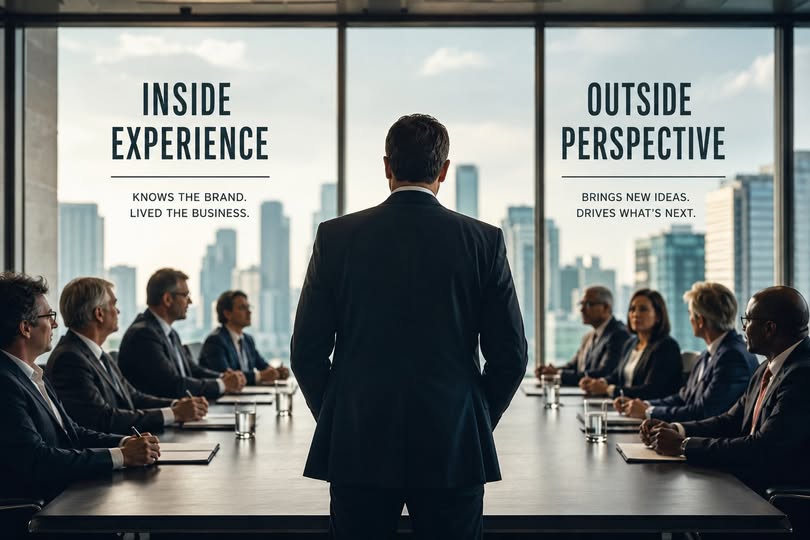
Every so often, a franchise system reaches a crossroads that has nothing to do with new products, marketing campaigns, technology, or expansion. Instead, it comes down to a single decision that will influence virtually every aspect of the organization for years to come: Who should lead the brand?
Whenever a CEO transition occurs, the debate almost inevitably follows. Should the board or ownership look within the system and elevate someone who has lived the brand, perhaps a successful multi-unit franchisee who helped build it one location at a time? Or is the better choice an accomplished executive recruited from outside the organization, someone who has demonstrated success leading another franchise brand or comparable business?
It’s a fascinating discussion because both perspectives are compelling. More importantly, both have produced extraordinary leaders.
Perhaps the mistake is assuming there is a universally correct answer.
Franchising is unlike almost any other business model. A franchise CEO doesn’t simply lead a corporate office. They lead an ecosystem of independently owned businesses, each with its own employees, customers, financial realities, and local market challenges. Every decision made in the boardroom eventually finds its way into someone else’s business. That reality creates a level of complexity that is often underestimated by those outside the franchise world.
It’s one reason why the successful multi-unit franchisee is frequently viewed as an ideal candidate for senior leadership. They have lived the business in ways that cannot be replicated through reports, presentations, or field visits. They have experienced labor shortages, inflation, changing consumer preferences, equipment failures, difficult landlords, rising operating costs, and the daily responsibility of making payroll. They know firsthand that strategies rarely unfold exactly as planned once they reach the front lines.
Perhaps even more important, they understand how franchisees think because they’ve sat in those same seats. They recognize that behind every corporate initiative is another independent business owner trying to determine whether the change will improve operations, increase profitability, or simply create more work. That perspective creates credibility. Franchisees often listen differently when they know the person speaking has walked in their shoes.
Operational credibility is difficult to manufacture.
It is earned over years of opening stores, hiring managers, solving problems, adapting to changing markets, and consistently delivering results. It provides an instinct that often cannot be taught. Many successful franchisees develop an intuitive understanding of what will actually work in the field and what may look impressive in a PowerPoint presentation but prove difficult to execute across hundreds of locations.
Yet operating multiple successful businesses, regardless of how impressive those accomplishments may be, is not necessarily the same as leading an entire franchise organization.
The responsibilities change dramatically.
A CEO must think beyond today’s operations. The role requires balancing long-term strategy with short-term performance, attracting talent, allocating capital, managing organizational structure, strengthening franchise development, maintaining lender and investor confidence, overseeing legal and regulatory matters, evaluating acquisitions, protecting the brand, and ensuring that every department moves in the same direction. The lens becomes considerably broader than maximizing the performance of individual locations.
That is where the accomplished outside executive often brings tremendous value.
Leadership experience gained in another successful franchise organization should never be dismissed simply because it was earned elsewhere. Quite the opposite. Sometimes the greatest opportunity for a brand lies in introducing ideas, systems, technologies, or disciplines that have already proven successful in another organization. Fresh perspectives have a way of challenging assumptions that long-standing insiders may no longer recognize.
History has shown that many exceptional leaders have successfully transitioned from one company to another, bringing with them best practices that accelerated growth, improved culture, and strengthened organizational performance. Experience, after all, is transferable.
Or is it?
That may be the most important question of all.
Success at one franchise brand does not automatically guarantee success at another because franchise systems are far more than business models. They are cultures. Every brand develops its own personality, its own pace of decision-making, its own relationship between franchisor and franchisee, and its own expectations regarding collaboration and communication. Two organizations operating within the same industry may appear remarkably similar on paper while functioning entirely differently in practice.
What worked brilliantly in one system may create resistance in another.
Likewise, someone who spent decades inside a single organization may possess extraordinary institutional knowledge while finding it difficult to challenge long-held assumptions or introduce meaningful change. Familiarity can be an advantage, but it can also become a limitation if it discourages innovation or reinforces the belief that the current way is the only way.
Neither path is without risk.
Perhaps this is why framing the conversation as an either-or decision misses the bigger opportunity.
Maybe the strongest franchise organizations intentionally build executive leadership that reflects both perspectives. Imagine an accomplished CEO whose strengths include enterprise leadership, finance, strategic planning, capital formation, organizational development, and long-term vision working alongside a president whose experience was forged operating multiple franchise locations, leading franchisees, and understanding exactly how decisions affect day-to-day execution throughout the system.
One naturally focuses on where the organization should go.
The other instinctively understands what it will take to get there.
One views the business through the lens of enterprise value.
The other views it through the lens of operational reality.
Those perspectives are not competing.
They’re complementary.
The healthiest franchise organizations have always been partnerships between franchisor and franchisee. Why shouldn’t leadership reflect that same philosophy?
Having spent much of my career on both sides of that relationship, I’ve come to appreciate how dramatically perspective changes depending on where you’re sitting. Early in my career, serving within corporate leadership provided a comprehensive view of organizational growth, strategic planning, and system development. Later, becoming a multi-unit franchisee transformed that perspective entirely. Suddenly, every corporate initiative was filtered through staffing challenges, customer expectations, local market conditions, profitability, and execution. Decisions that once seemed relatively straightforward became considerably more nuanced when I was responsible for making them work inside my own businesses.
Perhaps one of the most rewarding experiences of my career was helping establish a Franchise Advisory Council from the corporate side, only to later serve as a multi-unit franchisee and ultimately be elected by fellow franchisees to lead that very same council. That journey reinforced something I continue to believe today: neither perspective tells the entire story. Each reveals insights that the other may never fully appreciate.
And maybe that’s exactly the point.
The future of franchise leadership shouldn’t be about choosing between operational experience and executive pedigree. Nor should it become a debate over whether insiders or outsiders make better CEOs. The more meaningful question may be whether franchise systems are intentionally building leadership teams that bring together operational wisdom, strategic vision, financial discipline, organizational leadership, and genuine franchise credibility.
Because at the end of the day, great franchise brands are rarely built by one perspective alone.
They are built when different perspectives challenge one another, respect one another, and ultimately work together in pursuit of something larger than themselves.
My Final Thoughts
As franchising continues to mature, I suspect this conversation will become even more relevant. More franchise systems will face leadership transitions. More boards will wrestle with these very questions. And more franchisees will wonder whether the person leading their brand truly understands what it takes to operate one location, or ten, or more.
I’m not convinced the answer lies exclusively with the insider who helped build the brand. Nor am I convinced it rests solely with the accomplished executive who built success elsewhere.
I believe the strongest franchise organizations recognize the value of both.
Perhaps the real competitive advantage isn’t deciding which leader is better.
Perhaps it’s creating a leadership culture where both perspectives are not only welcomed—but expected.
What do you think? If you were selecting the next CEO of a franchise organization, where would your confidence lie, with the insider who knows the brand intimately, the executive who has proven success elsewhere, or a leadership team intentionally built to leverage the strengths of both?
Discover more from Acceler8Success Cafe
Subscribe to get the latest posts sent to your email.

One thought on “Who Should Lead a Franchise Brand? The Insider Who Helped Build It or the Executive Who Built Success Elsewhere?”
Comments are closed.