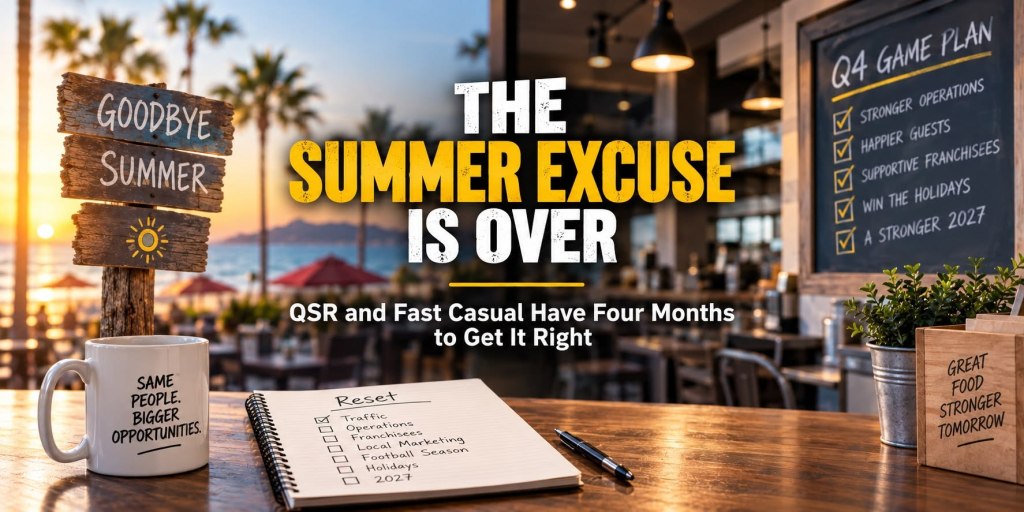
Summer is ending, routines are returning, and the restaurant business is entering a stretch that may matter more than everything that came before it. For QSR and fast-casual franchise brands, September through December isn’t simply the fourth quarter. It’s an opportunity to reset operations, reconnect with customers, strengthen franchisees, and determine how the brand will enter 2027.
Summer has a way of distorting the restaurant business. Travel patterns change. Families abandon their normal schedules. Employees take vacations. Tourism lifts some markets while draining others. College towns empty and then suddenly refill. Highway and destination locations may flourish while neighborhood restaurants experience inconsistent traffic. Labor becomes more difficult to predict, promotions compete with vacations and entertainment spending, and even loyal customers behave differently when their normal routines disappear. For QSR and fast-casual franchise brands, summer can create both false confidence and unnecessary panic because the numbers often reflect temporary behavior rather than the underlying condition of the business.
That is why the weeks immediately following Labor Day should be treated as something far more important than simply the end of summer. They should represent a post-summer reset.
From now through December 31, the restaurant calendar compresses quickly. School is back in session. Youth sports return. Commuting patterns become more predictable. Football dominates weekends. Families settle back into routines. Halloween arrives, followed almost immediately by Thanksgiving, holiday shopping, office gatherings, travel, Christmas and New Year’s Eve. Consumer behavior becomes simultaneously more predictable and more competitive because restaurants are no longer simply competing against other restaurants. They are competing for dollars being pulled toward travel, gifts, entertainment, sporting events, celebrations and virtually every other expense associated with the final four months of the year.
For QSR and fast-casual franchise brands, this is no time to coast into year-end. It is time to reset.
Start With the Truth About the Numbers
Before launching another promotion, adding another limited-time offer or asking franchisees to spend another dollar on marketing, brands should know exactly where they stand. Not where they hoped they would be when the annual budget was created. Not where the strongest stores are performing. Not where systemwide averages make the organization appear to be. Leadership needs an honest store-by-store assessment of traffic, average ticket, transactions, food cost, labor, discounting, delivery mix, digital sales, customer frequency and four-wall profitability.
Averages can be dangerous in franchise systems because strong operators frequently disguise weak ones. A brand reporting respectable systemwide sales growth may still have franchisees quietly struggling with declining transactions, higher labor costs, occupancy pressure or excessive dependence on discounting. The problem becomes even more pronounced when topline sales increases are driven primarily by price rather than increased customer visits. Revenue can rise while the underlying health of the business deteriorates.
September should therefore become something of a diagnostic month. Which stores are gaining customers? Which are losing them? Which markets are improving? Which franchisees are generating acceptable sales but insufficient cash flow? Which restaurants are becoming too dependent upon third-party delivery? Where are online reviews deteriorating? Which units have labor problems? Where is food waste climbing? Which franchisees are delaying repairs, reducing staffing or cutting local marketing because cash is getting tight?
These aren’t simply operational questions. They are early-warning signals.
The worst time for a franchisor to discover a franchisee is in financial trouble is when that franchisee can no longer make payroll, pay vendors or meet royalty obligations. A strong post-summer reset requires leadership to identify vulnerability while there is still time to do something about it.
Traffic Must Matter More Than the Illusion of Sales Growth
Restaurant operators have spent years navigating inflation, wage pressure, food-cost volatility and increasingly price-sensitive consumers. Menu prices increased across much of the industry because they had to, but there is a limit to how long pricing can compensate for declining transactions.
That makes one question especially important heading toward year-end:
Are more people choosing the brand?
A restaurant can raise prices and temporarily protect revenue. It cannot build a sustainable future without customers.
QSR and fast-casual brands should therefore use the post-summer period to aggressively evaluate traffic rather than becoming satisfied with sales alone. Frequency matters. Visit patterns matter. Dayparts matter. Customer acquisition matters. The restaurant with a slightly lower average ticket but increasing visits may ultimately be healthier than one producing a larger ticket from a shrinking customer base.
This also means brands should resist the temptation to solve every traffic problem with discounts. Value and discounting are not synonymous. Consumers may want affordability, but they also want convenience, quality, reliability, hospitality and an experience that justifies what they spend. Constant discounting can train customers to wait for deals while simultaneously compressing franchisee margins.
The better question is not simply, How can we make the meal cheaper? It is, How can we make the customer feel the meal was worth what they paid?
That distinction could become increasingly important through the remainder of the year.
Operations Need a Fall Tune-Up
The final months of the year leave very little room for operational weakness. Restaurants that enter October with staffing problems, equipment issues, inconsistent food execution or poor management practices will find those weaknesses amplified as traffic patterns change and holiday demands increase.
September should therefore become the restaurant equivalent of preventative maintenance.
Franchisees should be examining equipment before failures occur. Managers should be reviewing scheduling and labor deployment before holiday availability becomes an issue. Training should be refreshed. Restaurants should be cleaned beyond the normal closing checklist. Exterior signage, lighting, parking lots, restrooms, dining rooms, drive-thru lanes and digital menu boards should be evaluated through the eyes of a customer who has never visited before.
Mystery shops and operational audits can be valuable, but leadership should also spend time physically visiting restaurants without turning every visit into a ceremonial appearance. Sit in the dining room. Order through the app. Use the drive-thru. Place a delivery order. Visit during a rush. Visit during a slow period. Read recent online reviews.
Experience the business the way customers experience it.
Franchise executives sometimes become too far removed from the restaurant itself. Reports, dashboards and conference calls provide information, but they don’t tell you whether fries are arriving cold, tables are dirty, employees appear disengaged or a customer waited twelve minutes for an order that was supposed to take five.
Those details determine whether customers return.
The Customer Experience Is Becoming Part of the Value Equation
For years, much of QSR competed primarily around speed, convenience and price. Fast casual added quality, customization and a somewhat elevated environment. But consumer expectations continue to evolve, particularly when discretionary dollars are under pressure.
When people spend hard-earned money eating away from home, even a thirty- or forty-minute restaurant visit can represent a small escape from the demands of the day. That matters.
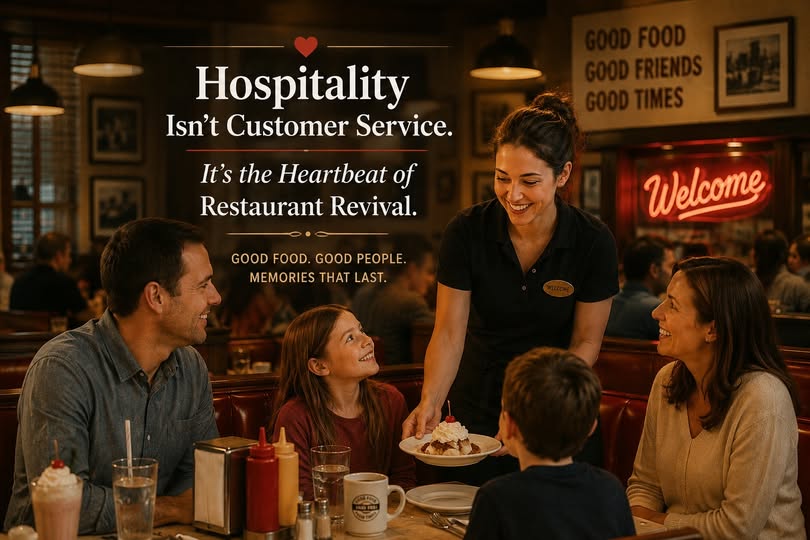
Customers increasingly notice whether the dining room is inviting, whether employees acknowledge them, whether the restaurant feels clean, whether the music is appropriate, whether orders are accurate and whether the experience feels transactional or hospitable. Even businesses built primarily around takeout and drive-thru should recognize that hospitality doesn’t disappear simply because the interaction is brief.
A smile still matters. Recognition still matters. Accuracy matters. Cleanliness matters. Speed matters. And making someone feel appreciated may matter more than another loyalty-program notification appearing on their phone.
Technology should enhance that experience rather than replace it.
Marketing Must Become Local Again
National campaigns have value, but restaurants live in communities.
The post-summer reset should include a renewed emphasis on local store marketing, particularly as schools, sports leagues, churches, nonprofits, businesses and community organizations return to more predictable schedules. Franchisees should not simply wait for corporate marketing to generate traffic. They should become visible again.
Sponsor the local team. Partner with a school. Host a fundraiser. Connect with nearby businesses. Participate in community events. Build catering relationships. Reach out to office managers. Create reasons for customers within a three- to five-mile radius to think about the restaurant before they think about competitors.
Digital marketing can amplify these efforts, but it cannot replace them.
A restaurant with thousands of social media followers but little connection to the neighborhood surrounding it may have built an audience without building a customer base.
The distinction matters.
Football Season Should Be Treated as a Business Season
For many QSR and fast-casual concepts, particularly pizza, wings, sandwiches, barbecue, burgers and other group-friendly categories, football season creates opportunities that extend far beyond running a Sunday promotion.
NFL and college football create recurring consumption occasions. So do high school games, fantasy leagues, tailgates, watch parties and youth sports. Brands should be examining bundles, catering, family meals, group ordering, pickup efficiency and digital ordering capacity now rather than improvising later.
The opportunity is not simply to sell more food during games. It is to become part of the ritual surrounding them.
The brands that accomplish that create habits, and habits are far more valuable than promotions.
Franchisee Health Must Become a Systemwide Priority
A franchise system cannot be healthy if a meaningful portion of its franchisees are financially unhealthy.
That sounds obvious, yet too many franchise organizations remain primarily focused on unit development, franchise sales and systemwide revenue while struggling operators quietly deteriorate beneath the surface. Growth looks impressive in press releases, but new openings mean considerably less if existing restaurants are closing, transferring under distress or generating insufficient returns for their owners.
The post-summer reset should therefore include meaningful conversations with franchisees about profitability, debt, labor, food cost, local competition, management challenges and capital needs.
Not every struggling franchisee needs to be rescued, and not every underperforming restaurant can be fixed. But franchisors should know the difference between an operator who needs coaching, a location that needs intervention and a business that may no longer be economically viable.
Pretending everything is fine until the problem becomes unavoidable benefits no one.
Development Should Be Examined Through the Same Lens
The reset should extend beyond restaurant operations and into franchise development.
How many units were projected to open this year? How many actually opened? How many signed franchise agreements remain undeveloped? How many franchisees are struggling to secure financing, real estate or construction? How many development schedules are realistic rather than aspirational?
Brands should also ask whether opening more restaurants remains the correct priority in every market.
Sometimes the best growth strategy is opening twenty stores. Sometimes it is making the existing fifty significantly stronger before opening number fifty-one.
Unit count makes headlines. Unit economics build franchise systems.
The strongest brands heading into 2027 will understand the difference.
Use the Holidays Before the Holidays Use You
By the time Thanksgiving arrives, much of the year’s remaining strategy has already been determined. Restaurants should therefore be preparing now for holiday catering, gift cards, employee scheduling, seasonal promotions, community events, corporate orders and year-end celebrations.
Gift cards deserve particular attention because they generate both immediate cash and future traffic. Catering can introduce the brand to customers who may never have visited. Corporate holiday orders can become recurring business relationships. Community partnerships formed during the holidays can continue throughout the following year.
But none of these opportunities materialize simply because December arrives.
They require planning, outreach and execution beginning now.
Technology Needs an ROI Conversation
Restaurant brands have accumulated an enormous technology stack: POS systems, loyalty platforms, ordering apps, kiosks, delivery integrations, kitchen display systems, labor tools, inventory software, CRM platforms, AI applications and countless analytics dashboards.
September is an appropriate time to ask an uncomfortable question:
Which of these technologies are actually making the restaurant more profitable?
Technology should reduce friction, improve productivity, increase customer frequency, strengthen decision-making or lower costs. If it does none of those things, it may simply represent another monthly expense appearing on the franchisee’s P&L.
Every technology vendor can produce a dashboard. The restaurant still needs to produce a profit.
The Final Four Months Should Also Be About 2027
Perhaps the greatest mistake brands can make during the post-summer reset is treating the remainder of the year solely as an effort to hit 2026 numbers.
September through December should also become the laboratory for 2027.
Test menu ideas. Experiment with local marketing. Refine labor models. Evaluate pricing. Improve catering. Study loyalty behavior. Strengthen franchisee communication. Identify technology that works and eliminate what doesn’t. Examine underperforming markets. Revisit development assumptions. Listen carefully to customers and operators.
By December, leadership should not merely know whether the brand hit its annual targets. It should understand why it did or didn’t and what must change next.
That knowledge becomes far more valuable than another spreadsheet forecasting optimistic growth.
Final Thoughts
The end of summer offers QSR and fast-casual franchise brands something increasingly rare in the restaurant business: a natural moment to recalibrate.
The next four months will move quickly. Football will become Halloween. Halloween will become Thanksgiving. Thanksgiving will become Christmas, and suddenly executives and franchisees will be sitting in January meetings discussing what happened in 2026 and what needs to happen in 2027.
The brands that wait until January to ask those questions will already be behind.
This is the time to walk the restaurants, study the numbers, listen to franchisees, reconnect with customers, repair operational weaknesses, strengthen local marketing and challenge assumptions that may have quietly become accepted as fact. It is also the time to remember that restaurant success ultimately comes down to something remarkably simple despite all the technology, analytics and strategy surrounding the business: give people a compelling reason to choose you, deliver on that promise consistently and make sure there is enough profit left for the people operating the restaurants.
September isn’t merely the month after summer.
For QSR and fast-casual franchise brands, it may be the starting line for the most important race of the year.
The question isn’t whether your brand is ready for the fourth quarter. The question is whether you’re willing to use the next four months to build the brand you want to take into 2027.

You must be logged in to post a comment.