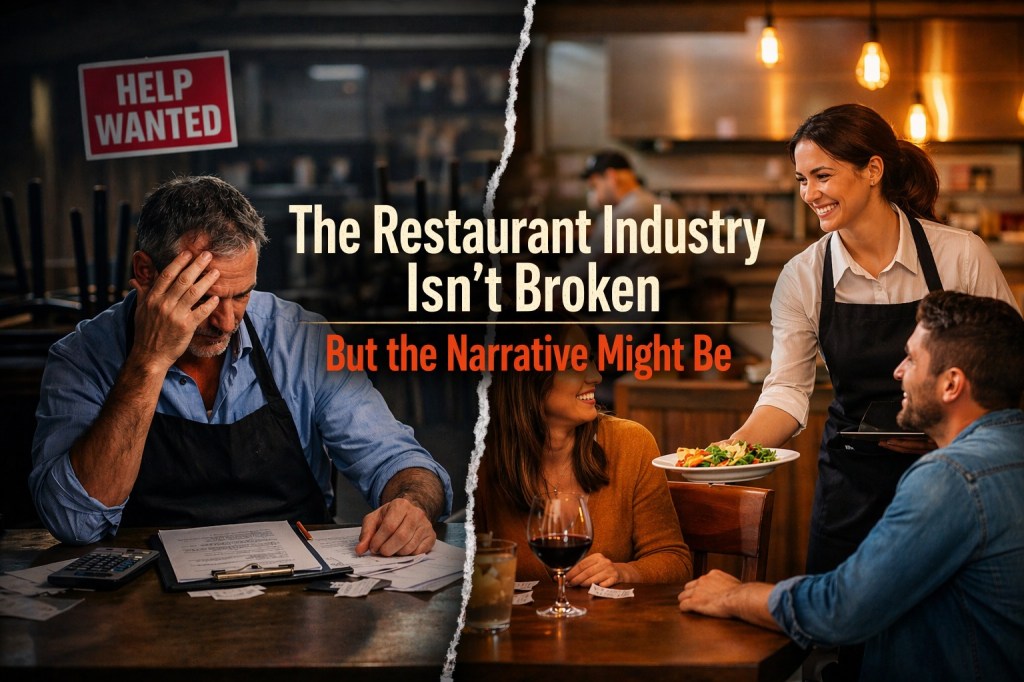
The restaurant industry has always operated under pressure. Tight margins, long hours, staffing unpredictability, and constant competition were part of the model long before COVID ever entered the conversation. The pandemic didn’t create those challenges. It magnified them.
But years removed from the height of that disruption, a different question is worth asking.
Are the challenges we continue to face entirely external… or have operators contributed to sustaining them?
There’s no debate that labor shortages have been real. Costs have risen. Consumer behavior has evolved. These are facts. But somewhere along the way, a narrative has taken hold… one rooted less in reality and more in repetition. A steady drumbeat of negativity has become part of the industry’s voice.
And that’s where the problem begins to shift.
Negativity, unlike rising costs or labor constraints, is controllable. Yet it is often left unchecked. It seeps into conversations, meetings, and daily interactions. It becomes the backdrop against which teams operate. Over time, it stops being commentary and starts becoming culture.
That distinction matters more than most operators realize.
In a restaurant, culture is not a concept. It is a lived experience. Employees don’t read about it in a handbook. They feel it in real time, every shift. When leadership consistently communicates frustration… about hiring, about guests, about margins, about “how things used to be,” it’s the tone that becomes embedded in the business itself.
We often talk about staffing as a supply issue. Not enough applicants. Not enough qualified people. Not enough willingness to work. But what if part of the issue isn’t supply at all?
What if it’s environment?
An employee doesn’t need a survey to understand whether a workplace is optimistic or defeated. They hear it. They see it. They absorb it. A server who hears daily that “nobody wants to work anymore” begins to disengage. A cook who is constantly reminded of rising costs may start to feel like nothing more than an expense line. Over time, effort declines, accountability softens, and pride erodes.
And then we call it a labor problem.
But it doesn’t stop there.
Negativity doesn’t just affect hiring and retention. It influences decision-making. It narrows perspective. It turns challenges into excuses and delays necessary change. It impacts how managers coach, how teams communicate, and how standards are enforced. When the prevailing belief is that “the industry is broken,” it becomes easier to justify inaction. Growth stalls. Innovation slows. Standards slip. Guest experience declines. And slowly, almost quietly, the brand begins to weaken from the inside out.
In that sense, negativity doesn’t just reflect challenges… it amplifies them.
It also distorts priorities.
Instead of focusing on improving systems, enhancing training, strengthening leadership, or elevating the guest experience, energy is redirected toward explaining why things aren’t working. Conversations shift from “how do we improve?” to “why this won’t work here.” That mindset doesn’t just stall progress… it institutionalizes it.
This is not to suggest that operators ignore reality. That would be irresponsible. The industry has faced legitimate headwinds, and many still do. But there is a difference between acknowledging difficulty and anchoring your business in it.
The most effective operators today are not those who have avoided challenges. They are the ones who have chosen how to respond to them.
They communicate facts, but they lead with direction.
They recognize obstacles, but they focus on solutions.
They create environments where accountability exists alongside belief in improvement.
They set expectations that performance matters and that improvement is always possible.
And in those environments, something notable happens.
Employees stay.
Performance improves.
Standards rise.
Guests feel the difference.
Not because the challenges disappeared, but because the tone changed.
We’ve seen it play out. In the same markets, under the same economic conditions, some restaurants continue to struggle while others find ways to grow, adapt, and even thrive. That contrast cannot be explained by external forces alone.
It points inward.
The post-COVID workforce has also evolved. Employees are not just looking for a paycheck. They are looking for stability, respect, and a sense that their work has meaning. They want to feel part of something that is moving forward, not something that is stuck explaining the past.
When operators default to negativity, they unintentionally communicate uncertainty. Even if the business is stable, the perception becomes one of fragility.
And perception drives behavior.
Employees leave environments that feel uncertain, even if the opportunity itself is solid.
Operators often ask why it’s so difficult to find and retain good people. It’s a fair question. But it may not be the complete one. A more revealing question might be:
What kind of environment are we asking people to commit to?
Negativity, left unchecked, becomes a convenient shield. It explains underperformance. It rationalizes stagnation. It deflects accountability. If the industry is the problem, then the solution is external. But if culture is part of the problem, then the responsibility shifts back to leadership.
And that is where real change begins.
So, is operator negativity fueling the restaurant industry’s labor and other challenges?
It may not be the root cause. But it is very likely an accelerant.
Negativity doesn’t just describe the state of a business. It shapes it.
If the industry is going to move forward, not just recover, but evolve, then operators must look beyond costs, staffing models, and market conditions. They must examine the tone they set, the narrative they reinforce, and the culture they create every day.
Because people don’t leave restaurants because the work is hard.
They leave because the environment makes it harder than it needs to be.
That realization creates a clear inflection point.
You can continue to operate within the narrative… or you can redefine it.
If you’re feeling the weight of ongoing labor challenges, inconsistent performance, or a culture that isn’t where it needs to be, it may be time to take a deliberate step back and reassess, not just what’s happening in your business, but how it’s being led and communicated.
Let’s start that conversation.
Reach out directly to explore how to shift the narrative, strengthen your culture, and position your restaurant for sustainable performance, not just in today’s environment, but for what comes next.
Discover more from Acceler8Success Cafe
Subscribe to get the latest posts sent to your email.

One thought on “Why Some Restaurants Thrive While Others Struggle in the Same Market”
Comments are closed.