
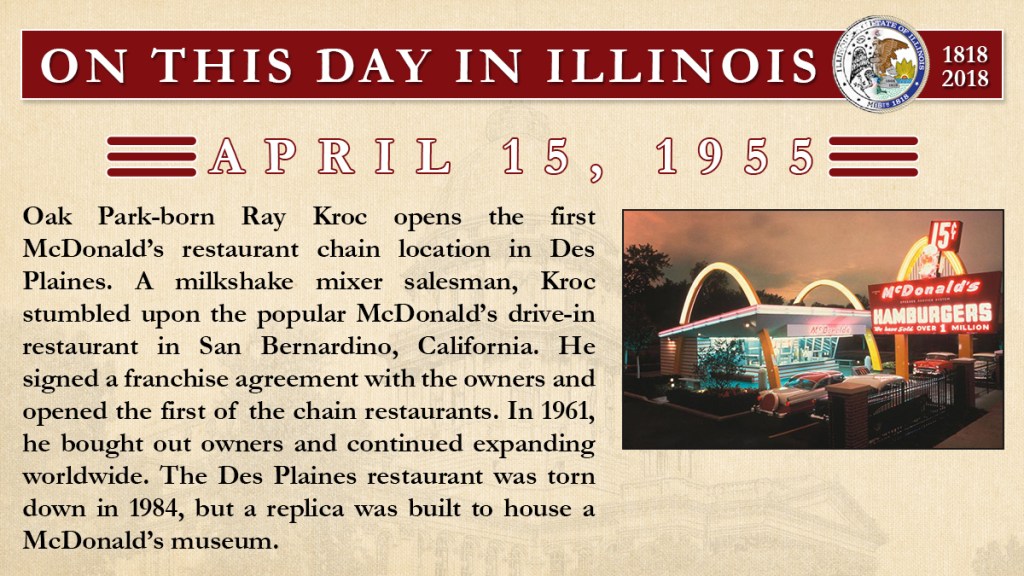
On April 15, 1955, Ray Kroc opened the first McDonald’s restaurant under his new corporation in Des Plaines, Illinois. It was not the first McDonald’s ever built, nor was it the first franchise business in America. Yet this date is widely recognized as the beginning of a new era in franchising, one that introduced a level of systemization, standardization, and scalability that would define modern franchising for decades to come.
Although franchising had existed in various forms for over a century, most notably in the soft drink, automobile, and petroleum industries, Ray Kroc’s vision for McDonald’s introduced a disciplined and replicable model that reshaped the business landscape. What began as a single unit serving a simple menu of burgers, fries, and shakes would evolve into one of the most influential business systems in history. More importantly, the principles established under Kroc’s leadership would become the foundation for the franchise industry as we know it today.
A New Model for Business Replication
What distinguished Ray Kroc’s approach from others before him was not simply the idea of duplication, but the meticulous structure around which that duplication would occur. At the heart of the McDonald’s model was consistency across locations, across operators, and across experiences. Kroc believed that a customer’s experience at a McDonald’s in Illinois should be identical to that of a customer visiting a McDonald’s in Arizona or New York. This was a radical departure from the more flexible, often decentralized franchise models of the time.
To achieve this level of consistency, Kroc introduced what would become some of the most widely emulated practices in franchising: detailed operational manuals, centralized training at the company’s Hamburger University, stringent site selection protocols, and ongoing franchisee support. These elements collectively established the franchise relationship not just as a legal contract, but as a fully integrated business partnership built on mutual success and accountability.
Kroc also understood the value of owning the real estate on which McDonald’s restaurants were built, an approach that allowed the corporation to exert significant control over franchisees while also creating a strong and stable revenue stream. This dual focus on operations and ownership created a model that was both financially sound and operationally efficient.
A Leadership Pipeline That Shaped an Industry
The culture within the McDonald’s system produced more than just successful franchisees, it became a breeding ground for industry leaders. Many executives, operators, and suppliers who cut their teeth within the McDonald’s ecosystem went on to establish or lead some of the most well-known brands in the franchise sector. Their success stories reflect the depth of the McDonald’s influence, which extends far beyond burgers and fries.
Fred Turner, who started as a grill operator in 1956, would eventually become CEO and chairman of McDonald’s. Under his stewardship, the company grew into a global institution, with increasingly refined systems and processes that reinforced the strength of the franchise model. Turner’s leadership further solidified the internal philosophy that training, discipline, and support were essential to sustainable growth.
Ed Rensi, another McDonald’s veteran who began as a grill cook, rose through the ranks to become President and Chief Executive Officer of McDonald’s USA. After leaving the company, Rensi applied the same operational discipline to other ventures, including serving as CEO of Famous Dave’s and as an advisor to several emerging franchise brands.
Rick Rosenfield and Larry Flax, both former McDonald’s franchisees, went on to found California Pizza Kitchen, a more upscale concept, yet one that retained many of the operational efficiencies they learned under Kroc’s system.
Others from the McDonald’s sphere brought their expertise to brands such as Burger King, Wendy’s, and countless franchise development firms, investment groups, and consulting practices. The culture of discipline and performance instilled at McDonald’s carried with them, and they replicated elements of that model in every new venture they touched.
An Enduring Legacy in Today’s Franchising Landscape
Nearly seventy years after Ray Kroc opened that first McDonald’s in Des Plaines, the company’s influence on franchising remains as strong as ever. The operational playbook he created is still used, in some form, by nearly every franchise system in existence today. From quick service restaurants to fitness concepts, from home service brands to education platforms, the core principles—consistency, support, replicability, and brand uniformity can all be traced back to the standards McDonald’s set in motion.
Training universities, franchise manuals, structured discovery processes, and site development protocols were not just innovations; they were institutional advancements that elevated franchising from an entrepreneurial experiment to a legitimate industry. Even the legal and regulatory frameworks that govern franchising today were influenced by the rise and scale of McDonald’s, prompting state and federal agencies to develop guidelines that could support this growing method of business expansion.
Today, as franchising continues to evolve in response to changing consumer behavior, digital transformation, and global market dynamics, the McDonald’s model remains a touchstone. Whether in discussions of operational excellence, franchisee support, or brand scalability, the example set by Ray Kroc and his successors continues to be studied, admired, and, more often than not, emulated.
A Historical Milestone With Modern Relevance
April 15, 1955, marks more than the opening of a restaurant. It marks the genesis of a movement. Ray Kroc may not have invented franchising, but he gave it form, function, and credibility. He showed the world what was possible when systems and people aligned in the pursuit of a singular brand experience delivered at scale.
The lessons learned under the golden arches have found their way into boardrooms, training rooms, and franchise expos across the globe. In doing so, McDonald’s did more than change the way people eat, it changed the way people do business. And it all began on a spring day in suburban Illinois, with a vision, a system, and a determination to do things differently.
Make today a great day. Make it happen. Make it count!
About the Author
Paul Segreto brings over four decades of hands-on experience in franchising, restaurants, and small business development. A passionate advocate for entrepreneurship, Paul has helped countless individuals turn their visions into thriving ventures. Ready to take your next step in business or looking for expert insight to overcome today’s challenges? Reach out directly to Paul at paul@acceler8success.com—your path to success may be one conversation away.
About Acceler8Success Group
Acceler8Success Group is where entrepreneurial ambition meets expert execution. We partner with entrepreneurs, founders, and business leaders to ignite growth through a tailored hybrid appoach of coaching, consulting, and business advisory. Whether you’re launching your first venture or scaling your next big idea, our team is ready to help you accelerate success. Let’s build your future—visit and connect with us today at Acceler8Success.com.
Discover more from Acceler8Success Cafe
Subscribe to get the latest posts sent to your email.

You must be logged in to post a comment.