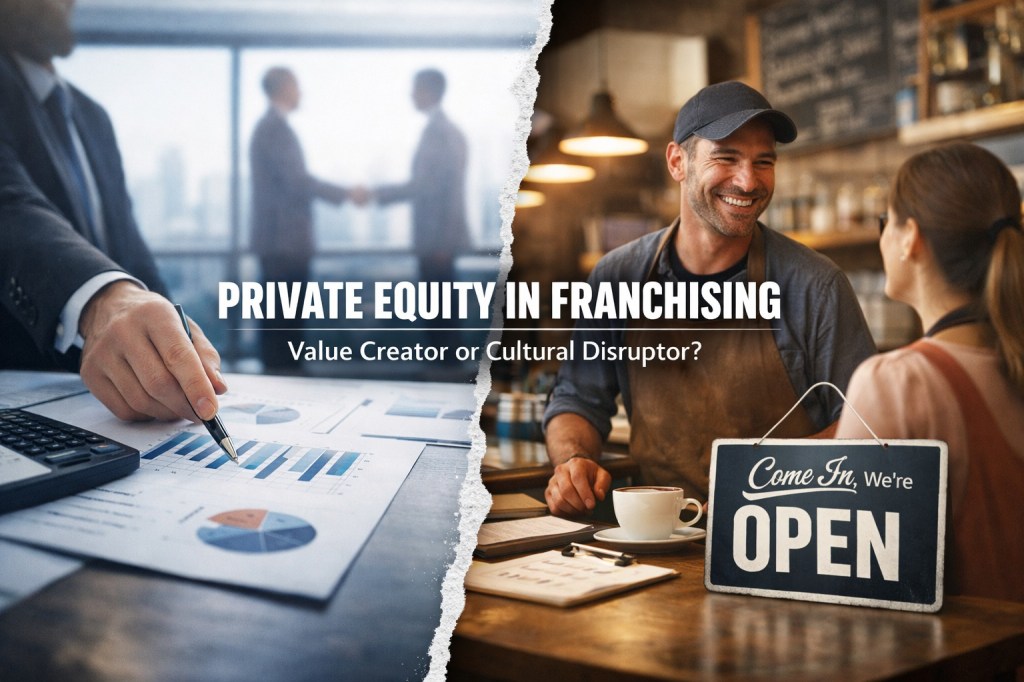
In my more than forty years in franchising, I have had the opportunity to serve in a wide range of leadership roles, including CEO, COO, and President, across organizations that experienced mergers and acquisitions, turnarounds, aggressive growth phases, and periods of steady, disciplined expansion. While those roles placed me squarely in the middle of strategic decision-making, I was always clear-eyed about where my greatest strengths lived and where they did not. My expertise was built through operations, franchise relations, marketing, and franchise development. When it came to complex financial engineering, capital structures, valuation models, and exit scenarios, I leaned heavily on what I often refer to as the smartest people in the room: seasoned Chief Financial Officers and highly capable financial consulting firms. That balance between operational leadership and financial rigor shaped many of the outcomes I was part of.
Over the years, I have also consulted with and advised a broad spectrum of franchise organizations, which has given me a better-than-average understanding of private equity’s expanding role in franchising. I have seen it from multiple vantage points: inside the boardroom, across leadership teams, through the eyes of franchisees, and from the perspective of founders who suddenly found themselves accountable to investors rather than to the systems they spent years building. What follows is written through that lens. It is not meant to be definitive, nor is it intended to indict or defend private equity as a category. There is certainly more to add and gaps to fill. But it is a conversation worth having, especially as private equity continues to shape the future of franchising in ways that are both powerful and deeply consequential.
Private equity’s growing presence in franchising is one of those topics that resists a simple yes-or-no conclusion. Like most things in business, it carries clear advantages alongside equally clear risks. Setting aside debates around deal structures, leverage ratios, and valuation multiples, the more important question is whether private equity ownership is truly compatible with franchising as a long-term system built on relationships, shared risk, and mutual success. That distinction matters because franchising, at its core, is not simply a growth strategy. It is a partnership model that depends on trust, alignment, consistency, and patience over long periods of time.
There is no denying the upside. Private equity has elevated franchising’s profile and reinforced what many operators and founders have long understood: franchising, when executed well, is a powerful and scalable business model. Institutional capital brings visibility, credibility, and access to resources that many brands could not achieve on their own. In numerous cases, private equity ownership has helped modernize legacy systems, professionalize leadership teams, improve financial reporting, introduce data-driven decision-making, and accelerate growth. From an enterprise perspective, franchising has benefited from being taken seriously as an asset class rather than being viewed as a fragmented collection of small, independently owned businesses.
But the same spotlight that brings credibility also exposes fault lines that have always existed beneath the surface of the franchise model.
Private equity firms are driven by return on investment. That is not a criticism; it is their mandate. Most funds operate on a three- to five-year investment horizon with a disciplined focus on increasing EBITDA, improving margins, tightening unit economics, and positioning the brand for a successful exit. Franchise agreements, by contrast, typically span ten years, often with renewal options that extend the relationship even further. Franchisees commit capital, sign personal guarantees, take on long-term leases, and structure their lives around businesses they expect to operate for decades. These timelines do not naturally align, and the consequences of that misalignment are very real.
Once a private equity firm acquires a franchise brand, the clock begins ticking almost immediately. Strategic decisions are filtered through the lens of exit readiness. Growth targets, cost controls, staffing models, technology investments, fee structures, and system-wide initiatives are evaluated based on how they enhance valuation within a relatively short window. Financial discipline and accountability matter, but problems arise when near-term financial optimization begins to outweigh the long-term health of the franchise system and the people who operate it every day.
Franchisees are not short-term investors. They are operators, employers, and community members. They have invested their savings, taken on debt, and tied their livelihoods to a brand they expect to grow with over time. When decisions are driven primarily by what a future buyer wants to see rather than by what franchisees need to succeed over the next decade, strain shows up quickly. Support resources may be reduced. Growth may outpace training and operational infrastructure, and other core areas can be impacted as well. Individually, these changes may appear manageable. Collectively, they can quietly erode trust.
This dynamic plays out very differently depending on whether the brand is a mature, legacy franchise system or an emerging franchise concept, and the chasm between those two realities is significant.
Legacy brands often have decades of operating history, substantial unit counts, established training platforms, experienced field teams, and strong consumer awareness. While franchisees in these systems are not immune to the pressures created by private equity ownership, the brand’s scale and maturity can provide a buffer. There is institutional knowledge, proven economics, and operational depth that can absorb disruption and ownership transitions with less volatility.
Emerging franchise brands operate without those safety nets. These systems are still being built. Unit economics are evolving. Processes are being refined in real time. Early franchisees are often taking on disproportionate risk in exchange for belief in the concept and the leadership team. When private equity enters at this stage, the margin for error narrows dramatically. Aggressive growth mandates can push systems to scale before the foundation is solid. Cost controls can strip away critical support functions at precisely the moment franchisees need them most. Strategic decisions may prioritize optics over durability. For emerging brands, private equity ownership can either accelerate maturation responsibly or magnify weaknesses that ultimately destabilize the system.
This reality leads to a difficult but necessary question: who is the true steward of the brand under private equity ownership?
Is stewardship held by individuals who have built businesses, understand the realities of operating a location, and feel personal accountability for franchisee outcomes? Or does it rest with boards and investment committees whose expertise is rooted primarily in financial modeling and portfolio performance? Many of the latter have never met payroll, negotiated a lease, or managed frontline employees. When stewardship shifts from builders and operators to financial overseers, culture often becomes abstract, decision-making more distant, and franchisees begin to feel like data points rather than partners.
The issue becomes even more pronounced at exit. If a franchisee has several years remaining on their agreement when a private equity firm sells the brand, they are suddenly partnered with someone new and often without a voice in that transition. The strategy they originally bought into may change overnight. The new owner may have entirely different priorities, growth expectations, or operational philosophies. Yet the franchisee remains bound by the same agreement, often living with decisions made years earlier by owners who have long since moved on.
This is where long-term risk quietly accumulates. Cost-cutting that weakens franchise support, aggressive development that overwhelms training and operations, fee increases without value creation, or a shift from partnership to extraction can damage trust in ways that are difficult to reverse. Franchising only works when trust exists. Once that trust erodes, even strong financial performance cannot fully compensate for the loss.
There is also a human and historical dimension that deserves acknowledgment. Many industry veterans remember a time when founders and franchisees built brands together in a more direct and personal way. Leaders such as Bud Hadfield, Fred DeLuca, and Anthony Martino were not distant figures hidden behind layers of management and investor relations teams. They were builders and stewards who thought in decades, not exit multiples. Franchisees felt seen, heard, and supported, and the success of the brand and the success of the franchisee were inseparable.
That era was not perfect, and mistakes were certainly made. But alignment was clearer. Long-term health mattered. Today, with some franchise brands changing ownership multiple times within a single franchise term, that sense of shared destiny can feel diluted, particularly for emerging systems still searching for their identity.
This is not an argument against private equity. It is a call for balance, responsibility, and awareness. Private equity can be a positive force in franchising when it respects the long-term nature of franchise relationships, honors the commitments embedded in franchise agreements, and treats franchisees as true partners rather than line items on a spreadsheet. When capital and stewardship work together, franchising can thrive.
But when short-term exit strategies collide with long-term franchise agreements, both the math and the trust begin to unravel. Franchising was never meant to be a flip. It was meant to be a relationship. And the further the industry moves away from that principle, especially across the wide gap between emerging and legacy brands, the more fragile the model becomes, regardless of how strong the numbers may look on paper.
If you are a franchisor, franchisee, investor, advisor, or industry professional who has lived through private equity ownership, explored possibilities, or deliberately chosen to avoid it, I invite you to share your perspective. What have you seen work well? Where have you seen tension or breakdowns occur? How do you believe private equity can better align with the long-term nature of franchising? This conversation matters, and the future of the franchise model will be shaped not just by capital, but by the collective insight and experience of those who are part of it every day.
About the Author
Paul Segreto brings over forty years of real-world experience in franchising, restaurants, and small business growth. Recognized as one of the Top 100 Global Franchise and Small Business Influencers, Paul is the driving voice behind Acceler8Success Café, a daily content platform that inspires and informs thousands of entrepreneurs nationwide. A passionate advocate for ethical leadership and sustainable growth, Paul has dedicated his career to helping founders, franchise executives, and entrepreneurial families achieve clarity, balance, and lasting success through purpose-driven action.
About Acceler8Success America
Acceler8Success America is a comprehensive business advisory and coaching platform dedicated to helping entrepreneurs, small business owners, and franchise professionals achieve The American Dream Accelerated.
Through a combination of strategic consulting, results-focused coaching, and empowering content, Acceler8Success America provides the tools, insights, and guidance needed to start, grow, and scale successfully in today’s fast-paced world.
With deep expertise in entrepreneurship, franchising, restaurants, and small business development, Acceler8Success America bridges experience and innovation, supporting current and aspiring entrepreneurs as they build sustainable businesses and lasting legacies across America.
Learn more at Acceler8SuccessAmerica.com
Discover more from Acceler8Success Cafe
Subscribe to get the latest posts sent to your email.

You must be logged in to post a comment.