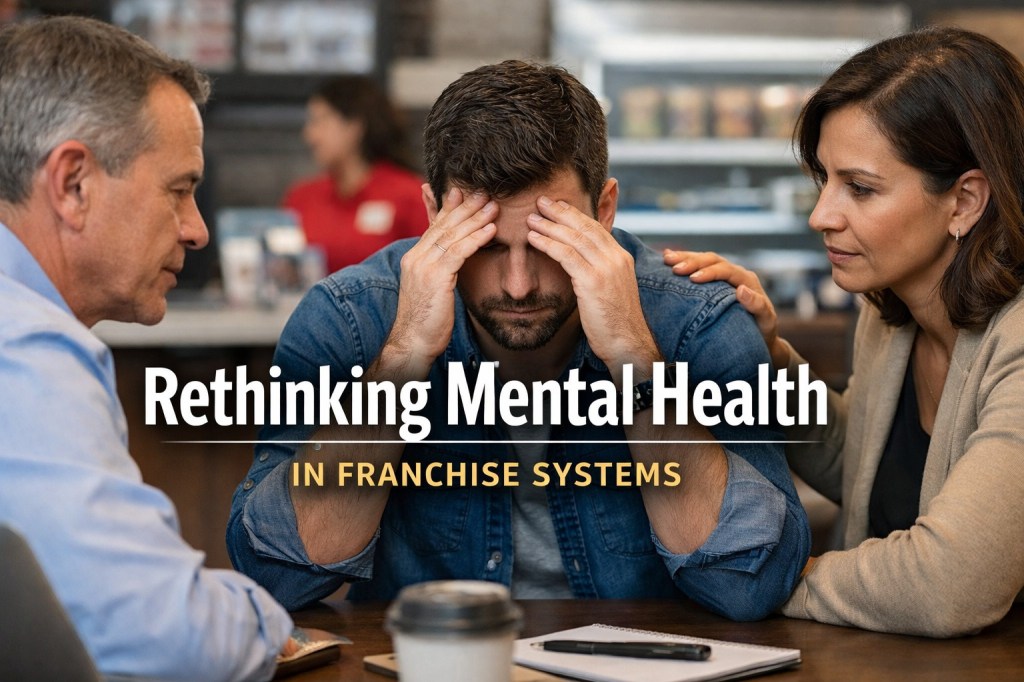
Mental health is no longer a peripheral issue in franchising. It sits at the intersection of brand performance, franchisee sustainability, and the long-term health of the system itself. Franchisors often pride themselves on culture, community, and being “one big family,” yet mental health remains an uncomfortable topic… acknowledged quietly, if at all. The reality is unavoidable: a struggling franchisee does not operate in isolation. Emotional distress, burnout, anxiety, or depression can ripple through operations, employee morale, customer experience, and ultimately brand reputation. The question is no longer whether franchisors should care, but how far their responsibility reasonably extends.
Franchisees live in a unique pressure chamber. They shoulder personal financial risk, long hours, staffing challenges, compliance obligations, customer expectations, and the emotional weight of being both owner and operator. Unlike corporate executives, many franchisees do not have layers of support beneath them. When they struggle mentally, the symptoms often surface operationally—missed standards, poor communication, irritability with staff, inconsistent execution, withdrawal from the system, or resistance to guidance. These are frequently treated as performance or compliance issues when, in reality, they may be warning signs of something deeper.
From a purely business standpoint, ignoring mental health is risky. A franchisee in distress can destabilize a unit, create employee turnover, generate customer complaints, and damage the brand image in a local market. Their stress can spread to neighboring franchisees through peer groups, advisory councils, and informal conversations, quietly eroding confidence in the system. From a human standpoint, the issue is even more profound. Many franchisors speak about franchisees as partners and family members. If that language is more than marketing, it carries ethical weight. Families do not look away when one member is clearly struggling.
That said, franchisors are not therapists, doctors, or counselors. There are legal, practical, and ethical boundaries that must be respected. The goal is not to diagnose or treat mental health conditions, nor to intrude into franchisees’ private lives. The appropriate role is awareness, preparedness, and compassionate response. Franchisors should ask themselves whether their systems are designed only to enforce standards or also to support the people responsible for executing them. Is the culture one where franchisees feel safe admitting they are overwhelmed, or one where vulnerability is seen as weakness and failure?
Operations support teams sit on the front line of this issue. They interact with franchisees regularly and are often the first to notice changes in behavior, tone, or engagement. Yet most are trained exclusively on metrics, standards, and corrective action, not on recognizing human distress. Thoughtful training can change this without crossing professional boundaries. Support teams should be educated to recognize common red flags such as sudden disengagement, uncharacteristic hostility, persistent fatigue, missed deadlines, emotional volatility, or expressions of hopelessness. Just as importantly, they should be trained on what not to do—avoid assumptions, diagnoses, or judgment, and never position themselves as mental health experts.
Clear guidelines matter. Teams should know when and how to escalate concerns internally, who within the organization is responsible for sensitive conversations, and what resources can be offered. This might include access to confidential counseling resources, peer support groups, crisis hotlines, or third-party employee assistance programs that extend to franchisees. Even simply normalizing conversations around stress and mental health in system meetings can reduce stigma. The message should be consistent: seeking support is a sign of responsibility, not failure.
There is also a leadership question franchisors must confront. Does the system’s structure unintentionally contribute to burnout? Are expectations realistic, communication clear, and support accessible? Are franchisees given space to breathe, or are they perpetually reacting to initiatives, mandates, and compliance pressures without regard to human capacity? Mental health awareness is not only about intervention; it is about prevention. Strong onboarding, realistic ramp-up periods, clear financial expectations, and honest conversations about the emotional demands of ownership all play a role.
Ultimately, franchisors must wrestle with difficult questions. If a franchisee is visibly struggling, is it responsible leadership to treat it solely as a performance problem? At what point does protecting the brand require protecting the person behind the unit? Can a system truly claim to be “family” if it only engages when numbers are strong and distances itself when someone is faltering? Conversely, how does a franchisor balance compassion with accountability without creating dependency or legal exposure?
Mental health in franchise systems is not a soft issue. It is a leadership issue, a risk management issue, and a culture issue. The strongest brands of the future will not be those that ignore human strain in pursuit of short-term compliance, but those that understand sustainable performance is inseparable from the well-being of the people who carry the brand into their communities every day. The real question is not how much franchisors should concern themselves with franchisees’ mental health, but whether they can afford not to.
About the Author
Paul Segreto brings over forty years of real-world experience in franchising, restaurants, and small business growth. Recognized as one of the Top 100 Global Franchise and Small Business Influencers, Paul is the driving voice behind Acceler8Success Café, a daily content platform that inspires and informs thousands of entrepreneurs nationwide. A passionate advocate for ethical leadership and sustainable growth, Paul has dedicated his career to helping founders, franchise executives, and entrepreneurial families achieve clarity, balance, and lasting success through purpose-driven action.
About Acceler8Success America
Acceler8Success America is a comprehensive business advisory and coaching platform dedicated to helping entrepreneurs, small business owners, and franchise professionals achieve The American Dream Accelerated.
Through a combination of strategic consulting, results-focused coaching, and empowering content, Acceler8Success America provides the tools, insights, and guidance needed to start, grow, and scale successfully in today’s fast-paced world.
With deep expertise in entrepreneurship, franchising, restaurants, and small business development, Acceler8Success America bridges experience and innovation, supporting current and aspiring entrepreneurs as they build sustainable businesses and lasting legacies across America.
Learn more at Acceler8SuccessAmerica.com
Discover more from Acceler8Success Cafe
Subscribe to get the latest posts sent to your email.

One thought on “What Happens When Franchisee Mental Health Is Treated as “Not Our Problem””
Comments are closed.