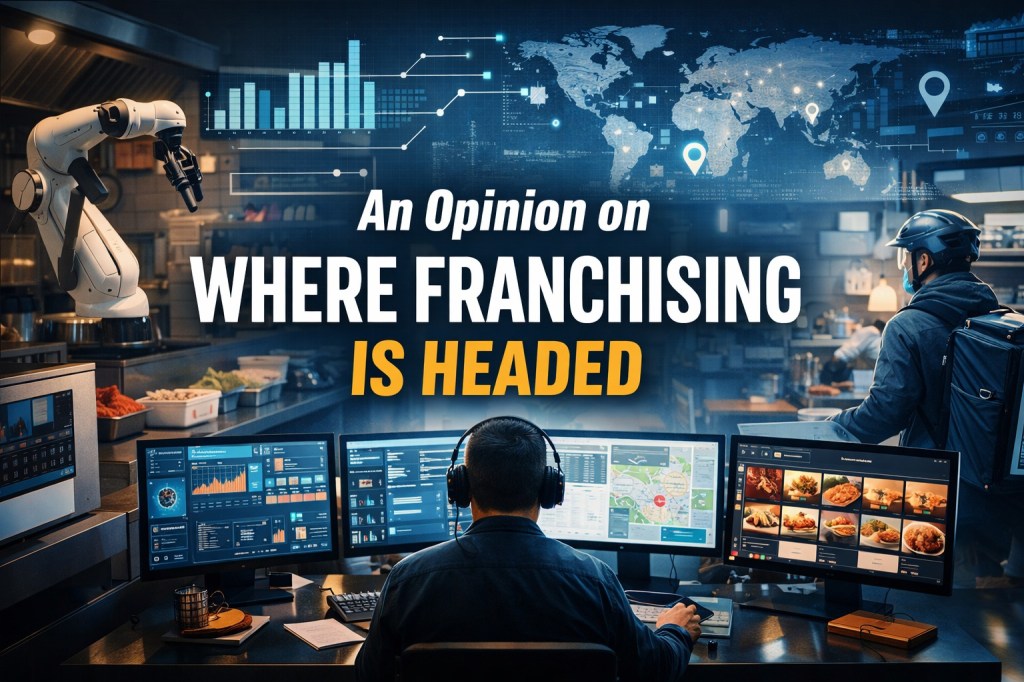
Franchising is approaching a moment that, in my opinion, will redefine what the model actually is, not just how it operates.
For decades, franchising has been built on replication. A proven concept, standardized systems, consistent execution. That foundation isn’t going away. But I believe the next 10, 15, 25 years will fundamentally challenge how that replication is achieved and what it even looks like.
Let me be clear. I don’t think franchising will evolve incrementally.
I think it will be reshaped.
Technology, and more specifically artificial intelligence, is going to move from being a support function to being the backbone of franchise systems. Today, brands talk about data. Tomorrow, they will run on it. Site selection, marketing, pricing, labor models, inventory… these won’t be decisions supported by technology. They will be decisions driven by it.
In my view, the franchisee of the future won’t be guessing. They’ll be operating within a system that is constantly optimizing itself.
And that leads to something many operators don’t want to fully acknowledge yet… less labor.
Not no labor. But less. And different.
Automation is already making its way into kitchens, ordering systems, and back-of-house operations. Over time, I believe we’ll see leaner teams, higher-skilled employees, and a shift away from labor-intensive models that have defined the restaurant space for decades. The brands that figure this out early will have a structural advantage. The ones that don’t will be chasing margin in an environment that won’t forgive inefficiency.
Real estate is another area where I believe we’re underestimating the shift.
We still talk about “non-traditional” locations as if they are secondary. I don’t see it that way. I see a future where those locations become primary. Smaller footprints. Embedded environments. Locations that meet the consumer where they already are, whether that’s in a hospital, an office building, a residential development, or a transit hub.
The traditional box isn’t going away. But I don’t believe it will be the centerpiece of growth much longer.
And then there’s virtual.
Ghost kitchens were the early signal, not the endgame. I believe we will see fully developed franchise systems that operate without traditional storefronts altogether. Territory-based operators managing production, logistics, and brand execution through distributed kitchens and delivery ecosystems.
That changes everything. Capital requirements. Speed to market. Scalability.
It also opens the door for something else I feel strongly about niche-specific concepts.
The future isn’t broad. It’s precise.
Brands that try to be everything to everyone will struggle against those that are deeply aligned with a specific customer, a specific lifestyle, a specific need. Whether it’s dietary, cultural, functional, or convenience-driven, the winners will know exactly who they serve and build around that with intention.
Because at the center of all of this is one word.
Convenience.
In my opinion, convenience is no longer a differentiator. It’s the baseline. The brands that remove friction through technology, location, and operational design will win. The ones that don’t will be left trying to catch up in a market that won’t slow down for them.
But here’s where I think the conversation really needs to shift.
This isn’t about predicting the future for the sake of it.
It’s about asking a very real question today.
Are franchise brands building in a way that allows them to evolve, or are they building in a way that forces them to react later?
Because I’ve seen what happens when brands wait too long.
They retrofit instead of redesign. They layer technology on top of outdated systems instead of rethinking the system itself. They make rushed decisions under pressure because the market moved faster than they did.
That’s not strategy. That’s survival.
And I don’t believe the next decade will be forgiving to brands that operate that way.
The brands that will lead—again, this is my view—are the ones that start now. Not with massive overhauls, but with intentional evolution. Testing. Learning. Adapting. Building flexibility into their models so they can move without breaking.
Franchising 25 years from now won’t belong to the biggest systems.
It will belong to the most adaptive ones.
Let me leave you with this…
This isn’t about whether these changes will happen. It’s about how prepared you are when they do.
In my opinion, the future of franchising is already taking shape. The question is whether you’re participating in building it, or waiting to respond to it.
If you’re a franchisor, founder, or operator and this resonates, even if you disagree with parts of it, that’s where the conversation should start.
Let’s have it. Share your thoughts and perspective on this platform, or reach out to me via direct message or by email to paul@acceler8success.com.
Discover more from Acceler8Success Cafe
Subscribe to get the latest posts sent to your email.

You must be logged in to post a comment.