An entrepreneurial perspective on Richard Hagberg and Tien Tzuo’s approach to founder development
Building a business requires conviction. An entrepreneur sees an opportunity, commits resources, and moves forward while much remains uncertain. That willingness to act is essential. As the business grows, however, the founder’s responsibilities change and the habits that helped establish the company deserve closer examination.
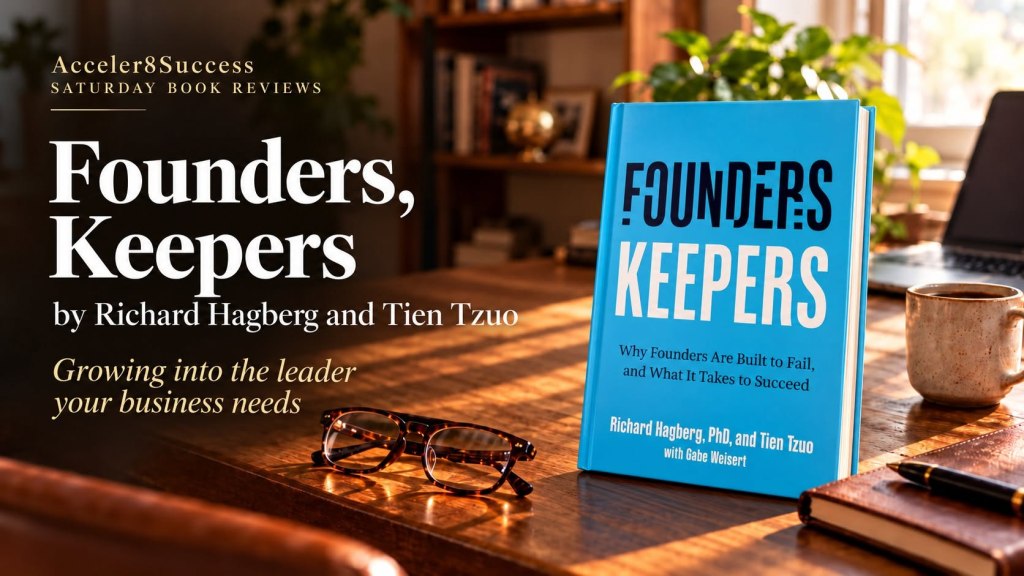
That is the perspective I bring to Founders, Keepers: Why Founders Are Built to Fail, and What It Takes to Succeed by Richard Hagberg, PhD, and Tien Tzuo, with Gabe Weisert. The book examines how a founder’s personality and leadership tendencies influence a company’s development, including the ways personal strengths can become obstacles as the organization grows.
For entrepreneurs, the question it raises is direct: Are we developing our ability to lead at the same pace we are trying to develop the business?
Over more than four decades in entrepreneurship, franchising, restaurants, and small business development, I have come to appreciate how much depends on that answer. Growth brings additional customers, employees, commitments, and decisions. It also exposes the limits of an organization built around one person’s availability.
An owner can work longer hours for a while. Eventually, the business needs a more dependable way to operate.
Hagberg and Tzuo approach this challenge through leadership psychology and founder experience. Hagberg brings decades of executive coaching experience, while Tzuo brings the perspective of having cofounded Zuora. Their central argument is that building a durable company requires founders to develop themselves alongside the enterprise.
From my perspective, that makes the book relevant well beyond the technology startup environment.
Consider an independent restaurant preparing to open a second location. At the original restaurant, the owner may know every employee, recognize regular customers, approve purchases, resolve complaints, and notice immediately when something is wrong.
Much of the operation may depend on knowledge the owner has never fully communicated.
A second location changes that arrangement. Managers need clear authority. Employees need usable standards. Financial information needs to arrive consistently. Customers need to receive the promised experience when the founder is somewhere else.
My application of the book’s premise would begin with a practical question: What currently works because the business has a reliable process, and what works because the owner personally intervenes?
That distinction deserves attention before signing another lease.
For an aspiring entrepreneur, I would use Founders, Keepers as an opportunity to think about leadership before habits become deeply established.
What do you naturally enjoy? Where do you tend to avoid responsibility? How do you respond when someone questions an idea you believe in? Can you acknowledge that another person may be better equipped to handle part of the business?
These questions influence early hiring decisions, partnerships, and the expectations an owner establishes.
Someone who enjoys selling may devote considerable energy to generating business while neglecting delivery capacity. A technically accomplished founder may assume that employees understand instructions that were never explained clearly. A creative entrepreneur may introduce so many ideas that the team struggles to finish the work already underway.
Recognizing those tendencies creates an opportunity to build appropriate support around them.
The book’s chapter structure addresses working through others, adaptability, self-awareness, systems, hiring, team development, and conflict resolution. It also gives specific attention to delegation, accountability, and coaching—responsibilities that become increasingly important as a founder’s direct involvement becomes less practical.
For an operating business, I see particular value in examining how delegation actually happens.
An owner may say, “I need my managers to take more responsibility,” while continuing to approve routine decisions, change priorities without discussion, or reverse a manager’s judgment in front of employees.
Under those circumstances, waiting for the owner can become the most sensible behavior available to the team.
My recommendation would be to examine one recurring responsibility closely. Define the expected outcome. Establish who has authority to act. Clarify financial or operational limits. Agree on when progress will be reviewed and which situations require escalation.
Then give the person room to perform.
Consider a restaurant manager responsible for labor costs. Accountability requires an agreed target, access to timely information, authority over scheduling within defined limits, and an understanding of service expectations. A weekly conversation can then address what happened, why it happened, and what adjustment is needed.
That creates a more useful management discussion than repeatedly telling someone to “watch labor.”
For experienced entrepreneurs, the more demanding application may involve reconsidering practices that once produced good results.
Experience provides perspective and judgment. It can also make an owner especially confident in a familiar approach. A founder who successfully navigated an earlier crisis may continue making every decision as though the business remains in that emergency.
Employees can become accustomed to reacting. Managers may stop offering recommendations. The founder becomes increasingly frustrated by a team that appears unable to act independently.
I would encourage established owners to ask themselves: Have I helped create the behavior I am now trying to change?
That question requires candor. It can also open a productive conversation.
Within an emerging franchise organization, the implications become especially significant.
A founder may be highly effective at operating the original business and communicating its potential. Supporting franchisees introduces additional responsibilities: training, field support, consistent communication, operating standards, and decisions that affect people who have invested their own capital.
My application of the book’s leadership themes would be to examine whether the organization has the people, authority, and operating discipline to fulfill those commitments.
Can a franchisee get an answer without waiting for the founder? Do support employees understand their responsibilities? Are recurring problems being addressed through better training and processes? Does the founder welcome information that challenges the growth plan?
These are useful questions before increasing the pace of franchise development.
I would approach Founders, Keepers with one current leadership challenge in mind. Its startup and scaling context will require some translation for an independent operator or a smaller business. An owner should apply its ideas in proportion to the company’s actual needs, resources, and goals.
A neighborhood business does not need the management structure of a large enterprise. It does need clear responsibilities, dependable execution, and an owner willing to learn.
My suggested routine would be simple:
- Each day, notice one unnecessary dependency. Identify a decision or task that reached you because authority, information, or expectations were unclear.
- Each week, improve one handoff. Give someone a clearly defined responsibility, the resources to perform it, and an appropriate review point.
- Each month, invite specific feedback. Ask a trusted colleague where your involvement helps and where it slows progress. Request examples.
- Each quarter, reassess your role. Consider what the business now requires from you and which responsibilities others are ready to assume.
This is my proposed application of the book’s themes, rather than a schedule prescribed by the authors.
I would also encourage owners to pay attention to their response when receiving feedback. If every observation is met with an explanation, employees quickly learn which conversations are worth attempting.
Listen carefully. Ask questions. Consider what you may be missing. Then demonstrate through a specific action that the conversation mattered.
The value of reflection becomes visible in what changes afterward.
My recommendation is to approach Founders, Keepers with a willingness to examine your own contribution to the business’s challenges. Aspiring entrepreneurs can use it to anticipate leadership responsibilities. Operating owners can use it to examine dependence on their daily involvement. Experienced founders can use it to reconsider how their role should evolve.
From my perspective, its strongest contribution is the attention it directs toward a responsibility entrepreneurs can easily postpone: becoming better equipped to lead the business they are working so hard to grow.
We invest considerable effort in improving our products, marketing, systems, and financial performance. Our leadership deserves that same deliberate attention.
Richard and Tien, thank you for bringing this important conversation to entrepreneurs. Encouraging founders to examine their own behavior, develop their teams, and grow with their companies contributes to a more thoughtful understanding of entrepreneurial success.
A business’s next stage of growth asks something of everyone involved. The founder should be prepared to grow, too.
About Acceler8Success Saturday Book Reviews
Published every Saturday at Acceler8Success Cafe, this series explores books that help aspiring entrepreneurs, business owners, and experienced leaders start, grow, and lead their businesses. Each review brings Paul Segreto’s entrepreneurial perspective to the ideas presented, examining their relevance to real business challenges and opportunities for everyday application. The goal is simple: accelerating entrepreneurial success through reading, reflection, and practical application.
Discover more from Acceler8Success Cafe
Subscribe to get the latest posts sent to your email.

You must be logged in to post a comment.