In honor of Small Business Saturday, a look at Michael Glauser’s lessons on creating a livelihood, serving customers, and becoming part of the place you call home.
If your business closed tomorrow, what would your community miss?
It is a question worth considering on Small Business Saturday. Beyond the products on the shelves, the meals served, or the appointments booked, what have you created that people value? What relationships would disappear? What need would go unmet?
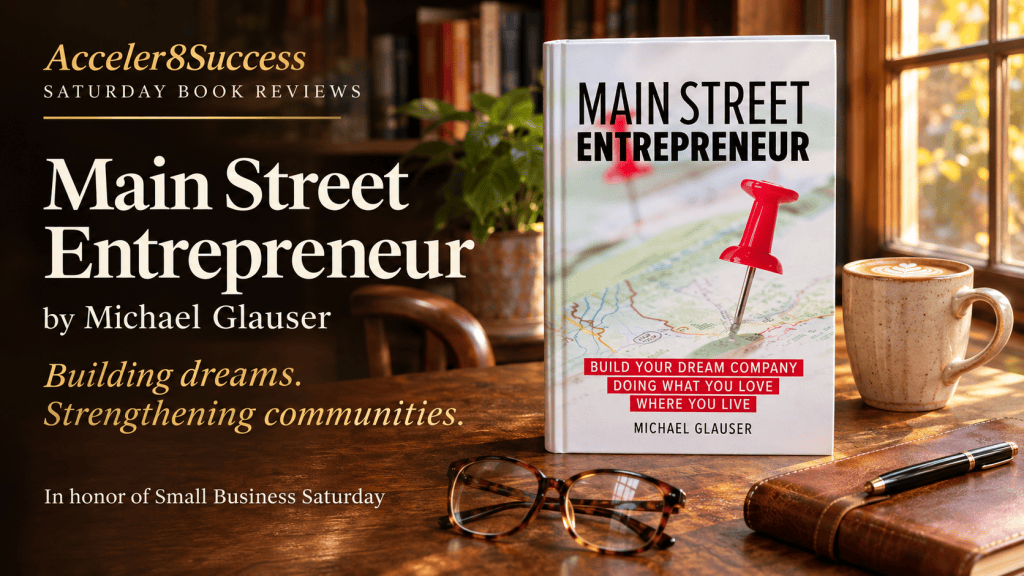
In honor of Small Business Saturday, founded by American Express in 2010, this week’s Acceler8Success Saturday Book Review features Main Street Entrepreneur: Build Your Dream Company Doing What You Love Where You Live by Michael Glauser. As we celebrate the occasion on November 28, the book offers a fitting opportunity to consider both the people behind our local businesses and the work required to keep those businesses strong.
Glauser built the book around an unusual research journey: a roughly 4,000-mile bicycle ride across America, interviewing entrepreneurs along the way. From those conversations, he developed nine keys to building a business, with attention to purpose, community needs, supporting relationships, customer service, and a life the owner wants to live.
What appeals to me about that approach is its proximity to everyday entrepreneurship. The owner unlocking a storefront, the couple preparing for the lunch rush, and the service professional following up after a job all have something to teach us about building a business.
Their decisions deserve thoughtful attention. So do their ambitions.
Last week’s review of 10x Is Easier Than 2x raised questions about focus, growth, and the responsibilities an owner must reconsider. This week’s selection brings another question into that conversation: What do we want the business we are building to mean to ourselves, our customers, and our community?
A business can have considerable significance while serving a relatively small geographic area. Providing dependable employment, earning customer trust, supporting a family, and creating something worth passing on are substantial entrepreneurial achievements.
One of the book’s strongest themes is the relationship between purpose and the work itself. In an excerpt, Glauser describes entrepreneurs motivated by solving problems, creating local jobs, and contributing to their communities. He connects that purpose to perseverance, standards, and the ability to attract people who share the mission.
For me, the practical question is whether that purpose is visible in everyday decisions.
An owner may say the business exists to serve families. Does the scheduling process respect their time? Does the restaurant make it easy for a parent to manage a meal with young children? Does the service company explain the work clearly before asking the customer to approve it?
Purpose becomes meaningful when a customer can experience it.
At the same time, a business needs the financial capacity to keep delivering on its promises. An owner who wants to create good jobs must understand what the business can afford. Someone committed to exceptional service must price the work to support the people and resources that service requires.
My takeaway is that purpose should guide the model, while sound operating decisions help sustain it.
Glauser also draws a useful distinction between having an idea and identifying a business opportunity. His framework considers need, experience, resources, customers, and the business model. That is particularly relevant for aspiring entrepreneurs who know what they would enjoy doing but have yet to determine who will pay for it.
Before committing to a lease or purchasing equipment, I would encourage them to investigate the community they intend to serve. Talk with potential customers. Observe existing choices. Learn what people find inconvenient, unreliable, or missing. Then test whether enough customers value the proposed solution at a price that makes the business viable.
Those conversations are equally valuable for an established owner. A neighborhood changes. Customers develop different routines. A service that once stood out can become commonplace. Remaining close to the market requires curiosity long after opening day.
The book’s emphasis on customer relationships makes it especially relevant to Small Business Saturday. Glauser encourages owners to deliver service that exceeds expectations and gives customers reasons to become enthusiastic advocates.
My application of that idea begins with consistency.
Did someone answer the phone? Was the order correct? Did the employee follow through? When something went wrong, did the customer receive a clear response and a reasonable resolution?
A memorable gesture has greater value when the ordinary experience is dependable. A customer who receives a warm welcome today should encounter the same care on a quiet Tuesday in February.
That is an important consideration for businesses welcoming new customers this weekend. The opportunity extends beyond today’s transaction. Every visit can provide insight into what customers want and an opening to earn another visit.
For a restaurant, that might mean making first-time guests aware of a convenient weekday lunch option. For a retailer, it could mean helping someone find the right item and explaining a useful service they did not know was available. The follow-up should fit the customer’s interests and permission.
Another useful theme is the importance of a supporting team. Glauser discusses mentors, partners, and relationships that bring expertise the entrepreneur does not possess. For an owner accustomed to handling nearly everything, this deserves attention.
Knowing the product does not automatically prepare someone to manage cash flow, develop employees, negotiate a lease, or plan an expansion. A trusted advisor can challenge an assumption before it becomes an expensive commitment. A capable manager can identify a recurring problem the owner has stopped noticing.
The willingness to seek help belongs alongside the willingness to work hard.
There is also relevance here for franchise organizations. In my view, a recognizable brand and genuine local relationships should reinforce one another. The franchisee still has to earn trust, develop a team, and understand the community around the location.
For franchisors, that raises a practical question: How well does the organization prepare franchisees to become active, effective local business owners? Marketing materials help. So do training, sales management, community involvement, and follow-through.
I also appreciate the book’s attention to developing additional revenue streams. My caution in applying that idea is to examine the demands each opportunity creates. A restaurant considering catering needs to assess staffing, production capacity, delivery, and margins. An appealing new service can create problems if it weakens the experience existing customers depend on.
The question I would ask is whether the addition makes better use of capabilities already being developed and whether the business can execute it profitably and consistently.
As with any collection of successful entrepreneurial stories, readers should resist treating the examples as a guarantee. Circumstances differ. Demand, competition, available capital, and personal obligations matter. The book is most useful as a source of questions and principles to test against the realities of a particular business.
To put those ideas into practice, I would suggest the following rhythm. This is my application of the themes, rather than a schedule prescribed by Glauser:
- Daily: Notice one point where customers encounter unnecessary effort, confusion, or delay, and take a step toward improving it.
- Weekly: Have a meaningful conversation with a customer, employee, or neighboring business owner about needs you may be overlooking.
- Monthly: Review which products, services, and relationships contribute to profitability and repeat business, along with the resources they require.
- Quarterly: Assess whether the business is supporting the life you intended to build and identify where additional expertise or a change in direction would help.
For aspiring entrepreneurs, Main Street Entrepreneur offers an approachable way to consider business ownership close to home. For existing owners, it provides reasons to revisit the purpose, relationships, and customer needs behind the daily workload. For franchise leaders, it opens a useful discussion about what makes a location matter in its own market.
Michael, thank you for bringing attention to entrepreneurs whose work enriches the places they call home, and for encouraging others to consider what they might build in their own communities.
This Small Business Saturday, I encourage readers to visit a local business, make a purchase, share a recommendation, and give an owner a reason to feel that the work is appreciated. Then carry that support into the weeks and months ahead.
And if you are the owner, consider what you want people to remember after they leave.
What will give them a reason to return? Who will they tell? What can you do today to make the relationship stronger?
A business your community would miss is worth building—and worth supporting.
About Acceler8Success Saturday Book Reviews
Published every Saturday at Acceler8Success Cafe, this series explores books that help aspiring entrepreneurs, business owners, and experienced leaders start, grow, and lead their businesses. Each review brings Paul Segreto’s entrepreneurial perspective to the ideas presented, examining their relevance to real business challenges and opportunities for everyday application. The goal is simple: accelerating entrepreneurial success through reading, reflection, and practical application.
Discover more from Acceler8Success Cafe
Subscribe to get the latest posts sent to your email.

You must be logged in to post a comment.