I believe anything a franchisor does should be done to benefit the franchise brand and as such, franchise relationships. The digital world plays perfectly into this philosophy as it affords interactivity at all stages of the franchise relationship – from inquiry through award while trickling into consumer awareness. This is especially the case for startup and emerging franchise brands.
From prospecting for qualified franchise candidates to supporting the first wave of franchisees, the utilization of digital tools creates environments that strengthen relationships, shares information, provides two-way communications, and provides points of reference for follow up.
Doing so creates a multi-tiered platform of information and interaction that benefits both franchise development and consumer proposition efforts alike. Often, simultaneously. That is the power of personal branding!
For franchise startups and emerging brands, the founder’s vision of the concept is paramount to future success. The founder is perceived as the concept. In the earliest of stages, he or she are essentially the brand. At least until a significant number of franchises are awarded and brand awareness is established across multiple markets, the founder is the inspiration for franchise candidates.
The benefits to spreading this message through digital channels and outlets such as social media, blogs, podcasts, etc. are that these tools and associated strategies will generate direct excitement about the business concept and the brand. As well, it will generate subliminal, subtle interest in the franchise concept.
This all establishes a strong foundation for growth. It also defines a very worthwhile, visible support mechanism for franchisees as the consumer proposition is fortified by the digital activity. Passion becomes ignited at all points of contact. Brand loyalty quickly follows suit.
It’s all centered around the founder’s vision and a personal touch that candidates and consumers desire. The vision becomes the brand and vice versa.
Essentially, it all starts and continues with personal branding for the founder to the point the founder becomes synonymous with the brand even if his or her name is not part of the brand name.
In 1994, just two years before he returned to Apple, Steve Jobs was interviewed by the Santa Clara Valley Historical Association. In a video excerpt from this interview, Jobs talks about his discovery of one simple, but monumental secret of life.
“When you grow up you tend to get told that the world is the way it is and your life is just to live your life inside the world…try not to bash into the walls too much, try to have a nice family life, have fun, save a little money. But that’s a very limited life. Life can be much broader once you discover one simple fact. And that is everything around you that you call life, was made up by people that were no smarter than you. And you can change it, you can influence it, you can build your own things that other people can use.
The minute that you understand that you can poke life and actually something will, you know if you push in, something will pop out the other side, that you can change it, you can mold it. That’s maybe the most important thing. It’s to shake off this erroneous notion that life is there and you’re just gonna live in it, versus embrace it, change it, improve it, make your mark upon it.
I think that’s very important and however you learn that, once you learn it, you’ll want to change life and make it better, cause it’s kind of messed up, in a lot of ways. Once you learn that, you’ll never be the same again.”
When signing on the dotted line for a franchise, yes, a business contingency plan should be in place and the plan should begin with the end in sight.
Huh? What? Really?
Yes, the business contingency plan must include an exit strategy. It’s actually the first place to start as it addresses the “what if” questions that must be answered before a problem occurs. It always helps to be prepared. It also helps for all parties to be aware.
The exit strategy must include a plan for predetermined events like retirement. As well, it must be in place in case of unforeseen events that typically occur as a result of poor sales, and in some cases as a result of employee theft, mismanagement, poor health, etc. and the repercussions that come from these instances that often blindside all parties.
Unfortunately, it’s human nature to only look at the positives of a relationship, personal or business. How many couples avoid the issue of prenuptial agreements because they don’t want to start off on the wrong foot? Or because it’s just too difficult to have the conversation? Maybe the sentiment is that it will jinx their relationship or provide an out to the party not willing to work at the relationship? The same is certainly true in the franchise relationship.
However, in both cases it is prudent to look at the potential downside and have as many of the potential scenarios outlined ahead of time. If nothing else, at least it keeps everyone focused on the potential consequences of failure – something that may provide them even more incentive to succeed. After all, it is easier to fail than it is to succeed, mostly because the momentum going downhill is quicker. As such, it’s easier for things to get out of control, and fast if a plan is not in place.
In most cases of franchisee failure, there’s no way it can possibly be a surprise to anyone. Certainly, it shouldn’t be a surprise. Trends become evident and it would take a tremendous amount of shear stupidity and ignorance for anyone to believe a franchise location closing is a surprise. I guess we could chalk it up to the “head in the sand” scenario? Possibly on both sides of the relationship.
My recommendation to franchisees and franchisors alike is to have a business plan in place at the beginning, complete with an exit strategy. It should be discussed between all parties to the franchise agreement. All must understand mutual obligations upon termination. Communicate, communicate and communicate must be the case throughout the relationship from franchise disclosure to the closing of the franchise location – and all points in between!
Notice the one thing missing is “dis.” To use the street slang of “dis”, make sure you don’t dis communications, don’t dis obligations, and don’t dis responsibility. For anyone that doesn’t know what dis means, it’s most easily defined as “ignoring and/or disrespecting.” Again, this is paramount on both sides of the relationship.
My advice to franchisees, don’t get all starry-eyed at your franchisor like you’re in love. Realize it’s a business relationship and make sure all parties to the agreement, including yourself, live up to their obligations. To franchisors, be sure to do your part, as proactively as possible.
Sure it’s easy to refer to the franchise relationship as one of family but there is such a thing referred to as dysfunctional families, right. Shit happens, right? And when least expected!
Further, to all parties involved in the relationship, when trouble is on the horizon, do not, I repeat, do not put your respective heads in the sand. Keep in mind that when heads are in the sand, your most vulnerable ass-ets are exposed to the entire world leaving everyone at a distinct disadvantage. Especially, as the rumor mill starts to heat up.
Below is a link to a great article about business contingency plans:
A while back, I started a discussion on LinkedIn about whether or not transitioning corporate executives made good franchisees. Most responses came from individuals from within the franchise industry. Some, from outside the industry. Several responses were based upon actual experience while some were simply opinion.
For our readers’ benefit I’ve listed below a handful of the responses which I feel provide a fair cross-reference of responses. In doing so, I’ve given credit for each response but only according to respondents’ titles as identified through their LinkedIn profiles.
Guerrilla Marketing Coach, behavioral analyst, speaker, author, student of life
“Really interesting question. In my ‘past life’ I worked in franchising and my general observation is that while a franchise offers a great framework and tool-kit for someone starting a business, it does not guarantee success.
People who buy a franchise understanding that they will have to work (and hard) to grow a successful business, and who are committed to using the franchisors tools and resources, are likely to be quite successful. On the other hand, those who think that a franchise is going to be a ‘magic pill’ that allows them to prosper without putting effort into it are surely destined to something far less than success.
Anyone looking at a franchise should take their time, talk to other current (and former) franchisees, find out what is involved in order to succeed, and what may contribute to failure within that particular franchise. Then, each person has to look deep into themselves to understand if they are truly prepared to start a business…”
Franchise Information, Mentoring & Development Professional
“Interesting question, Paul. As I’ve thought about it, I don’t think it’s an easy question to answer. Or the answer would have to be fairly simple, such as Yes and No! (Not very helpful, I realize).
Maybe we could ask the question another way. How have franchisors succeeded when they awarded franchises to transitioning executives? . . . Puts a little different emphasis on it.
We sometimes look at franchise success as up to the franchisor – i.e. it’s the franchisor’s job to be sure franchisees succeed, and that includes transitioning executives. But of course we know that not all franchisees, including transitioning executives, are created equal. Some are better than others! People in transition may, in fact, not make very good decisions – they may panic and jump into a franchise too quickly and they don’t do all the homework that’s necessary or they don’t at least ask all the right questions.
It would be interesting for franchisors to reveal how ‘transitioning executives’ have fared in the past, though that’s probably asking a bit too much. Because again, even if the transitioning executives failed, it doesn’t mean the franchise system is a bad one. Maybe the brand is not a right fit for a transitioning executive, but that’s probably incorrect. Would that be like saying it’s not right for left-handed people? I just don’t think ‘transitioning executive’ matters. What matters is how well prepared the candidate is for franchising and whether or not the candidate picked a good franchise for him or her. Because we also know that all franchisors are not created equal, either. Some are better than others – and I bet there are some that could tell us 100% of the transitioning executives that joined them succeeded.”
Director of Operating Systems at a National Foodservice Franchisor
“It depends…. There is a significant difference between being a corporate executive and a franchisee. As a corporate executive of a brand you have a wide and deep support system with interdepartmental experts that can solve problems or point you in the right direction with one phone call.
As a franchisee you are ‘it’, unless you buy into a multi-unit franchise that can afford a support system that can make up for the skills that you lack or for skills for which you lack experience (accounting, finance, legal, HR, workers comp., marketing, training, operations, etc., etc., etc.).
The corporate executives that I have seen succeed are those that had an entrepreneurial mindset or prior experience running a business and quickly understood that forming a support system (internal or external) was crucial. It is not that corporate executives don’t want to do the hard work, it’s just that they are not used to think at the level of detail that is necessary to be successful at each level and therefore, they may not be familiar with all of the intricacies of running a business.
Franchisees need to be generalists and not specialists. Corporate executives are usually very good at the role that they had in their corporate career. While they will understand the brand’s perspective and strategy better than the average franchisee, they would only make the best franchisees if they are able and willing to adapt quickly to the demands of being a small business owner.”
“I doubt there are reliable statistics to support an empirical conclusion to your question.
However, my opinion for what it’s worth is that when people make decisions to become franchisees out of desperation to replace a job/income it can be problematic as opposed to someone who transitions from employment to self-employment on their own terms.”
What do you think? Do transitioning executives make good franchisees?
I’d love to hear your thoughts and perspective on this topic, especially as franchising is once again realizing an influx of transitioning corporate executives explore franchising. A trend that is certain to continue as we face financial challenges and economic uncertainty.
Please feel free to post your comments in the appropriate section, message me on LinkedIn, or send an email to me at Paul@Acceler8Success.com.
Have you ever looked back at content you had developed in the past and thought about its relevance then, and today? If you have, I’m sure it has raised a lot of questions as it does for me ranging from what the heck was I thinking to wow, I was really onto something or that’s as relevant today as it was back then?”
This morning I decided to go back, way back to my first blog post. The date was February 5, 2009 – almost 13 years ago! Blogging was relatively new. The only blogger I was aware of in the franchise space at the time was Joel Libava As proficient as Joel was at the time it was clear he had been at it for quite awhile, even at that early date. There may have been others, but Joel was not only The Franchise King, he was also in my mind, The Franchise Blog King!
As many will recall, 2008 and into early 2009 was the beginning of a very rough spell for the economy and of course, for franchising. Interesting, here we are again as we’re facing similar circumstances. As such, I believe my first blog post under my initial platform, franchisEssentials – WEB 2.0: A Jungle for Franchise Development is relevant today. Albeit it may need some minor edits, or does it?
To that end, today I’m sharing the post exactly how it was published back then and asking you to share your comments and suggestions on what should be changed for the here and now. I certainly look forward to your insight and perspective. (Although, please be kind and refrain from critiquing my poor writing skills – thank you!)
Web 2.0 – A Jungle for Franchise Development
Franchise Development is no stranger to change. The industry adapted well to the internet when it integrated its then traditional marketing at tradeshows with development of elaborate websites. Next, the industry adapted again as it integrated its marketing efforts and web presence with franchise consultants and brokers through a multitude of franchise portals.
Well, as Bob Dylan once wrote, “…the times they are a-changing.” Much has been written and spoken about weeding through the many tire-kickers experienced on the internet, shuffling from one portal to the next with the same non-objective to “see what’s out there.” The franchise industry has literally seen thousands of these leads with no purpose, no chance of ever presenting a franchise opportunity.
Instead of trying to catch fish in a wide open ocean, why not direct your attention to the fish in a lake, pond or even, a barrel? That’s correct, a barrel! In searching for qualified franchise candidates, we, as an industry, need to locate the barrels of candidates that exist in the market today. How do we accomplish this seemingly insurmountable task? We need to embrace new technology and integrate the same with traditional efforts. Specifically, Web 2.0 (and Social Media) technology, and all it has to offer.
Unfortunately, Web 2.0 technology is so extraordinary, consisting of many different aspects. Including such familiar buzzwords as social media, social networking, wikis, webinars, video sharing, blogs, podcasts, just to name a few, the thought of stepping foot into the Web 2.0 jungle is daunting, and therefore, often delayed. So, as the old adage of how one could eat an entire elephant (of course, one bite at a time), we need to take small bites out of the Web 2.0 elephant and step through the jungle carefully, one step at a time.
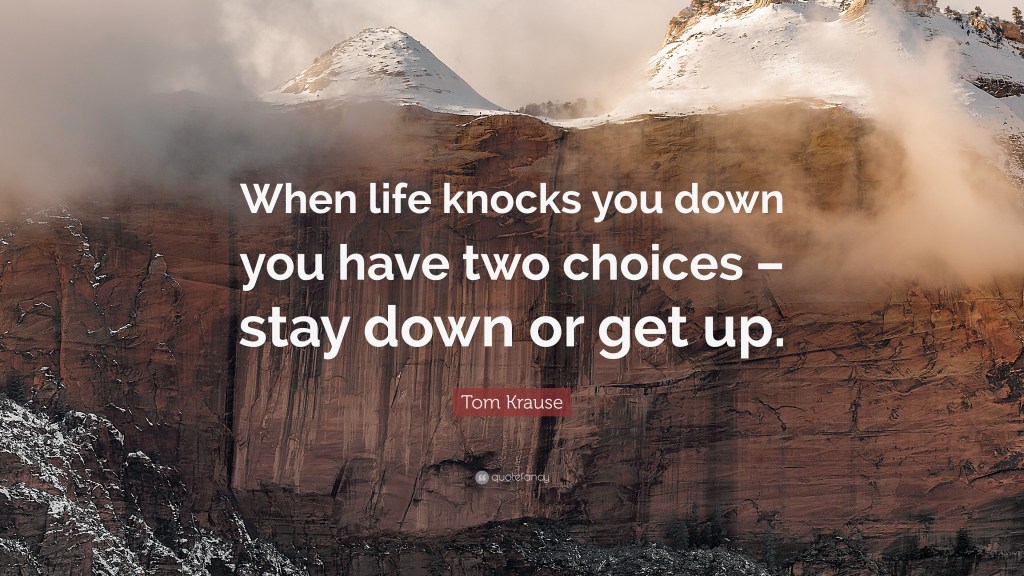
“Life has knocked me down a few times. It has shown me things I’ve never wanted to see. I experienced sadness and failures. but one things is for sure, I always get up.” – Unknown
A conversation the other day had me thinking long and hard about this quote. Sometimes it’s easier said than done, but it’s always possible to get back up. Honestly, I should practice what I preach. Well, not so much to get back up, but to do so quickly and without leaning on excuses. Even if there are justifiable reasons, they’re still excuses. I should know better. I do know better. So, from me to you, here are my thoughts on getting back up after being knocked down by life.
When life knocks you down, you MUST get back up. Always!
Often, it’s quick to jump right up on your feet. Other times it takes getting up on one knee and pulling yourself up, sometimes holding onto something, but all the while progressing to an upright position. And yes, there are times you’ll actually stumble and fall back down, but you must push again to get back up.
If an unforeseen weight causes you to fall down and is making it difficult to get back up, find a way to push it aside. Dig deep inside for extra strength, for the will to get out from under it, crawling out if you must.
When all is said and done, you must get back up. You can do it. You must do it.
Now, I’m thinking about what I believe is one of the greatest motivational and inspirational speeches in movie history. The speech I’m referring to is by Rocky Balboa to his son… I believe that anyone that has seen the movie, Rocky Balboa will remember the speech but whether you do or not, take a minute or two to read through the words below:
“Let me tell you something you already know. The world ain’t all sunshine and rainbows. It’s a very mean and nasty place and I don’t care how tough you are it will beat you to your knees and keep you there permanently if you let it. You, me, or nobody is gonna hit as hard as life. But it ain’t about how hard ya hit. It’s about how hard you can get hit and keep moving forward. How much you can take and keep moving forward. That’s how winning is done! Now if you know what you’re worth then go out and get what you’re worth. But ya gotta be willing to take the hits, and not pointing fingers saying you ain’t where you wanna be because of him, or her, or anybody! Cowards do that and that ain’t you! You’re better than that! I’m always gonna love you no matter what. No matter what happens. You’re my son and you’re my blood. You’re the best thing in my life. But until you start believing in yourself, ya ain’t gonna have a life. “
Over the past few weeks, I’ve shared my thoughts about change. The title of a particular article I had read as part of my research made a light bulb go off in my head. It was extremely thought-provoking:
If You Want To Create Change, Change Your Perspective.
Then this…
Every so often, whether in Facebook Memories, in Google Alerts, in a Google search of a related topic, or as someone reminds you, an experience from years ago is brought front and center. I always find it interesting to reflect upon the same, always curious to see if my perspective might have changed or remained steadfast.
For business, it also serves as a reminder of what may have been working that I’ve moved away from, especially in recent years.
As I’m writing this, I recall a thought shared with me by a leading franchise founder some years back. We were talking about system improvements that needed to be made when he expressed his frustration. It was about a process that he had built into his franchise system but that of late had mostly been ignored.
He said, “We’ve always done X and with great results, so much so that we stopped doing it!”
I understand his frustration more and more today than ever before. Albeit, the frustration is with myself.
It was at that same point in time that I was interviewed by Lizette Pirtle, CEO of Expansion Experts. Lizette had the vision of creating a series that, in essence would document franchise success AND provide information to newcomers to franchising that would help them succeed. I was humbled to have been asked to share my perspective. Especially, as it was at a point in my career when things were moving extremely fast and with a laser-focus on franchise success. It was just prior to completing my acquisition of Franchise Foundry AND accepting the position of CEO at FranchisEsource Brands International, the overarching brand of The Entrepreneur’s Source and AdviCoach.
I bring this up as in my Facebook Memories today, Lizette’s article appeared. I believe it to have popped up at a perfect time for me…
Franchise Success: It is All in the Culture by Lizette Pirtle
Paul Segreto, CFE, is the CEO and President of Franchise Foundry and serves as the CEO of several of their clients’ companies. I met Paul in 2009 upon my first engagement in Social Media. From day one it was obvious that Paul was a man of honor. I loved his honesty, his straightforward style, his heart, his thirst for knowledge–and most of all, his passion for franchising and for sharing and helping others. Paul has a rich franchising history having been a franchisee as well as leading several franchise companies in many management roles. He is the first one to talk about the ups and downs of his career and all the lessons he has taken from both turns. Paul is always filled with great ideas; his mind never stops, always learning, and always passing on the lessons. He never rests and never gives up; his tenacity and perseverance are equal to none. I was thus delighted when he agreed to be part of this study on Franchise Success.
Paul first defined Franchise Success academically as: “the combination of bottom line profitability and bottom up profitability and growth.” In other words, “You can’t kick in high gear the growth of your franchise network until you have unit and overall company profitability,” Paul explains. “But, it is really all about culture,” he shares as he starts getting into his passion. “Franchise Success is about building a culture that creates positive, memorable experiences at all levels and at all times. Many franchisors get this at the customer’s level, but forget about it when it comes to their franchisees or their staff. It has to be a culture that produces these types of experiences for everyone,” Paul goes on.
“So how do you do that?” I asked. According to Paul, it comes from the realization that success is not a permanent state. He says, “You can go from total success to total failure in an instant if you take your eye off the goal. You must have processes and procedures in place and you must make sure that they are followed at all times. You also must be constantly aware of and foster the interdependent relationship that exists between the franchisor and the franchisee.”
Paul considers the greatest challenge he’s had to face in franchising as “getting franchisees to realize that you truly have their best interest in mind. When a relationship is fragmented, trust disappears, and without it, healthy relationships can’t exist.” Paul has always found himself in situations where he has had to introduce a new way of doing things and has inherited cultures that haven’t been the most conducive to true and honest communication. Although he thrives in the challenges of making a difference and turning around companies, he also has to deal with recreating rather than creating, which is always more difficult to do.
Paul believes that as important as trust is in a company’s culture so is the resilience of its members. The ability to change is crucial for the longevity of franchise companies. “Moving your brand forward requires you and all of your franchisees and staff members to adapt to change. Comfort levels are shaken when we embrace change, so not everyone is going to like you; and I am OK with that,” Paul shares.
Paul deals with these challenges in his usual honest and straightforward style: “By putting my money where my mouth is; by knowing that I must earn the right to people’s trust, that I must lead by example and that I must put my ego aside and say ‘I am sorry’ when needed and try a different approach.” Paul does not sugar coat his communications with franchisees, or anyone else for that matter. He helps them understand how their results are directly related to their actions, and also to their lack of action. The company cultures he creates are not only resilient and trust-filled, but they also include personal accountability at all levels as well as transparency.
When talking about what is required to replicate success, my conversation with Paul got even more interesting. “Here we face an oxymoron. When we think of franchising we think of doing the same thing over and over again all over the place; but to really replicate success franchisors need to be discerning and they need to modify the concept according to the conditions present, be it economic or regional differences.” Paul continues, “For example, take McDonald’s, why have they been so successful? They have adapted. Today the locations look different depending on where they are. You have urban locations, suburban ones, and specialty ones like the one in Asheville, NC, where you live. The menus also change. So, what’s stays the same? The culture: clean bathrooms, attention to details, management controls, and some core menu items.” Paul summarizes, “To replicate success, a franchisor must be quick to adapt and change and tweak the concept slightly to ensure it works in the new area of growth or under new economic conditions without compromising the culture that is identified with the brand.”
Paul has some great tips for those who are considering franchising their businesses. He says:
– Make sure you understand that when you franchise you are no longer in the business you used to be. You are now in the business of franchising, which is all about process, procedures and relationships.
– Keep your eye on the details: ALL OF THEM.
– Give back to the community, and remember you are now entering the franchise community.
– And, most importantly: From the beginning make sure to build a culture that produces POSITIVE, MEMORABLE EXPERIENCES AT ALL LEVELS AND ALL OF THE TIME.
Again and I can’t say it enough, Thank you, Lizette!
Reading Lizette’s article again along with the following quote and my recent articles linked below are all for me driving forces behind my continued self-reflection on many, many things.
“Without reflection, we go blindly on our way, creating more unintended consequences, and failing to achieve anything useful.” – Margaret J. Wheatley
It all has me motivated to keep moving forward on my goals for 2023, making changes as necessary. As well, it has me laser-focused on not making the same mistakes again… for my benefit and certainly for the benefit of others.
Who hasn’t seen the phrase “organizational skills” listed as a requirement of a position? It might seem excessive that this vague term is so in demand, but the possession of organizational skills can make or break your career success.
While this is true for any role, it is even more essential for a small business owner.* Because there are so many tasks to juggle on any given day, keeping everything organized is the best way to ensure you’re getting the most out of your working hours.
Read on for a look at the essential organizational skills to propel your small business toward success:
Scheduling. More than just scheduling shifts and meetings, as a small business owner you’ll be expected to schedule every aspect that goes into running your business. From scheduling progress check-ins for projects to scheduling incentive programs for sales goals, the ability to create a schedule and stick to it is essential to running your business.
Delegation. It’s impossible for one person to handle everything that needs to happen to keep a business running smoothly—that’s why delegation is key. By delegating, you’re lightening the load on your own shoulders while empowering your team to tackle the difficult tasks.
Time Management. In many jobs, your time is managed for you. You’re provided with small goals on the way to larger accomplishments and project timelines are completed at your own manager’s discretion. However, as a small business owner, those project timelines and daily tasks are set by you.
People Management. Managing is commonly regarded as a “people skill,” but it takes organizational savvy as well. Planning evaluations, building a successful team and orchestrating group meetings may not be the leadership tasks that get all the attention, but they’re just as integral to being a respected and regarded manager.
Preparation. Being prepared is the key to staying on top of your business routine. Whether it’s taking notes before a meeting with your staff, franchisor, or banker or jotting down the next to-do list at the end of the day, starting off on the right foot will keep you from playing catch-up when you should be looking ahead.
*Note: Small Business Owners include small independent business operators (Mom & Pop), franchisees, restaurant operators, professional services providers (law offices, medical offices) and even solopreneurs with staff.
Getting Things Done: The Art of Stress-Free Productivity by David Allen
Since it was first published almost fifteen years ago, David Allen’s Getting Things Done has become one of the most influential business books of its era, and the ultimate book on personal organization. “GTD” is now shorthand for an entire way of approaching professional and personal tasks, and has spawned an entire culture of websites, organizational tools, seminars, and offshoots.
Allen has rewritten the book from start to finish, tweaking his classic text with important perspectives on the new workplace, and adding material that will make the book fresh and relevant for years to come. This new edition of Getting Things Done will be welcomed not only by its hundreds of thousands of existing fans but also by a whole new generation eager to adopt its proven principles.
Spending some time very early this morning reflecting on the past year and thinking about the year ahead, a year that may have us facing new, unprecedented challenges, I found myself being self-analyzing and very self-critical. My mind was racing about possibilities but quickly turned to what it would take to turn possibilities to opportunities to success.
Many that know me know that I’m a very creative, innovative person. But I know all too well that ideas are worthless without taking action. I need to put those ideas into action. It’s who I’ve been. And it’s who I need to be once again, now more than ever.
I asked myself the following simple question that I believe sums up the foundation of my action plan for the new year:
If I were to do all that I believe is necessary to be done to achieve success in 2023, would it be possible to fail?
Living by a great Tony Robbins quote will be an important motivating factor…
“The path to success is to take massive, determined action.”
However, due to prevailing challenges and an evolving business environment, I also realize it’ll take extreme focus – something that had never been an issue before. I realize I must commit to this without fail – a personal commitment that I know is essential to drive my efforts to a new level, to new heights embracing the changes (personal and business) necessary to do so, staying focused, and this is paramount… on the most important tasks!
It will also mean diligently following through (and following up) each step of the way, and not resting on my laurels and past success. After all, as Babe Ruth once said,
Is a college degree truly necessary in order to have a successful future in business? This was the basis of an article at AllBusiness.com, Is College Necessary for Success?
Insights and perspectives are shared by 9 business leaders under the points listed below. Although, in retrospect I wish I had been able to ponder over each heading before reading the entire article. Maybe even view each as a statement to be considered as true or false? Try it for yourself…
1. College isn’t necessary, but it can teach useful skills.
2. The internet has brought education to the masses.
3. A successful future requires education, not college.
4. College may not be necessary if you have high potential.
5. Securing a trade is a fine choice.
6. College improves your earning potential and networking.
7. Employers view college as a wise investment.
8. Only certain career paths require a degree today.
9. College makes you competitive.
My Insight and Perspective
First and foremost, considering the varying costs of tuition from state colleges to private universities, I still believe a formal education is worth it and more than likely will help open doors in one’s career. That said, like anything else, it’s what a student makes of it.
Understanding the job market and industry trends must be considered, but too often is not. As such, a degree in African Art or Greek Mythology may fulfill a student’s interest in the subject and possibly their passion for learning, but it’d be a long shot as a career path, and especially if the degree is earned at an expensive private university. I believe being practical and realistic is paramount when deciding upon a major course of study.
As for the question about whether a college degree is necessary for success, it seems that only two paths are being considered when the statement is made that college is not for everyone – trade school or college. What about the option for those who would be “right” for college that possibly decides he or she just wants a different path for their future and trade school or even joining the military are not of interest to them?
Starting a business could be a viable path if not for financial barriers. It’s much easier to secure funding for education than it is for business. Multi-generational business partnerships are a viable option. Freelancing and side gigs are viable, as well. Of course, where there’s a will, there’s a way.
But, what would help improve the probability of success? Would it be feasible to develop an entrepreneurship school along the lines of a trade school to help create a foundation for a young person to choose a path toward entrepreneurship and business ownership? Would attendance at such a learning institution help to build traditional and private lender confidence? Could it also provide an option for individuals that may want to shift career paths after working 5–10–15 years?
It’s been said that entrepreneurship will drive our country’s economic recovery and provide a foundation for the future. Yet, what’s being done to help our younger generations explore and prepare for entrepreneurship? After all, they will soon represent the majority of our labor force and is enough being done today for them to represent the majority of future business owners?
Mind you, I’m not hunkered down into one position or another on the topic, but I firmly believe we need to be thinking about and exploring options if our country is to remain as a leader on the world’s stage.
Let’s keep the conversation moving along. I look forward to learning your thoughts and opinions on the subject.







You must be logged in to post a comment.