Tag: Leadership

The Emotional Weight Behind Franchise Leadership

National Mental Health Awareness Month: A Message to Franchisors, Brand Founders, and Franchise Leadership Teams

During National Mental Health Awareness Month, conversations often center around employees, consumers, and even entrepreneurs and small business owners. In my world, because of the fragile and often unforgiving realities of the restaurant industry, my thoughts naturally gravitate toward restaurant operators as well.

But this year, I found myself reflecting on another group.

A group that I have been close to for more than 40 years.

Franchisors.
Brand founders.
Executive leadership teams.
The individuals carrying the weight of franchise systems on their shoulders every single day.

It’s a responsibility few outside the franchise community truly understand.

Behind every franchise brand are leaders navigating constant pressure, balancing growth with stability, protecting the integrity of a brand, supporting franchisees, managing expectations from investors, vendors, lenders, and stakeholders, while at the same time attempting to preserve culture, relationships, and momentum.

Franchise leadership is not simply about operations, development, marketing, or compliance.

It’s emotional weight.

It’s waking up every morning knowing that hundreds, sometimes thousands, of individuals and families rely on your decisions, your guidance, your vision, and your ability to lead through uncertainty.

It’s the burden of knowing that when franchisees struggle, leadership feels it.

When costs rise, leadership absorbs it.

When markets shift, labor challenges intensify, margins tighten, or public perception changes, franchise leadership carries those pressures long before anyone else sees them publicly.

And unlike many traditional businesses, franchising carries a unique layer of responsibility because franchise relationships are deeply interconnected.

They are contractual, yes.

But they are also personal.

Franchise systems are built on trust, belief, expectations, shared risk, and shared opportunity.

That creates enormous pressure on founders and leadership teams to continually show strength, confidence, direction, and certainty, even during moments when they themselves may feel exhausted, overwhelmed, uncertain, or isolated.

The reality is that leadership can be lonely.

Especially in franchising.

Founders often feel they cannot show vulnerability because everyone is looking to them for answers. Executive teams frequently absorb pressure from every direction while attempting to shield franchisees and teams from instability. The higher someone climbs within an organization, the fewer places they often feel they can openly talk.

And yet, mental health matters at every level of a franchise system.

From the founder…
to the CEO…
to the franchise development leader…
to operations executives…
to field support teams…
to franchisees…
to restaurant managers…
to hourly employees.

Everyone matters.

This month serves as an important reminder that leadership strength is not measured solely by endurance. Sometimes strength means asking for help. Sometimes it means slowing down long enough to recalibrate. Sometimes it means simply checking in on one another and recognizing that behind titles, positions, and responsibilities are human beings carrying very real emotional and mental burdens.

The franchise community has always been built on relationships.

Now more than ever, we need to be there for each other.

Reach out to someone.

Check in on a franchisee.
Call a founder.
Encourage a leadership team member.
Support a colleague.
Listen more carefully.
Lead with empathy.
Extend grace.

Because the pressures facing franchising today are real, and nobody should feel they have to carry them alone.

After more than four decades in franchising, restaurants, entrepreneurship, and business leadership, there are not many parts of the franchise model I have not personally experienced in some capacity.

I understand the pressure.
I understand the responsibility.
I understand the weight that leadership can place on individuals and families.

So this month, and frankly every month, I simply want to say this:

If you need someone to talk to, someone who understands franchising beyond theory and truly appreciates the realities of leadership within franchise systems, please reach out.

Sometimes the most important conversations are the ones we never planned to have.

The Revolving Door in Restaurants Often Has Nothing to Do With Pay

I recently came across a question in a restaurant operator group on Facebook from an owner frustrated over constant turnover, particularly among line cooks. It’s a conversation happening everywhere in the restaurant industry right now.

Operators are exhausted.

Applications are inconsistent. Employees leave without notice. Kitchens become unstable. Management grows frustrated. Owners begin believing that “nobody wants to work anymore.”

But perhaps the better question is this:

Why don’t people want to work there?

My response to the operator was simple:

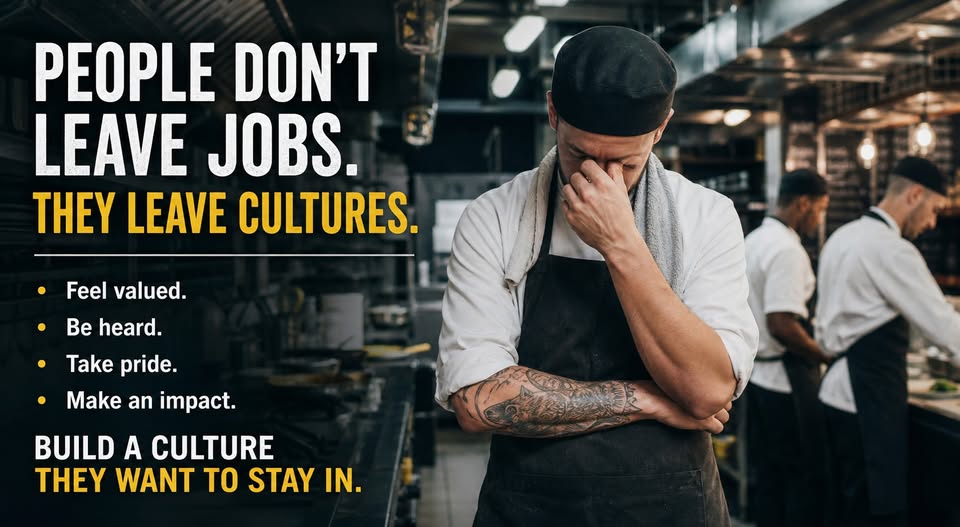
“I’d suggest taking a long, hard look at the culture of your business. Does your entire staff truly feel like they’re part of the business? Do their opinions matter? Are their concerns heard and addressed? Are they encouraged to express creativity and take pride in what they do?

If not, you’ll likely continue dealing with a revolving door of employees.

Yes, we may be talking about line cooks, but they’re human beings with a strong sense of pride and purpose. That pride has to be nurtured, respected, and fed.”

The reality is this:

Most restaurant operators dramatically underestimate the importance of culture at the hourly employee level.

Too often, culture is discussed only in terms of management teams, executive leadership, or corporate vision statements framed on walls nobody reads.

Meanwhile, the line cook working six nights a week in extreme heat feels invisible.

The prep cook who has a better system for improving efficiency is never asked for input.

The dishwasher who never misses a shift feels nobody notices.

And eventually, they leave.

Not always because of money.

Not always because of hours.

Not always because of the workload.

They leave because people want to feel valued.

Especially in restaurants.

Restaurant work is hard. It’s physical. It’s emotional. It’s stressful. It demands teamwork, urgency, accountability, and consistency every single shift. Yet many operators unintentionally create environments where employees feel more like replaceable labor than valued contributors.

That becomes dangerous.

Because once employees emotionally disconnect from the business, turnover becomes inevitable.

Culture is not free meals.

It’s not motivational posters.

It’s not an employee-of-the-month plaque.

Culture is how people feel when they walk into your building every day.

Do they feel respected?

Do they feel heard?

Do they feel leadership cares about them as individuals?

Do they feel they can grow?

Do they feel trusted?

Do they feel pride in where they work?

Those questions matter more than most operators realize.

Particularly with kitchen employees.

Great line cooks often carry enormous pride in their craft. They care about timing, consistency, presentation, execution, and teamwork. Many genuinely love the intensity and rhythm of a kitchen. But if leadership creates an environment where they are constantly criticized, ignored, overworked, or treated as disposable, that pride eventually disappears.

Once pride disappears, performance usually follows.

Then turnover follows shortly after that.

Ironically, many operators spend more time trying to recruit new employees than investing in retaining the ones they already have.

Retention starts with leadership.

Owners and managers must create environments where employees feel connected to something bigger than simply punching a clock.

That does not mean lowering standards.

In fact, strong culture and high standards often go hand in hand.

People generally rise to expectations when they feel respected, supported, and included.

The strongest restaurant cultures are usually built around a few simple realities:

Leadership is visible and engaged.

Communication is consistent.

Recognition is genuine.

Accountability applies to everyone.

Employees are treated with dignity.

Ideas and feedback are welcomed.

Pride is reinforced daily.

None of this guarantees perfection.

Restaurants will always experience turnover.

But there is a major difference between normal turnover and constant instability.

One is operational reality.

The other is often cultural failure.

Restaurant operators today are competing for more than customers.

They’re competing for people.

And the businesses that win long term will not necessarily be the ones paying the most.

They’ll be the ones building environments where people genuinely want to stay.

Because when employees feel valued, respected, challenged, appreciated, and connected to the mission of the business, they stop feeling like “workers.”

They begin feeling like part of a team.

And that changes everything.

If you’re a restaurant operator, franchisee, founder, or leadership team member struggling with turnover, culture challenges, operational inconsistency, or team engagement, perhaps it’s time for a different conversation.

Not just about labor.

But about leadership.

Not just about staffing.

But about culture.

Sometimes the issues facing a restaurant business are not operational at all. Sometimes they stem from deeper disconnects within the organization that leadership has either overlooked or simply become too close to see clearly.

I welcome the opportunity to have a direct conversation about your restaurant business, franchise organization, or brand.

Sometimes an outside perspective can help identify what’s really happening beneath the surface.

Feel free to reach out to me directly by email at paul@acceler8success.com to start a conversation.

The Quiet Struggle Behind Franchise Leadership

As the weekend winds down and the week ahead is in sight , the quiet for many franhcisors isn’t peaceful… it’s heavy.

Another week ahead. Another round of questions that don’t seem to have clear answers.

What is it really going to take to make our franchisees successful?

Is there ever a week where everything just… works?

Or is this simply the reality of leading a franchise system; constant friction, constant pressure, constant uncertainty?

You think about where to begin. Do you focus on struggling units? Brand consistency? Marketing? Operations? Leadership? Culture?

Everything feels important. Everything feels urgent.

And somewhere in that swirl, a more difficult question surfaces…

Is it worth it?

Will the effort, the time, the energy, and the constant push actually be appreciated? Will it translate into stronger operators, better performance, a healthier system?

Or are you just preparing to repeat the same conversations again this week?

Here’s the truth most don’t say out loud: this is more common than you think.

I’ve had countless conversations with franchisors sitting in this exact moment. Successful brands, growing systems, experienced leaders, and yet, the same underlying questions persist.

Because franchising, at its core, is not simple. It’s not linear. And it’s certainly not easy.

But it is addressable.

Not by trying to fix everything at once. Not by reacting to the loudest issue in the moment. And not by accepting that “this is just the way it is.”

It starts with clarity.

Clarity on what truly drives unit-level success. Clarity on where your system is aligned and where it’s not. Clarity on what needs immediate attention versus what needs disciplined, deliberate development.

Then it requires focus. Real focus. The kind that says, “We’re going to address this first, and we’re going to do it right.”

And most importantly, it requires a willingness to confront the hard truths about your brand, your systems, your support structure, and your leadership.

This isn’t about having a perfect week.

It’s about building a system where more things go right than wrong… by design, not by chance.

If this feels familiar, you’re not alone.

And no, it’s not easy. Not at all.

But it must be addressed.

If you’re heading into this week with more questions than answers, let’s start a conversation. I’ve been part of these discussions many times, and sometimes all it takes is stepping outside the noise to begin seeing things clearly again.

Reach out to me directly at paul@acceler8success.com or send me a message.

Let’s figure out where to start, and more importantly, how to move forward.

Franchise Leadership Starts With a Simple “How Are You?”

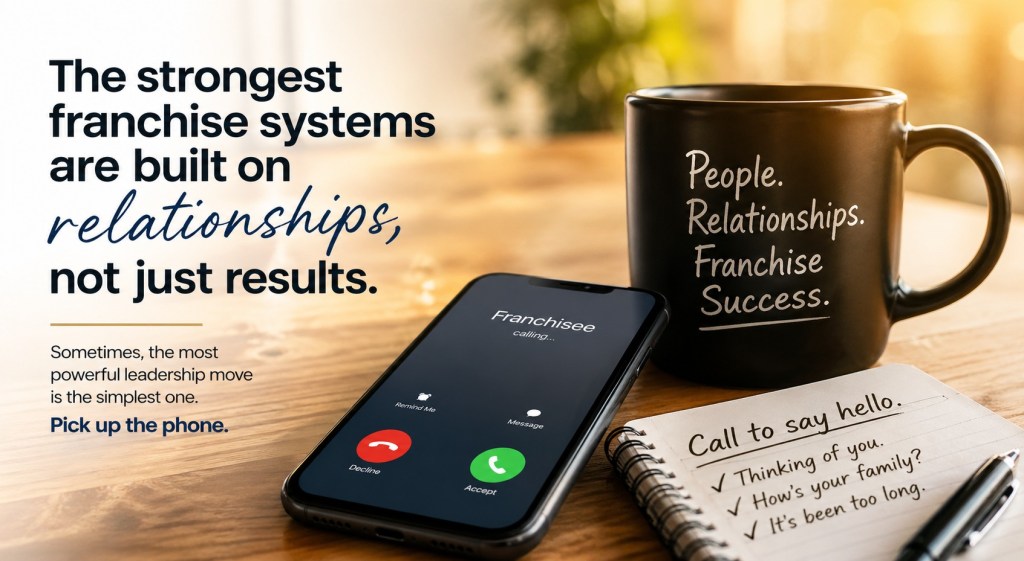
When was the last time you picked up the phone and called one of your franchisees… just to say hello?

Not about numbers. Not about performance. Not about a promotion, a new rollout, or a compliance issue. Just a simple, human conversation. Thinking of you. How are you? How’s your husband or wife? How are the kids? It’s been awhile… too long, actually, and I wanted to check in.

For many franchisors and brand leaders, that moment is rare. Not because they don’t care, but because the business gets in the way. There’s always something urgent, something measurable, something that demands attention. Calls become scheduled, structured, and purposeful. Agendas take over. Relationships quietly take a back seat.

But here’s the reality. Franchise systems are not built on operations manuals, technology platforms, or marketing calendars alone. They are built on people. On trust. On connection. And those things don’t grow through transactional conversations.

They grow through moments that aren’t required.

A franchisee who hears from you out of the blue, with no agenda, experiences something different. There’s no pressure in the call. No expectation. Just presence. Just a reminder that they are seen not as a unit number, not as a revenue stream, but as a person who chose to believe in your brand.

That matters more than most leaders realize.

Think about the journey of a franchisee. The decision to invest. The leap of faith. The long hours. The stress that often doesn’t get shared. The responsibility to employees, to family, to their own financial future. It’s a heavy load, even in the best systems.

And yet, most of the communication they receive from leadership is tied to performance. Improve this. Fix that. Execute better. Follow the system.

All necessary, of course. But incomplete.

Because what many franchisees need, and rarely get, is acknowledgment without condition. A simple check-in that says, I remember you. I appreciate you. I’m here.

It’s easy to underestimate the power of that kind of call. It doesn’t show up on a P&L. It doesn’t move a KPI overnight. But it strengthens something far more valuable. Loyalty. Trust. Alignment.

And over time, those things absolutely impact performance.

A franchisee who feels connected to leadership will engage differently. They will communicate more openly. They will be more receptive to guidance. They will be more willing to go the extra mile, not because they have to, but because they want to.

Contrast that with a system where communication only happens when something is wrong. Where the only time the phone rings is when there’s an issue. Over time, that creates distance. It creates tension. It turns leadership into something to avoid rather than something to value.

The difference isn’t complicated. It’s intentional.

Make the call.

No notes. No agenda. No follow-up email summarizing action items. Just a conversation.

You might be surprised by what you hear. Not because franchisees have been waiting to unload complaints, but because they’ve been waiting to connect. To talk about life. To share what’s going on beyond the four walls of their business.

And in those conversations, something shifts. The relationship becomes real again.

Leadership, at its core, is not about directing people. It’s about understanding them. And understanding doesn’t come from dashboards or reports. It comes from moments like this.

So ask yourself honestly. When was the last time you made that call?

If you have to think about it, it’s been too long.

Pick up the phone today. Not tomorrow. Not next week when things slow down, because they won’t. Today.

Call one franchisee. Then another. No reason other than to say, I was thinking about you.

You may walk away from the conversation feeling like you didn’t accomplish anything measurable. But that would be missing the point entirely.

Because what you actually did was reinforce the foundation of your brand. And that’s something no system can automate and no strategy can replace.

And if you’re on the receiving end of that call… I know I’d love to hear from you.

Why Some Restaurants Thrive While Others Struggle in the Same Market

The restaurant industry has always operated under pressure. Tight margins, long hours, staffing unpredictability, and constant competition were part of the model long before COVID ever entered the conversation. The pandemic didn’t create those challenges. It magnified them.

But years removed from the height of that disruption, a different question is worth asking.

Are the challenges we continue to face entirely external… or have operators contributed to sustaining them?

There’s no debate that labor shortages have been real. Costs have risen. Consumer behavior has evolved. These are facts. But somewhere along the way, a narrative has taken hold… one rooted less in reality and more in repetition. A steady drumbeat of negativity has become part of the industry’s voice.

And that’s where the problem begins to shift.

Negativity, unlike rising costs or labor constraints, is controllable. Yet it is often left unchecked. It seeps into conversations, meetings, and daily interactions. It becomes the backdrop against which teams operate. Over time, it stops being commentary and starts becoming culture.

That distinction matters more than most operators realize.

In a restaurant, culture is not a concept. It is a lived experience. Employees don’t read about it in a handbook. They feel it in real time, every shift. When leadership consistently communicates frustration… about hiring, about guests, about margins, about “how things used to be,” it’s the tone that becomes embedded in the business itself.

We often talk about staffing as a supply issue. Not enough applicants. Not enough qualified people. Not enough willingness to work. But what if part of the issue isn’t supply at all?

What if it’s environment?

An employee doesn’t need a survey to understand whether a workplace is optimistic or defeated. They hear it. They see it. They absorb it. A server who hears daily that “nobody wants to work anymore” begins to disengage. A cook who is constantly reminded of rising costs may start to feel like nothing more than an expense line. Over time, effort declines, accountability softens, and pride erodes.

And then we call it a labor problem.

But it doesn’t stop there.

Negativity doesn’t just affect hiring and retention. It influences decision-making. It narrows perspective. It turns challenges into excuses and delays necessary change. It impacts how managers coach, how teams communicate, and how standards are enforced. When the prevailing belief is that “the industry is broken,” it becomes easier to justify inaction. Growth stalls. Innovation slows. Standards slip. Guest experience declines. And slowly, almost quietly, the brand begins to weaken from the inside out.

In that sense, negativity doesn’t just reflect challenges… it amplifies them.

It also distorts priorities.

Instead of focusing on improving systems, enhancing training, strengthening leadership, or elevating the guest experience, energy is redirected toward explaining why things aren’t working. Conversations shift from “how do we improve?” to “why this won’t work here.” That mindset doesn’t just stall progress… it institutionalizes it.

This is not to suggest that operators ignore reality. That would be irresponsible. The industry has faced legitimate headwinds, and many still do. But there is a difference between acknowledging difficulty and anchoring your business in it.

The most effective operators today are not those who have avoided challenges. They are the ones who have chosen how to respond to them.

They communicate facts, but they lead with direction.

They recognize obstacles, but they focus on solutions.

They create environments where accountability exists alongside belief in improvement.

They set expectations that performance matters and that improvement is always possible.

And in those environments, something notable happens.

Employees stay.

Performance improves.

Standards rise.

Guests feel the difference.

Not because the challenges disappeared, but because the tone changed.

We’ve seen it play out. In the same markets, under the same economic conditions, some restaurants continue to struggle while others find ways to grow, adapt, and even thrive. That contrast cannot be explained by external forces alone.

It points inward.

The post-COVID workforce has also evolved. Employees are not just looking for a paycheck. They are looking for stability, respect, and a sense that their work has meaning. They want to feel part of something that is moving forward, not something that is stuck explaining the past.

When operators default to negativity, they unintentionally communicate uncertainty. Even if the business is stable, the perception becomes one of fragility.

And perception drives behavior.

Employees leave environments that feel uncertain, even if the opportunity itself is solid.

Operators often ask why it’s so difficult to find and retain good people. It’s a fair question. But it may not be the complete one. A more revealing question might be:

What kind of environment are we asking people to commit to?

Negativity, left unchecked, becomes a convenient shield. It explains underperformance. It rationalizes stagnation. It deflects accountability. If the industry is the problem, then the solution is external. But if culture is part of the problem, then the responsibility shifts back to leadership.

And that is where real change begins.

So, is operator negativity fueling the restaurant industry’s labor and other challenges?

It may not be the root cause. But it is very likely an accelerant.

Negativity doesn’t just describe the state of a business. It shapes it.

If the industry is going to move forward, not just recover, but evolve, then operators must look beyond costs, staffing models, and market conditions. They must examine the tone they set, the narrative they reinforce, and the culture they create every day.

Because people don’t leave restaurants because the work is hard.

They leave because the environment makes it harder than it needs to be.

That realization creates a clear inflection point.

You can continue to operate within the narrative… or you can redefine it.

If you’re feeling the weight of ongoing labor challenges, inconsistent performance, or a culture that isn’t where it needs to be, it may be time to take a deliberate step back and reassess, not just what’s happening in your business, but how it’s being led and communicated.

Let’s start that conversation.

Reach out directly to explore how to shift the narrative, strengthen your culture, and position your restaurant for sustainable performance, not just in today’s environment, but for what comes next.

Beware the Proven Entrepreneur: A Franchisor’s Reality Check

There’s a natural instinct among franchisors, especially emerging brands, to welcome a highly accomplished, well-capitalized entrepreneur into the system with open arms. On the surface, it feels like a win. Strong balance sheet. Proven business acumen. Confidence. Experience. The kind of candidate who, in theory, should accelerate growth and elevate the brand.

But that instinct, if left unchecked, can lead to one of the more precarious relationships in franchising.

Because what makes someone a successful entrepreneur is often the very thing that makes them a challenging franchisee.

At its core, franchising is not entrepreneurship in the traditional sense. It is a structured system built on replication, consistency, and adherence to a defined model. The franchisor has already taken the entrepreneurial risk, built the brand, refined the operations, and established the playbook. The franchisee’s role is to execute that playbook, effectively, consistently, and at scale.

Now layer in a very specific and increasingly common candidate profile.

This is an individual who has never been a franchisee before. They may not have any direct experience in the brand’s industry or segment. Their interest is often sparked not by operational understanding, but by a positive customer experience. They like the brand. They believe in it. They can see themselves owning it.

They are initially looking at a single unit.

But in the same breath, they speak about multi-unit ownership, territory development, and long-term growth. The ambition is there. The capital may be there. The confidence is certainly there.

What’s often missing is an appreciation for what it actually means to operate within a franchise system.

This is where the risk begins to take shape.

Strong entrepreneurial types are wired as builders. They trust their instincts because those instincts have worked. They are used to making independent decisions, adapting in real time, and shaping businesses around their own judgment. When they enter franchising without prior exposure to its structure, they don’t always recognize the discipline required to follow a system that was built by someone else.

The gap between perception and reality can be significant.

Liking a brand as a customer is not the same as operating it as a franchisee. Without industry experience or franchise exposure, the candidate may underestimate the operational rigor, the importance of standardization, and the non-negotiable nature of brand standards. What feels like “common sense improvements” to them can quickly become deviations that impact consistency across the system.

For an emerging franchisor, this is where caution is critical.

Early-stage brands are still defining themselves. Systems are evolving. Operational guardrails are being reinforced. Introducing a first-time franchisee who is also a strong-willed entrepreneur and who lacks both industry context and franchise discipline can create unintended pressure on the system.

They may push for changes before they’ve earned the right to suggest them.

They may test boundaries early, not מתוך defiance, but מתוך confidence. They may believe that their success in other ventures translates directly into this model, without fully appreciating the nuances that make this particular concept work.

And when they are operating just one unit, the risk can actually be higher, not lower.

A single-unit operator with entrepreneurial instincts may treat the business more like a personal venture than part of a broader system. The temptation to “tweak” the model, experiment with offerings, or localize decisions beyond approved parameters can be strong. Multiply that behavior across even a handful of early franchisees, and consistency begins to erode before the brand has had a chance to solidify.

There is also a narrative risk.

When a candidate speaks about multi-unit ownership from day one, it can be appealing. It signals growth. It suggests scale. But without first demonstrating the ability to operate one unit successfully within the system, those conversations are theoretical at best—and distracting at worst.

Franchisors, particularly emerging ones, must resist the urge to sell the vision of scale before validating the reality of execution.

None of this is to suggest that these candidates should be avoided.

In fact, when properly guided and aligned, they can become exceptional franchisees. Their drive, resources, and long-term vision can be powerful assets to a growing brand.

But alignment does not happen by default.

It must be established intentionally.

Franchisors need to go beyond financial qualification and enthusiasm for the brand. They must assess mindset. Can this individual follow a system they did not create? Can they commit to learning before leading? Can they accept that their first unit is not a platform for innovation, but a proving ground for execution?

That requires candid conversations early in the process.

It means clearly defining expectations around adherence to the model. It means reinforcing that operational discipline comes before expansion. It means setting the tone that growth, whether multi-unit or otherwise, is earned through performance within the system, not projected based on prior success elsewhere.

And for the franchisor, it requires discipline as well.

The temptation to award a franchise to a well-capitalized, enthusiastic candidate is real, especially in the early stages of growth. But the cost of misalignment is far greater than the benefit of a quick deal.

The most effective franchisors understand that every franchisee sets a precedent.

The goal is not to simply grow the network. It is to build the right network.

Because in franchising, the strength of the system is not determined by the resumes of its franchisees, it is determined by their willingness to operate within the framework that defines the brand.

And when it comes to strong entrepreneurial types entering franchising for the first time, with no industry experience and a customer’s perspective of the brand, that distinction becomes not just important… but essential.

If you’re developing or refining your franchise growth strategy, this is a conversation worth having.

Let’s take a deeper dive into your franchise development playbook; how you qualify candidates, how you identify alignment beyond financials, and how you build a system that works with entrepreneurs from a wide range of backgrounds and success levels without compromising the integrity of your brand.

Reach out to me at Paul@Acceler8Success.com or via direct message to start the discussion.

Why Communication Breakdowns Destroy Franchise Systems

Franchise systems are not built on products, menus, or even brand identity. They are built on alignment. And alignment lives and dies with communication.

You can have a strong concept, compelling economics, and real market demand, but if communication is inconsistent, unclear, or undisciplined, the system will eventually break down. Not all at once, but gradually, quietly, and often irreversibly. What begins as minor misalignment becomes operational inconsistency. What starts as confusion becomes frustration. And what ultimately emerges is a system that no longer operates as a system at all.

For emerging franchise brands, this reality is even more critical.

At the early stages of franchising, everything is still being defined, refined, and tested. Processes are evolving. Messaging is being shaped. The culture is being established in real time. This is precisely when communication matters most, yet it is often when it is least structured. Founders and leadership teams are moving quickly, making decisions on the fly, and communicating in ways that feel natural in the moment but are not scalable.

What works with two or three franchisees does not work with ten. What works with ten will not work with twenty-five.

Emerging brands often rely on informal communication. Text messages. Quick calls. One-off emails. Verbal direction during site visits. While this may feel efficient, it creates inconsistency. Different franchisees hear different things. Messages are interpreted differently. There is no single source of truth. Over time, this lack of structure becomes the foundation for fragmentation.

And fragmentation is the beginning of the end for any franchise system.

The promise of franchising is consistency. A customer walking into one location should have the same experience as they would in another. That consistency is not achieved through intention alone. It is achieved through disciplined communication that ensures standards are not only defined but understood, embraced, and executed.

When communication breaks down, execution follows.

One franchisee runs a promotion as intended. Another modifies it. A third ignores it altogether because it was buried in a long email or never clearly explained. Marketing loses its impact. Operations become uneven. The brand begins to drift. Customers may not immediately identify the source of the inconsistency, but they feel it.

Internally, the impact is even more damaging.

Franchisees begin to question leadership. Not always openly at first, but the questions start to surface. Why are directives changing? Why are expectations unclear? Why does one field consultant say one thing while another says something different? Silence is interpreted as a lack of support. Mixed messages are interpreted as a lack of direction.

Trust erodes.

And once trust begins to erode in a franchise system, everything becomes harder. Compliance weakens. Collaboration declines. Innovation slows. Franchisees begin to operate more independently, not out of defiance, but out of necessity. The system loses cohesion.

From the franchisor’s perspective, communication breakdowns often stem from a fundamental misunderstanding: believing that sending information is the same as communicating.

It is not.

Communication is not what is sent. It is what is received, understood, and executed consistently across the system.

This requires structure. It requires intention. It requires discipline.

It means establishing clear channels of communication and using them consistently. It means prioritizing what matters most instead of overwhelming franchisees with constant noise. It means reinforcing key initiatives through repetition, not assuming that one message is enough. It means ensuring that everyone within the franchisor’s organization is aligned before anything is communicated outward.

Because internal misalignment always becomes external confusion.

Field teams, marketing departments, operations leaders, and executive leadership must operate with a single voice. If they do not, franchisees are left to interpret conflicting guidance. That interpretation leads to inconsistency, and inconsistency leads directly to brand erosion.

For emerging brands, this is where many systems unknowingly create long-term challenges.

In the rush to grow, communication is treated as a secondary function rather than a core pillar of the franchise model. There is focus on selling units, opening locations, and building brand awareness, but not enough emphasis on building the communication infrastructure required to support that growth.

Growth without communication discipline is not growth. It is expansion without alignment.

And expansion without alignment will eventually stall, or worse, regress.

Technology has added another layer of complexity. There are more tools than ever to communicate—email, intranets, messaging platforms, apps—but more tools do not equal better communication. In many cases, they create fragmentation. Franchisees receive information from multiple sources, in multiple formats, with varying levels of importance. Critical messages get lost in the noise.

Clarity becomes the competitive advantage.

The most effective franchise systems simplify communication. They create a cadence. They establish a hierarchy of information. They ensure that when something is communicated, it is clear, actionable, and reinforced. They listen as much as they speak, creating feedback loops that allow the field to inform decision-making at the highest levels.

Because communication in franchising is not one-way. It is a continuous loop.

Franchisees are not just recipients of information. They are operators on the front lines. They see what works. They feel what doesn’t. Without structured mechanisms to capture and act on that feedback, franchisors risk becoming disconnected from their own system.

And disconnection is where poor decisions are made.

Strong communication keeps franchisors grounded. It ensures that strategies are not only well-intended but operationally viable. It strengthens relationships. It builds trust. It reinforces the idea that the system is working together, not operating in silos.

At its core, communication is what holds a franchise system together.

It is what turns individual business owners into a unified brand. It is what ensures that growth is not just measured in units, but in consistency, performance, and long-term sustainability.

Without it, even the best concepts will struggle.

With it, even emerging brands can build a foundation strong enough to scale with confidence.

If you are building, scaling, or recalibrating a franchise system, take a hard look at how communication is structured within your organization. Not just what is being said, but how it is being received, understood, and executed.

Because communication is not a support function.

It is the system.

If you are interested in discussing how to strengthen and improve communication within your franchise system, reach out directly at Paul@Acceler8Success.com.

Protecting the Franchise Brand in a Politically Divided World

For as long as I have been in business, I have believed in a simple, non-negotiable principle: sex, religion, and politics do not belong in business. That belief was shaped long before social media, long before every opinion became a public statement, and long before brands were expected to weigh in on cultural or political flashpoints. It comes from experience. Business works best when it is a place of common purpose, not ideological alignment. Franchising, more than almost any other business model, depends on that discipline.

Franchise systems are not built on shared political views. They are built on shared standards, shared economics, and shared responsibility to a brand that belongs to everyone and no one at the same time. When political views begin to seep into a franchise organization, the consequences are rarely theoretical. What often starts as casual commentary, a social media post, or a strongly held personal conviction expressed publicly can quickly ripple through a system designed around consistency and neutrality. The strain shows up in trust, morale, performance, and ultimately revenue.

Today, this issue is even more complex because franchisees are no longer just operators behind the scenes. In most local markets, they are the face of the brand. Customers know who owns the business. They follow them online. They see their posts, comments, and reactions. The distinction between “personal” and “business” views has blurred to the point where, in the public eye, it often no longer exists. When a franchisee speaks publicly, especially on social media, that voice is frequently interpreted as an extension of the brand, whether that is fair or not.

Inside the organization, political signaling quietly erodes confidence in leadership and in one another. Franchisees are independent business owners, but they rely on the franchisor and the system for fairness, consistency, and support. When leadership appears to tolerate, ignore, or implicitly endorse political expression tied to the brand, some operators will feel alienated. Others disengage. Peer relationships fracture. Meetings that should focus on growth, execution, and problem-solving become tense or guarded. The culture shifts from collaboration to caution.

Employees are often the first to feel the pressure. Franchise locations are staffed by people with diverse beliefs who did not sign up to navigate political landmines at work. When political views, whether framed as personal or business-related, creep into management behavior, internal conversations, or brand-adjacent messaging, employees can feel uncomfortable, judged, or unsafe. Morale suffers. Turnover rises. Managers spend more time managing emotions than leading teams. None of this improves the customer experience.

Customers, however, are where the damage becomes most visible and immediate. Franchise brands serve broad audiences. A brand perceived as politically partisan instantly narrows its appeal. Customers do not walk into a restaurant, fitness studio, or service business looking for a political statement. They come for familiarity, reliability, and a sense of welcome. When political messaging intrudes, some customers quietly leave. Others respond publicly through reviews, complaints, or social media backlash. Either way, sales suffer, and the brand absorbs the hit.

This is where the common franchisor refrain begins to fall apart. “It’s not our role to monitor franchisees’ personal views.” In theory, that sounds reasonable. Franchisees are independent operators with lives, beliefs, and rights outside of their businesses. But theory ends the moment one franchisee’s publicly expressed views, whether labeled personal or business-related, begin to affect another franchisee’s business. At that point, it is no longer about individual expression. It is a brand issue. And brand issues are absolutely the responsibility of the brand leader.

Franchising is a shared-risk environment. One name. One logo. One reputation. Customers do not parse ownership structures or legal disclaimers. They see the brand, and they react accordingly. When one franchisee publicly associates political views with themselves as a known brand operator in the community, every other franchisee shares the exposure. The operator across town, who has said nothing and done nothing wrong, may still lose customers or face uncomfortable interactions simply because they share the same signage.

Social media has magnified this reality beyond anything franchising faced in the past. What was once said privately is now posted publicly, screenshot instantly, and shared widely. A personal account does not insulate the brand when the individual is clearly identified as a franchise owner. Once a franchise brand is perceived as partisan, reversing that perception is nearly impossible, regardless of intent or clarification.

Neutrality is often criticized as avoidance or weakness. In franchising, neutrality is stewardship. A franchise brand does not exist to take political positions. It exists to serve customers, support franchisees, create jobs, and build opportunity. Protecting that mission requires boundaries. It requires clarity about expectations for both business and personal public conduct when it intersects with the brand. And it requires leadership willing to act when those boundaries are crossed, even when doing so is uncomfortable.

Leadership in franchising is not passive. It is not limited to operations manuals, training programs, or marketing approvals. It includes protecting franchisees from unnecessary risk, including risk created by other franchisees’ public behavior. Saying “we don’t get involved” may sound hands-off, but when inaction allows one operator’s public views to harm another’s livelihood, it becomes a failure of responsibility.

This is not about policing beliefs or suppressing free thought. It is about understanding that franchising is a collective enterprise. When you choose to operate under a shared brand, you benefit from its strength and reach, and you also accept the discipline required to protect it. Shared opportunity demands shared accountability.

In an era defined by division and amplification, franchise organizations have a choice. They can allow politics, whether framed as personal or professional, to fracture trust, culture, and performance, or they can deliberately remain places of common purpose where people of different backgrounds and beliefs work toward a shared economic goal. Keeping sex, religion, and politics out of business is not outdated thinking. It is a leadership choice. One that protects the brand, respects the people within it, and preserves the very opportunity franchising is meant to create.


About the Author

Paul Segreto brings over forty years of real-world experience in franchising, restaurants, and small business growth. Recognized as one of the Top 100 Global Franchise and Small Business Influencers, Paul is the driving voice behind Acceler8Success Café, a daily content platform that inspires and informs thousands of entrepreneurs nationwide. A passionate advocate for ethical leadership and sustainable growth, Paul has dedicated his career to helping founders, franchise executives, and entrepreneurial families achieve clarity, balance, and lasting success through purpose-driven action.


About Acceler8Success America

Acceler8Success America is a comprehensive business advisory and coaching platform dedicated to helping entrepreneurs, small business owners, and franchise professionals achieve The American Dream Accelerated.

Through a combination of strategic consulting, results-focused coaching, and empowering content, Acceler8Success America provides the tools, insights, and guidance needed to start, grow, and scale successfully in today’s fast-paced world.

With deep expertise in entrepreneurship, franchising, restaurants, and small business development, Acceler8Success America bridges experience and innovation, supporting current and aspiring entrepreneurs as they build sustainable businesses and lasting legacies across America.

Learn more at Acceler8SuccessAmerica.com

Leading a Franchise System Through the Holidays With Clarity and Care

For franchisors, the holiday season brings its own version of noise and quiet. The system is busy with year-end targets, staffing challenges, family obligations, and the emotional weight that often comes with closing out a year. At the same time, there is a quieter responsibility that never really turns off: being there for franchisees. This season offers a rare opportunity to pause long enough to remember that leadership in franchising is not just about systems, standards, and performance. It is about people. People who are carrying the same pressures you are, often while wearing even more hats at the unit level.

As a franchisor, you are conditioned to keep moving. You solve problems, set direction, protect the brand, and support operators who rely on you for guidance and stability. There is always another call to take, another decision to make, another franchisee who needs clarity or reassurance. Over time, that constant responsibility can quietly shift how you treat yourself. Rest becomes optional. Reflection becomes postponed. Personal well-being becomes something to address later, when things slow down, even though leadership rarely allows for that moment to arrive on its own. The holiday season is a reminder that leadership without renewal eventually becomes unsustainable.

Being present for franchisees requires more than availability. It requires clarity, patience, empathy, and sound judgment. Those qualities do not come from running on empty. Quiet time, whether it is a walk without a phone, an early morning moment of stillness, time in prayer or reflection, or simply stepping away long enough to breathe, is not indulgent. It is part of the responsibility. Franchisees feel the difference when their franchisor is grounded versus exhausted, intentional versus reactive, calm versus overwhelmed. Your internal state shapes the tone of the entire system.

Mental health and physical health are not separate from franchisor leadership. They are foundational to it. When stress goes unchecked, communication suffers. When exhaustion builds, patience shortens. When clarity fades, decisions become reactive instead of strategic. Franchisees look to franchisors not just for answers, but for steadiness. Protecting your well-being protects your ability to show up as a leader they can trust, especially during uncertain or demanding times.

It can feel uncomfortable to step back, particularly during a season centered on giving and service. Franchisors are often wired to put the system first, the brand first, the franchisees first. That instinct comes from care, not ego. But neglecting yourself does not strengthen the system. It weakens it. You cannot consistently support franchisees from a place of depletion. You cannot guide others effectively if you are running on fumes. Taking care of yourself is not a withdrawal from leadership; it is part of sustaining it.

Your reasons for leading a franchise system run deep. They may include your family, your team, the franchisees who invested their futures in your brand, or the legacy you are building. Caring for yourself is not separate from those responsibilities. It is directly tied to them. When you protect your mental health, you protect your ability to listen and lead with intention. When you honor your physical health, you preserve the energy required to serve others. When you prioritize your well-being, you ensure that franchisees receive leadership that is thoughtful, present, and steady, not rushed or reactive.

This holiday season does not need to be about doing more for the sake of appearance. It can be about becoming more aware. Aware of your limits. Aware of the pressures you carry. Aware of the signals your body and mind have been sending. Giving yourself permission to pause is not a sign of weakness. It is a sign of maturity as a leader.

Mental health matters. Physical health matters. Well-being matters. These are not abstract ideas or seasonal talking points. They are leadership truths that franchisors often learn through experience. If there is one message worth carrying into the new year, it is this: you matter. Not only as the steward of a brand or the head of a system, but as a human being. Taking care of yourself is not stepping away from your franchisees. It is one of the most important ways you show up for them.


About the Author

Paul Segreto brings over forty years of real-world experience in franchising, restaurants, and small business growth. Recognized as one of the Top 100 Global Franchise and Small Business Influencers, Paul is the driving voice behind Acceler8Success Café, a daily content platform that inspires and informs thousands of entrepreneurs nationwide. A passionate advocate for ethical leadership and sustainable growth, Paul has dedicated his career to helping founders, franchise executives, and entrepreneurial families achieve clarity, balance, and lasting success through purpose-driven action.


About Acceler8Success America

Acceler8Success America is a comprehensive business advisory and coaching platform dedicated to helping entrepreneurs, small business owners, and franchise professionals achieve The American Dream Accelerated.

Through a combination of strategic consulting, results-focused coaching, and empowering content, Acceler8Success America provides the tools, insights, and guidance needed to start, grow, and scale successfully in today’s fast-paced world.

With deep expertise in entrepreneurship, franchising, restaurants, and small business development, Acceler8Success America bridges experience and innovation, supporting current and aspiring entrepreneurs as they build sustainable businesses and lasting legacies across America.

Learn more at Acceler8SuccessAmerica.com

Planning Is Leadership: An Awakening for Franchisors Entering a New Year

The arrival of a new year has a way of demanding attention. Calendars reset. Forecasts are refreshed. Decks are rebuilt. Yet for franchisors, the turning of the year should be less about routine planning and more about an awakening. A moment of deliberate pause. A recognition that planning is not an administrative exercise, but a responsibility that shapes livelihoods, investments, and trust across an entire system.

Too often, planning begins with ambition before it begins with truth. Growth targets are set before lessons are absorbed. Initiatives are launched before friction is understood. A more grounded approach starts by asking harder questions. What did we believe a year ago that turned out not to be true? Where did we underestimate the strain on franchisees? Where did we mistake activity for progress? This kind of reflection can feel uncomfortable, but without it, planning becomes performance rather than preparation.

An awakened planning process forces leadership to slow down long enough to listen. Not just to reports and dashboards, but to the lived experience of those inside the system. Operations teams feel the pressure points first. Support teams hear the frustration before it shows up in metrics. Development sees the hesitations of prospects long before deals stall. Finance understands the limits of what can be sustained. When these voices are invited into the planning room, the plan gains depth, not complexity.

Franchisees must be more than an audience for the plan; they must be part of its formation. They are not theoretical operators. They are the ones hiring in tight labor markets, managing rising costs, responding to customer expectations that shift faster than brand standards can be rewritten. Their perspective grounds planning in reality. Inclusion here is not symbolic. It is strategic. A plan shaped with franchisee input is more likely to be executed with discipline, because it reflects conditions as they truly exist, not as leadership wishes them to be.

Awakened planning also expands the definition of stakeholder. Suppliers are not line items. Vendors are not interchangeable. Professional service providers are not merely outsourced functions. These partners operate at the edges of the system, often seeing disruption before it reaches the core. Ignoring their insights narrows vision. Inviting them into the conversation strengthens resilience. When partners understand where the brand is headed, they are better positioned to support, innovate, and adapt alongside it.

Then there is the customer, the most powerful stakeholder and the one most often spoken for rather than listened to. Customers rarely articulate strategy, but their behavior speaks volumes. What they buy, what they ignore, what they complain about, and what they praise all reveal the truth of the brand promise. Planning that fails to confront this reality risks internal alignment while drifting further from the market. An awakened franchisor treats customer insight not as a marketing input, but as a strategic compass.

Benchmarks, when viewed through this lens, become more than numbers. They become signals. Same-store sales, profitability, retention, operational consistency, and brand engagement all tell a story about the health of the system. Setting these benchmarks requires restraint and courage. Inflated targets may inspire briefly, but they corrode credibility over time. Realistic benchmarks, transparently chosen, create momentum because they are believed.

It is also worth acknowledging a quiet truth many leaders carry into the new year. Planning does not always happen on schedule. January arrives, the pace accelerates, and suddenly it feels as though the moment has passed. It has not. It is never too late to plan. In fact, planning in January, even when you feel behind, is often more honest than planning months earlier. Real conditions are visible. Early data is already emerging. The urgency sharpens focus. A delayed plan is far more powerful than no plan at all, and a reset done with clarity can still shape the remaining eleven months in meaningful ways.

Yet even the most thoughtful plan is only a starting point. The year ahead will not unfold as predicted. It never does. Monitoring the plan requires humility and discipline. Regular, structured reviews force leadership to confront what is working and what is not. Quarterly conversations are not about defending decisions made months earlier; they are about recalibrating with clarity. The strongest organizations do not cling to tactics out of pride. They adjust early, decisively, and with intention.

Change, however, must be anchored. Goals represent commitment. Tactics represent movement. When conditions shift, movement may change, but commitment should not. This distinction matters. Franchisees lose confidence when goals feel disposable. They gain confidence when leadership explains how and why the path is evolving while the destination remains steady.

Communication becomes the connective tissue of the entire process. Silence breeds speculation. Overly polished updates breed skepticism. What builds trust is consistent, honest communication about progress, setbacks, and decisions. When franchisors communicate openly, they invite the system into shared accountability. The plan stops belonging to corporate and starts belonging to the brand.

Planning for a new year, at its highest level, is an act of stewardship. It acknowledges that franchising is not just a growth model, but a relationship model. Every decision echoes across operators, partners, employees, and customers. An awakened approach to planning respects that weight. It resists shortcuts. It values inclusion over illusion. It recognizes that certainty is rare, but clarity is attainable.

The challenge now is not to admire the idea of planning, but to confront it. Not to ask whether a plan exists, but whether it is alive. Is your plan grounded in truth or propped up by optimism? Have you invited the voices that will be most affected by it, or only those who will approve it? Do your franchisees understand the plan well enough to defend it, execute it, and believe in it? Are you reviewing it with discipline, or only revisiting it when results disappoint?

If you find yourself already in January and behind, the challenge is sharper still. Pause anyway. Gather the right people. Ask the uncomfortable questions. Build the plan you wish you had started earlier. Then commit to managing it relentlessly for the rest of the year. The cost of delayed planning is real, but the cost of avoiding it is far greater.

The call to action is simple, but not easy. Treat planning as leadership, not logistics. Make it inclusive, measurable, and visible. Revisit it often. Communicate it clearly. Adjust without abandoning it. Because in franchising, the future is rarely decided by the strength of the idea, but by the discipline of the plan and the courage to lead it forward, together.


About the Author

Paul Segreto brings over forty years of real-world experience in franchising, restaurants, and small business growth. Recognized as one of the Top 100 Global Franchise and Small Business Influencers, Paul is the driving voice behind Acceler8Success Café, a daily content platform that inspires and informs thousands of entrepreneurs nationwide. A passionate advocate for ethical leadership and sustainable growth, Paul has dedicated his career to helping founders, franchise executives, and entrepreneurial families achieve clarity, balance, and lasting success through purpose-driven action.


About Acceler8Success America

Acceler8Success America is a comprehensive business advisory and coaching platform dedicated to helping entrepreneurs, small business owners, and franchise professionals achieve The American Dream Accelerated.

Through a combination of strategic consulting, results-focused coaching, and empowering content, Acceler8Success America provides the tools, insights, and guidance needed to start, grow, and scale successfully in today’s fast-paced world.

With deep expertise in entrepreneurship, franchising, restaurants, and small business development, Acceler8Success America bridges experience and innovation, supporting current and aspiring entrepreneurs as they build sustainable businesses and lasting legacies across America.

Learn more at Acceler8SuccessAmerica.com