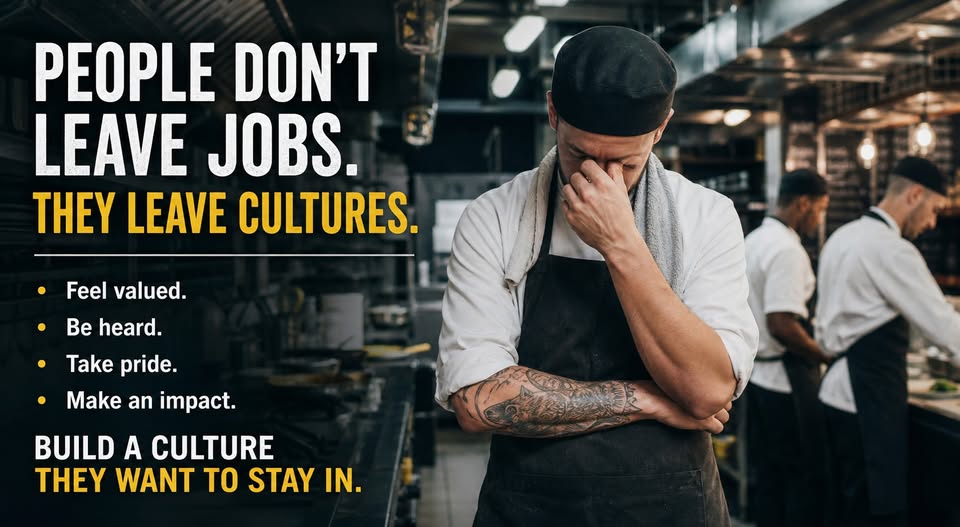
I recently came across a question in a restaurant operator group on Facebook from an owner frustrated over constant turnover, particularly among line cooks. It’s a conversation happening everywhere in the restaurant industry right now.
Operators are exhausted.
Applications are inconsistent. Employees leave without notice. Kitchens become unstable. Management grows frustrated. Owners begin believing that “nobody wants to work anymore.”
But perhaps the better question is this:
Why don’t people want to work there?
My response to the operator was simple:
“I’d suggest taking a long, hard look at the culture of your business. Does your entire staff truly feel like they’re part of the business? Do their opinions matter? Are their concerns heard and addressed? Are they encouraged to express creativity and take pride in what they do?
If not, you’ll likely continue dealing with a revolving door of employees.
Yes, we may be talking about line cooks, but they’re human beings with a strong sense of pride and purpose. That pride has to be nurtured, respected, and fed.”
The reality is this:
Most restaurant operators dramatically underestimate the importance of culture at the hourly employee level.
Too often, culture is discussed only in terms of management teams, executive leadership, or corporate vision statements framed on walls nobody reads.
Meanwhile, the line cook working six nights a week in extreme heat feels invisible.
The prep cook who has a better system for improving efficiency is never asked for input.
The dishwasher who never misses a shift feels nobody notices.
And eventually, they leave.
Not always because of money.
Not always because of hours.
Not always because of the workload.
They leave because people want to feel valued.
Especially in restaurants.
Restaurant work is hard. It’s physical. It’s emotional. It’s stressful. It demands teamwork, urgency, accountability, and consistency every single shift. Yet many operators unintentionally create environments where employees feel more like replaceable labor than valued contributors.
That becomes dangerous.
Because once employees emotionally disconnect from the business, turnover becomes inevitable.
Culture is not free meals.
It’s not motivational posters.
It’s not an employee-of-the-month plaque.
Culture is how people feel when they walk into your building every day.
Do they feel respected?
Do they feel heard?
Do they feel leadership cares about them as individuals?
Do they feel they can grow?
Do they feel trusted?
Do they feel pride in where they work?
Those questions matter more than most operators realize.
Particularly with kitchen employees.
Great line cooks often carry enormous pride in their craft. They care about timing, consistency, presentation, execution, and teamwork. Many genuinely love the intensity and rhythm of a kitchen. But if leadership creates an environment where they are constantly criticized, ignored, overworked, or treated as disposable, that pride eventually disappears.
Once pride disappears, performance usually follows.
Then turnover follows shortly after that.
Ironically, many operators spend more time trying to recruit new employees than investing in retaining the ones they already have.
Retention starts with leadership.
Owners and managers must create environments where employees feel connected to something bigger than simply punching a clock.
That does not mean lowering standards.
In fact, strong culture and high standards often go hand in hand.
People generally rise to expectations when they feel respected, supported, and included.
The strongest restaurant cultures are usually built around a few simple realities:
Leadership is visible and engaged.
Communication is consistent.
Recognition is genuine.
Accountability applies to everyone.
Employees are treated with dignity.
Ideas and feedback are welcomed.
Pride is reinforced daily.
None of this guarantees perfection.
Restaurants will always experience turnover.
But there is a major difference between normal turnover and constant instability.
One is operational reality.
The other is often cultural failure.
Restaurant operators today are competing for more than customers.
They’re competing for people.
And the businesses that win long term will not necessarily be the ones paying the most.
They’ll be the ones building environments where people genuinely want to stay.
Because when employees feel valued, respected, challenged, appreciated, and connected to the mission of the business, they stop feeling like “workers.”
They begin feeling like part of a team.
And that changes everything.
If you’re a restaurant operator, franchisee, founder, or leadership team member struggling with turnover, culture challenges, operational inconsistency, or team engagement, perhaps it’s time for a different conversation.
Not just about labor.
But about leadership.
Not just about staffing.
But about culture.
Sometimes the issues facing a restaurant business are not operational at all. Sometimes they stem from deeper disconnects within the organization that leadership has either overlooked or simply become too close to see clearly.
I welcome the opportunity to have a direct conversation about your restaurant business, franchise organization, or brand.
Sometimes an outside perspective can help identify what’s really happening beneath the surface.
Feel free to reach out to me directly by email at paul@acceler8success.com to start a conversation.
Discover more from Acceler8Success Cafe
Subscribe to get the latest posts sent to your email.

You must be logged in to post a comment.