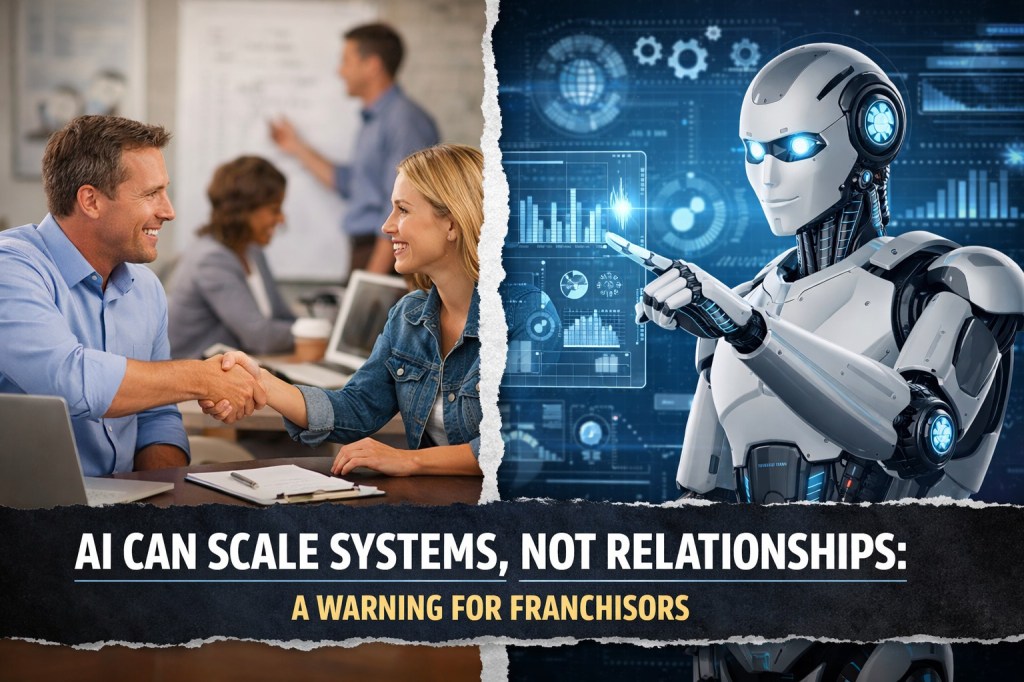
There is a certain kind of “crazy thought” making the rounds in franchising right now, and it usually sounds efficient, modern, and irresistible on the surface: what if training and franchisee support could be handled almost entirely by AI?
The logic is understandable. AI doesn’t sleep. It scales instantly. It answers questions consistently. It reduces labor costs. It never has a bad day. For emerging and even mature franchise systems under pressure to grow faster, spend less, and appear technologically advanced, the idea of AI-driven training and support can feel like the holy grail.
But franchising has never been just a systems business. It is a relationship business. And that is where this thinking starts to unravel.
Franchise relationships are built on trust, confidence, shared accountability, and human judgment. A franchisee is not just buying a playbook. They are buying access to people who have been in the trenches, who understand nuance, who can read between the lines, and who can respond not just to a question, but to the emotion behind the question. When training and support become almost exclusively AI-driven, the relationship risks becoming transactional, sterile, and emotionally disconnected.
AI can tell a franchisee what the standard operating procedure says. It can surface policy language. It can point to videos, checklists, and documentation. What it cannot do is sense frustration in a franchisee’s voice after a tough week, recognize fear behind a “simple” question about cash flow, or understand when someone is overwhelmed and needs reassurance as much as instruction. Those moments are not edge cases in franchising. They are the daily reality of ownership.
Exclusive reliance on AI also subtly changes accountability. When a franchisee struggles, who owns the outcome? A system that pushes them toward an algorithm instead of a person sends an unspoken message: figure it out yourself, just faster. Over time, that erodes the feeling of partnership that franchising depends on. Franchisees stop reaching out early. Issues go unspoken longer. Small problems quietly become big ones.
There is also a cultural cost. Franchise systems develop their personality through human interaction. The tone of a brand, the way standards are enforced, how exceptions are handled, how wins are celebrated, and how mistakes are coached all shape culture. AI can reinforce rules, but it cannot model leadership. It cannot mentor. It cannot pass down institutional wisdom that lives outside of documentation.
None of this means AI does not belong in franchise training and support. In fact, it absolutely does. The mistake is thinking of AI as a replacement rather than a force multiplier.
Used correctly, AI should remove friction, not relationships. It should handle first-level questions, documentation search, refresher training, onboarding reminders, compliance tracking, scheduling, and knowledge recall. It should help franchisees get answers quickly so that human support teams can focus on higher-value conversations. AI should prepare franchisees for human interactions, not replace them.
The healthiest model is a layered one. AI becomes the always-available assistant that supports consistency, speed, and efficiency. Human franchisor teams remain the interpreters, coaches, problem-solvers, and relationship builders. When a franchisee escalates from AI to a person, the conversation is better because both sides are better informed. Time is spent on judgment, strategy, and encouragement, not on reading manuals out loud.
Franchisors should also be intentional about where AI stops. Anything involving performance coaching, financial stress, conflict, exceptions, growth decisions, or cultural alignment belongs firmly in human hands. AI can support those conversations with data and insights, but it should never replace them.
The future of franchising is not human versus AI. It is human with AI. Systems that forget this risk building networks that are efficient but brittle, scalable but disconnected, technologically advanced yet emotionally hollow.
Franchisees do not stay loyal because information is accurate. They stay loyal because they feel supported, understood, and valued. AI can help deliver information. Only people can deliver trust.
About the Author
Paul Segreto brings over forty years of real-world experience in franchising, restaurants, and small business growth. Recognized as one of the Top 100 Global Franchise and Small Business Influencers, Paul is the driving voice behind Acceler8Success Café, a daily content platform that inspires and informs thousands of entrepreneurs nationwide. A passionate advocate for ethical leadership and sustainable growth, Paul has dedicated his career to helping founders, franchise executives, and entrepreneurial families achieve clarity, balance, and lasting success through purpose-driven action.
About Acceler8Success America
Acceler8Success America is a comprehensive business advisory and coaching platform dedicated to helping entrepreneurs, small business owners, and franchise professionals achieve The American Dream Accelerated.
Through a combination of strategic consulting, results-focused coaching, and empowering content, Acceler8Success America provides the tools, insights, and guidance needed to start, grow, and scale successfully in today’s fast-paced world.
With deep expertise in entrepreneurship, franchising, restaurants, and small business development, Acceler8Success America bridges experience and innovation, supporting current and aspiring entrepreneurs as they build sustainable businesses and lasting legacies across America.
Learn more at Acceler8SuccessAmerica.com
Discover more from Acceler8Success Cafe
Subscribe to get the latest posts sent to your email.

You must be logged in to post a comment.