There’s a tendency in today’s restaurant industry to believe that the challenges we face are new. Rising costs. Labor instability. Customer expectations that seem to shift by the day. Technology demanding constant attention. Margins tightening while competition expands.
Yet if you look back to the restaurants of the 1960s, you’ll find something striking. Many of the pressures existed in different forms, but the response from operators was fundamentally different. And in that difference lies a set of lessons that may be more relevant today than ever before.
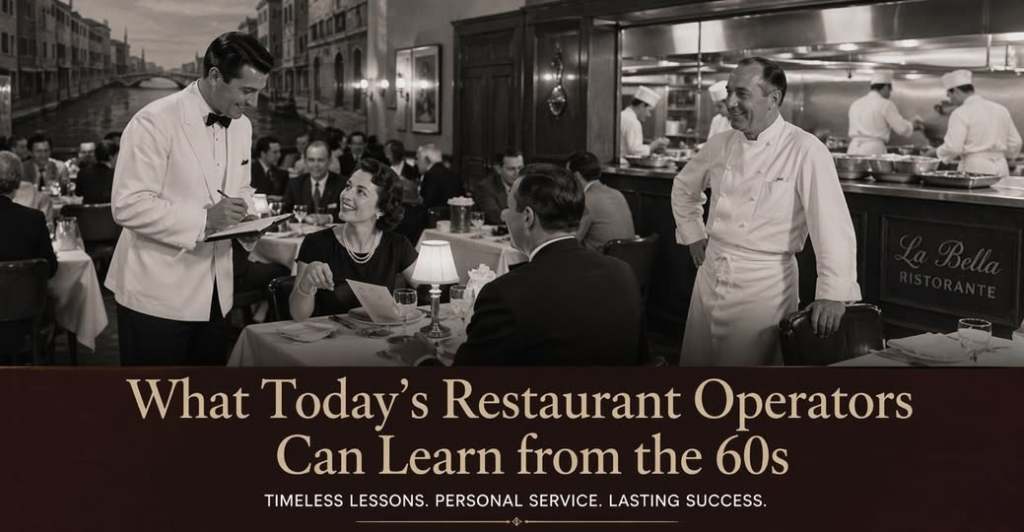
In the 1960s, the restaurant operator was not hidden behind systems, reports, or layers of management. The owner was present. If he was the chef, he was often visible from the dining room. If not in the kitchen, he was on the floor, greeting guests, shaking hands, asking about meals, and building relationships. Customers didn’t just visit a restaurant. They knew who they were supporting.
Today, operators often find themselves buried in the back office or behind a screen, managing numbers instead of experiences. The lesson is simple, but not easy: visibility matters. Presence matters. The operator sets the tone not from a distance, but from within the experience itself.
Service, too, carried a different weight. Waiting tables was not seen as a temporary job or a stepping stone. It was a career. Many servers stayed at the same restaurant for decades. They knew the menu inside and out. They knew the regulars by name, their preferences, their families, their routines. There was pride in the role, and that pride translated directly into the guest experience.
And perhaps most importantly, waitstaff treated their positions like their own businesses. Their customers. Their tables. Their reputation. There was a sense of ownership that went far beyond taking orders and delivering food. Servers built personal followings. It wasn’t uncommon to hear someone say, “We’re going to see Tony tonight,” rather than referring to the restaurant itself. The relationship was personal, direct, and earned over time.
Contrast that with today’s environment, where turnover is high and consistency is often difficult to maintain. The takeaway is not that we can magically return to a 30-year server tenure, but that we can elevate the perception of the role. Training, respect, compensation structures, and culture must reinforce that working in a restaurant is meaningful work, not just transitional work. More importantly, operators should encourage that sense of ownership within the team. When a server feels like they are building something of their own within your business, everything changes.
Another overlooked aspect of that era was simplicity. Menus were often more focused. Operations were tighter. Execution was consistent because complexity was controlled. Restaurants didn’t try to be everything to everyone. They were known for something, and they delivered it well, day in and day out.
Today, in an effort to capture more customers, many operators expand menus, layer on options, and complicate execution. The result is often the opposite of what was intended. Slower service, inconsistent quality, and increased costs. There’s a lesson here in restraint. In discipline. In knowing what you do best and building around it.
Customer relationships were built over time, not transactions. There were no loyalty apps, no push notifications, no automated campaigns. Loyalty was earned face-to-face, meal after meal. A handshake. A conversation. A remembered name. A favorite dish prepared just right without being asked.
Technology today offers incredible advantages, but it should not replace the human connection that defined the industry decades ago. The opportunity is to use technology to support the experience, not become the experience.
There was also a strong sense of community. Restaurants were gathering places. Regulars didn’t just come for the food. They came for familiarity, for connection, for belonging. The operator understood this and nurtured it intentionally.
Today’s operators can still create that same sense of belonging, but it requires deliberate effort. It requires consistency in service, authenticity in interactions, and an environment that feels personal rather than transactional. Encouraging team members to build their own guest relationships, just as servers once did, is a powerful way to bring that feeling back.
Discipline extended beyond the dining room. Costs were watched closely. Waste was minimized out of necessity, not just strategy. Purchasing was thoughtful. Inventory mattered. There was a respect for the business side of the operation that matched the passion for hospitality.
While today’s operators have more sophisticated tools, the principle remains unchanged. Discipline in operations is not optional. It is foundational.
So what does this mean in practical terms for today’s restaurant operator?
Be present. Not occasionally, but consistently. Your team and your guests should feel your presence in the operation.
Elevate the role of your team. Invest in training, create pride in the work, and build an environment where people want to stay longer.
Encourage ownership at every level. Let your team feel like they are building their own business within your business.
Simplify where possible. Focus your menu. Tighten your execution. Do fewer things better.
Build real relationships. Technology can support this, but it cannot replace it.
Create a sense of community. Give customers a reason to return beyond the product itself.
Operate with discipline. Watch costs, manage inventory, and respect the fundamentals of the business.
None of this is revolutionary. In fact, that’s the point.
The fundamentals that defined successful restaurants in the 1960s are still the fundamentals today. What has changed is not what works, but how often it is overlooked.
The operators who recognize this, who reconnect with these principles while intelligently leveraging today’s tools, are the ones who will not just survive, but build something lasting.
Because while the industry evolves, the essence of hospitality never has.
If this resonates, take a step back and ask yourself a simple question. Where has your operation drifted from these fundamentals, and what would it look like to bring them back with intention? If you’re ready to explore that conversation, I invite you to reach out to me directly. Let’s talk about how to reintroduce these principles into your business in a way that drives both culture and performance.
Discover more from Acceler8Success Cafe
Subscribe to get the latest posts sent to your email.

You must be logged in to post a comment.